


- Protocols

- Articles and Issues
- For Authors
- About
- Become a Reviewer


Flow Cytometric Detection of Reactive Oxygen Species


Published: Vol 3, Iss 8, Apr 20, 2013 DOI: 10.21769/BioProtoc.431 Views: 51786
Reviewed by: Lin Fang
 PDF
PDF  Ask a question
Original research article
The authors used this protocol in:

Sep 2012
Advertisement

Protocol Collections
Comprehensive collections of detailed, peer-reviewed protocols focusing on specific topics



Related protocols

Abstract
Reactive oxygen species (ROS) are molecules containing hydroxyl radicals or peroxides with unpaired electrons. In healthy aerobic cells, ROS are produced naturally as a byproduct of oxidative phosphorylation, oxidoreductase enzymes, or metal catalyzed oxidation at a controlled rate. However, ROS can be induced under some stress conditions especially exposure to environmental oxidants and certain drugs that leads to oxidative stress. Exceed ROS can cause damages in the building blocks of cells including DNA, proteins, and lipids, and eventually results in cell death. Cell-permeant 2', 7'-dichlorodihydrofluorescein diacetate (H2DCFDA) is a widely used ROS indicator. The reduced non-fluorescent fluorescein H2DCFDA can be oxidized and converted into fluorescent 2’, 7’-dichlorofluorescein (DCF) by intracellular ROS. In this protocol, we applied H2DCFDA to label the intracellular ROS and detected the DCF intensity by flow cytometry.
Materials and Reagents
- Cells to analyze (this protocol has been successfully performed on A549, CL1-0, and IMR-90 cells)
- Dulbecco's Phosphate-buffered saline (DPBS)
- 2’,7’-dichlorofluorescein diacetate (H2DCFDA) (Life Technologies, InvitrogenTM, catalog number: D-399 )
- Anhydrous DMF (N,N-dimethylformamide) (Sigma-Aldrich, catalog number: 227056 )
- N-acetyl-L-cysteine (NAC) (Sigma-Aldrich, catalog number: A7250 )
- Hydrogen peroxide (H2O2) (Sigma-Aldrich, catalog number: 349887 )
- 5 ml polystyrene BD falcon round-bottom tube with cell strainer cap (BD Biosciences, catalog number: 352235 )
- Sodium Chloride (NaCl)
- Potassium Chloride (KCl)
- Potassium Phosphate, monobasic (KH2PO4)
- Sodium Phosphate, dibasic (Na2HPO4)
- DPBS (see Recipes)
- H2DCFDA stock (10 mM) (see Recipes)
- NAC stock (1 M) (see Recipes)
- H2O2 stock (1 M) (see Recipes)
Equipment
- Flow cytometry
- Water bath
- Centrifuge
Procedure
- Cells were cultured with complete medium in a 6 cm dish at 37 °C and 5% CO2.
- Cells were treated with NAC or H2O2 after reaching 70-90% confluency. ROS scavenger NAC is a precursor to cysteine and glutathione which are strong antioxidants; while H2O2 is a compound with an oxygen-oxygen single bond and is known as a strong oxidizer.
- (For negative control) Incubate cells with freshly prepared 5 mM NAC in culture medium for 1 h at 37 °C after three time washes of pre-warmed DPBS.
- (For positive control) Incubate cells with freshly prepared 0.1 mM H2O2 from 1 M stock in DPBS for 20 min at 37 °C after three time washes of pre-warmed DPBS.
- Dilute the H2DCFDA stock solutions into DPBS to make 0.1 μM working solution.
- Cells were harvested by trypsinization.
- Suspend cells in working solution at a density of 1 x 10⁶ cells/ml and incubate at 37 °C for 30 min and protect from light.
- Centrifuge the tubes at 130 x g for 5 min.
- Remove the supernatant and gently resuspend the cells in pre-warmed DPBS.
- Repeat the wash steps 8 and 9 twice.
- Submit samples to flow cytometry for ROS detection using the 488 nm laser for excitation and detected at 535 nm.
Analysis
- Gate on the main cell population.
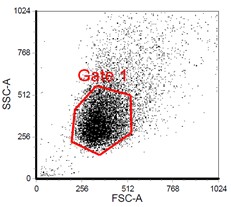
Figure 1. Cells were analyzed according to their size and granularity. The X-axis represents the forward scatter (FSC) parameter which is relative to the size for the cell. The Y-axis shows the side scatter (SSC) parameter which correlates with the components inside the cell. Gate 1 indicates the main population of the cells we analyzed.
- Show the intensity of H2DCFDA of cells in gate 1.
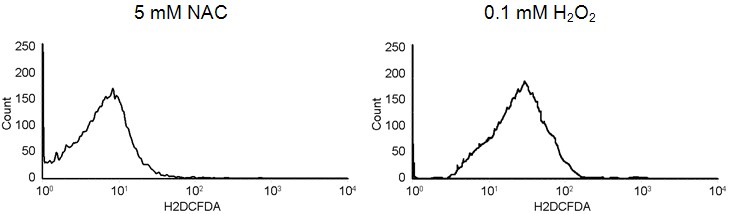
Figure 2. Histogram of H2DCFDA. It shows how many cells are at each intensity of H2DCFDA. The X-axis represents the H2DCFDA intensity, while the Y-axis indicates the cell counts in corresponding fluorescence intensity.
Recipes
- DPBS (1 L)
8 g Sodium Chloride (NaCl)
0.2 g Potassium Chloride (KCl)
0.2 g Potassium Phosphate, monobasic (KH2PO4)
1.15 g Sodium Phosphate, dibasic (Na2HPO4)
Adjust to pH = 7.3. - H2DCFDA stock (10 mM)
Dissolve 10 mg in 2.05 ml DMF to make 10 mM stock.
Aliquot and store at -20 °C.
Avoid from light and repeated freeze/thaw cycles. - NAC stock (1 M)
Dissolve 1 g in 6.128 ml distilled water to make 1 M stock.
Filter, aliquot and store at -20 °C.
Avoid from light and repeated freeze/thaw cycles. - H2O2 stock (1 M)
Dilute 50 μl H2O2 from 35% (=11.6M) in 530 μl sterile deionized water to make 1 M stock.
References
- Chang, H. Y., Huang, H. C., Huang, T. C., Yang, P. C., Wang, Y. C. and Juan, H. F. (2012). Ectopic ATP synthase blockade suppresses lung adenocarcinoma growth by activating the unfolded protein response. Cancer Res 72(18): 4696-4706.
Article Information
Copyright
© 2013 The Authors; exclusive licensee Bio-protocol LLC.
How to cite
Chang, H., Huang, H., Huang, T., Yang, P., Wang, Y. and Juan, H. (2013). Flow Cytometric Detection of Reactive Oxygen Species. Bio-protocol 3(8): e431. DOI: 10.21769/BioProtoc.431.

 Download Citation in RIS Format
Category
Cell Biology > Cell-based analysis > Flow cytometry
Biochemistry > Other compound > Reactive oxygen species
Do you have any questions about this protocol?
Post your question to gather feedback from the community. We will also invite the authors of this article to respond.
 Post a Question


