
- Home
- Protocols

-


Determination of total flavonoid content

Last updated date: Aug 17, 2026 Views: 13 Forks: 0

 Download PDF
 Ask a
question
Ask a
question
 How to
cite
How to
cite
 Favorite


Determination of Total Flavonoid Content in Choy Sum (Brassica chinensis var. parachinensis) Leaf Tissue Using a Microplate Reader
Subramanian Deivanai1 and Srinivasan Ramachandran2
1. AGRI Centre, Republic Polytechnic, 9 Woodlands Ave 9, 738964 Singapore
2. Temasek Life Sciences Laboratory Limited, Research Link, National University Singapore, Buona Vista, 117604 Singapore.
*For correspondence: deivanai@rp.edu.sg
Abstract
Estimating total flavonoid content (TFC) is important because flavonoids are a major class of plant secondary metabolites that contribute to plant growth, stress tolerance, antioxidant defence, and nutritional quality. Total flavonoid content is widely used as an indicator of antioxidant capacity and serves as an important biochemical trait for screening and selecting crop varieties with improved nutritional quality and stress resilience. The aluminium chloride (AlCl₃) colorimetric assay is one of the most widely used spectrophotometric methods for the quantification of flavonoids, particularly flavonol derivatives. In this assay, flavonoids form a stable yellow-colored complex with aluminium (Al³⁺) ions, which can be measured spectrophotometrically at a wavelength between 410 and 440 nm, depending on the protocol used. This protocol describes a simple, rapid, and reliable spectrophotometric method, adapted from previously established procedures, for determining the total flavonoid content of Choy Sum leaves.
Keywords: Total flavonoid content (TFC); Spectrophotometric quantification; Crop improvement; Leaf tissue; Choy Sum
Materials and Reagents
A. Materials
- 5 mL pipette tips
- 1 mL pipette tips
- 15 mL centrifuge tube
- 1.5 mL centrifuge tube
- Holder for Eppendorf tubes
- Microtiter plate
- Choy sum leaf tissue
- Liquid nitrogen
B. Reagents
- Aluminium chloride (Sigma-Aldrich- catalogue number:294713-500G)
- Ethanol (Sigma-Aldrich-catalogue number:459844-500ML)
- Potassium acetate (Sigma-Aldrich-catalogue number: 236497-500G)
- Quercetin (Sigma-Aldrich-catalogue number: Q4951-100G)
C. Equipment
- Mortar and pestle
- Freeze-drier (Buchi Lyovapor L-200, Germany)
- Orbital shaker (Eppendorf Thermomixer F series, Germany)
- Centrifuge (Sartorius-SIGMA 4K15 model, Mexico)
- Microplate reader (Tecan-Spark® Multimode, Austria)
D. Stock solution
Stock solutions may be prepared in advance and stored at 4°C. On the day of the experiment, allow the solutions to reach room temperature (if required) before use.
- 70% ethanol
- 80% ethanol
- 96% ethanol
- 1 M potassium acetate
- 10% aluminium chloride (Keep the reaction mixture on ice during preparation due to the exothermic nature of the reaction.)
- Quercetin (prepared by dissolving 1.0 mg quercetin in 1.0 mL of 80% ethanol)
Sample Preparation
The schematic procedure for the preparation of plant extract for total flavonoid content analysis is shown in Figure 1.
- Grind the fresh leaves into a fine powder using a pestle and mortar with liquid nitrogen and transfer the samples to a lyophilizer to freeze-dry the samples.
- Freeze-dry the samples at −45 °C for 24–48 h, or until the tissues are completely dry, while maintaining the vacuum pressure at 0.214 Pa. Properly seal the freeze-dried tissues and store them at −80 °C until further use.
Extract approximately 100 mg of freeze-dried powdered leaf samples with 15 mL of 70% ethanol at room temperature.
Incubate the extracts on an orbital shaker at 170 rpm for 24 h at room temperature.
Centrifuge the extracts at 4000 × g for 10 min at 4 °C.
Collect the supernatant (filtrate) and use it for flavonoid content analysis.
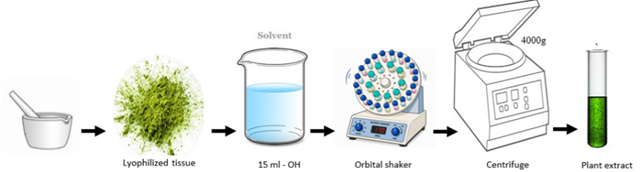
Figure1. Workflow for the preparation of plant extracts for flavonoid analysis
Procedure
Total flavonoid content was measured with the aluminium chloride colorimetric assay adapted from Chatattikun et al. (2013) with slight modification.
- Add 100 µL of plant extract to a microplate, followed by 20 µL of 10% aluminium chloride (AlCl₃) solution and 300 µL of 96% ethanol.
- Incubate the reaction mixture for 3 min at room temperature. Then, add 20 µL of 1 M potassium acetate solution and incubate the mixture for 30 min in the dark at room temperature.
- Use 96% ethanol as the reagent blank.
- Measure the absorbance at 415 nm using a microplate reader.
Calculation of total flavonoid content
- Prepare a standard solution (20, 40, 60, 80, 100 µg/ ml) using quercetin in ethanol
- Plot a calibration curve using the known concentrations of the standard (y-axis: Absorbance, x-axis: Concentration in µg/mL (Figure 2).
- Determine the linear regression equation (y = mx + c) from the curve.
- Calculate the flavonoid concentration (x) of the plant extract using its absorbance.
- Express the total flavonoid content as milligrams of Quercetin Equivalents per gram of plant extract:

where:
- C = Concentration of the sample extract calculated from the calibration curve (mg/mL)
- V = Volume of the extract used (mL)
- M = Mass of the freeze-dried plant sample/extract (g)
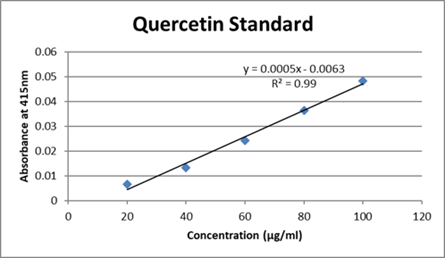
Figure 2. Calibration curve of quercetin showing absorbance (Y-axis) versus quercetin concentration (X-axis) for the determination of total flavonoid content in plant extracts.
Acknowledgments
This protocol was adapted from the methods described in Chatattikun et al. (2013).
Competing interests
The authors declare no conflicts of interest.
References
Chatattikun M, Choabchalard A. Phytochemical screening and free radical scavenging activities of orange baby carrot and carrot (Daucus carota Linn) root crude extracts. J Chem Pharm. 2013;5(4):97–102.
Deivanai, S., Sng, B.J.R., Van Vu, K. et al. EMS-induced mutagenesis in Choy sum (Brassica chinensis var. parachinensis) and selection for low light tolerance using abiotic stress indices. BMC Plant Biol 23, 581 (2023).
- Deivanai, S and Ramachandran, S(2026). Determination of total flavonoid content. Bio-protocol Preprint. bio-protocol.org/prep2983.
- Deivanai, S., Sng, B. J. R., Vu, K. V., Shibu, T. S. M., Jang, I. and Ramachandran, S.(2023). EMS-induced mutagenesis in Choy sum (Brassica chinensis var. parachinensis) and selection for low light tolerance using abiotic stress indices. BMC Plant Biology. DOI: 10.1186/s12870-023-04570-8
Do you have any questions about this protocol?
Post your question to gather feedback from the community. We will also invite the authors of this article to respond.
 Post a Question


