
- Home
- Protocols

-


 Download PDF
 Ask a
question
Ask a
question
 How to
cite
How to
cite
 Favorite


Instruments:
PCR Machine: Used for PCR amplification.
Temperature-Controlled Centrifuge**: Used for centrifugal separation.
Thermostatic Water Bath: Used for yeast transformation steps.
Gel Imaging System**: Used to observe the results of agarose gel electrophoresis.
Agarose Gel Electrophoresis Equipment**: Used for the separation and purification of DNA fragments.
Micropipettes: Used for precise reagent dispensing.
Temperature-Controlled Incubator**: Used for the cultivation of bacterial and yeast strains.
Laminar Flow Cabinet (Sterile Workstation)**: Used for sterile operations.
Reagents and Chemicals:
pBRIDGE Vector: Used for constructing the bait vector.
pGADT7 Vector: Used for constructing the prey vector.
KOD FX DNA Polymerase: Used for PCR amplification.
dNTPs (Deoxyribonucleotide Triphosphates)**: Substrates for PCR reactions.
Restriction Enzymes (NotI-HF, BglII-HF, EcoRI-HF, SalI-HF, BamHI-HF)**: Used for cutting vectors and insert fragments.
rCutSmart Buffer: Used for restriction enzyme reactions.
ClonExpress® Ultra One Step Cloning Kit**: Used for homologous recombination cloning.
EasyPure Quick Gel Extraction Kit**: Used for extracting DNA fragments from agarose gels.
Yeast Competent Cells (Y2HGold, Strain cc309)**: Used for transforming constructed vectors.
PEG/LiAc Solution**: Used for yeast transformation.
Carrier DNA**: Used as auxiliary DNA during yeast transformation.
SD Medium (Synthetic Defined Medium)**: Synthetic dropout medium for selection and screening of yeast strains.
X-α-Gal and 3-AT: Used for yeast colony screening and auto-activation testing.
Antibiotics (e.g., Ampicillin): Used for bacterial culture and plasmid selection.
Plasmid Extraction Kit: Used for extracting plasmid DNA from bacteria.
T7 and 3’AD Sequencing Primers: Used for DNA sequencing.
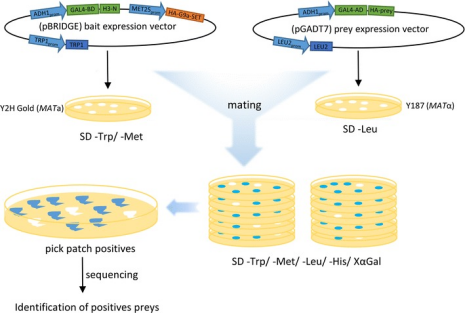
Schematic workflow of the Y3H experiment
Vectors used in this study were part of the Matchmaker Gold Yeast Two-Hybrid System (Takara Bio, Mountain View, CA, USA). The pBRIDGE vector was used as a backbone for the bait construct. To design a bait that will be recognized in a methylation-dependent manner, the catalytic SET domain of the G9a PKMT (G9a-SET; residues 931–1210) together with a nuclear localization sequence (NLS) and an HA-tag was cloned under the MET25 promoter in the MCS II region of the pBRIDGE vector using NotI and BglII restriction sites. On the same vector, the N-terminal twenty residues of histone H3 (referred later as an H3N) were cloned in fusion with the GAL4-binding domain (GAL4-BD) under an ADH1 promoter in the MCS I using EcoRI and BamHI restriction sites. The bait plasmid with H3N located C-terminally with respect to GAL4-BD was also cloned. The pBRIDGE vector containing GAL4-BD-H3N but without G9a-SET was also generated as a negative control. The preys were expressed in the pGADT7 vector(Rawłuszko-Wieczorek AA, Knodel F, Tamas R, Dhayalan A, Jeltsch A. Identification of protein lysine methylation readers with a yeast three-hybrid approach. Epigenetics Chromatin. 2018 Jan 25;11(1):4.)
The purpose of the yeast three-hybrid (Y3H) experiment is to verify the effect of gene X on the interaction between genes A and B, given their known relationship. Common methods include constructing gene A into the pGADT7 vector, and genes B and X into the MCSI and MCSII sites of the pBridge vector, respectively, and verifying the interaction through co-transformation into Y2HGold yeast cells.
1. Construction of pBridge-B-X Vector
1.1 PCR Amplification of Bait-B with Adapter Sequences
- Bait sequence synthesis rules:
- B-F: `tgactgtatcgccgg` + Bait CDS first 20bp
- B-R: `tagcttggctgcagg` + Bait CDS last 20bp (reverse complement)
1.2 PCR Amplification System for Bait Gene B with Adapters (using KOD FX, TOYOBO KFX-101)
- Before preparing the reaction mixture, mix all reagents except KOD FX (enzyme solution) thoroughly. Thaw frozen reagents on ice before use.
- 2x PCR buffer: 25 μl
- 2mM dNTPs: 10 μl
- B-F Primer: 1.5 μl
- B-R Primer: 1.5 μl
- Plant cDNA: 0.2 μg
- KOD FX (1.0U/μl): 1 μl
- ddH2O: up to 50 μl
- Add KOD FX (enzyme solution) last, mix the reaction mixture thoroughly using a vortex, spin down, and then perform PCR.
1.3 PCR Amplification of Bait-X with Adapter Sequences**
- Bait sequence synthesis rules:
- X-F: `gaagagaaaggtggc` + Bait CDS first 20bp
- X-R: `ggagatcagcccgaa` + Bait CDS last 20bp (reverse complement)
1.4 PCR Amplification System for Bait Gene X with Adapters (using KOD FX, TOYOBO KFX-101)**
- Before preparing the reaction mixture, mix all reagents except KOD FX (enzyme solution) thoroughly. Thaw frozen reagents on ice before use.
- 2x PCR buffer: 25 μl
- 2mM dNTPs: 10 μl
- X-F Primer: 1.5 μl
- X-R Primer: 1.5 μl
- Plant cDNA: 0.2 μg
- KOD FX (1.0U/μl): 1 μl
- ddH2O: up to 50 μl
- Add KOD FX (enzyme solution) last, mix the reaction mixture thoroughly using a vortex, spin down, and then perform PCR.
1.5 Linearization of pGBKT7 Plasmid
- Remove pGBKT7 plasmid from -20°C freezer, place 10x rCutSmart buffer on ice until completely dissolved, and prepare the following system:
- 10x rCutSmart buffer: 5 μl
- EcoRI-HF: 1 μl
- SalI-HF: 1 μl
- pBridge Plasmid DNA: 1 μg
- ddH2O: up to 50 μl
- Use a temperature-controlled PCR machine with the following program:
- 37°C for 45 min
- 65°C for 45 sec
- After the reaction, transfer to a 4°C refrigerator for storage.
1.6 Agarose Gel Electrophoresis and Gel Extraction (EasyPure Quick Gel Extraction Kit, TransGen Biotech, EG101)
- Method reference: Wang, S., et al. (2024). Application of the Nicotiana Allergic Necrosis Assay for the Validation of Protein-Protein Interactions between Fungal Effectors and Plant Receptor Kinases. Bio-protocol Preprint. bio-protocol.org/prep2729.
1.7 Homologous Recombination to Construct pBridge-B Vector (ClonExpress® Ultra One Step Cloning Kit, Vazyme, C115)
- Calculate the dosage of linearized vector and insert fragment:
- Optimal cloning vector dosage = [0.02 × vector base pairs] ng (0.03 pmol)
- Optimal insert fragment dosage = [0.04 × insert fragment base pairs] ng (0.06 pmol)
- Note: To ensure accurate sample addition, dilute the linearized vector and insert fragment appropriately before preparing the recombination reaction system, with each component added in a volume not less than 1 μl.
- Prepare the following reaction system on ice:
- Linearized vector pBridge: X μl
- Insert fragment Bait: B μl
- 2× ClonExpress Mix: 5 μl
- ddH2O: to 10 μl
- Mix gently using a pipette (do not vortex), spin down briefly to collect the reaction mixture at the bottom of the tube.
- Use a temperature-controlled PCR machine with the following program:
- 50°C for 30 min
- After the reaction, transfer to a 4°C refrigerator for storage.
1.8 Sequencing of pBridge-B
- Sequencing primers and sequences:
- 5' sequencing primer: 5'-TCATCGGAAGAGAGTAGT-3'
- 3' sequencing primer: 5'-AATTTATTTCTTTTCGGATAA-3'
- After sequencing, expand the E. coli culture and extract the plasmid. Method reference: Wang, S., et al. (2024). Application of the Nicotiana Allergic Necrosis Assay for the Validation of Protein-Protein Interactions between Fungal Effectors and Plant Receptor Kinases. Bio-protocol Preprint. bio-protocol.org/prep2729.
1.9 Linearization of pBridge-B Plasmid**
- Remove pBridge-B plasmid from -20°C freezer, place 10x rCutSmart buffer on ice until completely dissolved, and prepare the following system:
- 10x rCutSmart buffer: 5 μl
- NotI-HF: 1 μl
- BglII-HF: 1 μl
- pBridge-B Plasmid DNA: 1 μg
- ddH2O: up to 50 μl
- Use a temperature-controlled PCR machine with the following program:
- 37°C for 45 min
- 65°C for 45 sec
- After the reaction, transfer to a 4°C refrigerator for storage.
1.10 Agarose Gel Electrophoresis and Gel Extraction (EasyPure Quick Gel Extraction Kit, TransGen Biotech, EG101)
- Method reference: Wang, S., et al. (2024). Application of the Nicotiana Allergic Necrosis Assay for the Validation of Protein-Protein Interactions between Fungal Effectors and Plant Receptor Kinases. Bio-protocol Preprint. bio-protocol.org/prep2729.
1.11 Homologous Recombination to Construct pBridge-B-X Vector (ClonExpress® Ultra One Step Cloning Kit, Vazyme, C115)
- Calculate the dosage of linearized vector and insert fragment:
- Optimal cloning vector dosage = [0.02 × vector base pairs] ng (0.03 pmol)
- Optimal insert fragment dosage = [0.04 × insert fragment base pairs] ng (0.06 pmol)
- Note: To ensure accurate sample addition, dilute the linearized vector and insert fragment appropriately before preparing the recombination reaction system, with each component added in a volume not less than 1 μl.
- Prepare the following reaction system on ice:
- Linearized vector pBridge-B: X μl
- Insert fragment Bait: X μl
- 2× ClonExpress Mix: 5 μl
- ddH2O: to 10 μl
- Mix gently using a pipette (do not vortex), spin down briefly to collect the reaction mixture at the bottom of the tube.
- Use a temperature-controlled PCR machine with the following program:
- 50°C for 30 min
- After the reaction, transfer to a 4°C refrigerator for storage.
1.12 Sequencing of pBridge-B-X
- Sequencing primers and sequences:
- 5' sequencing primer: 5'-TCATCGGAAGAGAGTAGT-3'
- 3' sequencing primer: 5'-AATTTATTTCTTTTCGGATAA-3'
- After sequencing, expand the E. coli culture and extract the plasmid. Method reference: Wang, S., et al. (2024). Application of the Nicotiana Allergic Necrosis Assay for the Validation of Protein-Protein Interactions between Fungal Effectors and Plant Receptor Kinases. Bio-protocol Preprint. bio-protocol.org/prep2729.
2. Construction of pGADT7-A Vector
2.1 PCR Amplification of Prey with Adapter Sequences**
- Prey sequence synthesis rules:
- A-F: `GCCATGGAGGCCAGTGAA` + Prey CDS first 20bp
- A-R: `AGCTCGAGCTCGATGGAT` + Prey CDS last 20bp (reverse complement)
2.2 PCR Amplification System for Prey Gene X with Adapters (using KOD FX, TOYOBO KFX-101)
- Before preparing the reaction mixture, mix all reagents except KOD FX (enzyme solution) thoroughly. Thaw frozen reagents on ice before use.
- 2x PCR buffer: 25 μl
- 2mM dNTPs: 10 μl
- A-F Primer: 1.5 μl
- A-R Primer: 1.5 μl
- Prey cDNA: 0.2 μg
- KOD FX (1.0U/μl): 1 μl
- ddH2O: up to 50 μl
- Add KOD FX (enzyme solution) last, mix the reaction mixture thoroughly using a vortex, spin down, and then perform PCR.
2.3 PCR Amplification of Prey Gene X with Adapters
- Use a temperature-controlled PCR machine with the following program:
- Predenature at 94°C for 2 min.
- Denature at 98°C for 10 sec.
- Annealing at (Tm-5)°C for 30 sec.
- Extension at 68°C for 1kb/min.
- Set 33 cycles for Denature to Extension.
- Final extension at 68°C for 7 min.
- After the reaction, transfer to a 4°C refrigerator for storage.
2.4 Linearization of pGADT7 Plasmid
- Remove pGADT7 plasmid from -20°C freezer, place 10x rCutSmart buffer on ice until completely dissolved, and prepare the following system:
- 10x rCutSmart buffer: 5 μl
- EcoR I-HF: 1 μl
- BamH I-HF: 1 μl
- pGADT7 Plasmid DNA: 1 μg
- ddH2O: up to 50 μl
- Use a temperature-controlled PCR machine with the following program:
- 37°C for 45 min
- 65°C for 45 sec
- After the reaction, transfer to a 4°C refrigerator for storage.
2.5 Agarose Gel Electrophoresis and Gel Extraction (EasyPure Quick Gel Extraction Kit, TransGen Biotech, EG101)
- Method reference: Wang, S., et al. (2024). Application of the Nicotiana Allergic Necrosis Assay for the Validation of Protein-Protein Interactions between Fungal Effectors and Plant Receptor Kinases. Bio-protocol Preprint. bio-protocol.org/prep2729.
2.6 Homologous Recombination to Construct Vector pGADT7-A (ClonExpress® Ultra One Step Cloning Kit, Vazyme, C115)
- Calculate the dosage of linearized vector and insert fragment:
- Optimal cloning vector dosage = [0.02 × vector base pairs] ng (0.03 pmol)
- Optimal insert fragment dosage = [0.04 × insert fragment base pairs] ng (0.06 pmol)
- Note: To ensure accurate sample addition, dilute the linearized vector and insert fragment appropriately before preparing the recombination reaction system, with each component added in a volume not less than 1 μl.
- Prepare the following reaction system on ice:
- Linearized vector pGADT7: X μl
- Insert fragment Bait: A μl
- 2× ClonExpress Mix: 5 μl
- ddH2O: to 10 μl
- Mix gently using a pipette (do not vortex), spin down briefly to collect the reaction mixture at the bottom of the tube.
- Use a temperature-controlled PCR machine with the following program:
- 50°C for 30 min
- After the reaction, transfer to a 4°C refrigerator for storage.
2.7 Sequencing of pGADT7-A
- Sequencing primers and sequences:
- T7 sequencing primer
- 3’AD sequencing primer
- After sequencing, expand the E. coli culture and extract the plasmid. Method reference: Wang, S., et al. (2024). Application of the Nicotiana Allergic Necrosis Assay for the Validation of Protein-Protein Interactions between Fungal Effectors and Plant Receptor Kinases. Bio-protocol Preprint. bio-protocol.org/prep2729.
3. Auto-Activation Test of pGBKT7-B-X
3.1 Transformation of Y2HGold Competent Cells
- Take 100 µl of Y2HGold competent cells (Coolaber: cc309) thawed on ice, add 1 µg each of pre-cooled pGADT7 + pBridge-B-X and pGADT7, 10 µl of Carrier DNA (95-100°C for 5 min, quick chill in ice water, repeat once), and 500 µl of PEG/LiAc (333 µL of 50% PEG3350 solution, 83.5 µL of 1M LiAc solution, 83.5 µL of 10x TE buffer), mix by pipetting several times, incubate at 30°C for 30 min (invert 6-8 times at 15 min).
- Place the tube in a 42°C water bath for 15 min (invert 6-8 times at 7.5 min).
- Centrifuge at 5000 rpm for 40 s, discard the supernatant, resuspend in 400 µl of ddH2O, centrifuge for 30 s, discard the supernatant.
- Resuspend in 150 µl of sterile water, then take 50 µL each to spread on SD/-Trp/-Met, SD/-Trp/-Met/X-α-Gal, and SD/-Trp/-Met/X-α-Gal/3-AT solid selection media, incubate at 29°C for 48-96h; on different concentrations of 3-AT (10 mM, 20 mM, 30 mM, 40 mM, 50 mM, 60 mM, 70 mM, 80 mM) plates, the fewest yeast colonies (and not blue) or none at all indicate the best 3-AT concentration (best inhibitory concentration, minimum inhibitory concentration, background expression concentration, auto-activation concentration).
4. Yeast Three-Hybrid Dot-Blot Verification
4.1 Transformation of Y2HGold Competent Cells
- Take 100 µl of Y2HGold competent cells (Coolaber: cc309) thawed on ice, add 1 µg each of negative control: pGADT7 and pBridge-B-X, experimental group: pGADT7-A and pBridge-B-X, and 10 µl of Carrier DNA (95-100°C for 5 min, quick chill in ice water, repeat once), 500 µl of PEG/LiAc, mix by pipetting several times, incubate at 30°C for 30 min (invert 6-8 times at 15 min).
- Place the tube in a 42°C water bath for 15 min (invert 6-8 times at 7.5 min).
- Centrifuge at 5000 rpm for 40 s, discard the supernatant, resuspend in 400 µl of ddH2O, centrifuge for 30 s, discard the supernatant.
- Resuspend in 100 µl of sterile water, then take 50 µL each to spread on SD/-Leu/-Trp/-Met plates and SD/-Ade/-His/-Leu/-Trp/-Met/X-α-Gal/3-AT dropout plates (3-AT concentration as selected in auto-activation). Incubate at 30°C for 3 days, then observe colony growth.
- Note: Dilutions are 1:10, 1:100, 1:1000, 1:10,000, 1:100,000.
Supplement: Three-hybrid interaction verification dot-blotting (bait without auto-activation)
Y2HGold[pGADT7+pBridge-B-X] is spotted on SD/-Leu/-Trp (control group, can grow), SD/-Leu/-Trp/-His (experimental group), SD/-Leu/-Trp/-His/-Met (experimental group).
Three-hybrid interaction verification dot-blotting (bait with auto-activation)
Y2HGold[pGADT7+pBridge-B-X] is spotted on SD/-Leu/-Trp/-His/3-AT (control group), SD/-Leu/-Trp/-His/-Met/3-AT (control group); Y2HGold[pGADT7-A+pBridge-B-X] is spotted on SD/-Leu/-Trp/-His/3-AT (experimental group), SD/-Leu/-Trp/-His/-Met/3-AT (experimental group).
5. Three-Hybrid Interaction Result Analysis
(Refer to the Y2HGold-pBridge System Yeast Three-Hybrid Interaction Verification Kit, Coolaber: YH3001-10T for discussion of results)
This is applicable only when A and B interact or do not interact, and the interaction relationship is known. The above experiments have determined whether the bait yeast strain has auto-activation, so the inhibition or promotion of A and B interaction by X can be analyzed in the presence or absence of auto-activation.
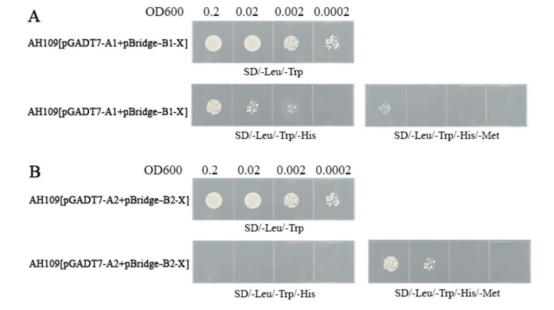
5.1 No Auto-Activation
The above experiments have determined that the bait has no auto-activation, so Y2HGold[pGADT7+pBridge-B-X] can be omitted as a control, and plates containing 3-AT can also be omitted. SD/-Leu/-Trp plates are used only as a control when X promotes the interaction between A and B (since no colonies are present on SD/-Leu/-Trp/-His plates). If the growth of Y2HGold[pGADT7-A+pBridge-B-X] on SD/-Leu/-Trp/-His and SD/-Leu/-Trp/-His/-Met plates is the same, then X has no effect on the relationship between A and B.
5.1.1 X Inhibits Interaction Between A and B
It is known from previous studies that A and B interact, and the bait has no auto-activation. Figure 1A, Y2HGold[pGADT7-A1+pBridge-B1-X] grows normally on SD/-Leu/-Trp plates (control), and the growth on SD/-Leu/-Trp/-His/-Met plates is weaker than on SD/-Leu/-Trp/-His plates (A1 and B1 interact), indicating that X inhibits the interaction between A1 and B1.
5.1.2 X Promotes Interaction Between A and B
It is known from previous studies that A and B do not interact, and the bait has no auto-activation. Figure 1B, Y2HGold[pGADT7-A2+pBridge-B2-X] grows normally on SD/-Leu/-Trp plates (control), does not grow on SD/-Leu/-Trp/-His plates (i.e., A2 and B2 do not interact), but can grow on SD/-Leu/-Trp/-His/-Met plates, indicating that X promotes the interaction between A2 and B2.
Three-hybrid interaction verification schematic (bait without auto-activation)
5.2 With Auto-Activation
The above experiments have determined that the bait has auto-activation, so plates containing 3-AT must be used to inhibit auto-activation of the bait and interaction between A and B. If the growth of Y2HGold[pGADT7-A+pBridge-B-X] on SD/-Leu/-Trp/-His and SD/-Leu/-Trp/-His/-Met plates is the same, then X has no effect on the relationship between A and B.
5.2.1 X Inhibits Interaction Between A and B
It is known from previous studies that A and B interact, and the bait has auto-activation. The concentration of 3-AT* on both plates is the same and can just inhibit the interaction of the double hybrid yeast (OD600=0.0002). Y2HGold[pGADT7-A3+pBridge-B3-X] grows weaker on SD/-Leu/-Trp/-His/-Met plates than on SD/-Leu/-Trp/-His plates (i.e., double hybrid yeast), and stronger than Y2HGold[pGADT7+pBridge-B3-X] (i.e., bait yeast), indicating that X inhibits the interaction between A3 and C3.
5.2.2 X Promotes Interaction Between A and B
It is known from previous studies that A and B do not interact, and the bait has auto-activation. Figure 2B, the concentration of 3-AT** on both plates is the same and can just inhibit the auto-activation of the bait yeast (OD600=0.0002). Y2HGold[pGADT7-A4+pBridge-B4-X] grows stronger on SD/-Leu/-Trp/-His/-Met plates than on SD/-Leu/-Trp/-His plates, and stronger than Y2HGold[pGADT7+pBridge-B4-X] (i.e., bait yeast), indicating that X promotes the interaction between A4 and B4.
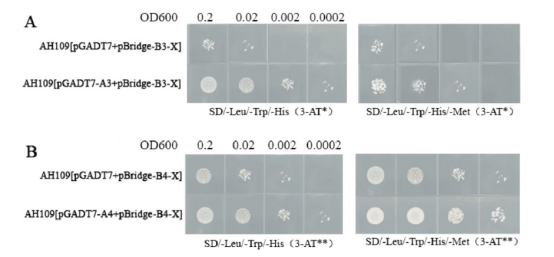
Three-hybrid interaction verification schematic (bait with auto-activation).
Reference
Maruta N, Trusov Y, Botella JR. Yeast Three-Hybrid System for the Detection of Protein-Protein Interactions. In: Botella J, Botella M, eds. Plant Signal Transduction. Methods in Molecular Biology. Vol 1363. Humana Press, New York, NY; 2016. https://doi.org/10.1007/978-1-4939-3115-6_12
Cottier S, Mönig T, Wang Z, Svoboda J, Boland W, Kaiser M, Kombrink E. The yeast three-hybrid system as an experimental platform to identify proteins interacting with small signaling molecules in plant cells: potential and limitations. Front Plant Sci. 2011;2:101. doi: 10.3389/fpls.2011.00101
Glass F, et al. The Yeast Three-Hybrid System for Protein Interactions. Methods Mol Biol. 2018;1794:61-73. doi: 10.1007/978-1-4939-7871-7_5
Tirode F, Malaguti C, Romero F, Attar R, Camonis J, Egly JM. A conditionally expressed third partner stabilizes or prevents the formation of a transcriptional activator in a three-hybrid system. J Biol Chem. 1997;272:22995–22999.
SenGupta DJ, Zhang B, Kraemer B, Pochart P, Fields S, Wickens M. A three-hybrid system to detect RNA–protein interactions in vivo. Proc Natl Acad Sci. 1996;93:8496–8501.
Kraemer B, Zhang B, SenGupta D, Fields S, Wickens M. Using the yeast three-hybrid system to detect and analyze RNA–protein interactions. Methods Enzymol. 2000;328:297–321.
Appendix: Vectors used in yeast one hybrid(Y3H) experiments
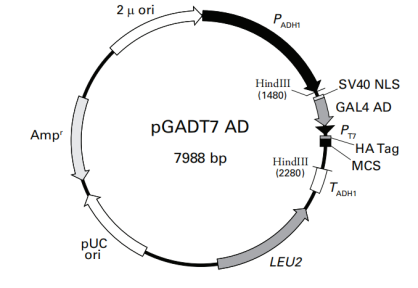

1.Vector Name: pGADT7
Origin of Replication: pUC
Promoter: ADH1
Vector Size: 7987 bp
5' Sequencing Primer and Sequence: 5'-CTATTCGATGATGAAGATACCCC-3'
3' Sequencing Primer and Sequence: 5'-GTGAACTTGCGGGGTTTTTCAG-3'
Vector Resistance: Ampicillin
Selection Marker: LEU2
>pGADT7 vector sequence
TGCATGCCTGCAGGTCGAGATCCGGGATCGAAGAAATGATGGTAAATGAAATAGGAAATCAAGGAGCATGAAGGCAAAAGACAAATATAAGGGTCGAACGAAAAATAAAGTGAAAAGTGTTGATATGATGTATTTGGCTTTGCGGCGCCGAAAAAACGAGTTTACGCAATTGCACAATCATGCTGACTCTGTGGCGGACCCGCGCTCTTGCCGGCCCGGCGATAACGCTGGGCGTGAGGCTGTGCCCGGCGGAGTTTTTTGCGCCTGCATTTTCCAAGGTTTACCCTGCGCTAAGGGGCGAGATTGGAGAAGCAATAAGAATGCCGGTTGGGGTTGCGATGATGACGACCACGACAACTGGTGTCATTATTTAAGTTGCCGAAAGAACCTGAGTGCATTTGCAACATGAGTATACTAGAAGAATGAGCCAAGACTTGCGAGACGCGAGTTTGCCGGTGGTGCGAACAATAGAGCGACCATGACCTTGAAGGTGAGACGCGCATAACCGCTAGAGTACTTTGAAGAGGAAACAGCAATAGGGTTGCTACCAGTATAAATAGACAGGTACATACAACACTGGAAATGGTTGTCTGTTTGAGTACGCTTTCAATTCATTTGGGTGTGCACTTTATTATGTTACAATATGGAAGGGAACTTTACACTTCTCCTATGCACATATATTAATTAAAGTCCAATGCTAGTAGAGAAGGGGGGTAACACCCCTCCGCGCTCTTTTCCGATTTTTTTCTAAACCGTGGAATATTTCGGATATCCTTTTGTTGTTTCCGGGTGTACAATATGGACTTCCTCTTTTCTGGCAACCAAACCCATACATCGGGATTCCTATAATACCTTCGTTGGTCTCCCTAACATGTAGGTGGCGGAGGGGAGATATACAATAGAACAGATACCAGACAAGACATAATGGGCTAAACAAGACTACACCAATTACACTGCCTCATTGATGGTGGTACATAACGAACTAATACTGTAGCCCTAGACTTGATAGCCATCATCATATCGAAGTTTCACTACCCTTTTTCCATTTGCCATCTATTGAAGTAATAATAGGCGCATGCAACTTCTTTTCTTTTTTTTTCTTTTCTCTCTCCCCCGTTGTTGTCTCACCATATCCGCAATGACAAAAAAATGATGGAAGACACTAAAGGAAAAAATTAACGACAAAGACAGCACCAACAGATGTCGTTGTTCCAGAGCTGATGAGGGGTATCTCGAAGCACACGAAACTTTTTCCTTCCTTCATTCACGCACACTACTCTCTAATGAGCAACGGTATACGGCCTTCCTTCCAGTTACTTGAATTTGAAATAAAAAAAAGTTTGCTGTCTTGCTATCAAGTATAAATAGACCTGCAATTATTAATCTTTTGTTTCCTCGTCATTGTTCTCGTTCCCTTTCTTCCTTGTTTCTTTTTCTGCACAATATTTCAAGCTATACCAAGCATACAATCAACTCCAAGCTTTGCAAAGATGGATAAAGCGGAATTAATTCCCGAGCCTCCAAAAAAGAAGAGAAAGGTCGAATTGGGTACCGCCGCCAATTTTAATCAAAGTGGGAATATTGCTGATAGCTCATTGTCCTTCACTTTCACTAACAGTAGCAACGGTCCGAACCTCATAACAACTCAAACAAATTCTCAAGCGCTTTCACAACCAATTGCCTCCTCTAACGTTCATGATAACTTCATGAATAATGAAATCACGGCTAGTAAAATTGATGATGGTAATAATTCAAAACCACTGTCACCTGGTTGGACGGACCAAACTGCGTATAACGCGTTTGGAATCACTACAGGGATGTTTAATACCACTACAATGGATGATGTATATAACTATCTATTCGATGATGAAGATACCCCACCAAACCCAAAAAAAGAGATCTTTAATACGACTCACTATAGGGCGAGCGCCGCCATGGAGTACCCATACGACGTACCAGATTACGCTCATATGGCCATGGAGGCCAGTGAATTCCACCCGGGTGGGCATCGATACGGGATCCATCGAGCTCGAGCTGCAGATGAATCGTAGATACTGAAAAACCCCGCAAGTTCACTTCAACTGTGCATCGTGCACCATCTCAATTTCTTTCATTTATACATCGTTTTGCCTTCTTTTATGTAACTATACTCCTCTAAGTTTCAATCTTGGCCATGTAACCTCTGATCTATAGAATTTTTTAAATGACTAGAATTAATGCCCATCTTTTTTTTGGACCTAAATTCTTCATGAAAATATATTACGAGGGCTTATTCAGAAGCTTTGGACTTCTTCGCCAGAGGTTTGGTCAAGTCTCCAATCAAGGTTGTCGGCTTGTCTACCTTGCCAGAAATTTACGAAAAGATGGAAAAGGGTCAAATCGTTGGTAGATACGTTGTTGACACTTCTAAATAAGCGAATTTCTTATGATTTATGATTTTTATTATTAAATAAGTTATAAAAAAAATAAGTGTATACAAATTTTAAAGTGACTCTTAGGTTTTAAAACGAAAATTCTTATTCTTGAGTAACTCTTTCCTGTAGGTCAGGTTGCTTTCTCAGGTATAGCATGAGGTCGCTCTTATTGACCACACCTCTACCGGCCGGTCGAAATTCCCCTACCCTATGAACATATTCCATTTTGTAATTTCGTGTCGTTTCTATTATGAATTTCATTTATAAAGTTTATGTACAAATATCATAAAAAAAGAGAATCTTTTTAAGCAAGGATTTTCTTAACTTCTTCGGCGACAGCATCACCGACTTCGGTGGTACTGTTGGAACCACCTAAATCACCAGTTCTGATACCTGCATCCAAAACCTTTTTAACTGCATCTTCAATGGCCTTACCTTCTTCAGGCAAGTTCAATGACAATTTCAACATCATTGCAGCAGACAAGATAGTGGCGATAGGGTTGACCTTATTCTTTGGCAAATCTGGAGCAGAACCGTGGCATGGTTCGTACAAACCAAATGCGGTGTTCTTGTCTGGCAAAGAGGCCAAGGACGCAGATGGCAACAAACCCAAGGAACCTGGGATAACGGAGGCTTCATCGGAGATGATATCACCAAACATGTTGCTGGTGATTATAATACCATTTAGGTGGGTTGGGTTCTTAACTAGGATCATGGCGGCAGAATCAATCAATTGATGTTGAACCTTCAATGTAGGAAATTCGTTCTTGATGGTTTCCTCCACAGTTTTTCTCCATAATCTTGAAGAGGCCAAAACATTAGCTTTATCCAAGGACCAAATAGGCAATGGTGGCTCATGTTGTAGGGCCATGAAAGCGGCCATTCTTGTGATTCTTTGCACTTCTGGAACGGTGTATTGTTCACTATCCCAAGCGACACCATCACCATCGTCTTCCTTTCTCTTACCAAAGTAAATACCTCCCACTAATTCTCTGACAACAACGAAGTCAGTACCTTTAGCAAATTGTGGCTTGATTGGAGATAAGTCTAAAAGAGAGTCGGATGCAAAGTTACATGGTCTTAAGTTGGCGTACAATTGAAGTTCTTTACGGATTTTTAGTAAACCTTGTTCAGGTCTAACACTACCTGTACCCCATTTAGGACCACCCACAGCACCTAACAAAACGGCATCAGCCTTCTTGGAGGCTTCCAGCGCCTCATCTGGAAGTGGGACACCTGTAGCTTCGATAGCAGCACCACCAATTAAATGATTTTCGAAATCGAACTTGACATTGGAACGAACATCAGAAATAGCTTTAAGAACCTTAATGGCTTCGGCTGTGATTTCTTGACCAACGTGGTCACCTGGCAAAACGACGATCTTCTTAGGGGCAGACATTAGAATGGTATATCCTTGAAATATATATATATATTGCTGAAATGTAAAAGGTAAGAAAAGTTAGAAAGTAAGACGATTGCTAACCACCTATTGGAAAAAACAATAGGTCCTTAAATAATATTGTCAACTTCAAGTATTGTGATGCAAGCATTTAGTCATGAACGCTTCTCTATTCTATATGAAAAGCCGGTTCCGGCGCTCTCACCTTTCCTTTTTCTCCCAATTTTTCAGTTGAAAAAGGTATATGCGTCAGGCGACCTCTGAAATTAACAAAAAATTTCCAGTCATCGAATTTGATTCTGTGCGATAGCGCCCCTGTGTGTTCTCGTTATGTTGAGGAAAAAAATAATGGTTGCTAAGAGATTCGAACTCTTGCATCTTACGATACCTGAGTATTCCCACAGTTGGGGGATCTCGACTCTAGCTAGAGGATCAATTCGTAATCATGTCATAGCTGTTTCCTGTGTGAAATTGTTATCCGCTCACAATTCCACACAACATACGAGCCGGAAGCATAAAGTGTAAAGCCTGGGGTGCCTAATGAGTGAGCTAACTCACATTAATTGCGTTGCGCTCACTGCCCGCTTTCCAGTCGGGAAACCTGTCGTGCCAGCTGATAACTTCGTATAATGTATGCTATACGAAGTTATTAGGTCTGAAGAGGAGTTTACGTCCAGCCAAGCTAGCTTGGCTGCAGGTCGAGCGGCCGCGATCCGGAACCCTTAATATAACTTCGTATAATGTATGCTATACGAAGTTATCAGCTGCATTAATGAATCGGCCAACGCGCGGGGAGAGGCGGTTTGCGTATTGGGCGCTCTTCCGCTTCCTCGCTCACTGACTCGCTGCGCTCGGTCGTTCGGCTGCGGCGAGCGGTATCAGCTCACTCAAAGGCGGTAATACGGTTATCCACAGAATCAGGGGATAACGCAGGAAAGAACATGTGAGCAAAAGGCCAGCAAAAGGCCAGGAACCGTAAAAAGGCCGCGTTGCTGGCGTTTTTCCATAGGCTCCGCCCCCCTGACGAGCATCACAAAAATCGACGCTCAAGTCAGAGGTGGCGAAACCCGACAGGACTATAAAGATACCAGGCGTTTCCCCCTGGAAGCTCCCTCGTGCGCTCTCCTGTTCCGACCCTGCCGCTTACCGGATACCTGTCCGCCTTTCTCCCTTCGGGAAGCGTGGCGCTTTCTCATAGCTCACGCTGTAGGTATCTCAGTTCGGTGTAGGTCGTTCGCTCCAAGCTGGGCTGTGTGCACGAACCCCCCGTTCAGCCCGACCGCTGCGCCTTATCCGGTAACTATCGTCTTGAGTCCAACCCGGTAAGACACGACTTATCGCCACTGGCAGCAGCCACTGGTAACAGGATTAGCAGAGCGAGGTATGTAGGCGGTGCTACAGAGTTCTTGAAGTGGTGGCCTAACTACGGCTACACTAGAAGAACAGTATTTGGTATCTGCGCTCTGCTGAAGCCAGTTACCTTCGGAAAAAGAGTTGGTAGCTCTTGATCCGGCAAACAAACCACCGCTGGTAGCGGTGGTTTTTTTGTTTGCAAGCAGCAGATTACGCGCAGAAAAAAAGGATCTCAAGAAGATCCTTTGATCTTTTCTACGGGGTCTGACGCTCAGTGGAACGAAAACTCACGTTAAGGGATTTTGGTCATGAGATTATCAAAAAGGATCTTCACCTAGATCCTTTTAAATTAAAAATGAAGTTTTAAATCAATCTAAAGTATATATGAGTAAACTTGGTCTGACAGTTACCAATGCTTAATCAGTGAGGCACCTATCTCAGCGATCTGTCTATTTCGTTCATCCATAGTTGCCTGACTCCCCGTCGTGTAGATAACTACGATACGGGAGGGCTTACCATCTGGCCCCAGTGCTGCAATGATACCGCGAGACCCACGCTCACCGGCTCCAGATTTATCAGCAATAAACCAGCCAGCCGGAAGGGCCGAGCGCAGAAGTGGTCCTGCAACTTTATCCGCCTCCATCCAGTCTATTAATTGTTGCCGGGAAGCTAGAGTAAGTAGTTCGCCAGTTAATAGTTTGCGCAACGTTGTTGCCATTGCTACAGGCATCGTGGTGTCACGCTCGTCGTTTGGTATGGCTTCATTCAGCTCCGGTTCCCAACGATCAAGGCGAGTTACATGATCCCCCATGTTGTGCAAAAAAGCGGTTAGCTCCTTCGGTCCTCCGATCGTTGTCAGAAGTAAGTTGGCCGCAGTGTTATCACTCATGGTTATGGCAGCACTGCATAATTCTCTTACTGTCATGCCATCCGTAAGATGCTTTTCTGTGACTGGTGAGTACTCAACCAAGTCATTCTGAGAATAGTGTATGCGGCGACCGAGTTGCTCTTGCCCGGCGTCAATACGGGATAATACCGCGCCACATAGCAGAACTTTAAAAGTGCTCATCATTGGAAAACGTTCTTCGGGGCGAAAACTCTCAAGGATCTTACCGCTGTTGAGATCCAGTTCGATGTAACCCACTCGTGCACCCAACTGATCTTCAGCATCTTTTACTTTCACCAGCGTTTCTGGGTGAGCAAAAACAGGAAGGCAAAATGCCGCAAAAAAGGGAATAAGGGCGACACGGAAATGTTGAATACTCATACTCTTCCTTTTTCAATATTATTGAAGCATTTATCAGGGTTATTGTCTCATGAGCGGATACATATTTGAATGTATTTAGAAAAATAAACAAATAGGGGTTCCGCGCACATTTCCCCGAAAAGTGCCACCTGACGTCTAAGAAACCATTATTATCATGACATTAACCTATAAAAATAGGCGTATCACGAGGCCCTTTCGTCTCGCGCGTTTCGGTGATGACGGTGAAAACCTCTGACACATGCAGCTCCCGGAGACGGTCACAGCTTGTCTGTAAGCGGATGCCGGGAGCAGACAAGCCCGTCAGGGCGCGTCAGCGGGTGTTGGCGGGTGTCGGGGCTGGCTTAACTATGCGGCATCAGAGCAGATTGTACTGAGAGTGCACCATAACGCATTTAAGCATAAACACGCACTATGCCGTTCTTCTCATGTATATATATATACAGGCAACACGCAGATATAGGTGCGACGTGAACAGTGAGCTGTATGTGCGCAGCTCGCGTTGCATTTTCGGAAGCGCTCGTTTTCGGAAACGCTTTGAAGTTCCTATTCCGAAGTTCCTATTCTCTAGCTAGAAAGTATAGGAACTTCAGAGCGCTTTTGAAAACCAAAAGCGCTCTGAAGACGCACTTTCAAAAAACCAAAAACGCACCGGACTGTAACGAGCTACTAAAATATTGCGAATACCGCTTCCACAAACATTGCTCAAAAGTATCTCTTTGCTATATATCTCTGTGCTATATCCCTATATAACCTACCCATCCACCTTTCGCTCCTTGAACTTGCATCTAAACTCGACCTCTACATTTTTTATGTTTATCTCTAGTATTACTCTTTAGACAAAAAAATTGTAGTAAGAACTATTCATAGAGTGAATCGAAAACAATACGAAAATGTAAACATTTCCTATACGTAGTATATAGAGACAAAATAGAAGAAACCGTTCATAATTTTCTGACCAATGAAGAATCATCAACGCTATCACTTTCTGTTCACAAAGTATGCGCAATCCACATCGGTATAGAATATAATCGGGGATGCCTTTATCTTGAAAAAATGCACCCGCAGCTTCGCTAGTAATCAGTAAACGCGGGAAGTGGAGTCAGGCTTTTTTTATGGAAGAGAAAATAGACACCAAAGTAGCCTTCTTCTAACCTTAACGGACCTACAGTGCAAAAAGTTATCAAGAGACTGCATTATAGAGCGCACAAAGGAGAAAAAAAGTAATCTAAGATGCTTTGTTAGAAAAATAGCGCTCTCGGGATGCATTTTTGTAGAACAAAAAAGAAGTATAGATTCTTTGTTGGTAAAATAGCGCTCTCGCGTTGCATTTCTGTTCTGTAAAAATGCAGCTCAGATTCTTTGTTTGAAAAATTAGCGCTCTCGCGTTGCATTTTTGTTTTACAAAAATGAAGCACAGATTCTTCGTTGGTAAAATAGCGCTTTCGCGTTGCATTTCTGTTCTGTAAAAATGCAGCTCAGATTCTTTGTTTGAAAAATTAGCGCTCTCGCGTTGCATTTTTGTTCTACAAAATGAAGCACAGATGCTTCGTTGCT
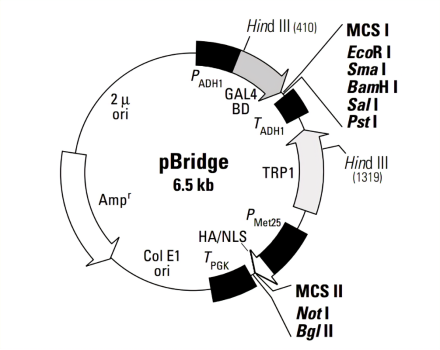
2.Vector Name: pBridge
Promoter: ADH1
Origin of Replication: 2μori, ColE1 ori
Vector Size: 6526bp
5' Sequencing Primer and Sequence: 5'-TCATCGGAAGAGAGTAGT-3'
3' Sequencing Primer and Sequence: 5'-AATTTATTTCTTTTCGGATAA-3'
Vector Resistance: Ampicillin
Selection Marker: TRP1
>pBridge vector sequence
GCTTGCATGCAACTTCTTTTCTTTTTTTTTCTTTTCTCTCTCCCCCGTTGTTGTCTCACCATATCCGCAATGACAAAAAAATGATGGAAGACACTAAAGGAAAAAATTAACGACAAAGACAGCACCAACAGATGTCGTTGTTCCAGAGCTGATGAGGGGTATCTCGAAGCACACGAAACTTTTTCCTTCCTTCATTCACGCACACTACTCTCTAATGAGCAACGGTATACGGCCTTCCTTCCAGTTACTTGAATTTGAAATAAAAAAAAGTTTGCTGTCTTGCTATCAAGTATAAATAGACCTGCAATTATTAATCTTTTGTTTCCTCGTCATTGTTCTCGTTCCCTTTCTTCCTTGTTTCTTTTTCTGCACAATATTTCAAGCTATACCAAGCATACAATCAACTCCAAGCTTGAAGCAAGCCTCCTGAAAGATGAAGCTACTGTCTTCTATCGAACAAGCATGCGATATTTGCCGACTTAAAAAGCTCAAGTGCTCCAAAGAAAAACCGAAGTGCGCCAAGTGTCTGAAGAACAACTGGGAGTGTCGCTACTCTCCCAAAACCAAAAGGTCTCCGCTGACTAGGGCACATCTGACAGAAGTGGAATCAAGGCTAGAAAGACTGGAACAGCTATTTCTACTGATTTTTCCTCGAGAAGACCTTGACATGATTTTGAAAATGGATTCTTTACAGGATATAAAAGCATTGTTAACAGGATTATTTGTACAAGATAATGTGAATAAAGATGCCGTCACAGATAGATTGGCTTCAGTGGAGACTGATATGCCTCTAACATTGAGACAGCATAGAATAAGTGCGACATCATCATCGGAAGAGAGTAGTAACAAAGGTCAAAGACAGTTGACTGTATCGCCGGAATTCCCGGGGATCCGTCGACCTGCAGCCAAGCTAATTCCGGGCGAATTTCTTATGATTTATGATTTTTATTATTAAATAAGTTATAAAAAAAATAAGTGTATACAAATTTTAAAGTGACTCTTAGGTTTTAAAACGAAAATTCTTATTCTTGAGTAACTCTTTCCTGTAGGTCAGGTTGCTTTCTCAGGTATAGCATGAGGTCGCTCTTATTGACCACACCTCTACCGGCATGCCGGCAAGTGCACAAACAATACTTAAATAAATACTACTCAGTAATAACCTATTTCTTAGCATTTTTGACGAAATTTGCTATTTTGTTAGAGTCTTTTACACCATTTGTCTCCACACCTCCGCTTACATCAACACCAATAACGCCATTTAATCTAAGCGCATCACCAACATTTTCTGGCGTCAGTCCACCAGCTAACATAAAATGTAAGCTTTCGGGGCTCTCTTGCCTTCCAACCCAGTCAGAAATCGAGTTCCAATCCAAAAGTTCACCTGTCCCACCTGCTTCTGAATCAAACAAGGGAATAAACGAATGAGGTTTCTGTGAAGCTGCACTGAGTAGTATGTTGCAGTCTTTTGGAAATACGAGTCTTTTAATAACTGGCAAACCGAGGAACTCTTGGTATTCTTGCCACGACTCATCTCCATGCAGTTGGACGATATCAATGCCGTAATCATTGACCAGAGCCAAAACATCCTCCTTAGGTTGATTACGAAACACGCCAACCAAGTATTTCGGAGTGCCTGAACTATTTTTATATGCTTTTACAAGACTTGAAATTTTCCTTGCAATAACCGGGTCAATTGTTCTCTTTCTATTGGGCACACATATAATACCCAGCAAGTCAGCATCGGAATCTAGAGCACATTCTGCGGCCTCTGTGCTCTGCAAGCCGCAAACTTTCACCAATGGACCAGAACTACCTGTGAAATTAATAACAGACATACTCCAAGCTGCCTTTGTGTGCTTAATCACGTATACTCACGTGCTCAATAGTCACCAATGCCCTCCCTCTTGGCCCTCTCCTTTTCTTTTTTCGACCGAATTAATTCGTAATCATGTCATAGCTGTTTCCTGTGTGAAATTGTTATCCGCTCACAATTCCACACAACATACGAGCCGGAAGCATAAAGTGTAAAGCCTGGGGTGCCTAATGAGTGAGCTAACTCACATTAATTGCGTTGCGCTCACTGCCCGCTTTCCAGTCGGGAAACCTGTCGTGCCAGGAAGATCCGAGGCCTAGCTTCTAATTCTTCCAACATACAATGGGAGTTTGGCCGAGTGGTTTAAGGCGTCAGATTTAGGTGGATTTAACCTCTAAAATCTCTGATATCTTCGGATGCAAGGGTTCGAATCCCTTAGCTCTCATTATTTTTTGCTTTTTCTCTTGAGGTCACATGATCGCAAAATGGCAAATGGCACGTGAAGCTGTCGATATTGGGGAACTGTGGTGGTTGGCAAATGACTAATTAAGTTAGTCAAGGCGCCATCCTCATGAAAACTGTGTAACATAATAACCGAAGTGTCGAAAAGGTGGCACCTTGTCCAATTGAACACGCTCGATGAAAAAAATAAGATATATATAAGGTTAAGTAAAGCGTCTGTTAGAAAGGAAGTTTTTCCTTTTTCTTGCTCTCTTGTCTTTTCATCTACTATTTCCTTCGTGTAATACAGGGTCGTCAGATACATAGATACAATTCTATTACCCCCATCCATACAATGGGCCATATGGCTTCTAGCTATCCTTATGACGTGCCTGACTATGCCAGCCTGGGAGGACCTTCTAGTCCTAAGAAGAAGAGAAAGGTGGCGGCCGCATTAGCCCGAAGATCTTCGGGCTGATCTCCCATGTCTCTACTGGTGGTGGTGCTTCTTTGGAATTATTGGAAGGTAAGGAATTGCCAGGTGTTGCTTTCTTATCCGAAAAGAAATAAATTGAATTGAATTGAAATCGATAGATCAATTTTTTTCTTTTCTCTTTCCCCATCCTTTACGCTAAAATAATAGTTTATTTTATTTTTTGAATATTTTTTATTTATATACGTATATATAGACTATTATTTATCTTTTAATGATTATTAAGATTTTTATTAAAAAAAAATTCGCTCCTCTTTTAATGCCTTTATGCAGTTTTTTTTTCCCATTCGATATTTCTATGTTCGGGTTCAGCGTATTTTAAGTTTAATAACTCGAAAATTCTGCGTTCGTTAAAGCTAGGCCTCGGATCTTCCTGCATTAATGAATCGGCCAACGCGCGGGGAGAGGCGGTTTGCGTATTGGGCGCTCTTCCGCTTCCTCGCTCACTGACTCGCTGCGCTCGGTCGTTCGGCTGCGGCGAGCGGTATCAGCTCACTCAAAGGCGGTAATACGGTTATCCACAGAATCAGGGGATAACGCAGGAAAGAACATGTGAGCAAAAGGCCAGCAAAAGGCCAGGAACCGTAAAAAGGCCGCGTTGCTGGCGTTTTTCCATAGGCTCCGCCCCCCTGACGAGCATCACAAAAATCGACGCTCAAGTCAGAGGTGGCGAAACCCGACAGGACTATAAAGATACCAGGCGTTTCCCCCTGGAAGCTCCCTCGTGCGCTCTCCTGTTCCGACCCTGCCGCTTACCGGATACCTGTCCGCCTTTCTCCCTTCGGGAAGCGTGGCGCTTTCTCATAGCTCACGCTGTAGGTATCTCAGTTCGGTGTAGGTCGTTCGCTCCAAGCTGGGCTGTGTGCACGAACCCCCCGTTCAGCCCGACCGCTGCGCCTTATCCGGTAACTATCGTCTTGAGTCCAACCCGGTAAGACACGACTTATCGCCACTGGCAGCAGCCACTGGTAACAGGATTAGCAGAGCGAGGTATGTAGGCGGTGCTACAGAGTTCTTGAAGTGGTGGCCTAACTACGGCTACACTAGAAGAACAGTATTTGGTATCTGCGCTCTGCTGAAGCCAGTTACCTTCGGAAAAAGAGTTGGTAGCTCTTGATCCGGCAAACAAACCACCGCTGGTAGCGGTGGTTTTTTTGTTTGCAAGCAGCAGATTACGCGCAGAAAAAAAGGATCTCAAGAAGATCCTTTGATCTTTTCTACGGGGTCTGACGCTCAGTGGAACGAAAACTCACGTTAAGGGATTTTGGTCATGAGATTATCAAAAAGGATCTTCACCTAGATCCTTTTAAATTAAAAATGAAGTTTTAAATCAATCTAAAGTATATATGAGTAAACTTGGTCTGACAGTTACCAATGCTTAATCAGTGAGGCACCTATCTCAGCGATCTGTCTATTTCGTTCATCCATAGTTGCCTGACTCCCCGTCGTGTAGATAACTACGATACGGGAGGGCTTACCATCTGGCCCCAGTGCTGCAATGATACCGCGAGACCCACGCTCACCGGCTCCAGATTTATCAGCAATAAACCAGCCAGCCGGAAGGGCCGAGCGCAGAAGTGGTCCTGCAACTTTATCCGCCTCCATCCAGTCTATTAATTGTTGCCGGGAAGCTAGAGTAAGTAGTTCGCCAGTTAATAGTTTGCGCAACGTTGTTGCCATTGCTACAGGCATCGTGGTGTCACGCTCGTCGTTTGGTATGGCTTCATTCAGCTCCGGTTCCCAACGATCAAGGCGAGTTACATGATCCCCCATGTTGTGCAAAAAAGCGGTTAGCTCCTTCGGTCCTCCGATCGTTGTCAGAAGTAAGTTGGCCGCAGTGTTATCACTCATGGTTATGGCAGCACTGCATAATTCTCTTACTGTCATGCCATCCGTAAGATGCTTTTCTGTGACTGGTGAGTACTCAACCAAGTCATTCTGAGAATAGTGTATGCGGCGACCGAGTTGCTCTTGCCCGGCGTCAATACGGGATAATACCGCGCCACATAGCAGAACTTTAAAAGTGCTCATCATTGGAAAACGTTCTTCGGGGCGAAAACTCTCAAGGATCTTACCGCTGTTGAGATCCAGTTCGATGTAACCCACTCGTGCACCCAACTGATCTTCAGCATCTTTTACTTTCACCAGCGTTTCTGGGTGAGCAAAAACAGGAAGGCAAAATGCCGCAAAAAAGGGAATAAGGGCGACACGGAAATGTTGAATACTCATACTCTTCCTTTTTCAATATTATTGAAGCATTTATCAGGGTTATTGTCTCATGAGCGGATACATATTTGAATGTATTTAGAAAAATAAACAAATAGGGGTTCCGCGCACATTTCCCCGAAAAGTGCCACCTGACGTCTAAGAAACCATTATTATCATGACATTAACCTATAAAAATAGGCGTATCACGAGGCCCTTTCGTCTCGCGCGTTTCGGTGATGACGGTGAAAACCTCTGACACATGCAGCTCCCGGAGACGGTCACAGCTTGTCTGTAAGCGGATGCCGGGAGCAGACAAGCCCGTCAGGGCGCGTCAGCGGGTGTTGGCGGGTGTCGGGGCTGGCTTAACTATGCGGCATCAGAGCAGATTGTACTGAGAGTGCACCATAACGCATTTAAGCATAAACACGCACTATGCCGTTCTTCTCATGTATATATATATACAGGCAACACGCAGATATAGGTGCGACGTGAACAGTGAGCTGTATGTGCGCAGCTCGCGTTGCATTTTCGGAAGCGCTCGTTTTCGGAAACGCTTTGAAGTTCCTATTCCGAAGTTCCTATTCTCTAGCTAGAAAGTATAGGAACTTCAGAGCGCTTTTGAAAACCAAAAGCGCTCTGAAGACGCACTTTCAAAAAACCAAAAACGCACCGGACTGTAACGAGCTACTAAAATATTGCGAATACCGCTTCCACAAACATTGCTCAAAAGTATCTCTTTGCTATATATCTCTGTGCTATATCCCTATATAACCTACCCATCCACCTTTCGCTCCTTGAACTTGCATCTAAACTCGACCTCTACATTTTTTATGTTTATCTCTAGTATTACTCTTTAGACAAAAAAATTGTAGTAAGAACTATTCATAGAGTGAATCGAAAACAATACGAAAATGTAAACATTTCCTATACGTAGTATATAGAGACAAAATAGAAGAAACCGTTCATAATTTTCTGACCAATGAAGAATCATCAACGCTATCACTTTCTGTTCACAAAGTATGCGCAATCCACATCGGTATAGAATATAATCGGGGATGCCTTTATCTTGAAAAAATGCACCCGCAGCTTCGCTAGTAATCAGTAAACGCGGGAAGTGGAGTCAGGCTTTTTTTATGGAAGAGAAAATAGACACCAAAGTAGCCTTCTTCTAACCTTAACGGACCTACAGTGCAAAAAGTTATCAAGAGACTGCATTATAGAGCGCACAAAGGAGAAAAAAAGTAATCTAAGATGCTTTGTTAGAAAAATAGCGCTCTCGGGATGCATTTTTGTAGAACAAAAAAGAAGTATAGATTCTTTGTTGGTAAAATAGCGCTCTCGCGTTGCATTTCTGTTCTGTAAAAATGCAGCTCAGATTCTTTGTTTGAAAAATTAGCGCTCTCGCGTTGCATTTTTGTTTTACAAAAATGAAGCACAGATTCTTCGTTGGTAAAATAGCGCTTTCGCGTTGCATTTCTGTTCTGTAAAAATGCAGCTCAGATTCTTTGTTTGAAAAATTAGCGCTCTCGCGTTGCATTTTTGTTCTACAAAATGAAGCACAGATGCTTCGTT
Results interpretation:
1.
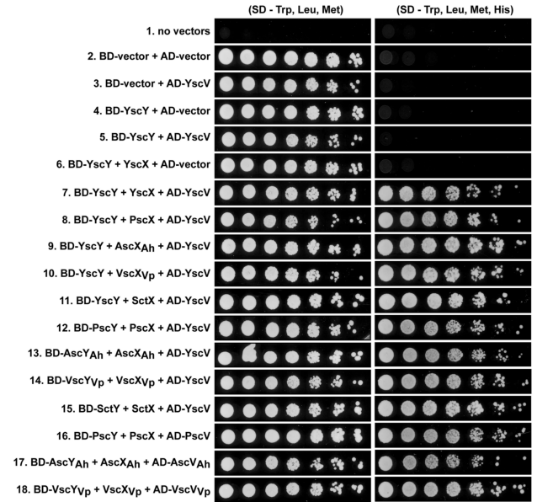
SD/Trp-Leu+Met:
The constructs pBT3-STE and pBT3-STEhPiP2;1 show growth on the SD/Trp-Leu+Met medium, indicating that they are capable of expressing the Met marker gene, which allows for growth on this medium.
SD/Trp-Leu+Met+His:
The constructs pBT3-STE and pBT3-STEhPiP2;1 show growth on the SD/Trp-Leu+Met+His medium, indicating that they are capable of expressing the His marker gene, which allows for growth on this medium.
The constructs pBT3-STE and pBT3-STEhP2;1 show growth on the SD/Trp-Leu+Met+His medium, indicating that they are capable of expressing the His marker gene.
The constructs pBT3-STE and pBT3-STEhPiP2;1 do not show growth on the SD/Trp-Leu+Met+His medium, indicating that they are not capable of expressing the His marker gene, which is required for growth on this medium.
Conclusion:
The results suggest that the constructs pBT3-STE and pBT3-STEhP2;1 are capable of expressing both the Met and His marker genes, allowing for growth on both selective media.
The constructs pBT3-STE and pBT3-STEhP2;1 serve as controls, showing that the growth on the SD/Trp-Leu+Met medium is dependent on the expression of the Met marker gene.
2.
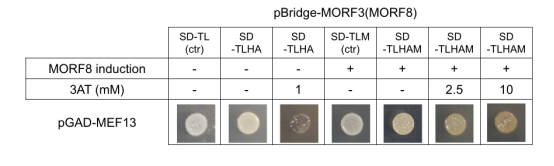
Assay Setup:
Columns: The columns represent different conditions:
SD-TL (ctrl): Selective media lacking tryptophan and leucine, serving as a control.
SD -TLHA: Selective media lacking tryptophan, leucine, and histidine, with 3-aminotriazole (3AT) added to inhibit the Mx2 promoter, which controls MORF8 expression.
SD -TLHAM: Similar to SD -TLHA but with histidine added back, allowing for the expression of MORF8 when induced by 3AT.
Rows:
MORF8 Induction: Indicates whether MORF8 is induced (+) or not (-).
3AT (mM): The concentration of 3AT used to induce MORF8 expression, with increasing concentrations from 0 to 10 mM.
Results:
pGAD-MEF13: This is a plasmid used as a reporter for the interaction. The presence of growth on the selective media indicates a positive interaction between the proteins.
SD-TL (ctrl): No growth is expected here as there is no induction of MORF8.
SD -TLHA: Growth is observed even without MORF8 induction, suggesting a background level of interaction or leaky expression.
SD -TLHAM: The presence of growth in the absence of 3AT (0 mM) indicates a basal level of interaction. As the concentration of 3AT increases, the growth becomes more pronounced, suggesting that the interaction between MORF3 and MORF8 is enhanced with MORF8 induction.
Interpretation:
The results suggest that there is an interaction between MORF3 and MORF8, which can be induced by 3AT.
The increasing growth on SD -TLHAM plates with higher concentrations of 3AT indicates that the interaction strength increases with MORF8 induction.
The control plates (SD-TL and SD -TLHA) show baseline levels of growth, which help to distinguish specific interactions from non-specific background growth.
3.
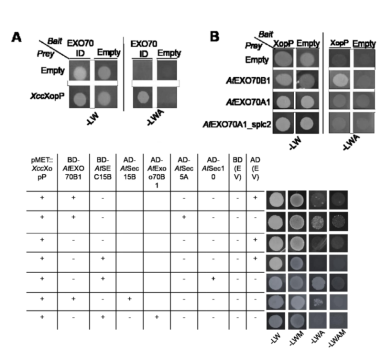
Panel A:
Columns: The columns are labeled with different plasmids: Bait (pMET: XooXopP), Prey (Empty), and XooXopP.
Rows: The rows indicate the presence or absence of various plasmids: BD (AEXO 7081), AD (AISE C158), and AD (AISE 158).
Plus Signs (+): Indicate the presence of the corresponding plasmid.
Minus Signs (-): Indicate the absence of the corresponding plasmid.
Results: The grayscale circles represent the strength of the interaction. Darker circles indicate a stronger interaction. The presence of XooXopP with BD AEXO 7081 and AD AISE C158 shows a strong interaction, as indicated by the dark circles.
Panel B:
Columns: Similar to Panel A, but with different plasmids: Bait (Empty), Prey (XooP), and KoeP (Empty).
Rows: The rows indicate the presence or absence of various plasmids: BD (AEXO 7081), AD (AISE C158), and AD (AISE 158).
Results: The grayscale circles represent the strength of the interaction. The presence of XooP with BD AEXO 7081 and AD AISE C158 also shows a strong interaction, as indicated by the dark circles.
Interpretation:
Positive Controls: The interactions observed with XooXopP and XooP in Panels A and B, respectively, serve as positive controls, indicating that these proteins can interact with the bait and prey constructs.
Negative Controls: The empty columns and rows serve as negative controls, showing no interaction, which is expected.
Specificity: The specific interactions observed with certain plasmid combinations suggest that the proteins encoded by these plasmids may interact with each other in a specific manner.
4.
Panel A:
Columns: The columns are labeled with different dilutions (1, 1:10, 1:100) and two different selective media: QDO and QDO/XA.
Rows: The rows indicate the presence of different plasmids: BD-SnRK1α1, AD-Raptor1B, and pYES (GAL1):FLZ8.
Plus Signs (+): Indicate the presence of the corresponding plasmid.
Results: The circles represent the growth of yeast cells. The presence of growth on selective media indicates a positive interaction between the proteins. The color and size of the colonies can indicate the strength of the interaction.
Panel B:
Columns: Similar to Panel A, but with different selective media: Glucose and Galactose.
Rows: The same as Panel A.
Results: Again, the circles represent the growth of yeast cells. The presence of growth on selective media indicates a positive interaction between the proteins.
Interpretation:
QDO and QDO/XA Media: These media are used to select for yeast cells that have lost the LEU2 and URA3 genes, which are necessary for the expression of the proteins of interest. The presence of growth on these media indicates that the proteins are being expressed and potentially interacting.
Glucose and Galactose Media: These media are used to control for the induction of the pYES (GAL1):FLZ8 plasmid. The presence of growth on Galactose media indicates that the GAL1 promoter is active, leading to the expression of FLZ8.
Dilutions: The dilutions (1, 1:10, 1:100) are used to assess the strength of the interaction. A stronger interaction will result in growth even at higher dilutions.
Specific Observations:
BD-SnRK1α1 and AD-Raptor1B Interaction: Growth is observed on QDO and QDO/XA media, indicating a potential interaction between SnRK1α1 and Raptor1B.
pYES (GAL1):FLZ8 Induction: Growth on Galactose media indicates that FLZ8 is being expressed when the GAL1 promoter is active.
Dilution Series: The presence of growth at all dilutions suggests a strong interaction between the proteins.
5.
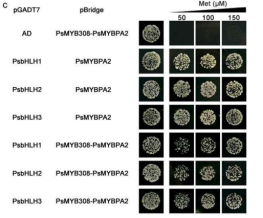
Assay Setup:
Columns: The columns are labeled with different plasmids: pBridge and various AD (Activation Domain) fusion proteins (Pb3HLJ1, Pb3HLJ2, Pb3HLJ3).
Rows: The rows indicate the presence of different plasmids: pGADT7 and PbMYB33D-PbMYBPA2.
Myc: This likely refers to a column that tests for a control interaction, possibly with a known interacting partner of PbMYB33D-PbMYBPA2.
Results:
Growth on Media: The presence of yeast growth on the media indicates a positive interaction between the proteins fused to the AD and BD (Binding Domain) vectors. The different media (SD, SD+Met, SD+Met+Cys) are selective media that allow for the detection of interactions by suppressing the growth of non-interacting yeast.
Myc: The growth in this column serves as a positive control, indicating that the assay is working correctly and that the proteins being tested are capable of interacting.
Interpretation:
PbMYB33D-PbMYBPA2 Interaction: The growth observed in the presence of PbMYB33D-PbMYBPA2 and the various AD fusion proteins suggests that there may be interactions between PbMYB33D-PbMYBPA2 and the proteins fused to the AD vector.
Control Interaction: The growth in the Myc梁 column confirms that the assay is capable of detecting known protein interactions, providing a baseline for interpreting the results of the other interactions.
Specific Observations:
SD Media: Growth on SD media indicates that the proteins are able to interact in the absence of leucine, which is a selective marker for the presence of the pGADT7 vector.
SD+Met Media: Growth on SD+Met media indicates that the interaction is not dependent on methionine, which is a selective marker for the presence of the pBridge vector.
SD+Met+Cys Media: Growth on SD+Met+Cys media indicates that the interaction is not dependent on cysteine, which is a selective marker for the presence of the AD vector.
6.
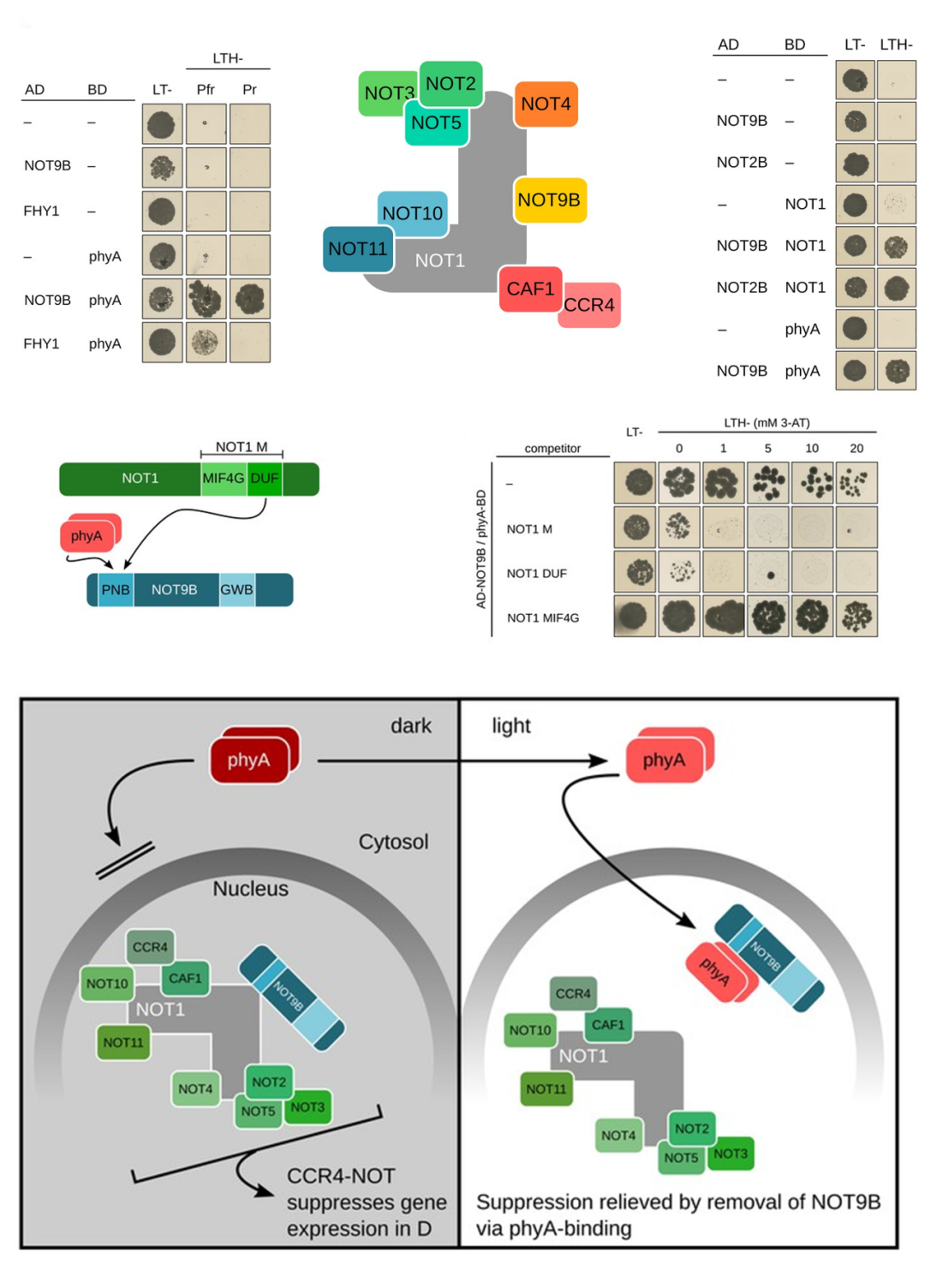
Yeast Three-Hybrid Assay (Y3H) Results:
Top Left Section:
Assay Design: This section shows the results of a Y3H assay, which is used to detect interactions between three proteins. The proteins are represented by different plasmids: Activation Domain (AD), Binding Domain (BD), Library (LT), and Prey (Pr).
Growth on Media: The presence of growth on the selective media indicates a positive interaction between the proteins. The different colors and shades of the circles represent the strength of the interaction, with darker circles indicating stronger interactions.
Specific Interactions: The image highlights interactions between phyA and various NOT proteins (NOT1, NOT2, NOT3, NOT4, NOT5, NOT9B, NOT10, NOT11). The presence of growth in the presence of phyA and NOT proteins suggests that these proteins may interact with each other.
Top Right Section:
Inhibition Assay: This section shows an inhibition assay where the interaction between phyA and NOT proteins is tested in the presence of a competitor (LT+, with varying concentrations of mM 3-AT).
Growth Patterns: The presence of growth in the presence of the competitor indicates that the interaction between phyA and NOT proteins can be inhibited by the competitor. The reduction in growth with increasing concentrations of the competitor suggests that the interaction is dose-dependent.
Regulatory Mechanism Model:
Bottom Section:
PhyA Localization: The model illustrates how phyA behaves differently under dark and light conditions. In the dark, phyA is localized in the nucleus and interacts with the NOT proteins, leading to the suppression of gene expression. In the light, phyA moves to the cytosol, relieving the suppression of gene expression.
CCR4-NOT Complex: The model also shows the role of the CCR4-NOT complex in gene expression regulation. The interaction between phyA and the NOT proteins affects the activity of this complex, which in turn influences gene expression.
Relief of Suppression: The removal of NOT9B via phyA-binding relieves the suppression of gene expression, as indicated by the change in the model from dark to light conditions.
Interpretation:
PhyA Regulation: The results suggest that phyA plays a crucial role in regulating gene expression by interacting with the NOT proteins and the CCR4-NOT complex.
Environmental Response: The model demonstrates how plants respond to environmental cues (light and dark) through the phyA signaling pathway, which affects the localization and activity of regulatory proteins.
Gene Expression Control: The interaction between phyA and the NOT proteins is a key mechanism for controlling gene expression in plants, with implications for various biological processes.
In summary, the Y3H assay results provide experimental evidence for the interactions between phyA and the NOT proteins, which is further supported by the regulatory model that explains how these interactions control gene expression in response to light conditions.
- Wang, S(2024). Yeast Three-Hybrid Screening and Validation Experiment Protocol. Bio-protocol Preprint. bio-protocol.org/prep2754.
Do you have any questions about this protocol?
Post your question to gather feedback from the community. We will also invite the authors of this article to respond.
 Post a Question


