
- Home
- Protocols

-


An Efficient and Simplified Technique for Cardiac Puncture to Collect Blood from Mice

Last updated date: Oct 12, 2024 DOI: 10.21769/p2726 Views: 270 Forks: 0
 Download PDF
 Ask a
question
Ask a
question
 How to
cite
How to
cite
 Favorite


An Efficient and Simplified Technique for Cardiac Puncture to Collect Blood from Mice
Tetsuya Kimura, MD, PhD
Laboratory of Immunometabolism, Research Institute for Microbial Diseases,
Osaka University, Osaka, Japan.
Contact information:
Tetsuya Kimura, MD, PhD
Address: Yamadaoka 3-1, Suita City, Osaka 5650871, Japan
E-mail: tetsuyakimura@biken.osaka-u.ac.jp
Abstract
Animal experiments remain a crucial component of medical research. In particular, mice are widely used because of their fully decoded genome and the availability of numerous genetically modified strains. Blood sampling is essential for evaluating blood cells, cytokines, hormones, and metabolites. In some cases, obtaining the maximum blood volume is desirable. This study presents an improved method for collecting cardiac blood from mice. Performing the puncture without opening the chest allows collecting a larger volume of blood from the heart, which remains oxygenated. This method also reduces the need to sacrifice additional mice because of the low failure rate due to the less anatomically variable puncture pathway. Furthermore, the aseptic collection process enables the use of blood in downstream applications such as cell culture experiments. This enhanced blood collection technique will facilitate various medical studies with reduced time and labor costs.
Background
Blood sampling from mice is crucial in medical research for several reasons. First, blood samples allow researchers to assess various physiological parameters and monitor the disease progression in mouse models. This is essential in study areas such as cancer, metabolic disorders, and infectious diseases. In addition, blood sampling enables evaluation of drug efficacy and pharmacokinetics in preclinical studies. Researchers can measure drug concentrations, metabolites, and biomarkers in blood to determine the effectiveness and safety of potential therapeutic agents. In immunological research, blood sampling is essential to analyze immune cell populations, cytokine levels, and antibody responses. They are crucial for understanding immune system functions and for developing new vaccines or immunotherapies.
Blood can be drawn from mice via the tail vein, inferior vena cava, jugular vein, heart, or retroorbital sinus (1). It is challenging to obtain a large volume and maintain sterility of the blood from the retroorbital sinus. Obtaining sufficient blood from the tail vein or inferior vena cava requires considerable skills, particularly in C57BL/6 mice, which are relatively small. Several methods exist for cardiac blood sampling. Puncturing the heart ventricle without opening the thorax is difficult in mice; however, opening the thorax causes lung collapse and prevents oxygenated blood from reaching the heart, leading to cardiac arrest.
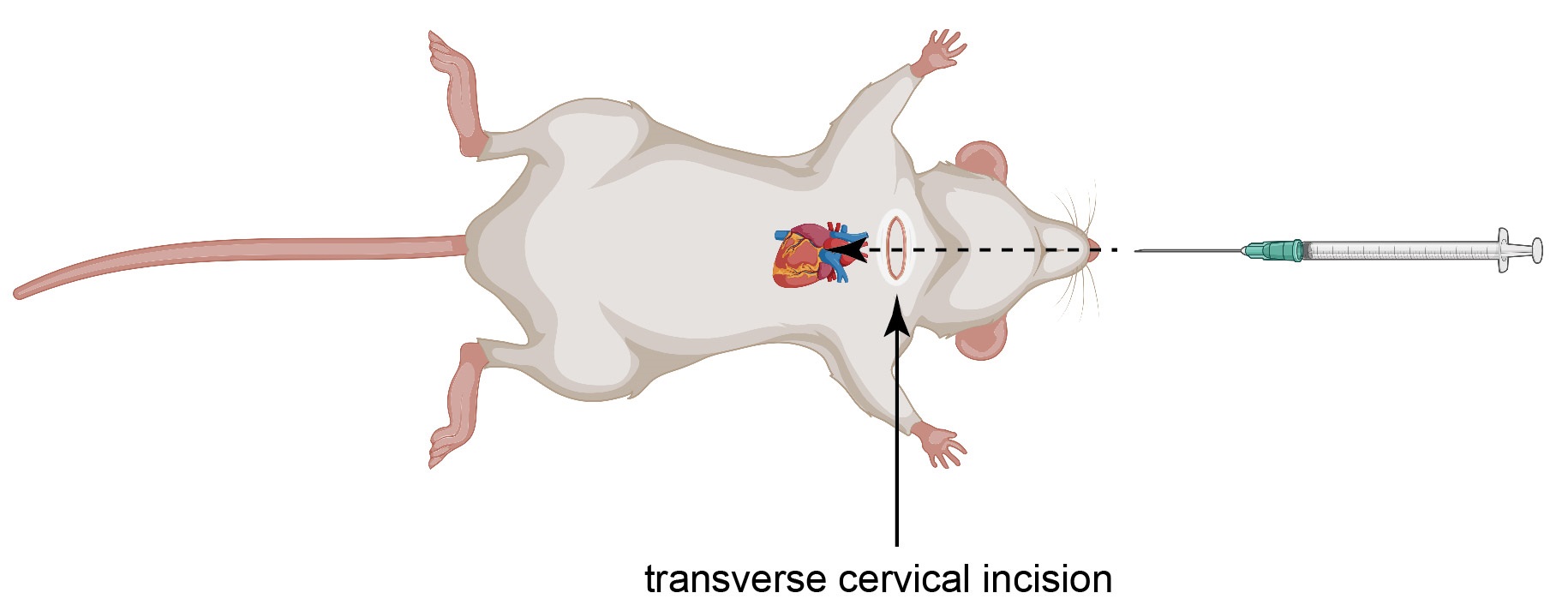
In this report, we describe an improved cardiac blood collection. We improved Frankenberg’s original method (2) from two perspectives: sterility and ease for beginners. The anatomical position to be punctured was easily determined by first making a transverse incision in the disinfected anterior neck skin. The needle avoided touching the skin and advanced from the jugular notch through the anterior mediastinum to puncture the heart without opening the thorax, allowing aseptic blood sampling. The non-opening of the thorax allows oxygenated blood to be supplied to the heart and the heartbeat is maintained, allowing a large volume of blood to be drawn. In previous methods of blood collection from mice, the limbs were often pinned to the dissection table. However, pinning is unnecessary in this method, allowing for more rapid blood collection from anesthetized mice.
Materials and reagents
- Isoflurane (Pfizer, NY, USA).
- C57BL/6 mice (Japan CLEA, Tokyo, Japan)
- 70% ethanol (Sigma-Aldrich, MO, USA)
Equipment
- Anesthesia machine (tightly sealed transparent jars, or some anesthesia vaporizer)
- Forceps and scissors
- 1 mL tuberculin syringe (SS-01T, Terumo, Tokyo, Japan)
- 26-gauge sterile disposable needle (1/2 inch, NN-2613S, Terumo)
- Blood collection tubes (Microtainer series; Becton, Dickinson and Company, NJ, USA)
Procedure
- Anesthetize a mouse. Since the procedure requires approximately 1 minute, anesthesia with isoflurane is sufficient.
- Place the mouse in a supine position. Pinning of limbs is not necessary.
- Disinfect the skin of the anterior neck with 70% ethanol, then make a transverse incision.
- The jugular vein is visible through the incision and is a landmark for the puncture point. Insert a 26-gauge needle attached to a 1 ml syringe under the jugular notch. The head of mouse should be slightly turned away from the experimenter to allow the needle to advance along the midline.
- After inserting the needle slightly into thorax, withdraw the plunger by 0.05 ml and apply light negative pressure.
- The needle should be advanced parallel to the floor. Insert most of the needle (1/2 inch) into the thorax. In large mice, the needle tip can be lowered by a few degrees.
- When the needle reaches the heart, the blood flows back into the syringe. Slowly pull the plunger to avoid creating excessive negative pressure, which can cause hemolysis and affect the quality of the blood sample.
- If the blood flow stops during the procedure, release the negative pressure for approximately 3 seconds. It allows blood to flow again. If blood still does not flow, try to pull the needle tip back slightly.
- If oxygenated red blood is drawn, up to 1 ml can be quickly collected from a male C57BL/6 mouse. However, even though it is dark red, up to approximately 1 ml of blood can be collected with additional time.
- The flow of blood into the syringe depends on the heart continuing to beat. If cardiac arrest occurs during blood collection, the syringe should remain in place, and the experimenter should massage both sides of the rib cage using their thumb and index finger at a frequency of four times per second. When the rib cage is compressed, positive pressure forces blood into the syringe. When the pressure is released, negative pressure allows blood to flow from the venous system into the right side of the heart.
- After removing the needle from the mouse and detaching it from the syringe, quickly transfer the collected blood to a blood collection tube.
Acknowledgements
This work was supported by JST FOREST Program (Grant Number JPMJFR210N, Japan), and JSPS KAKENHI Grant Numbers JP18K16200 and JP22K16426.
Illustration was created with BioRender.com.
Competing interests
The authors declare no competing interests.
Ethical considerations
All experiments were conducted with the approval of the Animal Experiment Committee at Osaka University.
References
1. S Parasuraman 1, R Raveendran, R Kesavan. Blood sample collection in small laboratory animals. J Pharmacol Pharmacother 2010, 1(2):87-93. doi: 10.4103/0976-500X.72350.
2. L Frankenberg. Cardiac puncture in the mouse through the anterior thoracic aperture.
Lab Anim 1979, 13(4):311-2. doi: 10.1258/002367779780943224.
- Kimura, T(2024). An Efficient and Simplified Technique for Cardiac Puncture to Collect Blood from Mice. Bio-protocol Preprint. 10.21769/p2726.
Do you have any questions about this protocol?
Post your question to gather feedback from the community. We will also invite the authors of this article to respond.
 Post a Question


