
- Home
- Protocols

-


Electrocorticography recording
Last updated date: Jun 24, 2021 Views: 706 Forks: 0

 Download PDF
 Ask a
question
Ask a
question
 How to
cite
How to
cite
 Favorite


Dear Dr. Rubinstein. I’m very sorry for the slow response. Below is our answers to your questions and attached is additional detail regarding the EEG headstage apparatus. Please feel free to email me directly for additional information.
Best,
Dan
1. Did you use Ketamine / Xylazine or isoflurane anesthesia?
Isoflurane, I believe 1.5%.
2. For the 12 h of recovery, did you return the pups to the nursing dam?
We were concerned the mother would kill the pups or damage the head stage so all pups were single housed after surgery.
3. How many mice did not recover?
The surgery is pretty minor and we did not have any mice that died as a result of this procedure. However, some mice lost the head stage during the recovery period so these animals were sacrificed.
4. Did you attempt to record for several days after the surgery?
We did not attempt repeated measures of EEG activity. However, if you are able to return the pups to the nursing dam I think this is possible.
EEG headstage installation in neonatal mice(p15)
Making recording stage
Tools: Mill-MAX miniature socket (Digikey, ED11265-ND)
Stainless steel wire electrodes (A-M system 790900, diameter = 0.003 in)
Soldering tool
Scalpel
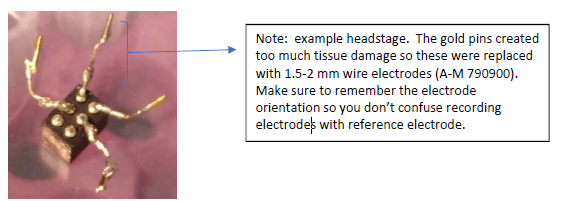
Installation:
Tools: 1 diaper (cut in half)
1 scalpel (fresh every time)
1 syringes for saline
Q-tips
Toolbox
Betadine ,70% EtOH
Superglue
30G needle
- Mouse is anesthetized by isoflurane following IACUA regulation
- Gently tape the mouse to the stage and remove hair on the head with a scissor
- Sterilize the skin with Betadine and 70% EToH
- Using the needle to poke 4 small holes at skull where your recording electrodes and reference electrodes will be **Do not to poke through the brain but only skull, 2 holes will be near prefrontal cortex, 2 holes will be posterior to lambda
- Slide one electrode into each hole. One at the time and then stabilize it with superglue.
- Close the scalp with super glue
- Inject 500 ul saline (I.P)and let mouse recover in a individual cage for 12h
EEG set-up
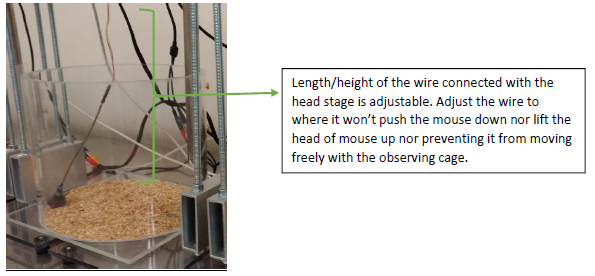
Tools: Piler
Observing cage
DAM-50 differential amplifier Computer with Sirenia software
- Double check the orientation of how the miniature socket is installed, then gently clamp the miniature socket with a piler and connect the recording socket and reference socket with the correct pin on thestage.
- Double check the wire (check the above figure) is not too low or too high.
- Record mouse EEG activity with Sirenia along with video recording of its behavior for 2 hrs
- Mouse will be sacrifice right after the experiment but keep the brain tissue for further Examination or post-hoc genotyping.
- Kuo, F and Mulkey, D(2021). Electrocorticography recording. Bio-protocol Preprint. bio-protocol.org/prep1204.
- Kuo, F., Cleary, C. M., LoTurco, J. J., Chen, X. and Mulkey, D. K.(2019). Disordered breathing in a mouse model of Dravet syndrome. eLife. DOI: 10.7554/eLife.43387
Category
Do you have any questions about this protocol?
Post your question to gather feedback from the community. We will also invite the authors of this article to respond.
 Post a Question


