


- Protocols

- Articles and Issues
- For Authors
- About
- Become a Reviewer


A Dual-gRNA CRISPR/Cas9 System for Efficient Generation of Large Fragment Deletions in Poplar

Published: Vol 16, Iss 13, Jul 5, 2026 DOI: 10.21769/BioProtoc.5734 Views: 297
Reviewed by: Deepti M NambiarKishwar Jahan ShethiAnonymous reviewer(s)
 PDF
PDF  Ask a question
Advertisement


Protocol Collections
Comprehensive collections of detailed, peer-reviewed protocols focusing on specific topics



Related protocols
Abstract
CRISPR/Cas9-based genome editing is a powerful approach for functional genomics and bioenergy research in woody plants. However, conventional single guide RNA (gRNA) strategies predominantly generate small insertions or deletions that may not fully disrupt gene function and often require extensive sequencing for mutation identification. Here, we present an optimized protocol for the efficient generation of large-fragment deletion mutants in Populus tremula × P. alba clone INRA 717-1B4 using a dual-gRNA CRISPR/Cas9 system. Co-expression of two gRNAs flanking the target region induces double-strand breaks at both sites, enabling the deletion of the intervening genomic fragment, typically larger than 50 bp. This protocol describes step-by-step procedures for gRNA design, vector construction, Agrobacterium-mediated transformation, plant regeneration, and molecular validation. Using the PtFBX230 gene as a representative target, large deletions are readily identified by conventional PCR and agarose gel electrophoresis, enabling rapid and cost-effective genotyping. This protocol can be readily adopted to other loci in poplar and related woody species and provides a robust framework for generating null alleles to support functional genomics and bioenergy-related trait engineering in woody plants.
Key features
• Enables efficient deletion of large genomic fragments (>50 bp) using a dual-gRNA CRISPR/Cas9 strategy.
• Optimized for the hybrid poplar (Populus tremula × P. alba clone INRA 717-1B4) using the pORE303N vector system.
• Compatible with Agrobacterium-mediated transformation and tissue culture–based regeneration.
• Simplifies mutant screening through PCR-based genotyping, minimizing reliance on sequencing.
• Facilitates simultaneous editing of homologous genes in bioenergy-relevant poplar lines.
Keywords: CRISPR/Cas9 Genome editing
Dual-gRNA strategy
PtFBX230
Populus tremula × P. alba INRA 717-1B4
Bioenergy crop
Genome editing
Dual-gRNA strategy
PtFBX230
Populus tremula × P. alba INRA 717-1B4
Bioenergy crop
Graphical overview
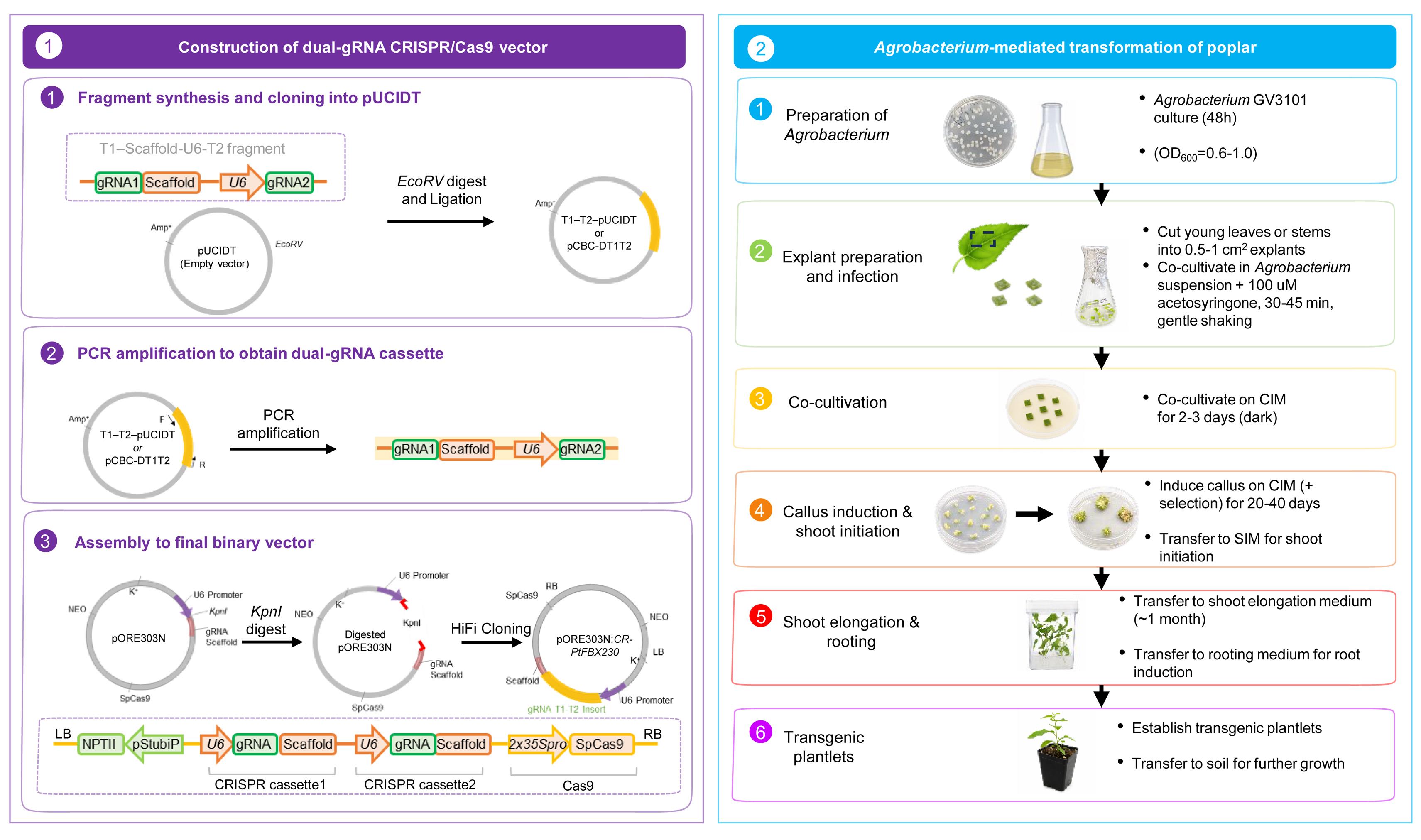
Dual-gRNA CRISPR/Cas9 vector construction and Agrobacterium-mediated transformation of hybrid poplar. CIM, callus-inducing medium; SIM, shoot-inducing medium.
Background
Trees in the genus Populus are among the most widely distributed woody plants in North America, Asia, and Europe and have become important model species for bioenergy research, particularly for studies of lignin biosynthesis, secondary cell wall formation, and biomass conversion [1,2]. Owing to their fast growth, ease of vegetative propagation, and extensive genomic resources, hybrid poplars such as Populus tremula × P. alba INRA 717-1B4 are widely used as feedstock models for engineering lignocellulosic biomass traits relevant to advanced biofuels and bioproducts [3–6].
The availability of high-quality genome assemblies and transcriptome datasets has greatly facilitated functional genomics in poplar [7–9]. However, stable genetic analysis in woody plants remains technically challenging because transformation and regeneration are time-consuming, and primary transgenic plants frequently exhibit chimeric editing events [10]. Therefore, efficient and reliable strategies for generating stable loss-of-function mutants are essential for both basic research and bioenergy-related trait engineering in poplar.
CRISPR/Cas9 technology has enabled targeted genome editing in multiple Populus species and genotypes [11–14]. Most reported poplar genome-editing studies rely on single guide RNA (gRNA) design, which predominantly generates small insertions or deletions (indels) [15]. Such small indels may not fully disrupt gene function and often require extensive Sanger or amplicon sequencing for reliable identification of the mutations. In addition, gRNA activity can be influenced by chromatin context, single-nucleotide polymorphisms (SNPs), and sequence features, making it difficult to predict editing efficiency prior to stable transformation [15,16].
Dual-gRNA CRISPR/Cas9 strategy provides an effective alternative by inducing two double-strand breaks flanking a target region, resulting in excision of the intervening genomic fragment [17,18]. This approach increases the likelihood of generating complete loss-of-function alleles and enables straightforward identification of edited lines by conventional PCR based on amplicon size shifts. In the context of woody plants, such PCR-detectable large-fragment deletions (larger than 50 bp) are particularly advantageous because they reduce the reliance on extensive sequencing and simplify screening of large numbers of regenerated lines.
The plant F-box proteins function as structural components of SCF (SKP1–Cullin–F-box) E3 ubiquitin ligase complex and are responsible for substrate recognition. They play central roles in phytohormone signaling, stress responses, and proteolytic regulation of secondary metabolism [19]. Many F-box genes belong to large gene families with partial functional redundancy. In this context, single-gRNA-induced small indels may not always yield definitive null alleles, necessitating additional strategies to ensure complete functional disruption. PtFBX230 (Potri.018G090800), a representative member of this gene family, is a homolog of the previously identified Arabidopsis F-box genes AtKFB01, AtKFB20, AtKFB39, and AtKFB50, which encode kelch domain–containing F-box proteins that mediate selective ubiquitination and degradation of the rate-limiting enzyme phenylalanine ammonia-lyase in the phenylpropanoid–lignin biosynthetic pathway, thus serving as proteolytic regulators of cell wall lignification [20,21]. As such, PtFBX230 was selected as a validation target in this protocol. This choice enables a demonstration of the utility and efficiency of dual gRNA-mediated large-fragment deletions for generating null alleles pertaining to secondary cell wall lignification in poplar.
Although the dual-gRNA approach has been applied in several other plant species [17,22], a standardized protocol optimized for Populus species is still lacking. Here, we describe a robust step-by-step protocol for generating large-fragment deletion mutants in P. tremula × P. alba INRA 717-1B4 using a dual-gRNA CRISPR/Cas9 system. The protocol integrates optimized gRNA design, efficient vector assembly, Agrobacterium-mediated transformation, tissue culture–based regeneration, and PCR-based molecular validation. This workflow provides a practical and scalable framework for generating stable large-deletion mutants to support functional genomics and bioenergy-related trait engineering in poplar and related woody species.
Materials and reagents
Biological materials
1. Populus tremula × P. alba clone INRA 717-1B4
Note: The hybrid poplar plant was originally from Institut National de la Recherche Agronomique (INRA), France; the in vitro plantlets are maintained in the laboratory.
2. Agrobacterium tumefaciens strain GV3101(GoldBio, catalog number: CC-207-5x50)
3. Escherichia coli DH5α competent cells (Thermo Scientific, catalog number: 18265017)
Sequences of gene editing targets
Target 1: positions 306–328 of PtFBX230 (+ strand): AATAAGAAGATGCCTCGAAG (PAM: AGG)
Target 2: positions 469–491 of PtFBX230 (+ strand): ATTGATCTAGGTCCCGTGCC (PAM: TGG)
Plasmids
1. T1–T2–pUCIDT: plasmid synthesized by Integrated DNA Technologies (IDT), containing the designed dual-gRNAs targeting PtFBX230, in which gRNA2 is driven by the Medicago truncatula U6 promoter (Figure S1A)
2. pCBC-DT1T2: plasmid containing a gRNA scaffold and the Arabidopsis thaliana U6 promoter that drives gRNA2 (Addgene, plasmid #50590 [23]) (Figure S1B)
3. pORE303N: Binary CRISPR/Cas9 vector compatible with poplar transformation (Addgene, plasmid #194438 [16,24]) (Figure S1C)
PCR primers for dual-gRNA insert amplification
PtFBX230_Sg_PORE_F: caagcgaaccagtaggcttGAATAAGAAGATGCCTCGAAGgttttagagctagaaatag
PtFBX230_Sg_PORE_R: ctatttctagctctaaaacGGCACGGGACCTAGATCAATCaagcctactggttcgcttg (T1-T2-pUCIDT as template).
PtFBX230_DT1_PORE_F: caagcgaaccagtaggcttGAATAAGAAGATGCCTCGAAGgttttagagctagaaatag
PtFBX230_DT2_PORE_R: ctatttctagctctaaaacGGCACGGGACCTAGATCAATCaatctcttagtcgactct (pCBC-DT1T2 as template).
Colony PCR primers
mtu6end_PORE_F: CTTCAAGCGAACCAGTAGGCTT
2×35Shyb_PORE_R: CTCCACCATGTTCACATCAATC
Construct sequencing primer
pStubiP_F: AGATCAAGATATATGCCCTTTTCCT
CRISPR genotyping primers
(300–600 bp upstream of gRNA1 and downstream of gRNA2)
PtFBX230CR-iden-F: GGTTGTCATTGATTATTGGCTATT
PtFBX230CR-iden-R: TCCCTTGGAGTCAAACGTGAA
Cas9 genotyping primer
SpCas9_F: ACTGCTGGGCATCACAATCA
SpCas9_R: TTATCGAGGTTAGCGTCGGC
Reagents
1. NEBuilder HiFi DNA Assembly Master Mix (New England Biolabs, catalog number: E2621L) (store at -20 °C)
2. KpnI-HF (New England Biolabs, catalog number: R3142) (store at -20 °C)
3. Luria-Bertani (LB) medium (Sigma, catalog number: L3522)
4. Murashige and Skoog (MS) basal medium (Sigma, catalog number: M5519) (store at 4 °C)
5. Sucrose (Sigma, catalog number: S5016)
6. L-glutamine (Sigma, catalog number: 68540)
7. 2-(N-Morpholino)ethanesulfonic acid (MES) (Sigma, catalog number: 69892)
8. Myo-inositol (Sigma, catalog number: I3011)
9. D-(+)-Galactose (Sigma, catalog number: G5388)
10. Agar/Phytol Gel (Sigma, catalog number: A1296)
11. Plant growth regulators:
a. 2-isopentenyladenine (2-IP) (Sigma, catalog number: D7660) (store at -20 °C)
b. 1-naphthaleneacetic acid (NAA) (Sigma, catalog number: 317918) (store at -20 °C)
c. 6-benzylaminopurine (BAP) (Sigma, catalog number: B3274) (store at -20 °C)
d. Indole-3-butyric acid (IBA) (Sigma, catalog number: 57310) (store at -20 °C)
e. Thidiazuron (TDZ) (Sigma, catalog number: P6186) (store at -20 °C)
12. Antibiotics for plant selection:
a. Kanamycin (GoldBio, catalog number: K-120-25, 50–100 mg/L) (store at -20 °C)
b. Cefotaxime (GoldBio, catalog number: C-104-25, 300–400 mg/L) (store at -20 °C)
c. Timentin (GoldBio, catalog number: T-104-25, 200–300 mg/L) (store at -20 °C)
13. Antibiotics for bacterial and Agrobacterium selection:
a. Gentamicin (GoldBio, catalog number: G-400-1) (store at -20 °C)
b. Ampicillin (GoldBio, catalog number: A-301-5) (store at -20 °C)
c. Spectinomycin (GoldBio, catalog number: S-140-5) (store at -20 °C)
d. Chloramphenicol (GoldBio, catalog number: C-105-5) (store at -20 °C)
e. Rifampicin (GoldBio, catalog number: R-120-1) (store at -20 °C)
Additional reagents
1. Acetosyringone (Sigma, catalog number: AMBH303C5EEB)
2. Cetyltrimethylammonium bromide (CTAB) (Sigma, catalog number: H9151)
3. Phusion High-fidelity DNA polymerase (Thermo Scientific, catalog number: F530) (store at -20 °C)
4. Agarose (Sigma, catalog number: A9539-500G)
5. DNA ladders (Thermo Scientific, catalog number: 10488085)
6. DNA gel staining dye (APExBIO, catalog number: A8743)
7. Ascorbic acid (MG Scientific, catalog number: MAL4407)
Kits
1. Zymoclean Gel DNA Recovery kit (Zymo Research, catalog number: D4002)
2. GeneJET Plasmid Miniprep kit (Thermo Scientific, catalog number: K0502)
Solutions
1. Agrobacterium induction medium (see Recipes)
2. Wash solution (see Recipes)
3. Callus induction medium (see Recipes)
4. Shoot induction medium (see Recipes)
5. Rooting medium (see Recipes)
Recipes
1. Agrobacterium induction medium
MS basal salts: 2.15 g/L
MES: 0.25 g/L
L-glutamine: 0.2 g/L
Myo-inositol: 0.05g/L
D-galactose: 1.8g/L
Ascorbic acid (VC): 250 mg/L
Adjust pH to 5.0 with sodium hydroxide (NaOH) before autoclaving at 121 °C for 20 min.
2. Wash solution
MS basal salts: 2.15 g/L
Thiamine: 40 mg/L
Ascorbic acid (VC): 250 mg/L
NAA: 10 μM
2-IP: 5 μM
BAP: 12.5 μg/L
Adjust pH to 5.8 with NaOH before autoclaving (121 °C, 20 min).
Antibiotics are filter-sterilized and added after the medium cools to ~60 °C, followed by thorough mixing.
3. Callus induction medium
MS basal salts: 4.3 g/L
Sucrose: 30 g/L
L-glutamine: 0.2 g/L
MES: 0.25 g/L
Myo-inositol: 0.1 g/L
NAA: 10 μM
2-IP: 5 μM
Kanamycin: 100–150 mg/L
Timentin: 100 mg/L
Cefotaxime: 300–350 mg/L
Agar 6 g/L
Adjust pH to 5.8 with NaOH before autoclaving (121 °C, 20 min).
4. Shoot induction medium
MS basal salts: 4.3 g/L
Sucrose: 25 g/L
L-glutamine: 0.2 g/L
MES: 0.25 g/L
Myo-inositol: 0.1 g/L
TDZ: 0.2 μM
Kanamycin: 100–150 mg/L
Timentin: 100 mg/L
Cefotaxime: 300 mg/L
Agar: 7 g/L
Adjust pH to 5.8–6.0 with NaOH (121 °C, 20 min).
5. Rooting medium
MS basal salts: 2.15 g/L
Sucrose: 15 g/L
IBA: 0.5 μM
Kanamycin: 50–100 mg/L
Timentin: 100 mg/L
Agar: 7.5 g/L
Adjust pH to 5.8–6.0 with NaOH (121 °C, 20 min).
Equipment
1. Laminar flow hood (Baker, model: SterilGARD e3)
2. Plant growth chamber (Percival Scientific, model: CU-36L5) with programmable light (16 h light/8 h dark) and temperature (22–25 °C)
3. Orbital shaker incubator (New Brunswick Scientific, model: Innova 44)
4. Benchtop centrifuge (Eppendorf, model: 5810 R)
5. Spectrophotometer (Thermo Fisher Scientific, model: NanoDrop One)
6. Analytical balance (Mettler Toledo, model: ME204T)
7. pH meter (Fisher Scientific, model: Accumet AB 15)
8. Autoclave (Buxton, model: 9400)
9. Gel Documentation System (analytik-jena, MultiDoc-It)
10. Thermal Cycler (for PCR verification) (Bio-Rad, model: C1000)
Surgical tools and tissue culture vessels
1. Forceps (Fine Science Tools, catalog number: 11000-12)
2. Scalpel handles and blades (Feather, size #11)
3. Magenta boxes (Sigma-Aldrich, catalog number: V8505)
4. Petri dishes (100 mm × 15 mm and 100 mm × 25 mm) (Sigma, catalog numbers: P5731 and Z358762)
5. Filter paper (Whatman, catalog number: 1001-090) and conical flasks (150 mL)
Software and datasets
1. CRISPR-P v2.0 (http://crispr.hzau.edu.cn/CRISPR2)
2. CHOPCHOP (https://chopchop.cbu.uib.no/)
3. Cas-OFFinder (http://www.rgenome.net/cas-offinder/)
4. Phytozome (https://phytozome-next.jgi.doe.gov/)
5. Primer3 (https://primer3.ut.ee/)
Procedure
The workflow for assembling a dual-sgRNA CRISPR/Cas9 expression vector is delineated in Figure 1. As an example, PtFBX230 is selected as the target gene for editing.
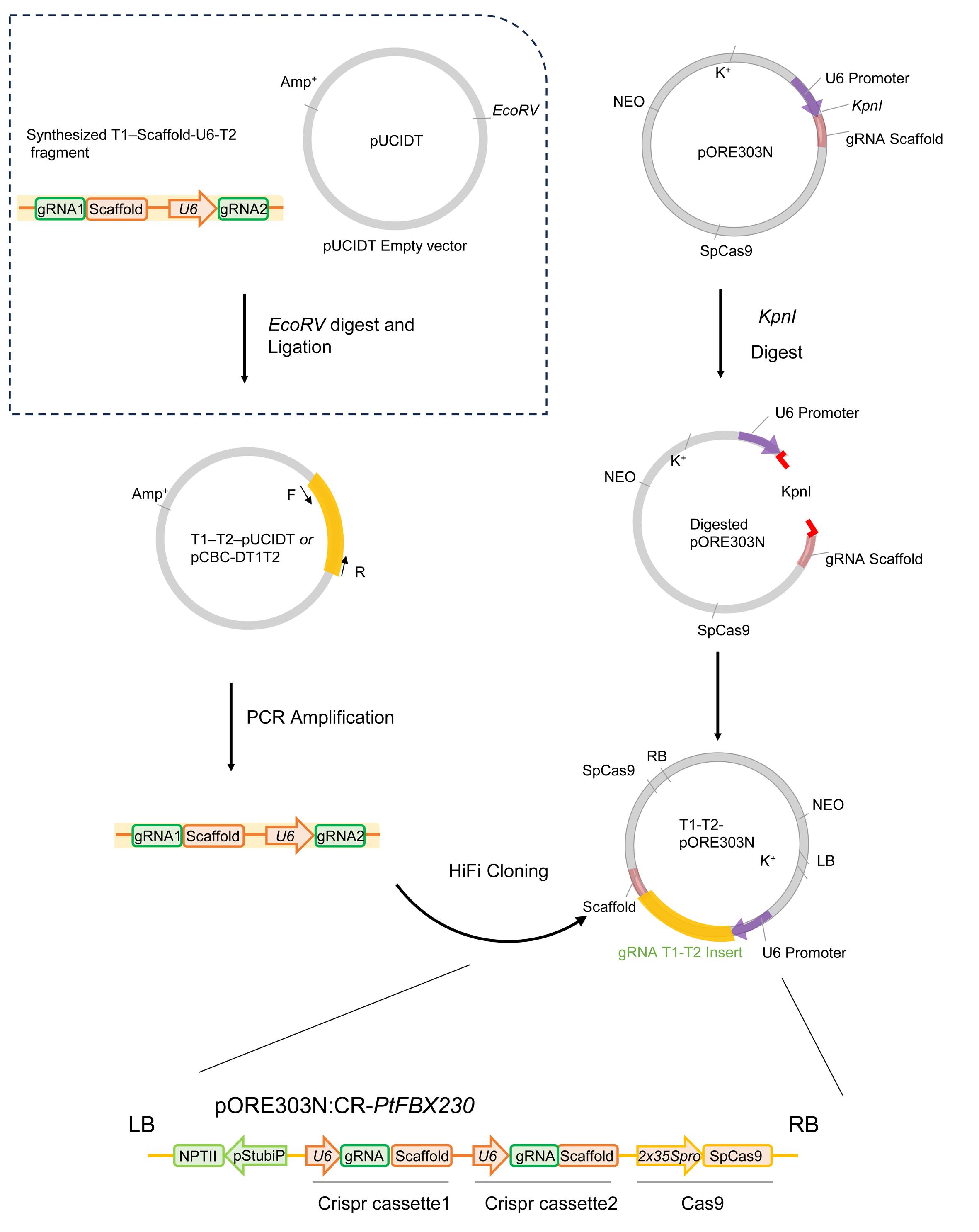
Figure 1. Workflow for assembling a dual-sgRNA cassette into a destination vector. The T1–Scaffold–U6–T2 fragment is synthesized and cloned into the pUCIDT vector via EcoRV digestion and ligation to generate T1–T2–pUCIDT. Alternatively, a plasmid containing similar fragments (pCBC-DT1T2) can be obtained directly from Addgene. The two sgRNA target sequences (T1 and T2) are then amplified from the shuttle plasmid (T1–T2–pUCIDT or pCBC-DT1T2) by PCR using gene-specific primers (PtGene_Sg_PORE_F/PtGene_Sg_PORE_R or PtGene_DT1_PORE_F/PtGene_DT2_PORE_R) to obtain a dual-gRNA insert fragment. In parallel, the destination vector pORE303N is linearized by KpnI digestion. The PCR-generated insert and the linearized vector are assembled using NEBuilder HiFi DNA Assembly at a vector-to-insert molar ratio of 1:2, yielding the final CRISPR/Cas9 construct for plant transformation. The orange bar indicates PCR amplification of a dual-sgRNA fragment targeting adjacent genomic sites within the same gene, using T1–T2–pUCIDT or pCBC-DT1T2 as template. The expected amplicon size is approximately 601 bp, corresponding to the assembled dual-sgRNA cassette. pORE303N:CR-PtFBX230 denotes the T-DNA region of the resulting Cas9/sgRNA binary construct following NEBuilder HiFi-mediated insertion of the PCR fragment into pORE303N, generating a vector harboring two sgRNA expression cassettes. The first sgRNA is driven by the Medicago truncatula U6 (MtU6) promoter. The second sgRNA is driven either by the MtU6 promoter when the PCR fragment is derived from T1–T2–pUCIDT, or by the Arabidopsis thaliana U6 (AtU6) promoter when pCBC-DT1T2 is used as the template. Steps indicated by dashed lines are optional and can be bypassed if the plasmid (e.g., pCBC-DT1T2) is available.
A. Design of dual gRNAs targeting PtFBX230
1. Retrieve gene information. Genomic DNA sequence and CDS of the candidate gene (PtFBX230) are retrieved from P. tremula × P. alba INRA 717-1B4 genome assembly (Phytozome; P. tremula × P. alba v5.1) and used to infer exon–intron structure.
2. Select target regions. Identify functionally important coding regions and prioritize early exons that are shared by all annotated transcript isoforms to maximize the likelihood of generating loss-of-function alleles. For PtFBX230, the second exon was selected because the first exon is short and separated from the second exon by a large intron (Figure 2).
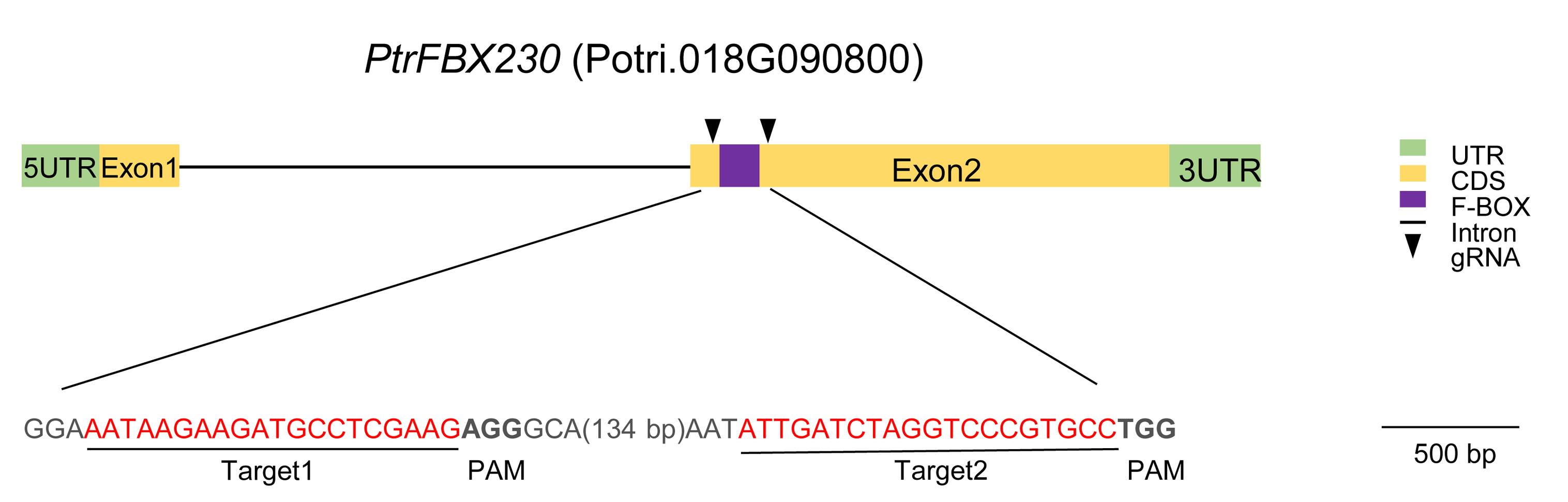
Figure 2. Schematic illustration of dual sgRNA target sites within the coding sequence of PtFBX230 (Potri.018G090800). Coding exons are shown as yellow boxes, the intron as a connecting line, and untranslated regions (UTRs) as green boxes. The F-box domain within the coding region is indicated as a purple box. The two sgRNA target sites are marked by inverted triangles. PAM indicates protospacer adjacent motif. Scale bar = 500 bp.
3. Design candidate gRNAs. Design candidate CRISPR/Cas9 target sites (19–20 bp) using online sgRNA design tools such as CRISPR-P or CHOPCHOP (see General note 1), specifying Streptococcus pyogenes Cas9 (SpCas9) with a 5′-NGG-3′ protospacer adjacent motif (PAM). Select gRNA sequences (20 bp, excluding the PAM) that meet the following criteria:
a. GC content between 40% and 60%.
b. Predicted melting temperature (Tm) between 60 and 75 °C.
c. A single predicted on-target site in the poplar genome to minimize off-target effects.
Record the strand orientation of each gRNA. For gRNAs located on the negative strand, use the reverse-complement sequence when designing cloning primers.
4. Select gRNA pairs for large-fragment deletion. For large-fragment deletion, select two gRNAs flanking the target region such that the expected deletion size exceeds 50 bp and can be readily detected by PCR. In general, gRNA pairs separated by approximately 0.1–1 kb are recommended to facilitate reliable amplification and visualization of size-shifted PCR products (see General note 2). For PtFBX230, two gRNAs located on the positive strand were selected:
a. gRNA1: Positions 306–328, sequence AATAAGAAGATGCCTCGAAG (PAM: AGG) (Figure 2).
b. gRNA2: Positions 469–491, sequence ATTGATCTAGGTCCCGTGCC (PAM: TGG) (Figure 2).
5. Evaluate off-target potential. Evaluate potential off-target sites for each selected gRNA using Cas-OFFinder or by BLAST analysis against the INRA 717-1B4 genome assembly or a closely related poplar reference genome, depending on the cultivar used. Exclude gRNAs with predicted high-scoring off-target sites located in coding regions.
6. Generate shuttle vector harboring dual-gRNA insert. The dual gRNA insert (for PtFBX230) (Figure 2) was synthesized via IDT service, which contains designed gRNA1 and gRNA2 and a MtU6 promoter (to drive gRNA2), then ligated into vector pUC to obtain T1–T2–pUCIDT (Figure S1A). For genes of interest other than PtFBX230, the step of synthesis and construction of T1–T2–pUCIDT can be skipped. Instead, a pair of PCR primers should be prepared by replacing PtFBX230 gRNA sequences in the primers PtFBX230_Sg_PORE_F and PtFBX230_Sg_PORE_R, or PtFBX230_DT1_PORE_F and PtFBX230_DT2_PORE_R with the gene of interest’s specific gRNA sequences. Then, go to step B3 to amplify T1–T2–pUCIDT or pCBC-DT1T2 to obtain the dual-gRNA insert for the gene of interest.
B. Assembly of dual-gRNA CRISPR/Cas9 construct
1. Linearize the vector. Digest the pORE303N CRISPR/Cas9 binary vector that contains the MtU6-driven gRNA cassette and the 2×35S:SpCas9 expression module [16,24] with KpnI-HF. A 50 μL digestion reaction contains 1 μg of plasmid DNA, 5 μL of 10× rCutSmart Buffer, 1 μL of KpnI-HF, and nuclease-free water to volume. Incubate the reaction at 37 °C for 1–1.5 h.
2. Purify the linearized vector. Separate the digestion products by agarose gel electrophoresis and purify the linearized pORE303N backbone using the Zymoclean Gel DNA Recovery kit, following the manufacturer’s protocol.
3. Amplify dual-gRNA insert by PCR. Amplify the dual-gRNA insert fragment from T1–T2–pUCIDT (or pCBC-DT1T2), using primers PtFBX230_Sg_PORE_F and PtFBX230_Sg_PORE_R (or PtFBX230_DT1_PORE_F / PtFBX230_DT2_PORE_R).
4. Conduct a PCR reaction with cycling conditions as in Table 1.
Table 1. PCR reaction mixture (25 μL total volume)
| Component | Volume |
|---|---|
| 5× Phusion HF buffer | 5.0 μL |
| dNTPs (10 mM each) | 0.5 μL |
| Forward primer (10 μM) | 1.25 μL |
| Reverse primer (10 μM) | 1.25 μL |
| Template DNA (plasmid, 10–50 ng) | 0.5 μL |
| Phusion High-Fidelity DNA Polymerase (2 U/μL) | 0.25 μL |
| Nuclease-free water | To 25 μL |
PCR cycling conditions
1) 98 °C, 30 s
2) 32 cycles:
98 °C, 10 s
55–60 °C, 15–20 s
72 °C, 60 s
3) 72 °C, 5 min
4) Hold at 4 °C
5. Purify and quantify the PCR product. Purify the PCR-amplified dual-gRNA insert using the Zymoclean Gel DNA Recovery kit and determine DNA concentration. Typical concentrations are approximately 100 ng/μL.
6. Assemble binary vector. Assemble the amplified dual-gRNA insert into the KpnI-linearized pORE303N using NEBuilder HiFi DNA Assembly Master Mix (see General note 3).
a. Prepare the reaction on ice in a sterile microcentrifuge tube following Table 2.
Table 2. NEBuilder HiFi DNA assembly reaction
| Component | Volume |
|---|---|
| KpnI-linearized pORE303N backbone | 2–5 μL |
| Dual-gRNA insert | 1–2 μL |
| NEBuilder HiFi DNA Assembly Master Mix (2×) | 5 μL |
| Nuclease-free water | To 10 μL total |
i. Use a total DNA amount of 0.03–0.2 pmol.
ii. Maintain a vector-to-insert molar ratio of 1:2.
b. Incubate the assembly reaction. Gently mix the assembly reaction by pipetting and briefly spin down. Incubate the reaction in a thermocycler at 50 °C for 15–30 min when assembling two fragments. For difficult templates or when transformation efficiency is low, extend the incubation to 50 min.
7. Transform into E. coli. Transform the assembled plasmid into chemically competent E. coli DH5α cells following standard procedures. Place cells on LB agar containing 100–200 mg/L kanamycin for selection of pORE303N transformants and incubate overnight at 37 °C.
8. Screen and verify transformants. Screen kanamycin-resistant colonies by colony PCR using the reaction conditions described in Table 1 and primers mtu6end_PORE_F and 2×35Shyb_PORE_R, which flank the dual-gRNA cassette. The expected PCR product size is approximately 1,023 bp. Confirm correct insertion and sequence integrity of both gRNA target sites by Sanger sequencing using vector- or insert-specific primers (e.g., pStubiP_F) (Figure 3; Figure S2).
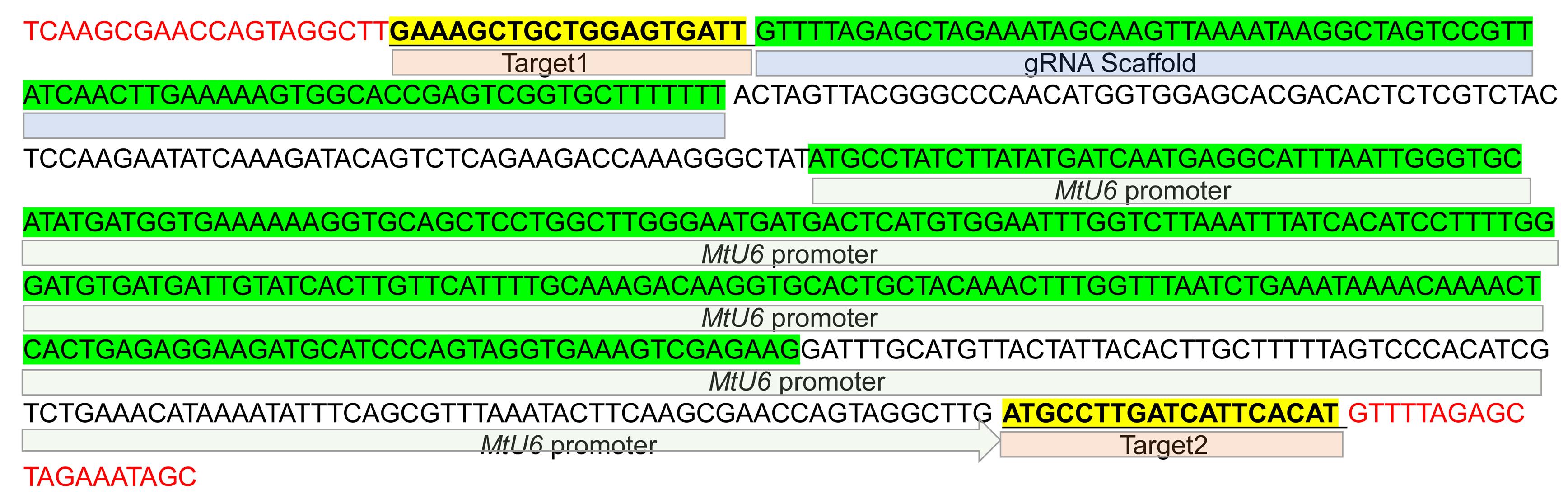
Figure 3. Sequence confirmation of the PCR fragment amplified from T1–T2–pUCIDT. The fragment contains the Target1 sequence, gRNA scaffold, MtU6 promoter, and Target2 sequence, arranged for assembly of a dual-sgRNA cassette. Target1 and Target2 represent user-defined guide RNA target sequences that can be replaced with gene-specific targets of interest. Sequences highlighted in red denote the flanking homologous regions used for HiFi cloning. This sequence corresponds to the PCR product shown in Figure 1.
C. Introduction of CRISPR/Cas9 construct into Agrobacterium
Note: Introduce the verified dual-gRNA CRISPR/Cas9 plasmid into Agrobacterium tumefaciens strain GV3101 by electroporation or chemical transformation, following a standard laboratory protocol.
1. Electroporation (recommended): Mix 1–2 μL (50–200 ng) of plasmid DNA with 50 μL of electrocompetent GV3101 cells, transfer to a pre-chilled 0.1 cm electroporation cuvette, and apply a pulse at 2.2 kV, 25 μF, and 200 Ω.
2. Chemical transformation (optional): Transform competent GV3101 cells using a freeze–thaw or CaCl2-based method according to established protocols.
3. Immediately add 1 mL of SOC or LB medium to the cuvette or transformation tube and incubate the cells at 28 °C with shaking (200 rpm) for 2–3 h to allow recovery and expression of antibiotic resistance genes.
4. Plate 100–200 μL of the recovered culture onto LB agar plates supplemented with rifampicin (50 mg/L), gentamicin (25 mg/L) (for GV3101 background), and kanamycin (50 mg/L) for pORE303N selection.
5. Incubate plates at 28 °C for 2–3 days until single colonies appear.
6. Confirm the presence of the CRISPR/Cas9 construct in selected colonies by colony PCR using vector-specific primers (mtu6end_PORE_F, 2×35Shyb_PORE_R) before proceeding to plant transformation.
D. Agrobacterium-mediated transformation of poplar
Note: Agrobacterium-mediated transformation of poplar is based on the protocol reported by Meilan and Ma [25], with modifications to optimize regeneration and selection efficiency, as illustrated in Figure 4.
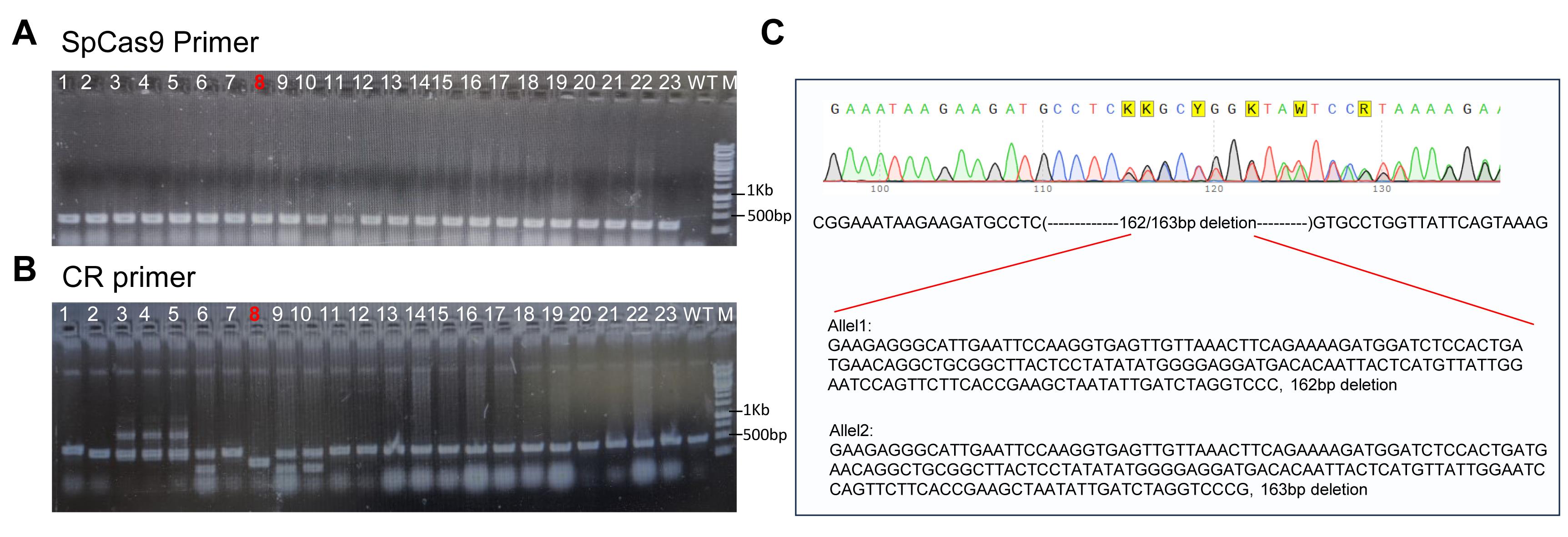
Figure 4. Genotyping of PtFBX230-sg-pORE transgenic lines generated using T1–T2–pUCIDT. (A) PCR amplification of the SpCas9 transgene using Cas9-specific primers. WT, wild-type control; M, DNA size marker. The red-labeled lane indicates the representative line (line 8) selected for subsequent analyses. (B) PCR amplification of a DNA fragment spanning the two sgRNA target sites using CR primers (PtFBX230CR-iden-F and PtFBX230CR-iden-R) in independent transgenic lines and the wild-type (WT) control. Lines 3, 4, 5, 6, 9, and 10 show both wild-type and size-altered PCR products, indicating chimeric editing events, whereas line 8 displays a single shorter amplicon, consistent with a homozygous or biallelic deletion. (C) Sanger sequencing analysis of the PCR amplicon from line 8, confirming a deletion within the target region. The deleted nucleotide sequences corresponding to the Populus alba and Populus tremula alleles are shown in the lower panel. The letters K, Y, and W in the sequencing chromatograms denote degenerate bases derived from P. tremula and P. alba.
1. Grow INRA 717-1B4 plantlets in vitro on 1/2 MS medium at 22–25 °C under a 16 h light/8 h dark photoperiod for 14 days to one month.
2. Streak glycerol stocks of Agrobacterium GV3101 onto LB medium with 50 mg/L rifampicin and 50 mg/L kanamycin for 48 h; skip this step if using fresh transformants. Grow single colonies overnight in 5 mL of liquid LB medium, then use 1 mL of this starter to inoculate a 50 mL culture. Incubate these secondary cultures in a shaker (200 rpm) at 28 °C until reaching an OD600 of 0.6–0.8. Harvest the cells by centrifugation at 3,200× g for 10 min and wash twice with 20 mL of sterile water.
3. Excise young, fully expanded leaves or young stems and cut into approximately 0.5–1 cm2 explants.
4. Resuspend Agrobacterium cells in 50 mL of Agrobacterium induction medium containing 100 μM acetosyringone. Submerge freshly cut explants in the Agrobacterium suspension (OD600 ~0.6) and incubate for 30–45 min at room temperature with gentle agitation on an orbital shaker.
5. Gently blot the explants dry on sterile filter paper in a clean Petri dish, then place them abaxial side down on the co-cultivation medium.
6. Co-cultivate explants in the dark at 22 °C for 2 days in a plant growth chamber (e.g., Percival, 22–25 °C).
E. Selection and regeneration of transgenic shoots
1. Post-infection washing and callus induction: Following Agrobacterium infection and co-cultivation, wash explants five times with sterile deionized water, followed by one wash with wash solution, to remove residual bacteria. Transfer healthy explants onto callus-inducing medium (CIM) consisting of MS basal medium supplemented with NAA (10 μM) and appropriate antibiotics for selection and bacterial suppression. Note that the medium is supplemented with kanamycin (100–150 mg/L) for plant selection and timentin (100 mg/L) and cefotaxime (300 mg/L) to eliminate Agrobacterium. Explants are placed with the wounded surface in contact with the medium.
2. Callus induction under dark conditions: Incubate cultures at 22–25 °C in the dark for 3–4 weeks. During this period, actively proliferating calli emerge from the wound sites of antibiotic-resistant explants, whereas non-transformed tissues exhibit bleaching or growth arrest under antibiotic selection.
3. Shoot induction and maintenance of selection: Transfer explants bearing healthy calli onto shoot-inducing medium (SIM) composed of MS basal medium supplemented with TDZ (0.2 μM). Maintain the cultures in 100 mm × 25 mm Petri dishes under continuous selection with kanamycin (100 mg/L) and timentin (200 mg/L) (tissue culture conditions: 23–25 °C, 16 h light/8 h dark photoperiod, 150 μmol·m-2·s-1). Sub-culture explants every 2–3 weeks to fresh medium to promote shoot initiation and prevent tissue browning. Multiple shoots are typically developed within 2–4 months.
4. Shoot elongation (see General note 4): Transfer explants with multiple emerging shoots onto shoot elongation medium consisting of MS basal medium supplemented with BAP (0.1 μM), kanamycin (100 mg/L), and timentin (200 mg/L). This step promotes elongation of regenerated shoots while maintaining selection pressure to eliminate escapes.
5. Root induction under reduced selection pressure: Excise individual shoots when they reach approximately 1–2 cm in length and transfer them to 1/2-strength MS rooting medium supplemented with IBA (0.5 μM). To confirm kanamycin resistance while allowing root formation, the medium is also supplemented with kanamycin (25 mg/L) and timentin (100 mg/L) (see General note 5). Maintain the cultures under standard tissue culture conditions and monitor for root development. Successfully transformed shoots typically form robust roots penetrating into the medium.
6. Establishment and propagation of transgenic plantlets: After approximately 30–45 days of root development and elongation, micropropagate the well-developed plantlets on the same rooting medium to generate sufficient replicates (Figure 4). Excise the stem of plantlets and cut it into 3–4 segments, each containing approximately three nodes, and vertically insert them into half-strength MS rooting medium for further growth. Established plantlets subsequently proceed for genotyping and molecular characterization (Figure 4).
F. PCR-based screening of large deletions
1. Extract genomic DNA from young leaves of candidate transgenic and wild-type plants (approximately 50–100 mg of fresh tissue) using the CTAB method [26]. Design PCR primers flanking the two gRNA target sites such that the wild-type amplicon exceeds 600 bp, while the deletion allele yields a markedly smaller fragment. Primers are designed using Primer3 to amplify regions located approximately 300 bp upstream of gRNA1 and downstream of gRNA2, with primer melting temperatures of 58–62 °C and minimal predicted secondary structures. For PtFBX230 genotyping, primers PtFBX230CR-iden_F and PtFBX230CR-iden_R were used.
2. Perform PCR using a high-fidelity DNA polymerase under the following cycling conditions: initial denaturation at 95 °C for 3 min; 32 cycles of 95 °C for 30 s, 58–60 °C for 30 s, and 72 °C for 1–3 min (depending on expected amplicon size); followed by a final extension at 72 °C for 5 min. PCR reactions are performed in a 25 μL volume using the reaction system described in Table 1, consisting of 12.5 μL of 2× Phusion Master Mix, 1 μL each of forward and reverse primers (10 μM), 100–250 ng (1–2.5 μL) of genomic DNA, and nuclease-free water to a final volume of 25 μL.
3. Separate PCR products on a 1.0%–1.5% agarose gel and visualize bands using a gel documentation system.
4. Identify putative deletion mutants based on the size of PCR products. The wild-type alleles produce a large amplicon, while the deletion alleles yield a shorter fragment corresponding to the expected deletion size. Heterozygous lines display both DNA amplification bands.
5. Purify PCR products corresponding to the deletion alleles using the Zymoclean Gel DNA Recovery kit and confirm deletion junctions by Sanger sequencing.
Validation of protocol
Protocol validation was conducted by targeting the PtFBX230 gene in Populus tremula × P. alba INRA 717-1B4. Two gRNAs were designed to flank the second exon of PtFBX230 (Figure 2), which can result in deletions consistently larger than 50 bp in the regenerated transgenic lines.
Following Agrobacterium-mediated transformation and plant regeneration, genomic DNA was extracted from 23 independent T1 lines. The presence of Cas9 transgene in the regenerated lines was first confirmed through PCR using Cas9-specific primers (Figure 4A). Then, PCR amplification with primers flanking the two PtFBX230 sgRNA target sites produced clearly shorter PCR products in the obtained transgenic lines, compared to the large amplicon in the wild-type alleles, indicating a large DNA fragment deletion in the transgenic lines (Figure 4B). Additionally, both the wild-type large band and the short deletion band were detected in several transgenic lines (6/23 for T1–T2–pUCIDT strategy and 16/23 for pCBC-DT1T2 strategy), indicating their chimeric editing events (see General note 6). In contrast, line 8 displayed only the shorter PCR products, suggesting a homozygous or biallelic deletion event.
Sanger sequencing of the shorter PCR product from line 8 revealed a 162/163-bp deletion spanning the region between the two Cas9 cleavage sites (Figure 4C). Across independent transformation experiments, the frequency of detectable large-fragment deletions (>50 bp) is approximately 39% of PCR-positive transgenic lines under the conditions tested. Both T1–T2–pUCIDT and pCBC-DT1T2 strategies are effective in generating detectable large-fragment deletions (Figure S3).
To assess potential off-target effects, a set of primers was designed to amplify predicted off-target loci. Sanger sequencing of six edited lines revealed no detectable off-target mutations at the examined sites. Vegetative propagation of selected mutant lines confirmed the stability of the PtFBX230 deletion, demonstrating that the described dual-sgRNA strategy efficiently and reliably generates large-fragment deletions in poplar.
General notes and troubleshooting
General notes
1. CHOPCHOP is limited to the P. trichocarpa v3.1 reference. Perform a sequence alignment between the reference and the 717 clone to verify SNP variations before finalizing targets.
2. Dual-gRNA spacing is critical: distances below 100 bp may result in preferential small indels, whereas distances above 1 kb may reduce deletion efficiency.
3. NEBuilder HiFi DNA assembly is strongly recommended for this step, as Gibson assembly does not efficiently eliminate residual KpnI, which may reduce editing efficiency.
4. This step may be omitted if regenerated shoots exhibit sufficient elongation on shoot induction medium.
5. Kanamycin sensitivity may vary between poplar lines; preliminary tests are recommended to determine optimal selection concentrations.
6. Chimerism is common in T1 poplar lines due to regeneration from multicellular explants; a second round of regeneration or vegetative propagation can help isolate uniform mutants.
Troubleshooting
| Problem | Possible reason | Solution |
|---|---|---|
| No deletion band detected | Low sgRNA activity or sequence variation at the target site | Sequence the target region of the plants to verify target integrity and redesign sgRNAs if necessary |
| Smear or weak PCR bands | Poor DNA quality | Use young leaves and ensure complete DNA purification |
| High frequency of chimeric lines | Regeneration from multicellular tissue | Perform additional regeneration cycles |
| Poor shoot regeneration | Excessive antibiotic concentration | Reduce kanamycin or bacteriostatic antibiotic levels |
Supplementary information
The following supporting information can be downloaded here:
1. Figure S1. Detailed maps of the vectors used in this protocol
2. Figure S2. Sequence confirmation of the PCR fragment amplified from pCBC-DT1T2
3. Figure S3. Genotyping of PtFBX230-sg-pORE transgenic lines generated using pCBC-DT1T2
Acknowledgments
We thank Prof. Chung-Jui Tsai (University of Georgia) for providing the pORE303N vector. This work was supported by the Center for Bioenergy Innovation, U.S. Department of Energy, Office of Science, Biological and Environmental Research, under Award Number ERKP886. Gene design and vector synthesis was supported by the U.S. Department of Energy, Office of Science, Office of Basic Energy Sciences under contract number DE-SC0012704, specifically through the Physical Biosciences program of the Chemical Sciences, Geosciences and Biosciences Division (to C.-J.L.).
Competing interests
The authors declare no competing interests.
Data availability: T1–T2–pUCIDT plasmid is available upon request.
References
- Douglas, C. J. (2017). Populus as a model tree. In Douglas, C. J. (Ed.). Comparative and evolutionary genomics of angiosperm trees. Springer International Publishing, Cham. pp. 61–84.
- Bryant, N. D., Pu, Y., Tschaplinski, T. J., Tuskan, G. A., Muchero, W., Kalluri, U. C., Yoo, C. G. and Ragauskas, A. J. (2020). Transgenic Poplar Designed for Biofuels. Trends Plant Sci. 25(9): 881–896. https://doi.org/10.1016/j.tplants.2020.03.008
- Sannigrahi, P., Ragauskas, A. J. and Tuskan, G. A. (2010). Poplar as a feedstock for biofuels: A review of compositional characteristics. Biofuels, Bioprod Biorefin. 4(2): 209–226. https://doi.org/10.1002/bbb.206
- Cai, Y., Zhang, K., Kim, H., Hou, G., Zhang, X., Yang, H., Feng, H., Miller, L., Ralph, J., Liu, C. J., et al. (2016). Enhancing digestibility and ethanol yield of Populus wood via expression of an engineered monolignol 4-O-methyltransferase. Nat Commun. 7(1): 11989. https://doi.org/10.1038/ncomms11989
- Zhao, Y., Yu, X., Lam, P. Y., Zhang, K., Tobimatsu, Y. and Liu, C. J. (2021). Monolignol acyltransferase for lignin p-hydroxybenzoylation in Populus. Nat Plants. 7(9): 1288–1300. https://doi.org/10.1038/s41477-021-00975-1
- Dwivedi, N., Ji, P., Tian, Y., Kaur, D., Vulavala, V. K. R., Tobimatsu, Y., Eudes, A. and Liu, C. (2025). Engineering 2‐Pyrone‐4,6‐Dicarboxylic Acid Production Reveals Metabolic Plasticity of Poplar. Plant Biotechnol J. 24(3): 1398–1413. https://doi.org/10.1111/pbi.70414
- Tuskan, G. A., DiFazio, S., Jansson, S., Bohlmann, J., Grigoriev, I., Hellsten, U., Putnam, N., Ralph, S., Rombauts, S., Salamov, A., et al. (2006). The Genome of Black Cottonwood, Populus trichocarpa (Torr. & Gray). Science. 313(5793): 1596–1604. https://doi.org/10.1126/science.1128691
- Zhou, R., Jenkins, J. W., Zeng, Y., Shu, S., Jang, H., Harding, S. A., Williams, M., Plott, C., Barry, K. W., Koriabine, M., et al. (2023). Haplotype‐resolved genome assembly of Populus tremula × P. alba reveals aspen‐specific megabase satellite DNA. Plant J. 116(4): 1003–1017. https://doi.org/10.1111/tpj.16454
- Shi, T., Zhang, X., Hou, Y., Jia, C., Dan, X., Zhang, Y., Jiang, Y., Lai, Q., Feng, J., Feng, J., et al. (2024). The super-pangenome of Populus unveils genomic facets for its adaptation and diversification in widespread forest trees. Mol Plant. 17(5): 725–746. https://doi.org/10.1016/j.molp.2024.03.009
- Ding, L., Chen, Y., Ma, Y., Wang, H. and Wei, J. (2020). Effective reduction in chimeric mutants of poplar trees produced by CRISPR/Cas9 through a second round of shoot regeneration. Plant Biotechnol Rep. 14(5): 549–558. https://doi.org/10.1007/s11816-020-00629-2
- Bae, E. K., Choi, H., Choi, J. W., Lee, H., Kim, S. G., Ko, J. H. and Choi, Y. I. (2021). Efficient knockout of the phytoene desaturase gene in a hybrid poplar (Populus alba × Populus glandulosa) using the CRISPR/Cas9 system with a single gRNA. Transgenic Res. 30(6): 837–849. https://doi.org/10.1007/s11248-021-00272-9
- Fan, D., Liu, T., Li, C., Jiao, B., Li, S., Hou, Y. and Luo, K. (2015). Efficient CRISPR/Cas9-mediated Targeted Mutagenesis in Populus in the First Generation. Sci Rep. 5(1): 12217. https://doi.org/10.1038/srep12217
- Liu, Y., Ma, D. and Constabel, C. P. (2023). CRISPR/Cas9 Disruption of MYB134 and MYB115 in Transgenic Poplar Leads to Differential Reduction of Proanthocyanidin Synthesis in Roots and Leaves. Plant Cell Physiol. 64(10): 1189–1203. https://doi.org/10.1093/pcp/pcad086
- Tang, X., Wang, Y., Fu, J., Li, X., Wang, W., Liu, Y., Wang, C., Meng, J., Lu, M., Li, S., et al. (2025). CRISPR/Cas9‐mediated disruption of DA1 enhances both biomass yield and quality in poplar. Plant Biotechnol J. 23(5): 1615–1617. https://doi.org/10.1111/pbi.14609
- Zhou, X., Jacobs, T. B., Xue, L., Harding, S. A. and Tsai, C. (2015). Exploiting SNPs for biallelic CRISPR mutations in the outcrossing woody perennial Populus reveals 4‐coumarate:CoA ligase specificity and redundancy. New Phytol. 208(2): 298–301. https://doi.org/10.1111/nph.13470
- Bewg, W. P., Harding, S. A., Engle, N. L., Vaidya, B. N., Zhou, R., Reeves, J., Horn, T. W., Joshee, N., Jenkins, J. W., Shu, S., et al. (2022). Multiplex knockout of trichome-regulating MYB duplicates in hybrid poplar using a single gRNA. Plant Physiol. 189(2): 516–526. https://doi.org/10.1093/plphys/kiac128
- Deng, L., Wang, H., Sun, C., Li, Q., Jiang, H., Du, M., Li, C. B. and Li, C. (2018). Efficient generation of pink-fruited tomatoes using CRISPR/Cas9 system. J Genet Genomics. 45(1): 51–54. https://doi.org/10.1016/j.jgg.2017.10.002
- Wang, J., Wu, H., Chen, Y. and Yin, T. (2020). Efficient CRISPR/Cas9-Mediated Gene Editing in an Interspecific Hybrid Poplar With a Highly Heterozygous Genome. Front Plant Sci. 11: e00996. https://doi.org/10.3389/fpls.2020.00996
- Yang, G. and Liu, C. (2026). F‐Box Protein‐Mediated Proteolytic Regulation of Phenylpropanoid Metabolism in Response to Biotic and Abiotic Stresses. Plant Cell Environ. 49(6): 3022–3038. https://doi.org/10.1111/pce.70445
- Zhang, X., Gou, M. and Liu, C. J. (2013). Arabidopsis Kelch Repeat F-Box Proteins Regulate Phenylpropanoid Biosynthesis via Controlling the Turnover of Phenylalanine Ammonia-Lyase. Plant Cell. 25(12): 4994–5010. https://doi.org/10.1105/tpc.113.119644
- Zhang, X., Gou, M., Guo, C., Yang, H. and Liu, C. J. (2015). Down-Regulation of Kelch Domain-Containing F-Box Protein in Arabidopsis Enhances the Production of (Poly)phenols and Tolerance to Ultraviolet Radiation. Plant Physiol. 167(2): 337–350. https://doi.org/10.1104/pp.114.249136
- Do, P. T., Nguyen, C. X., Bui, H. T., Tran, L. T. N., Stacey, G., Gillman, J. D., Zhang, Z. J. and Stacey, M. G. (2019). Demonstration of highly efficient dual gRNA CRISPR/Cas9 editing of the homeologous GmFAD2–1A and GmFAD2–1B genes to yield a high oleic, low linoleic and α-linolenic acid phenotype in soybean. BMC Plant Biol. 19(1): 311. https://doi.org/10.1186/s12870-019-1906-8
- Xing, H. L., Dong, L., Wang, Z. P., Zhang, H. Y., Han, C. Y., Liu, B., Wang, X. C. and Chen, Q. J. (2014). A CRISPR/Cas9 toolkit for multiplex genome editing in plants. BMC Plant Biol. 14(1): 327. https://doi.org/10.1186/s12870-014-0327-y
- Ortega, M. A., Zhou, R., Chen, M. S. S., Bewg, W. P., Simon, B. and Tsai, C. (2022). In vitro floral development in poplar: insights into seed trichome regulation and trimonoecy. New Phytol. 237(4): 1078–1081. https://doi.org/10.1111/nph.18624
- Meilan, R., and Ma, C. (2006). Poplar (Populus spp.). In Wang, K. (Ed.). Agrobacterium Protocols. Humana Press, Totowa, NJ. Volume 2: 143–151.
- Xin, Z. and Chen, J. (2012). A high throughput DNA extraction method with high yield and quality. Plant Methods. 8(1): 26. https://doi.org/10.1186/1746-4811-8-26
Article Information
Publication history
Received: Mar 2, 2026
Accepted: May 14, 2026
Available online: Jun 9, 2026
Published: Jul 5, 2026
Copyright
© 2026 The Author(s); This is an open access article under the CC BY-NC license (https://creativecommons.org/licenses/by-nc/4.0/).
How to cite
Yang, G., Yu, Y., Vulavala, V. K. R., Dwivedi, N. and Liu, C. (2026). A Dual-gRNA CRISPR/Cas9 System for Efficient Generation of Large Fragment Deletions in Poplar. Bio-protocol 16(13): e5734. DOI: 10.21769/BioProtoc.5734.

 Download Citation in RIS Format
Category
Plant Science > Plant molecular biology > DNA > Mutagenesis
Molecular Biology > DNA > Mutagenesis
Plant Science > Plant transformation > Agrobacterium
Do you have any questions about this protocol?
Post your question to gather feedback from the community. We will also invite the authors of this article to respond.
 Post a Question


