


- Protocols

- Articles and Issues
- For Authors
- About
- Become a Reviewer


Isolation of Chloroplast Inner and Outer Envelope Membranes


Published: Vol 5, Iss 4, Feb 20, 2015 DOI: 10.21769/BioProtoc.1405 Views: 15800
Reviewed by: Tie LiuAnonymous reviewer(s)
 PDF
PDF  Ask a question
Original research article
The authors used this protocol in:
May 2014
Advertisement



Protocol Collections
Comprehensive collections of detailed, peer-reviewed protocols focusing on specific topics



Related protocols
Abstract
The chloroplast is an important organelle found in plant cells that conduct photosynthesis. It is enclosed by a pair of closely spaced membranes, the double-membrane envelope, consisting of the inner membrane bounding the matrix or stroma and the outer membrane in contact with the cytoplasm. Like many bio-membranes, the chloroplast envelope plays an important role in mediating the complex interactions between the chloroplast and the cytoplasm. The envelope is also the site of various biosynthetic reactions, including the formation of the galactolipids, which are the major components of both envelope and the thylakoid membranes. The inner and outer envelope membranes have differences in both structure and function. For example, the outer membrane exhibits lower density of intramembranous particles than the inner membrane dose, suggesting that the protein content of the outer membrane is low. Also, the outer membrane is nonspecifically permeable to low molecular weight compounds, whereas the inner is impermeable to such compounds and contains several translocator systems for the transport of metabolites.
To prepare the envelope membranes, it is necessary to isolate intact chloroplasts first. Then the inner and outer envelope membranes are separated by: 1) the protease-treatment method and 2) the centrifuge method which based on the fact that the outer envelope is lighter and the inner membrane heavier. Both methods need to isolate the intact chloroplasts firstly. However, the centrifugal separation can get the pure inner and outer envelope preparations, which therefore are suitable to the subsequent analyses. Also, the centrifuge method can avoid the destruction of inner envelope polypeptides during the protease treatment, because some of the protease may gain access to the inner membrane. Moreover, the centrifuge method is easy to operate and to get the complete enveloped that contain less of the adhesion regions of the outer and inner envelope membranes. Here we describe a reliable method for isolation of the inner and outer envelope membranes of the chloroplasts from tobacco, which is the plant that relatively not easy to use for envelope isolation.
 Chloroplast membrane
Tobacco
Chloroplast membrane
Tobacco
Materials and Reagents
- 6-week old tobacco (Nicotiana tabacum) plants (3-week after sowing, the seedlings were transplanted and grew for another 3 weeks)
- 2-(N-morpholino) ethanesulfonic acid monohydrate (MES) (Dojindo Molecular Technologies, catalog number: 345-01625 )
- 2-[4-(2-hydroxyethyl)-1-piperazinyl] ethanesulfonic acid (HEPES) (Dojindo Molecular Technologies, catalog number: 342-01375 )
- Sobitol (Wako Pure Chemical Industries, catalog number: 191-14735 )
- di-sodium dihydrogen ethylenediaminetetraacetate dihydrate (EDTA-2Na) (Nacalai tesque, catalog number: 15111-45 )
- Manganese chloride tetrahydrate (MnCl2.4H2O) (Nacalai tesque, catalog number: 13446-34-9 )
- Magnesium chloride hexahydrate (MgCl2.6H2O) (Nacalai tesque, catalog number: 7791-18-6 )
- Sodium hydroxide (Nacalai tesque, catalog number: 1310-73-2 )
- Sodium chloride (Nacalai tesque, catalog number: 7647-14-5 )
- Isoascorbic acid (Nacalai tesque, catalog number: 89-65-6 )
- Polyvinylpyrrolidone (Sigma-Aldrich, catalog number: PVP40 )
- Percoll (GE Healthecare, catalog number: 17-0891-01 )
- Pyrophosphate aci (Wako Pure Chemical Industries, catalog number: 163-05485 )
- Glutathione (Wako Pure Chemical Industries, catalog number: 071-02014 )
- Tricine (Nacalai Tesque, catalog number: 5704-04-1 )
- Sucrose (Nacalai tesque, catalog number: 57-50-1 )
- Acetone (Wako Pure Chemical Industries, catalog number: 016-00346 )
- Extraction buffer for homogenization (see Recipes)
- Gradient buffer (see Recipes)
- TE buffer (see Recipes)
- 40% (v/v) Percoll in gradient buffer (see Recipes)
- 90% (v/v) Percoll in gradient buffer (see Recipes)
- 0.2 M, 0.6 M and 1.2 M sucrose in TE buffer (see Recipes)
- Linear gradient of 0.6~1.2 M sucrose-TE buffer (see Recipes)
Equipment
- Juicer mixer (TESCOM, model: TM837 )
- Scissors
- pH meter (Horiba, model: F-71S )
- Refrigerator 4 °C and -20 °C
- Funnel
- Centrifuge tube (250 ml, 50 ml, and 10 ml for ultracentrifuge)
- Miracloth (Calbiochem, catalog number: 475855 ) and/or gauze
- Paint brush with soft hair
- Pasteur pipet
- Spectrophotometer (Shimadzu, model: MPS2000 )
- Density gradient device (round type, inner diameter: 10 mm, total volume: 10~15 ml) (Sanplateccorp)
- Magnetic stirrer (Pasolina, model: TR-300 )
- Super centrifuge (Hitachi, model: CR20F )
- Ultracentrifuge (Hitachi, model: CP 70MX )
- Syringe (1 ml volumn)
Procedure
- Before the experiment, the tobacco leaf should be shaded for 2~3 days before extraction to reduce the starch content.
- Collect ~100 g tobacco young leaves from 6-week old tobacco seedlings with scissors, and cut leaves into 3~4 cm pieces on ice.
- Homogenize leaves with extraction buffer by Mixer for several times (see Note 1).
- Filter the leaf homogenates by 8 layers gauze or by 2 layers gauze with 1 layer Miracloth, and gather the filtrate into two 250 ml centrifuge tube.
- Centrifuge at 2, 500 x g for 70 sec at 4 °C.
- Discard the supernatant and suspend the crude chloroplasts in 5 ml extraction buffer gently by paint brush with soft hair. Using paint brush is suggested because the crude chloroplasts are easily broken.
- Add the crude chloroplasts suspension on a 40% and 90% Percoll gradient, and centrifuge at 2, 500 x g for 20 min at 4 °C by a swing rotor (see Figure 1).
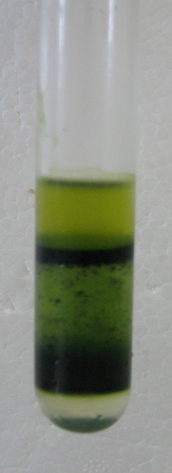
Figure 1. Crude chloroplast after centrifuged by 40% and 90% Percoll. The upper layer is the broken chloroplasts, and the lower green layer is the intact chloroplasts, the small white-green in the bottom of the tube is the starch.
- The intact chloroplasts are recovered in the lower green layer, and transfer the intact chloroplast into a 50 ml centrifuge tube by Pasteur pipet.
- Add 3-volume gradient buffer and centrifuge at 2,500 x g for 70 sec at 4 °C for washing.
- Suspend the intact chloroplasts in 0.6 M sucrose in TE buffer, and the chlorophyll concentration is adjusted to 2 mg/ml (see Note 7).
- After keeping on ice for 10 min, the chloroplasts are ruptured by three freeze-thaw cycles in which the suspension is placed in a -20 °C freezer for 1.5 h and then at room temperature until thawed, and this freeze-thaw procedure is repeated for 3 times.
- The suspension of broken chloroplasts are adjusted to 0.2 M Sucrose by adding 2-volume TE buffer, and centrifuge at 4, 500 x g for 15 min at 4 °C to remove the most of the thylakoids and residual intact chloroplasts, whereas the envelope membranes remained in the supernatant fraction.
- Centrifuge the supernatant at 40,000 x g for 30 min at 4 °C to gather the envelope membranes.
- Suspend the envelope membranes by 0.2 M sucrose in TE buffer.
- Add the envelope suspension on a linear gradient of 0.6~1.2 sucrose solution and centrifuge at 113,000 x g for 14 h at 4 °C in a swing rotor.
- The fraction of inner envelope membranes is recovered from the lower, and the fraction of outer envelope membranes from the upper sucrose/sucrose interface of the gradients [photograph can be seen in supplemental Figure S1 of the Wang et al. (2014)]. Gather the inner and outer envelope membranes by 1 ml syringe gently.
- Store the envelope membranes at -20 °C until use (within one month is better).
Notes
- Cut the leaves into 3~4 cm pieces and divide all leaves into 3~4 parts. Put one part of leaves and extraction buffer (200~300 ml) into the Mixer, and use flash function of Mixer (3~5 sec) for 3~4 times. Do flash each time after adding the leaves until all leaves are added. Do not homogenize too much. After homogenization, some small pieces of leaves still can be seen.
- In our procedure, the extractions tube should always be kept on ice during steps 5-13 except specially noted.
- The jug of the Mixer should be put into -20 °C to make it cool before using.
- All the buffers should be stored at 4 °C.
- The isoascorbic acid and glutathione should be added just before using.
- For measuring the chlorophyll concentration, dilute the suspended chloroplast 100-fold by 80% acetone, mix well and centrifuge at 10,000 x g for 5 min, then the supernatant was measured by a spectrophotometer at 645 nm, 663 nm, the spectrophotometer was adjust to zero using 80% acetone at 720 nm. The total chlorophyll concentration (mg/ml) = 100 x (0.0202 x A645 + 0.00802 x A663).
- In addition to tobacco leaf, other plants like spinach, etc., can be used for extraction, and sufficient leaf should be collected until ~100 g of fresh weight.
Recipes
- Extraction buffer for homogenization
0.33 M sorbitol
50 mM MES-NaOH (pH 6.1)
2 mM EDTA
1 mM MnCl2
1 mM MgCl2
20 mM NaCl
2 mM isoascorbic acid
1% (w/v) polyvinypyrrolidone-40
- Gradient buffer
0.33 M sorbitol
50 mM HEPES-NaOH (pH 6.8)
2 mM EDTA
1 mM MnCl2
1 mM MgCl2
1 mM sodium pyrophosphate
5 mM isoascorbic acid
5 mM glutathione
- TE buffer (pH 7.5)
10 mM tricine
2 mM EDTA-2Na
- 40% (v/v) Percoll in gradient buffer
- 90% (v/v) Percoll in gradient buffer
- 0.2 M, 0.6 M and 1.2 M sucrose in TE buffer
- Linear gradient of 0.6~1.2 M sucrose-TE buffer
This buffer is made by density gradient device (Equipment 11), by gradient mix the 0.6 M sucrose and 1.2 M sucrose in TE buffer solution.
Acknowledgments
This work was supported by the National Natural Science Foundation of China (grant no. 31200206), the West Light Foundation of the Chinese Academy of Sciences, and the Chinese Universities Scientific Fund (grant no. ZD2012023).
References
- Wang, S., Uddin, M. I., Tanaka, K., Yin, L., Shi, Z., Qi, Y., Mano, J., Matsui, K., Shimomura, N., Sakaki, T., Deng, X. and Zhang, S. (2014). Maintenance of chloroplast structure and function by overexpression of the rice MONOGALACTOSYLDIACYLGLYCEROL SYNTHASE gene leads to enhanced salt tolerance in tobacco. Plant Physiol 165(3): 1144-1155.
Article Information
Copyright
© 2015 The Authors; exclusive licensee Bio-protocol LLC.
How to cite
Readers should cite both the Bio-protocol article and the original research article where this protocol was used:
- Wang, S., Yin, L., Mano, J. and Tanaka, K. (2015). Isolation of Chloroplast Inner and Outer Envelope Membranes. Bio-protocol 5(4): e1405. DOI: 10.21769/BioProtoc.1405.
- Wang, S., Uddin, M. I., Tanaka, K., Yin, L., Shi, Z., Qi, Y., Mano, J., Matsui, K., Shimomura, N., Sakaki, T., Deng, X. and Zhang, S. (2014). Maintenance of chloroplast structure and function by overexpression of the rice MONOGALACTOSYLDIACYLGLYCEROL SYNTHASE gene leads to enhanced salt tolerance in tobacco. Plant Physiol 165(3): 1144-1155.

 Download Citation in RIS Format
Category
Plant Science > Plant physiology > Photosynthesis
Plant Science > Plant cell biology > Organelle isolation
Cell Biology > Organelle isolation > Chloroplast
Do you have any questions about this protocol?
Post your question to gather feedback from the community. We will also invite the authors of this article to respond.
 Post a Question


