
- Home
- Protocols

-


GLYCERIN AND ETHANOL-BASED PRESERVATION PROTOCOL FOR Cynoscion acoupa FOR MUSEUM EXHIBITION: NOVEL APPROACH ARISES FOR DIDATIC PURPOUSES
Last updated date: Jul 16, 2023 DOI: 10.21769/p2372 Views: 1111 Forks: 0
 Download PDF
 Ask a
question
Ask a
question
 How to
cite
How to
cite
 Favorite


GLYCERIN AND ETHANOL-BASED PRESERVATION PROTOCOL FOR Cynoscion acoupa FOR MUSEUM EXHIBITION: NOVEL APPROACH ARISES FOR DIDATIC PURPOUSES
Arthur Dartagnan Chaves dos Santos – Master Degree Researcher at Federal University of Sao Paulo, Diadema, Brazil; Fisheries Institute/Santos, Brazil; Aquaculture Laboratory, Oceanographic Institute, University of Sao Paulo, Brazil. Avenida Bartolomeu de Gusmão, 192, Ponta da Praia, Santos – SP – BRA, 11045-401, +55 13 3261-1900, arthur.chaves@usp.br
Renata Esper Haddad – Technical Director for Fisheries Museum, Fisheries Institute, Santos, Brazil
Caio Gomes Santos – Research support technician, Fishery Institute, Centro Avançado de Pesquisa e Desenvolvimento do Pescado Marinho, Santos – SP – BRA
Jéssica Levy – Post-doctorate researcher, Fisheries Institute, Santos, Brazil; Aquaculture Laboratory, Oceanographic Institute, University of Sao Paulo, Brazil.
Abstract
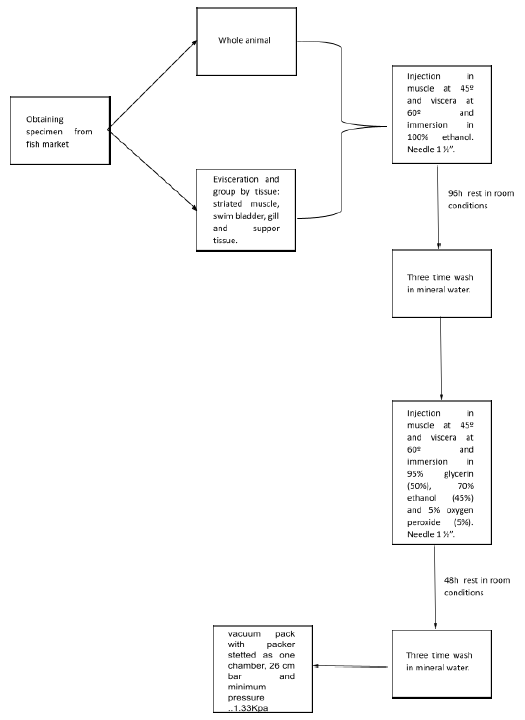
Preservation and fixation of marine specimens can be performed within >95% glycerin and >70% ethanol solutions 1:1 in both muscle and other tissues rather than formaldehyde. It provides and environmental friendly approach and an interactive possibility. Firstly, a control animal is provided and injections of 100% ethanol intramuscular and intravisceral injection are performed in, respectively, 45º and 60º using 1 ½” needles; a second animal is eviscerated and muscle torn apart exposing filets around spine, viscera are separated in 100% ethanol plastic bottle according to tissue origin: striated muscle, gill, swim bladder and other support tissue, using scalpel number 10. All material rest for 96h in room conditions. After rest time, all specimens are washed with mineral water three times and then (>95%) glycerin aqueous solution (50%) associated to 70% ethanol (45%) with 5% oxygen peroxide (5%) and once again injected in muscles and viscera, and the ethanol in the bottle is switched to the new solution. It’s necessary to put on rest for 48h. After rest, specimens are washed three times on mineral water, dried and vacuum packed in vaccum packer with one chamber, 26 cm bar and minimum pressure 1.33Kpa. Comparatively, intramuscular and intravisceral injections are more effective than immersion as alleged in other similar protocols. All specimen kept softness, odor and touch properties in 60 days further in room temperature. Further training, no expertise level rather than technician formation is needed.
Keywords: anatomy; specimen preservation; laboratory methods; marine fishery; scientific museum.
BACKGROUND AND PROCEDURE OBJECTIVES
São Paulo's Fishery Institute gathered with both Fisheries Museum aimed to develop novel technology on preservation and fixation approach for didactic objectives without formaldehyde. Touch, odor and appearance are resourceful features for visitors; formaldehyde, besides carcinogenic, restrict interaction between people and specimens. All institutions involved aims to be environmental friendly and accessible to visitors.
Previous experiments evidenced glycerin and ethanol in different concentrations as substitutes of formaldehyde (Mohsen et al., 2013; Crosado et al., 2020; Brenner, 2014, Wijaya, Margiana and Furgonita, 2021) all of those analyzed used immersion technique and, as well, performed for didactic purposes. None aimed to preserve muscle – or, as more adequate, filets – in its aspect closer to food one, thus did not experimented intramuscular injection and viscera injection in striated muscle.
Packing and oxygen involvement in color and organic material degradation was not observed, remaining an apart field. Use of vacuum packing and different pressures could deliver results directly related to interaction and preservation duration variables, such as biomass and dry or wet weight (Gaston et al., 1996).
MATERIAL AND METHODS
All specimens of Cynoscion acoupa were purchased at a fish Market in Santos, Brazil, fresh and stored on ice. At first, a control animal were provided and injections of 100% ethanol intramuscular and intravisceral injection were performed in, respectively, 45º and 60º angles of incision using 1 ½” needles, analogy to human specimens preservation (Dolci et al, 2019) (fig. A).
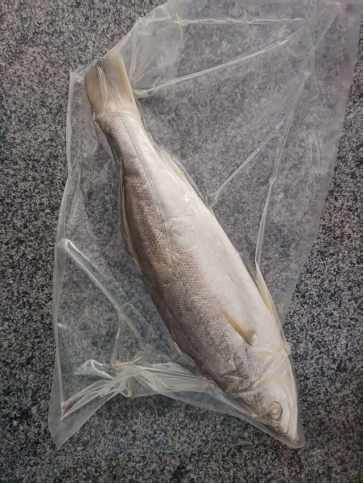
Fig. A: control animal.
A second animal was eviscerated (fig. B, C) and muscle torn apart exposing filets around spine, viscera were separated in 100% ethanol plastic bottle according to tissue origin: striated muscle, gill, swim bladder and other support tissue, and properly identified, using scalpel number 10. All material remained on rest for 96h in room conditions.
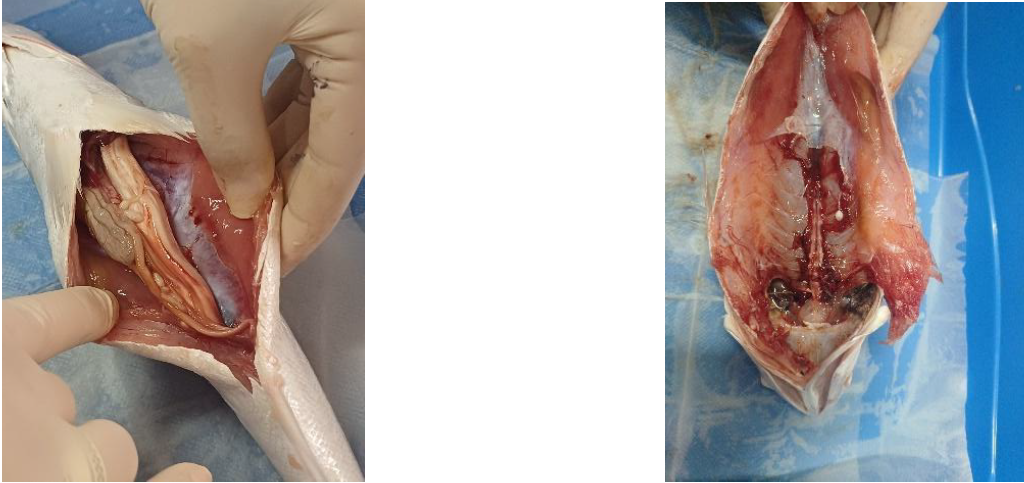
Fig. B: evisceration of Cyanoscion Acoupa. Fig. C: carcass.
After rest time, all specimens are washed with mineral water three times and then pure glycerin aqueous solution (50%) associated to 70% ethanol (45%) with 5% oxygen peroxide (5%) was injected in muscles and viscera, and the ethanol in the bottle was switched to the new solution. It remained on rest for 48h in room conditions. After rest, specimens are washed three times on mineral water, dried and vacuum packed in vaccum packer with one chamber, 26 cm bar and minimum pressure 1.33Kpa.
Storage was in room conditions for disclosure in 60 days for analysis, without ice or any technology for conservation other than oxygen reduction by vacuum packing.
PROCEDURE WORKFLOW
RESULTS
After 60 days, all eight samples in vacum packs were found without refrigeration, stored in room temperature inside refrigerator. Due to lack of vacum pressure, four of them lost vacuum, not avoiding high oxygen concentrations.
None of eight samples showed thickness or color related to high oxidation. Odor was characteristic of dried fish and touch kept similar to fresh fish. Color was brownish, slightly yellow, remaining aspects of fresh fish (fig. D).
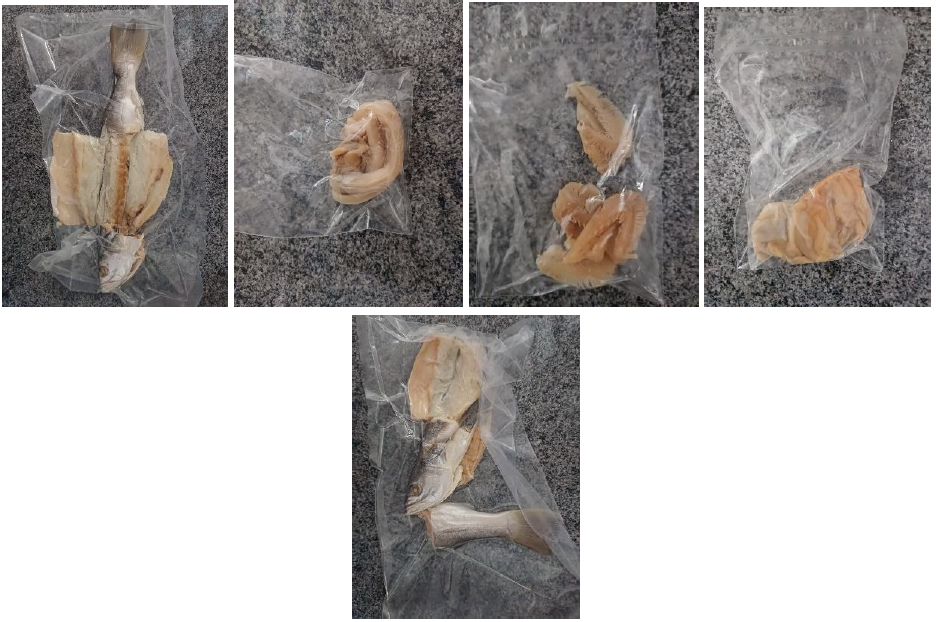
Fig. D: some samples after 60 days stored.
None evidenced oxidation signs or high nitrogen presence, besides no nitrogen of total volatile basis was performed. For didactic purposes, all objectives were accomplished.
DISCUSSION AND BASIS FOR VALIDATION
It is mandatory for establishing a guideline a validation process according to reproducibility. In our laboratory, it stands as a novel standard protocol.
FUNDING AND ETHICAL STATEMENT
Our research was funded by FUNDEPAG (Fundação de Desenvolvimento da Pesquisa do Agronegócio), related to Government of Sao Paulo state.
No interest is conflicting to this research, all authors claim ethical research and pledge to this.
REFERENCES
Brenner E. Human body preservation - old and new techniques. J Anat. 2014 Mar;224(3):316-44. doi: 10.1111/joa.12160. Epub 2014 Jan 18. PMID: 24438435; PMCID: PMC3931544.
Crosado B, Löffler S, Ondruschka B, Zhang M, Zwirner J, Hammer N. Phenoxyethanol-Based Embalming for Anatomy Teaching: An 18 Years' Experience with Crosado Embalming at the University of Otago in New Zealand. Anat Sci Educ. 2020 Nov;13(6):778-793. doi: 10.1002/ase.1933. Epub 2020 Jan 21. PMID: 31758863; PMCID: PMC7687111.
Dolci, Ricardo LL, et al. "Technique for latex injection and reuse of human heads preserved in formaldehyde." Journal of Neurological Surgery Part B: Skull Base 80.03 (2019): 270-275.
Gaston, G. R., Bartlett, J. H. W., McAllister, A. P., & Heard, R. W. (1996). Biomass variations of estuarine macrobenthos preserved in ethanol and formalin. Estuaries, 19, 674-679.
Mohsen SM, Esfandiari E, Rabiei AA, Hanaei MS, Rashidi B. Comparing two methods of plastination and glycerin preservation to study skeletal system after Alizarin red-Alcian blue double staining. Adv Biomed Res. 2013 Mar 6;2:19. doi: 10.4103/2277-9175.108003. PMID: 23930264; PMCID: PMC3732873.
Wijaya AN, Margiana R, Kusumaningtyas S, Furqonita D. Comparison of decomposition rate of hind limbs of preserved mice with ethanol-glycerin and formaldehyde of advanced fixative solution. Anat Cell Biol. 2021 Jun 30;54(2):225-231. doi: 10.5115/acb.20.314. PMID: 33767018; PMCID: PMC8225480.
- Santos, A D, Esper, R H, Santos, C G and Levy, J(2023). GLYCERIN AND ETHANOL-BASED PRESERVATION PROTOCOL FOR Cynoscion acoupa FOR MUSEUM EXHIBITION: NOVEL APPROACH ARISES FOR DIDATIC PURPOUSES. Bio-protocol Preprint. 10.21769/p2372.
Do you have any questions about this protocol?
Post your question to gather feedback from the community. We will also invite the authors of this article to respond.
 Post a Question


