
- Home
- Protocols

-


Drug release performance
Last updated date: Nov 25, 2022 Views: 819 Forks: 0

 Download PDF
 Ask a
question
Ask a
question
 How to
cite
How to
cite
 Favorite


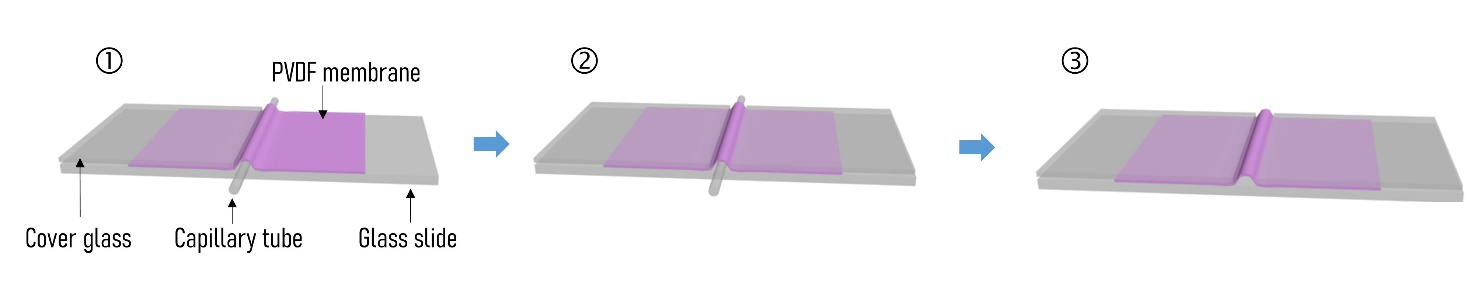
1. To conduct the drug release performance of LGMC, semicircular LGMC was sticking to a glass slide at first. As the following diagram shows, a 0.3 mm capillary tube was placed on a glass slide, then the optimized PVDF porous membrane fabricated with 15.9% mass ratio was skinning on the capillary tube. Two cover glasses were used to pinning the membrane, and after affixed with epoxy resin glue, capillary tube was drawn out. Following with the infusion of gating liquid, semicircular membrane-based LGMC was obtained. In this way, the semicircular LGMC has a radius of about 0.3 mm, and the material was PVDF porous membrane fabricated with 15.9% wt/wt electrospinning solution.
2. To detect the drug release performance, confocal laser scanning microscope (TCS SP5, Leica) was used, with which xzy mode can be realized, and fluorescent dyesdissolve in silicone oil 500 were used as indicators. While semicircular membrane-based LGMC was in a focused place, with slowly flowed DI water as transport fluid, fluorescent dyes (1 ml) was dropped on the LGMC near the laser focused position with a microsyringe, and at the same time, confocal images were recorded. Both oil-soluble (fluorescent yellow 131SC) and water-soluble (rhodamine B) molecules were used, respectively.
- Hou, X(2022). Drug release performance. Bio-protocol Preprint. bio-protocol.org/prep2053.
- Wang, C., Wang, S., Pan, H., Min, L., Zheng, H., Zhu, H., Liu, G., Yang, W., Chen, X. and Hou, X.(2020). Bioinspired liquid gating membrane-based catheter with anticoagulation and positionally drug release properties . Science Advances 6(36). DOI: 10.1126/sciadv.abb4700
Do you have any questions about this protocol?
Post your question to gather feedback from the community. We will also invite the authors of this article to respond.
 Post a Question


