
- Home
- Protocols

-


Delayed Alternation Task for the Study of Spatial Working and Long Term Memory in Rats


Published: Vol 10, Iss 5, Mar 5, 2020 DOI: 10.21769/BioProtoc.3549 Views: 5373
Reviewed by: Fanny Ehret
Original research article
The authors used this protocol in:
Jun 2019
 PDF
PDF  Ask a question
Abstract
Memory systems can hold previously presented information for several seconds, bridging gaps between discontinuous events. It has been previously demonstrated that the hippocampus and the medial entorhinal cortex (mEC) are necessary for memory retention over delay intervals in alternation tasks. Here we describe the delayed alternation task, a spatial working memory (WM) task in which animals need to alternate between left and right sides of a figure-8 maze on a trial-by-trial basis to receive a reward. On each trial of this task, the rat has to remember the last episode and turn in the opposite direction compared to the previous trial. We manipulated the WM load by introducing delays of various lengths (10 s and 60 s) between trials. While other alternation task protocols use short delay intervals between trials, our protocol introduces a longer delay condition that requires animals to use long-term memory resources that are not necessarily supported by sequential neuronal firing patterns (i.e., time cells) as are seen with shorter delay intervals.
Keywords: Hippocampus Working memory
Rat
Behavior
Time cells
Long-term memory
Delayed alternation task
Working memory
Rat
Behavior
Time cells
Long-term memory
Delayed alternation task
Background
A main function of the hippocampus and entorhinal cortex is to connect events separated by delay intervals (Eichenbaum, 2017; Robinson et al., 2017; Ainge et al., 2007; Sabariego et al., 2019). It has been proposed that retention of memory for these events is accomplished by cells that fire at successive moments in temporally structured experiences, known as time cells (Eichenbaum, 2017). However, while most studies have used alternation task protocols with short delay intervals that did not exceed 15 s (Ainge et al., 2007; Ito et al., 2015; Pastalkova et al., 2008), recent data suggest that time cell firing begins to disappear after approximately the first 20 s of the delay interval (Sabariego et al., 2019). Therefore, it is important to explore both behavioral performance and neuronal firing during delays that exceed these shorter time intervals. Consequently, the delayed alternation task protocol described here uses longer delays of 60 s, which require animals to use long term memory resources, likely due to a WM overload (Kim et al., 2013). This protocol represents a valuable tool for exploring the discrete serial firing patterns observed during shorter delay periods and the mechanisms involved in supporting WM and long-term memory maintenance sustained by other mechanisms, like local synaptic plasticity in hippocampus, sharp-wave ripples, or by activity patterns elsewhere in the brain. Moreover, and because it also includes a shorter delay condition (10 s delay), where sequential firing occurs, it provides an opportunity for the study of these discrete serial firing patterns observed during shorter delay periods.
Materials and Reagents
Note: All materials and reagents listed are examples based on what has been used successfully using the protocol provided; however, using different rat strains/sex/weights, and cereals could also be successful.
- Paper towels
- Chocolate sprinkles (i.e., Cocoa PebblesTM)
- Weigh boats (Chemglass, catalog number CLS-1815-002 )
- Pencil
- Eraser
- Behavioral sheets (see Appendix 1)
- Experimentally naive, male Long-Evans rats with weighing between 300 g-350 g (Charles Rivers Laboratories)
- Ethanol 70% (Fisher Scientific, Decon Laboratories, catalog number: 04-355-223 )
Equipment
- Figure-8-maze
Dimensions: 101 cm long crosspiece connected to a center arm to the right and left arms at the top and bottom of the maze. Side pieces were 101 cm long as well. The top and bottom pieces were 150 cm long. All runways were 10 cm wide x 2 cm tall. The maze was elevated 50 cm from the ground (Figure 1). Weigh boats containing reward pieces (i.e., Cocoa PebblesTM) were attached underneath the reward locations and served as non visible odor cues to prevent subjects from using odor when taking their decision.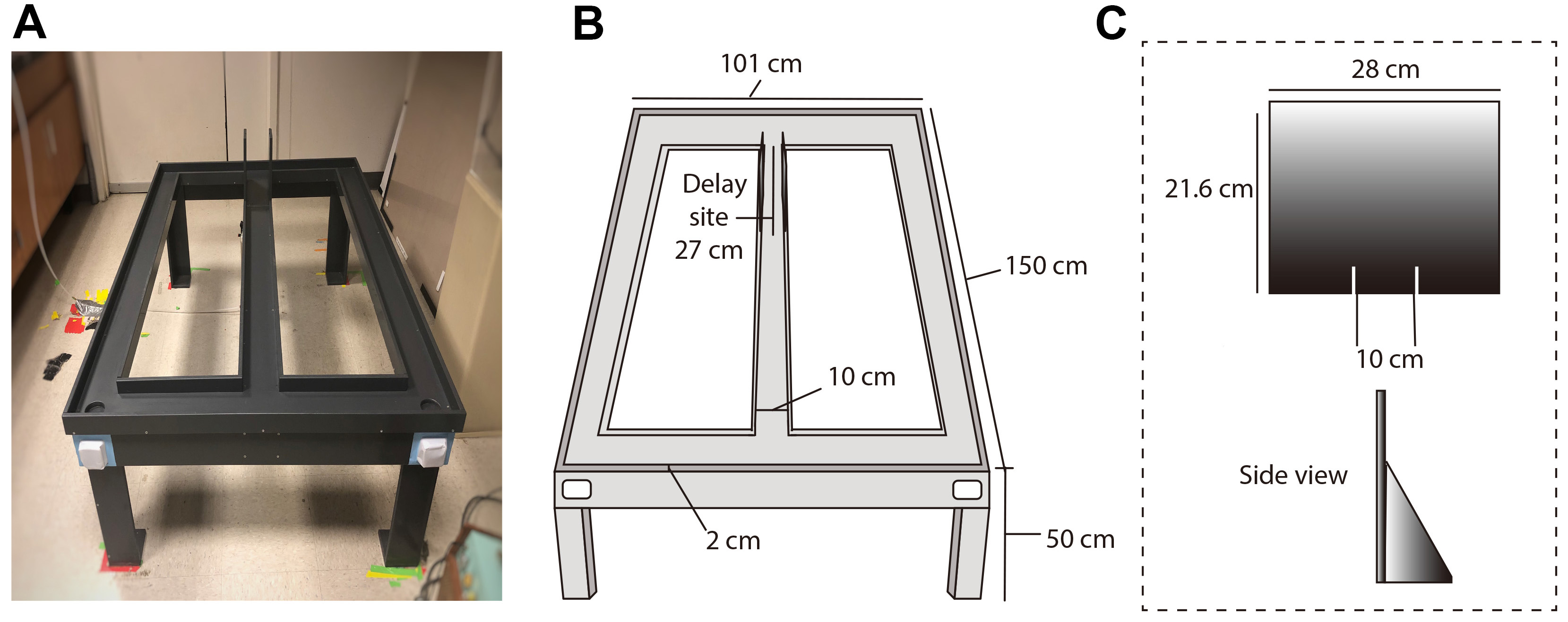
Figure 1. The Figure-8-maze apparatus used for behavioral training and testing. A. Photography of the maze. Side barriers in the center stem indicate the delay site. Odor cues were provided in both sides of the maze, below the reward sites, in order to prevent a bias in choosing a particular arm (white weigh boats). B. Illustration of the maze indicating measurements of each section. C. Removable card-board barriers (hand crafted). - Card-board barriers (hand crafted, dimensions: 21.6 cm x 28 cm)
- Stop-watch (Fisher Scientific, catalog number: ISO 17025 )
- Infrared camera (such as Acazon Conch-shape Infrared LEDs Security Camera, https://amzn.to/37XHKyG)
- Scale (Kent Scientific, catalog number SCL-1015 )
- Dim light source (i.e., desk lamp)
Software
Notes:
- Software listed below describes what has been used successfully using the protocol provided; however, using alternative software that allows for scoring of alternation could also be successful.
- For electrophysiological recordings a 4SX 64 channel Neuralynx system was used. We do not discuss electrophysiological procedures in this protocol but any high-density, low-noise electrophysiology system could be successful.
- Microsoft Excel
- Statistical package (i.e., SPSS, GraphPad prism, R)
Procedure
Category
Neuroscience > Behavioral neuroscience > Animal model
Systems Biology > Genomics > Functional genomics
Do you have any questions about this protocol?
Post your question to gather feedback from the community. We will also invite the authors of this article to respond.
 Post a Question


