


Combining Truncation-Free Genetic Code Expansion with bdSUMO/bdSENP1 On-Column Cleavage for High-Purity Recombinant Protein Production

发布: 2026年12月20日第16卷第24期 DOI: 10.21769/BioProtoc.5912 浏览次数: 15
评审: Kun YuanAlexandre SmirnovAnonymous reviewer(s)
 PDF
 Q&A





Abstract
Production of high-purity recombinant proteins remains challenging, particularly for proteins that are unstable, expressed at low levels, or require site-specific incorporation of noncanonical amino acids (ncAAs). Although polyhistidine-tag immobilized metal affinity chromatography (IMAC) is simple and economical, imidazole elution can co-elute nonspecifically bound host proteins, reducing purity when target protein abundance is low. The bdSUMO/bdSENP1 system provides a selective proteolytic elution strategy that addresses this limitation. Target proteins are expressed as N-terminal His6-bdSUMO fusions, captured on metal-affinity resin, and released directly from the resin by cleavage with the highly active bdSUMO-specific protease bdSENP1. Unlike conventional cleavable-tag workflows that require imidazole elution, buffer exchange, in-solution proteolysis, and subsequent removal of the cleaved affinity tag, bdSENP1-mediated on-column cleavage releases tag-free target protein while His6-bdSUMO, uncleaved fusion protein, and many resin-bound contaminants remain immobilized. The cleavage reaction is compatible with a broad range of buffer conditions and detergents, allowing target proteins to be recovered directly in a buffer appropriate for downstream applications. Here, we describe methods for preparing tag-free bdSENP1, expressing and purifying His6-bdSUMO-tagged proteins from E. coli, and adapting this workflow to RF1-deficient, truncation-free genetic code expansion systems. We demonstrate its application to proteins containing site-specifically incorporated phosphoserine and 3-nitrotyrosine, for which low expression levels can make the recovery of highly purified recombinant proteins particularly challenging.
Key features
• Selective on-column proteolysis releases highly pure tag-free target proteins from standard His-tag IMAC resin in a single step.
• Well suited for low-abundance recombinant proteins, including proteins made with genetic code expansion where conventional IMAC elution can yield poor purity.
• Target proteins can be recovered directly in user-selected cleavage buffers, reducing the need for post-purification desalting, dialysis, or reverse affinity chromatography.
• Includes adaptations for truncation-free phosphoserine and 3-nitrotyrosine incorporation in RF1-deficient E. coli, with analytical validation of ncAA incorporation fidelity.
Keywords: bdSUMO/bdSENP1 On-column cleavage
Immobilized metal affinity chromatography
Protein purification
Genetic code expansion
Phosphoserine
3-nitrotyrosine
Graphical overview
Background
Recombinant protein production is central to biochemical, structural, and biophysical studies, yet many proteins remain difficult to obtain in sufficient yield and purity. Immobilized metal affinity chromatography (IMAC), using polyhistidine tags such as His6 and Ni2+- or Co2+-based resins, is widely used because it is simple, scalable, and economical. However, host proteins can also interact nonspecifically with IMAC resins and co-elute with the target protein upon addition of imidazole. This problem becomes particularly consequential for poorly expressed proteins, for which nonspecifically bound host proteins can constitute a substantial fraction of the recovered material.
N-terminal fusion tags such as SUMO, maltose-binding protein (MBP), and glutathione S-transferase (GST) are commonly used to improve the solubility, folding, and recovery of recombinant proteins [1]. Because these tags can interfere with downstream applications, including biochemical assays, protein–protein interaction studies, and structural analyses, they are frequently removed after purification. Conventional workflows typically require elution of the intact fusion protein from the affinity resin, buffer exchange into conditions compatible with the selected protease, proteolytic cleavage, and a subsequent reverse-affinity or polishing step to separate the target protein from the cleaved tag, protease, uncleaved fusion protein, and other contaminants. Although effective, these additional manipulations increase purification time and create opportunities for sample loss, aggregation, or degradation, particularly for unstable or low-yield proteins.
The bdSUMO/bdSENP1 system developed by Frey and Görlich provides an alternative strategy that combines affinity purification with highly efficient tag cleavage [2,3]. In this system, the target protein is expressed as an N-terminal fusion to a SUMO ortholog from the grass Brachypodium distachyon (bdSUMO) and cleaved with its cognate SUMO-specific protease, bdSENP1. bdSENP1 is exceptionally active at low temperature and retains substantial activity across a broad range of pH and ionic-strength conditions [3]. Under commonly used purification conditions, approximately 30–100 nM bdSENP1 can achieve near-complete cleavage of bdSUMO-fused substrate within approximately 1 h at 0–4 °C, whereas substantially higher concentrations of proteases such as TEV are required under comparable conditions. bdSENP1 also remains effective at elevated salt concentrations (e.g., 1 M NaCl). Collectively, these features make the bdSUMO/bdSENP1 system exceptionally more adaptable and streamlined compared to the orthologous, more traditionally used Saccharomyces cerevisiae SUMO/ULP1 system, which is notably sensitive to buffer, salt, and temperature conditions [3].
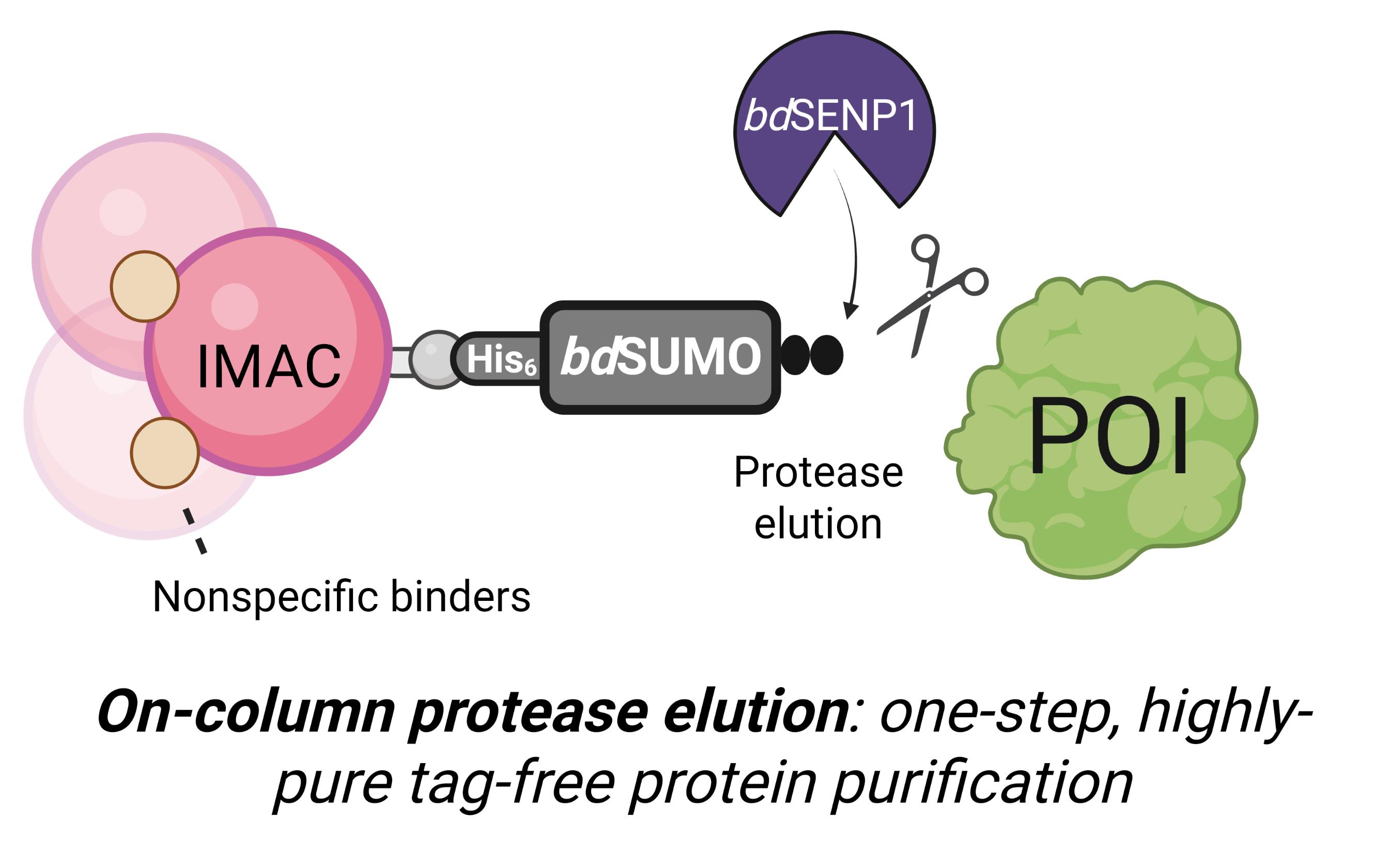
A major practical advantage of the bdSUMO/bdSENP1 system is that cleavage can be performed directly on the affinity resin to achieve selective proteolytic elution of the target protein [2] (Figure 1). His6-bdSUMO fusion proteins are first captured on IMAC resin and washed to remove weakly associated contaminants. The resin is then incubated with tag-free bdSENP1, which cleaves the target protein from the immobilized His6-bdSUMO tag. Consequently, the released target protein, along with a trace amount of tag-free bdSENP1 (typically used at ~100 nM, due to its high catalytic activity), is recovered in the flowthrough, while His6-bdSUMO, uncleaved fusion protein, and many nonspecifically bound proteins remain associated with the resin. This approach therefore combines the selectivity of affinity chromatography with the sequence and structural specificity of SUMO proteolysis, substantially reducing the contaminants that accompany conventional imidazole elution.
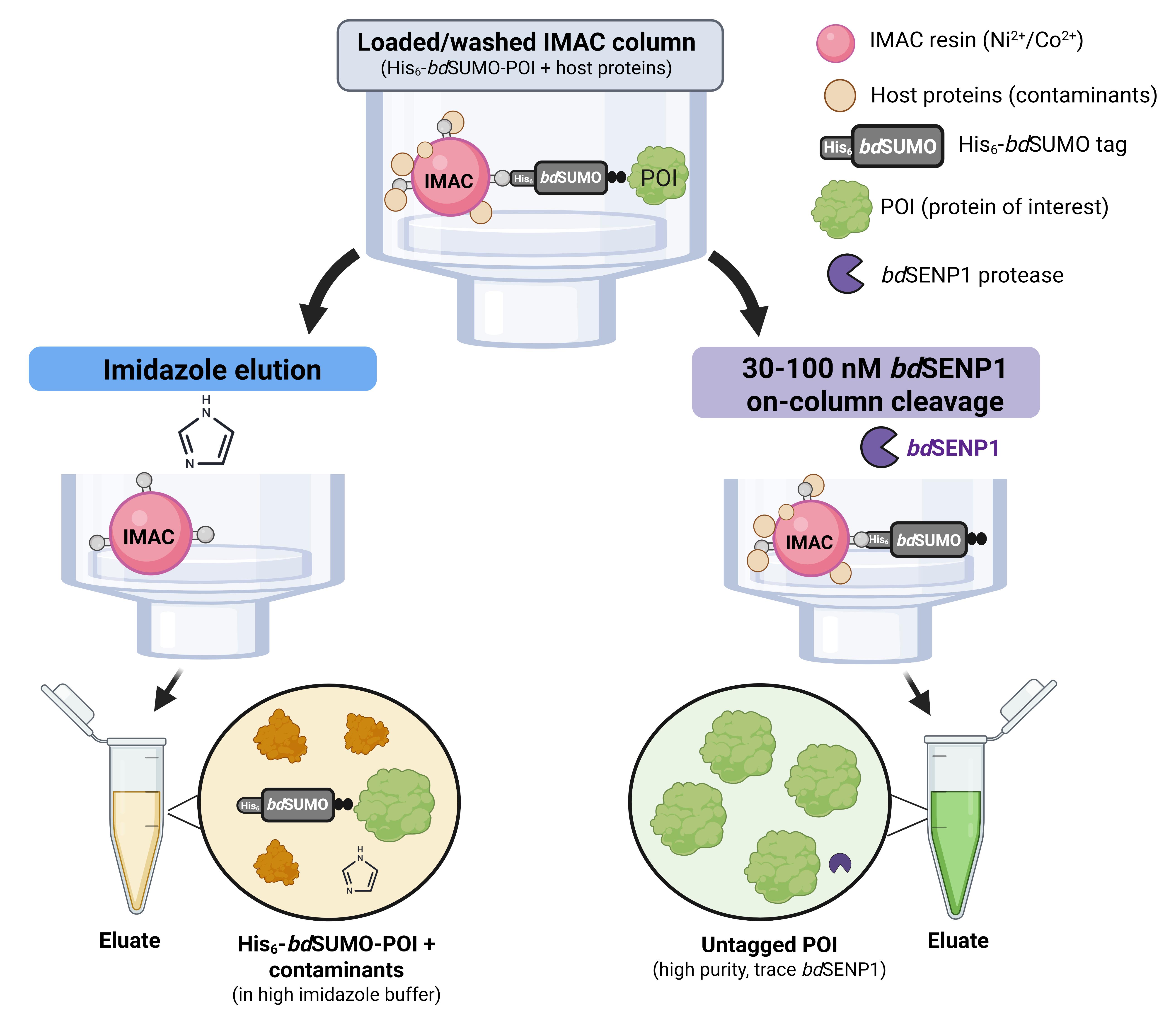
Figure 1. Comparison of conventional imidazole elution and bdSENP1-mediated on-column cleavage. His6-bdSUMO-tagged target proteins and nonspecifically bound host proteins are captured on immobilized metal affinity chromatography (IMAC) resin. Imidazole elution releases both the target fusion protein and resin-associated contaminants, producing a mixed eluate (left). In contrast, tag-free bdSENP1 selectively cleaves the target protein from immobilized His6-bdSUMO, while the tag, uncleaved fusion protein, and many contaminants remain resin-bound (right). This selective proteolytic elution yields a substantially cleaner target-protein fraction directly from the affinity column.
This purification strategy is especially attractive for low-yield or unstable targets for which extensive downstream purification can substantially reduce recovery. One particularly useful application is genetic code expansion (GCE), which enables site-specific incorporation of noncanonical amino acids (ncAAs), including post-translational modifications, bioorthogonal reactive groups, and spectroscopic probes [4]. Because ncAA incorporation requires competition between an orthogonal suppressor tRNA and endogenous translation processes at a reassigned codon, GCE frequently produces lower yields than the expression of the corresponding unmodified protein. This purification strategy is particularly advantageous for “truncation-free” GCE systems lacking release factor 1 (RF1) [5,6]. In conventional E. coli, RF1 recognizes the UAG stop codon used by many GCE systems and competes with the ncAA-charged suppressor tRNA, generating truncated translation products. This can limit the use of N-terminal affinity or solubility tags because truncated proteins retain the N-terminal tag and can therefore co-purify with the full-length product. RF1-deficient strains greatly reduce this termination pathway, enabling N-terminal tags such as His6-bdSUMO to be used effectively for GCE protein production. RF1 removal alone, however, does not guarantee homogeneous ncAA incorporation, because endogenous near-cognate tRNAs can compete for UAG and introduce canonical amino acids [6–9]. Therefore, truncation-free purification should be paired with GCE systems that have been validated for high incorporation fidelity in the selected RF1-deficient host.
Here, we describe a general workflow for bdSUMO/bdSENP1-mediated on-column purification and its integration with validated truncation-free GCE systems. We demonstrate the approach using site-specific incorporation of phosphoserine and 3-nitrotyrosine, illustrating how selective proteolytic elution can facilitate recovery of highly pure ncAA-containing proteins even when recombinant expression yields are comparatively low.
Overview of protocol
This protocol is organized as a modular workflow that guides users from protease preparation to purification of His6-bdSUMO-fused target proteins. In module 1, users first prepare tag-free bdSENP1, the protease required for selective on-column elution. His6-bdSENP1 is expressed and purified, the His6 tag is removed with His6-tagged TEV protease, and the cleaved tag and TEV are separated from bdSENP1 by reverse metal-affinity purification. A workflow for producing His6-TEV is included, although commercially available His-tagged TEV can also be used. A single preparation of tag-free bdSENP1 provides sufficient protease for at least 100 purifications of proteins expressed as N-terminal His6-bdSUMO fusions. A typical preparation yields approximately 20–30 mg of tag-free bdSENP1, sufficient for more than 100 purifications of His6-bdSUMO fusion proteins. Individual purifications typically require approximately 5–50 μg of bdSENP1, depending on the purification scale and cleavage reaction volume.
After bdSENP1 preparation, module 2 describes a general workflow for expressing N-terminal His6-bdSUMO fusion proteins and purifying them by bdSENP1-mediated on-column cleavage. This module can be used as a standalone strategy to obtain highly pure, tag-free recombinant proteins. Modules 3 and 4 adapt the same purification workflow to truncation-free GCE systems, where N-terminal His6-bdSUMO tagging is particularly useful (see section below). Phosphoserine (pSer; Module 3) and 3-nitrotyrosine (nitroTyr; Module 4) are used as representative ncAAs. Detailed protocols for expression of pSer- and nitroTyr-containing proteins are provided elsewhere [10,11]; the emphasis here is on adapting these established systems to His6-bdSUMO fusion constructs and bdSENP1-based purification.
Adaptation of the bdSUMO/bdSENP1 purification system to truncation-free GCE
GCE enables site-specific incorporation of ncAAs using orthogonal aminoacyl-tRNA synthetase (RS)/tRNA pairs that suppress engineered UAG amber codons (Figure 2). In conventional RF1-containing hosts such as BL21(DE3), suppressor tRNAs compete with RF1, which terminates translation at UAG, producing mixtures of full-length ncAA-containing protein and truncated products. Consequently, many GCE workflows use C-terminal affinity tags so that prematurely terminated proteins do not co-purify with the desired full-length product.
RF1-deficient strains, including the BL21(DE3)-derived B95(DE3) ΔAΔfabR strain, largely eliminate this source of premature termination when expressing proteins with GCE and enable the use of N-terminal affinity and solubility tags such as His6-bdSUMO [6,9]. This is particularly advantageous because GCE proteins, especially those containing multiple noncanonical amino acids, often express at reduced yields, making contaminating resin-binding proteins more problematic during conventional IMAC purification. Combining truncation-free GCE with bdSENP1-mediated on-column cleavage allows full-length His6-bdSUMO-tagged proteins to be captured by IMAC and selectively released as tag-free products, facilitating high-purity recovery even from low-yield expressions.
Importantly, RF1 deficiency does not itself guarantee homogeneous ncAA incorporation [6,8]. In the absence of RF1, endogenous near-cognate tRNAs can suppress UAG and introduce canonical amino acids in place of the intended ncAA. This workflow should therefore be paired with GCE systems validated to efficiently outcompete near-cognate suppression. High-fidelity phosphoserine, 3-nitrotyrosine, and optimized tetrazine GCE systems have been demonstrated in B95-derived RF1-deficient hosts [6,8,9], whereas other ncAA systems should first be evaluated using reporter proteins such as sfGFP. Here, we demonstrate the incorporation of phosphoserine and 3-nitrotyrosine into His6-bdSUMO-sfGFP-150TAG and validate incorporation by intact-protein mass spectrometry and, for phosphoserine, Phos-tag gel analysis.
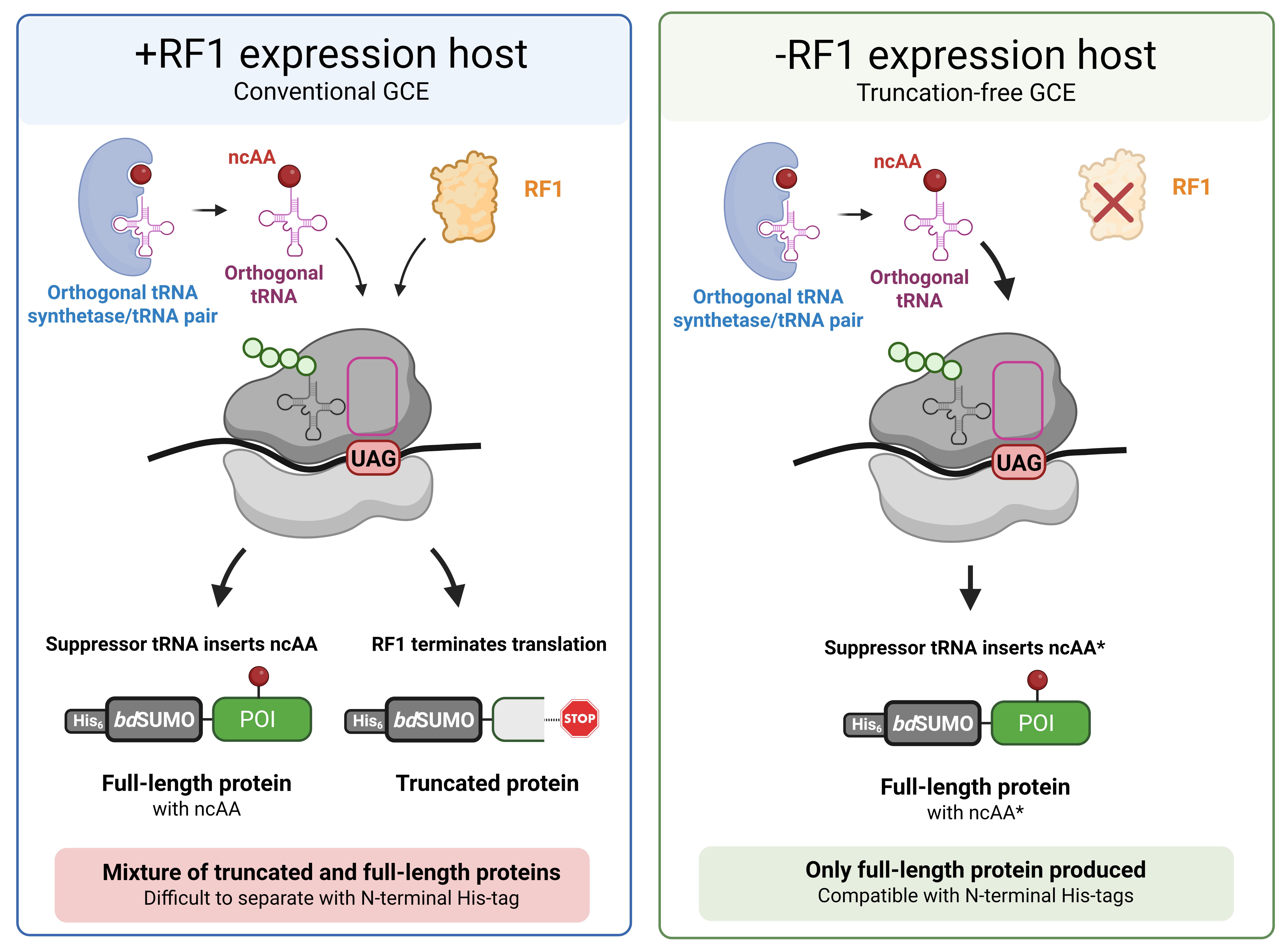
Figure 2. Effect of RF1 on modified protein expression using genetic code expansion. In RF1-containing strains, RF1 competes with the orthogonal suppressor tRNA at UAG codons, producing a mixture of truncated and full-length ncAA-containing proteins (left). With an N-terminal His6-bdSUMO tag, truncated products can co-purify with the desired full-length protein. In RF1-deficient strains, RF1-mediated termination is eliminated, enabling truncation-free expression and use of N-terminal His6-bdSUMO fusions (right). *RF1 deficiency does not itself ensure homogeneous ncAA incorporation; inefficient GCE systems may permit endogenous near-cognate suppressor tRNAs, e.g., glutamine-tRNA, to decode UAG. GCE systems should therefore be validated for high-fidelity incorporation in RF1-deficient hosts.
Materials and reagents
Biological materials
The materials and reagents for this protocol are listed below in Tables 1–4 and organized into modules so that users can identify only the components required for their application.
Table 1. Module 1: Strains and plasmids for expressing TEV and bdSENP1 proteases
| Item | Source | Use/key note |
| BL21(DE3) | ThermoFisher, EC0114 | Expression host for His6-TEV and His6-bdSENP1 |
| pMAL-TEVp | Addgene # 8827 | Expresses His6-TEV; AmpR [12] |
| pET28-His6-bdSENP1 | Addgene # 259300 | Expresses TEV-cleavable His6-bdSENP1; KanR |
Table 2. Module 2: Strains and plasmids for expressing unmodified bdSUMO fusion proteins
| Item | Source | Use/key note |
| BL21(DE3) | ThermoFisher, EC0114 | Expression host |
| pET28-His6-bdSUMO-sfGFP-WT | Addgene # 259301 | Expresses unmodified control bdSUMO fusion protein; KanR |
| pET28-His6-bdSUMO-POI | User generated | Expresses unmodified His6-bdSUMO-tagged target protein; KanR |
Table 3. Module 3: Additional reagents for pSer genetic code expansion (GCE)
| Item | Source | Use/key note |
| B95(DE3) ΔA Δ fabR ΔserB | Addgene # 197655 | Expression host |
| pKW2-EFSep | Addgene # 173897 | pSer GCE machinery; CmR |
| pRBC-His6-bdSUMO-sfGFP WT | Addgene # 259303 | Expresses unmodified control bdSUMO fusion protein; AmpR |
| pRBC-His6-bdSUMO-sfGFP-TAG150 | Addgene # 259304 | Expresses pSer-modified control bdSUMO fusion protein; AmpR |
| pRBC-His6-bdSUMO-POI WT | User generated | Expresses unmodified His6-bdSUMO-tagged target protein; AmpR |
| pRBC-His6-bdSUMO-POI TAG | User generated | Expresses pSer-modified His6-bdSUMO-tagged target protein; AmpR |
Note: For pSer expression, the target-protein plasmid must be compatible with the pKW2-EFSep machinery plasmid (which has a pBR322 origin of replication). We recommend using the pRBC backbone with a p15A origin of replication, or another compatible origin. pRBC plasmids express proteins under a T7 transcriptional promoter, similar to pET vectors. For more information on the pKW2-EFSep/pRBC plasmid system, please see [9].
Table 4. Module 4: Additional reagents for nitroTyr genetic code expansion (GCE)
| Item | Source | Use/key note |
| B95(DE3) ΔA Δ fabR | Addgene # 197934 | Expression host |
| pAJE-30-Mj-nitroTyr | Addgene # 249488 | Preferred nitroTyr machinery for truncation-free expression; SpecR |
| pET28-His6-bdSUMO-sfGFP-TAG150 | Addgene # 259302 | Expresses nitroTyr-modified control bdSUMO fusion protein; KanR |
| pET28-His6-bdSUMO-POI TAG | User generated | Expresses modified His6-bdSUMO-tagged target protein; KanR |
Note: The pAJE plasmid enables encoding of nitroTyr at TAG codons using the Methanocaldococcus jannaschii (Mj)-TyrRS-nitroTyr “A7” RS and its cognate TAG codon-suppressing tRNA. This plasmid has a low-copy synthetic origin of replication that is compatible with all standard origins, including ColE1/pBR322/pMB1, CDF, and p15A. For detailed information on these plasmids and this expression system, see [11].
Design note for His6-bdSUMO target plasmids. Proteins of interest (POIs) can be cloned into the pET28- or pRBC-based His6-bdSUMO expression plasmids by replacing the sfGFP control gene between the BamHI and XhoI sites using standard cloning methods such as ligation, Gibson Assembly, or SLiCE [13]. In these constructs, the BamHI junction encodes Gly-Ser in frame with the target protein. The Gly completes the C-terminal Gly-Gly motif of bdSUMO required for bdSENP1 recognition and cleavage, while the Ser becomes the P1’ residue and remains as the single vestigial N-terminal residue of the released target protein (Figure 3). Alternative junctions can be designed when a different N-terminal residue is desired, provided that the bdSUMO C-terminal Gly-Gly motif is preserved and the P1’ residue is compatible with bdSENP1 cleavage. Ser, Gly, and Ala are convenient choices for efficient cleavage, whereas Pro should not be placed at P1’ because bdSENP1 does not cleave substrates containing Pro immediately after the scissile bond [3].
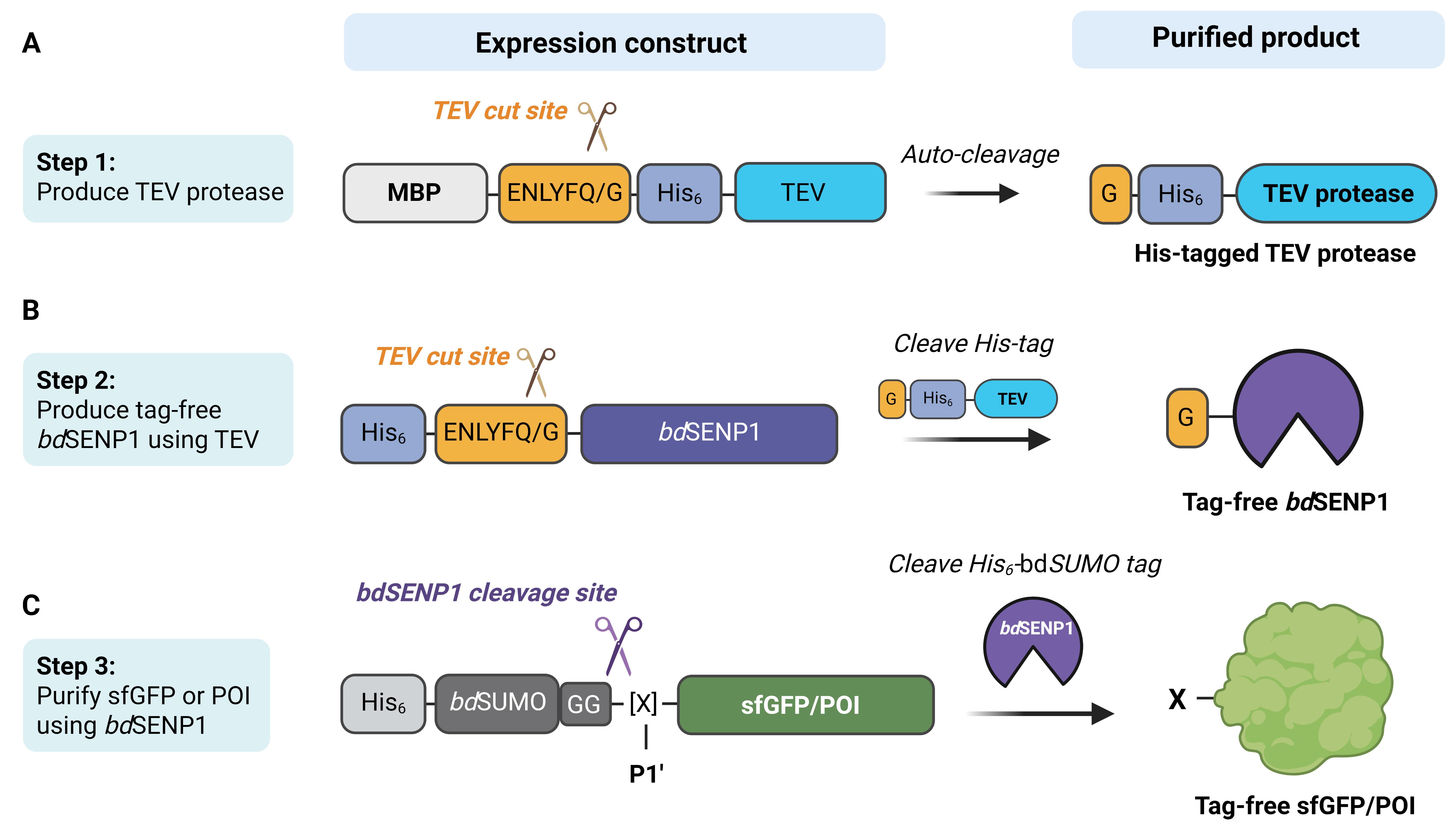
Figure 3. Expression constructs and protease-processing steps used in this protocol. (A) His6-TEV is produced from an MBP-containing precursor that undergoes TEV-mediated autocleavage during expression. (B) His6-bdSENP1 is cleaved with His6-TEV to generate tag-free bdSENP1. (C) His6-bdSUMO-sfGFP or user-defined His6-bdSUMO fusion proteins are cleaved with bdSENP1 to release the target protein. Although the P1’ residue (X) can be designed to be the native N-terminal methionine, preferred P1’ vestigial residues (for retaining maximal bdSENP1 activity) are smaller amino acids such as Gly, Ser, or Ala. Proline is not tolerated at the P1’ position.
Reagents
The reagents are split up by modules as done above.
Module 1: Expression and purification of TEV and bdSENP1 proteases
1. Tryptone (e.g., VWR, catalog number: 97063-386)
2. Yeast extract (e.g., VWR, catalog number: 97064-368)
3. Agar (e.g., VWR, catalog number: 97064-336)
4. NaCl (e.g., VWR, catalog number: 97061-274)
5. Tris base (e.g., RPI, catalog number: T60040-5000.0)
6. Imidazole (e.g., Thermo Scientific, catalog number: A10221.36)
7. Glycerol (e.g., VWR, catalog number: BDH24388.320)
8. Hydrochloric acid (e.g., VWR catalog number: 87003-251)
9. Polypropylene glycol 2000 (PPG2000, antifoam) (e.g., Thermo Fisher Scientific, catalog number: AAL14699AP)
10. Kanamycin (e.g., VWR, catalog number: 75856-684)
11. Ampicillin (e.g., VWR, catalog number: 97061-442)
12. Isopropyl β-D-1-thiogalactopyranoside (IPTG) (e.g., Anatrace, catalog number: I1003)
13. MgSO4 heptahydrate (e.g., VWR, catalog number: 97062-134)
14. α-D-glucose (e.g., VWR, catalog number: 97061-168)
15. His6-TEV protease (only if not purifying yourself in module 1) (e.g., Genscript Z03030-1K)
Module 2: Expression and purification of His6-bdSUMO fusion target proteins
Reagents are the same as for Module 1.
Module 3: Expression and purification of His6-bdSUMO fusion target proteins with site-specific encoding of pSer
Reagents for the expression of pSer-modified proteins can be found in [10]. The reagents below are needed for purification of His6-bdSUMO fusion proteins using bdSENP1 on-column proteolytic elution.
1. NaCl (e.g., VWR, catalog number: 97061-274)
2. Tris base (e.g., RPI, catalog number: T60040-5000.0)
3. Imidazole (e.g., Thermo Scientific, catalog number: A10221.36)
4. Glycerol (e.g., VWR, catalog number: BDH24388.320)
5. Sodium fluoride (e.g., VWR, catalog number: 470302-540)
6. Tetrasodium pyrophosphate decahydrate (e.g., VWR, catalog number: JT3850-1)
7. Sodium orthovanadate (e.g., VWR, catalog number: BT219470-25G)
8. Phos-tag acrylamide (e.g., VWR, catalog number: 77974-918)
9. MnCl2 (e.g., Sigma-Aldrich, catalog number: M3634)
10. Hydrochloric acid (e.g., VWR, catalog number: 87003-251)
Module 4: Expression and purification of His6-bdSUMO fusion target proteins with site-specific encoding of nitroTyr
Reagents for nitroTyr-modified protein expression can be found in [11]. The reagents below are needed for purification of His6-bdSUMO fusion proteins using bdSENP1 on-column proteolytic elution.
1. NaCl (e.g., VWR, catalog number: 97061-274)
2. Tris base (e.g., RPI, catalog number: T60040-5000.0)
3. Imidazole (e.g., Thermo Scientific, catalog number: A10221.36)
4. Glycerol (e.g., VWR, catalog number: BDH24388.320)
5. Hydrochloric acid (e.g., VWR, catalog number: 87003-251)
Solutions
Module 1: Expression and purification of TEV and bdSENP1 proteases (see Recipes)
1. LB/agar media
2. 2× YT media
3. SOC media
4. Kanamycin stock
5. Ampicillin stock
6. NaCl stock
7. Tris stock
8. Imidazole stock
9. Glycerol stock
10. IPTG stock
11. Lysis/wash buffer
12. Imidazole elution buffer
13. Protease storage buffer
Module 2: Expression and purification of His6-bdSUMO fusion target proteins (see Recipes)
Solutions are the same as for Module 1.
Module 3: Expression and purification of His6-bdSUMO fusion target proteins with site-specific encoding of pSer (see Recipes)
Solutions needed for the expression of pSer-modified proteins can be found in [10]. The solutions below are needed for purification of His6-bdSUMO fusion proteins using bdSENP1 on-column proteolytic elution.
1. NaCl stock
2. Tris stock
3. Imidazole stock
4. Glycerol stock
5. Sodium fluoride stock
6. Sodium pyrophosphate stock
7. Sodium orthovanadate stock
8. Lysis/wash buffer for module 3
Module 4: Expression and purification of His6-bdSUMO fusion target proteins with site-specific encoding of nitroTyr (see Recipes)
Solutions needed for the expression of nitroTyr-modified proteins can be found in [11]. The solutions below are needed for purification of His6-bdSUMO fusion proteins using bdSENP1 on-column proteolytic elution.
1. NaCl stock
2. Tris stock
3. Imidazole stock
4. Glycerol stock
Recipes
1. LB/agar media (all modules)
| Reagent | Final concentration | Amount |
|---|---|---|
| Tryptone | 1% (w/v) | 5 g |
| Yeast extract | 0.5% (w/v) | 2.5 g |
| NaCl | 1.0% (w/v) | 5 g |
| Agar | 1.5% (w/v) | 7.5 g |
| H2O | n/a | To 500 mL |
| Total | n/a | 500 mL |
After mixing reagents thoroughly, autoclave on a standard liquid setting to sterilize. The agar will not go into solution until autoclaved. After autoclaving, gently swirl the bottle to ensure molten agar is evenly mixed.
Note: LB/agar bottle can be stored in a 65 °C oven for up to two weeks, if sterility is maintained, and plates poured on an as-needed basis. If an oven is not available, plates can be poured with antibiotics once LB/agar is sufficiently cooled to touch. Plates can be stored at 4 °C for up to a week.
2. 2× YT media (all modules)
| Reagent | Final concentration | Amount |
|---|---|---|
| Tryptone | 1.6% (w/v) | 16 g |
| Yeast extract | 1.0% (w/v) | 10 g |
| NaCl | 0.5% (w/v) | 5 g |
| H2O | n/a | To 1,000 mL |
| Total | n/a | 1 L |
After mixing the reagents thoroughly, autoclave on the standard liquid setting to sterilize. After autoclaving, allow it to cool to room temperature before use.
3. SOC recovery media (all modules)
| Reagent | Final concentration | Amount |
|---|---|---|
| 2× YT media | n/a | 49 mL |
| 1 M MgSO4 | 10 mM | 0.5 mL |
| 40% (w/v) α-D-glucose | 0.4% (w/v) or ~20 mM | 0.5 mL |
| Total | n/a | 50 mL |
a. 1 M MgSO4 can be made by mixing 12.3 g of MgSO4·7H2O in water up to 50 mL of total volume. Adjust the mass of MgSO4 accordingly if using a salt with a different hydration status.
b. 40% (w/v) α-D-glucose can be made by mixing 20 g of α-D-glucose with water up to 50 mL of total volume. Mix thoroughly until glucose is dissolved. Gentle heating in a microwave may facilitate the dissolution of glucose.
c. Sterilize MgSO4, glucose, and 2× YT solutions individually by autoclaving. Allow each component to cool to room temperature and mix as indicated above. Maintain sterility while adding components together.
d. It is easy to contaminate SOC. We suggest breaking this into 5 × 10 mL aliquots before use or making smaller batches. If sterility is maintained, SOC can be stored at room temperature indefinitely. It can also be stored at -20 °C but avoid repeated freeze/thaw cycles.
4. Kanamycin stock (10 mL) (Module 1)
| Reagent | Final concentration | Amount |
|---|---|---|
| Kanamycin | 50 mg/mL | 0.5 g |
| H2O | n/a | To 10 mL |
| Total | n/a | 10 mL |
Sterilize by filtering with a 0.2 μm syringe-end filter. Store in 1 mL aliquots at -20 °C.
5. Ampicillin stock (10 mL) (Module 1)
| Reagent | Final concentration | Amount |
|---|---|---|
| Ampicillin | 100 mg/mL | 1 g |
| H2O | n/a | To 10 mL |
| Total | n/a | 10 mL |
Sterilize by filtering with a 0.2 μm syringe-end filter. Store in 1 mL aliquots at -20 °C.
6. NaCl stock (500 mL) (all modules)
| Reagent | Final concentration | Amount |
|---|---|---|
| NaCl | 5 M | 146.1 g |
| H2O | n/a | To 500 mL |
| Total | n/a | 500 mL |
Add NaCl to a 500 mL beaker containing a magnetic stir bar and 400 mL of prewarmed water. Mix until dissolved. Add the remaining volume of water to reach 500 mL. Heating the solution can help the salt dissolve. Filter using a 0.2 μm filter. Stock solution can be stored at room temperature.
7. Tris stock (500 mL) (all modules)
| Reagent | Final concentration | Amount |
|---|---|---|
| Tris | 500 mM | 30.3 g |
| H2O | n/a | To 500 mL |
| Total | n/a | 500 mL |
Add Tris to a 500 mL beaker containing a magnetic stir bar. Add 400 mL of water and mix until dissolved. Adjust pH to 7.5 using 12 M HCl. Add the remaining volume of water to reach 500 mL using a graduated cylinder. Filter using a 0.2 μm filter. Stock solution can be stored at room temperature.
8. Imidazole stock (500 mL) (all modules)
| Reagent | Final concentration | Amount |
|---|---|---|
| Imidazole | 2 M | 68.08 g |
| H2O | n/a | To 500 mL |
| Total | n/a | 500 mL |
Add imidazole to a 500 mL beaker containing a magnetic stir bar. Add 400 mL of water and mix until dissolved. Adjust pH to 8.0 using 12 M HCl. Add the remaining volume of water to reach 500 mL using a graduated cylinder. Filter using a 0.2 μm filter. Stock solution can be stored at room temperature.
9. Glycerol stock (500 mL) (all modules)
| Reagent | Final concentration | Amount |
|---|---|---|
| Glycerol | 50% | 250 mL |
| H2O | n/a | 250 mL |
| Total | n/a | 500 mL |
Add 250 mL of water to a graduated cylinder containing a magnetic stir bar. While stirring, pour 250 mL of glycerol and mix thoroughly. Stock solution can be stored at room temperature.
10. IPTG stock (10 mL) (Modules 1 and 2)
| Reagent | Final concentration | Amount |
|---|---|---|
| IPTG | 0.5 M | 1.2 g |
| H2O | n/a | To 10 mL |
| Total | n/a | 10 mL |
Add IPTG to a 15 mL conical tube. Add water to 10 mL of total volume and mix by inversion until dissolved. Aliquot into 1 mL aliquots and store at -20 °C.
11. Sodium fluoride stock (500 mL) (Module 3)
| Reagent | Final concentration | Amount |
|---|---|---|
| Sodium fluoride | 1 M | 21 g |
| H2O | n/a | To 500 mL |
| Total | n/a | 500 mL |
Dissolve 21 g of sodium fluoride in 450 mL of water while stirring. Adjust volume to 500 mL once dissolved using a graduated cylinder. Filter with a 0.2 μm filter. Stock solution can be stored at room temperature.
12. Sodium pyrophosphate stock (500 mL) (Module 3)
| Reagent | Final concentration | Amount |
|---|---|---|
| Tetrasodium pyrophosphate decahydrate | 250 mM | 55.8 g |
| H2O | n/a | To 500 mL |
| Total | n/a | 500 mL |
Dissolve tetrasodium pyrophosphate decahydrate in 450 mL of water. Adjust the pH to 7.5 using HCl. Adjust volume to 500 mL with a graduated cylinder, aliquot 45 mL into 50 mL conical tubes, and store at -20 °C.
13. Sodium orthovanadate stock (50 mL) (Module 3)
| Reagent | Final concentration | Amount |
|---|---|---|
| Sodium orthovanadate | 200 mM | 1.85 g |
| H2O | n/a | To 50 mL |
| Total | n/a | 50 mL |
Dissolve 1.85 g of sodium orthovanadate in 45 mL of water while stirring. Adjust pH to 10 using 1 M HCl. This will make the solution yellow, which indicates the formation of vanadate oligomers. Heat in the microwave until a gentle boil is reached. After boiling for approximately 10 s, the solution will be clear and colorless. Cool on ice until the solution reaches room temperature. Check the pH again, as it may be above 10 at this point. If this is the case, adjust back to pH 10 using 1 M HCl. If this causes the solution to turn yellow, repeat the cycle of boiling, cooling, and adjusting pH until the pH stabilizes at 10. Aliquot 1 mL into 1.5 mL Eppendorf tubes and store at -20 °C. pH will remain stable, and the solution will remain colorless after freeze/thaw cycles; additional adjustments are not required.
14. Lysis/wash buffer for Modules 1, 2, and 4
| Reagent | Final concentration | Amount |
|---|---|---|
| Tris stock | 50 mM | 100 mL |
| NaCl stock | 500 mM | 100 mL |
| Imidazole stock | 5 mM | 2.5 mL |
| Glycerol stock | 5% | 100 mL |
| H2O | n/a | To 1,000 mL |
| Total | n/a | 1,000 mL |
Add the individual components to 700 mL of water, then fill up to 1,000 mL with water. Store solution at 4 °C for up to 1 week.
15. Lysis/wash buffer for Module 3
| Reagent | Final concentration | Amount |
|---|---|---|
| Tris stock | 50 mM | 100 mL |
| NaCl stock | 500 mM | 100 mL |
| Imidazole stock | 5 mM | 2.5 mL |
| Glycerol stock | 5% | 100 mL |
| Sodium fluoride stock | 50 mM | 50 mL |
| Sodium pyrophosphate stock | 5 mM | 20 mL |
| Sodium orthovanadate stock | 0.5 mM | 2.5 mL |
| H2O | n/a | To 1,000 mL |
| Total | n/a | 1,000 mL |
Add the individual components to 600 mL of water, then add water to a final volume of 1,000 mL. Store solution at 4 °C for up to 1 week.
16. Imidazole elution buffer for Modules 1 and 2
| Reagent | Final concentration | Amount |
|---|---|---|
| Tris stock | 50 mM | 5 mL |
| NaCl stock | 500 mM | 5 mL |
| Imidazole stock | 300 mM | 7.5 mL |
| Glycerol stock | 5% | 5 mL |
| H2O | n/a | To 50 mL |
| Total | n/a | 50 mL |
Add the individual components to 20 mL water, then fill up to 50 mL with water. Store solution at 4 °C for up to 1 week.
17. Protease storage buffer for Modules 1 and 2 (500 mL)
| Reagent | Final concentration | Amount |
|---|---|---|
| Tris stock | 50 mM | 50 mL |
| NaCl stock | 300 mM | 30 mL |
| Glycerol stock | 10% | 100 mL |
| H2O | n/a | To 500 mL |
| Total | n/a | 500 mL |
Add the components to approximately 300 mL of water, mix thoroughly, and bring to a final volume of 500 mL with water. Store solution at 4 °C for up to 1 week.
Laboratory supplies
1. 1.7 mL Eppendorf tubes (e.g., VWR, catalog number: 87003-294)
2. 100 mm plates (e.g., VWR, catalog number: 470210-568)
3. 500 mL graduated cylinder
4. 15 mL conical tubes (e.g., VWR, catalog number: 89126-798)
5. 50 mL conical tubes (e.g., VWR, catalog number: 89039-656)
6. 14 mL sterile culture tubes (e.g., VWR, catalog number: 60818-689)
7. 250 mL baffled flasks (e.g., VWR, catalog number: 89095-266)
8. 2 L baffled flasks (e.g., VWR, catalog number: 10126-408)
9. 2.8 L baffled Fernbach flasks (e.g., Millipore-Sigma, catalog number: CLS44232XL)
10. Micropipette tips 10 μL (e.g., VWR, catalog number: 76323-394)
11. Micropipette tips 200 μL (e.g., VWR, catalog number: 76323-390)
12. Micropipette tips 1,000 μL (e.g., VWR, catalog number: 76323-454)
13. Disposable PD-10 desalting column, with Sephadex G-25 resin, 1.0–2.5 mL samples (Cytiva, catalog number: 17085101)
14. TALON® SuperflowTM (VWR, catalog number: CA71006-006)
15. Nalgene® bottle-top sterile filter (Millipore Sigma, catalog number: Z358223-12EA)
16. Purification columns (Bio-Rad; for purifications with <2 mL resin, use #7321010; for purifications with >2 mL resin, use #7311550)
17. SDS-PAGE apparatus and gel-casting supplies (e.g., Bio-Rad, catalog number: 1658025FC)
18. SDS-PAGE pre-cast gels, if needed (e.g., Bio-Rad: 12% acrylamide, 12-well #4561045; you may use different acrylamide percentages based on target protein size)
19. Phos-tag pre-cast gels, if needed (e.g., FujiFilm, catalog number: 77974-641)
20. 0.2 μm syringe-end sterile filters (e.g., VWR, catalog number: 76479-024)
Equipment
1. Autoclave capable of sterilizing liquid media and culturing materials at 121 °C, with saturated steam pressure of 15 PSI
2. Expression equipment:
a. Static incubator for growing LB/agar plates (set to 37 °C) (e.g., VWR, catalog number: 97025-630)
b. Shaker incubator for growing liquid cultures (e.g., New Brunswick I26R, Eppendorf, catalog number: M1324-0004)
Note: The shaker should be able to rotate at 250–300 rpm. Refrigeration is necessary for expression below room temperature (<25 °C). Shaker deck should have clamps to hold 250 mL and 2.8 L Fernbach flasks.
c. Optical density 600 nm spectrophotometer (e.g., Ultrospec 10, Biochrome, catalog number: 80-2116-30)
3. Fluorometer capable of reading sfGFP fluorescence (excitation 485 nm/emission 510 nm); handheld fluorometers work well for routine fluorescence reads (e.g., PicoFluor from Turner Biosystems)
4. Freezer (-20 °C) for storing plasmids and antibiotics (e.g., Fisher Scientific, catalog number: 10-549-264)
5. Ice machine (e.g., Fisher Scientific, catalog number: 09-540-003)
6. Water bath (42 °C)
7. Microfluidizer (e.g., Microfluidics M-100P) or cell sonicator (e.g., Fisher Scientific, catalog number: 22-309783, Branson Sonifier S-450A with 0.5 inch probe)
8. Nanodrop (e.g., ThermoFisher, catalog number: NDULTRAGL) or equivalent UV absorbance spectrophotometer
9. Conical tube rocker (e.g., ThermoFisher, catalog number: 50-998-800)
10. Centrifuge capable of >20,000 rcf (e.g., Beckman Coulter Allegra 64R with F0850 rotor)
11. 4 °C cold room or equivalent working refrigeration unit
12. Mass spectrometer capable of intact protein mass analysis (e.g., Agilent 6545XT Advance Bio Q-TOF system)
Procedure
登录 / 注册后阅读全文
文章信息
稿件历史记录
提交日期: Sep 26, 2026
接收日期: Nov 12, 2026
在线发布日期: Nov 25, 2026
出版日期: Dec 20, 2026
版权信息
© 2026 The Author(s); This is an open access article under the CC BY license (https://creativecommons.org/licenses/by/4.0/).
如何引用
McGee, S. B., Stanisheuski, S., Mehl, R. A. and Cooley, R. B. (2026). Combining Truncation-Free Genetic Code Expansion with bdSUMO/bdSENP1 On-Column Cleavage for High-Purity Recombinant Protein Production. Bio-protocol 16(24): e5912. DOI: 10.21769/BioProtoc.5912.

 Download Citation in RIS Format
您对这篇实验方案有问题吗?
在此处发布您的问题,我们将邀请本文作者来回答。同时,我们会将您的问题发布到Bio-protocol Exchange,以便寻求社区成员的帮助。
 发布问题


