


AI-Guided Peptide Engineering From Small Experimental Datasets Using SCARSE


发布: 2026年12月05日第16卷第23期 DOI: 10.21769/BioProtoc.5909 浏览次数: 30
评审: Prashanth N SuravajhalaAnonymous reviewer(s)
 PDF
 Q&A







Abstract
Peptides have considerable potential as therapeutics (e.g., antimicrobials, anticancer chemotherapeutics, or diabetic drugs) and drug delivery vehicles, but optimizing candidate sequences remains costly and labor-intensive because each design cycle requires experimental synthesis and testing. Machine learning offers a means to accelerate sequence-to-function optimization, yet conventional models often require thousands of labeled examples, far more than the few dozen typically available at the start of an engineering campaign. A key challenge is therefore determining, before committing experimental resources, whether a model trained on limited data is sufficiently reliable to guide candidate selection. This protocol presents a practical workflow using small-sample cross-validation-anchored regression solution for low-resource peptide engineering (SCARSE), a user-friendly computational framework designed for small datasets. By leveraging pretrained protein representations alongside standard statistical learning algorithms, SCARSE operates on as few as 20 labeled sequences without requiring structural data, complex alignments, or specialized computing hardware. We provide step-by-step instructions for data preparation, model training, candidate ranking, and integration into iterative laboratory design cycles via either a web interface or a simple Python script. Finally, we show how internal validation metrics can act as an early decision tool, allowing researchers to evaluate a model's predictive power and estimate potential candidate success before committing experimental resources.
Key features
• Trains a peptide property predictor from as few as 20 labeled sequences using ESM2 embeddings, without fine-tuning, multiple sequence alignment, or structural input.
• Provides a cross-validation R2 criterion that estimates, before any new experiment, by how much a SCARSE-guided campaign will outperform random screening.
• Runs either as a two-function Python package or as a no-code web application, on CPU-only hardware, for regression endpoints.
• Built for iterative peptide engineering, ranks unlabeled candidates, selects the next synthesis batch, and retrains as new activity data become available.
Keywords: Peptide engineering Protein language model
ESM2
Active learning
Low-data machine learning
Gaussian process regression
Antimicrobial peptides
Cross-validation
Graphical overview
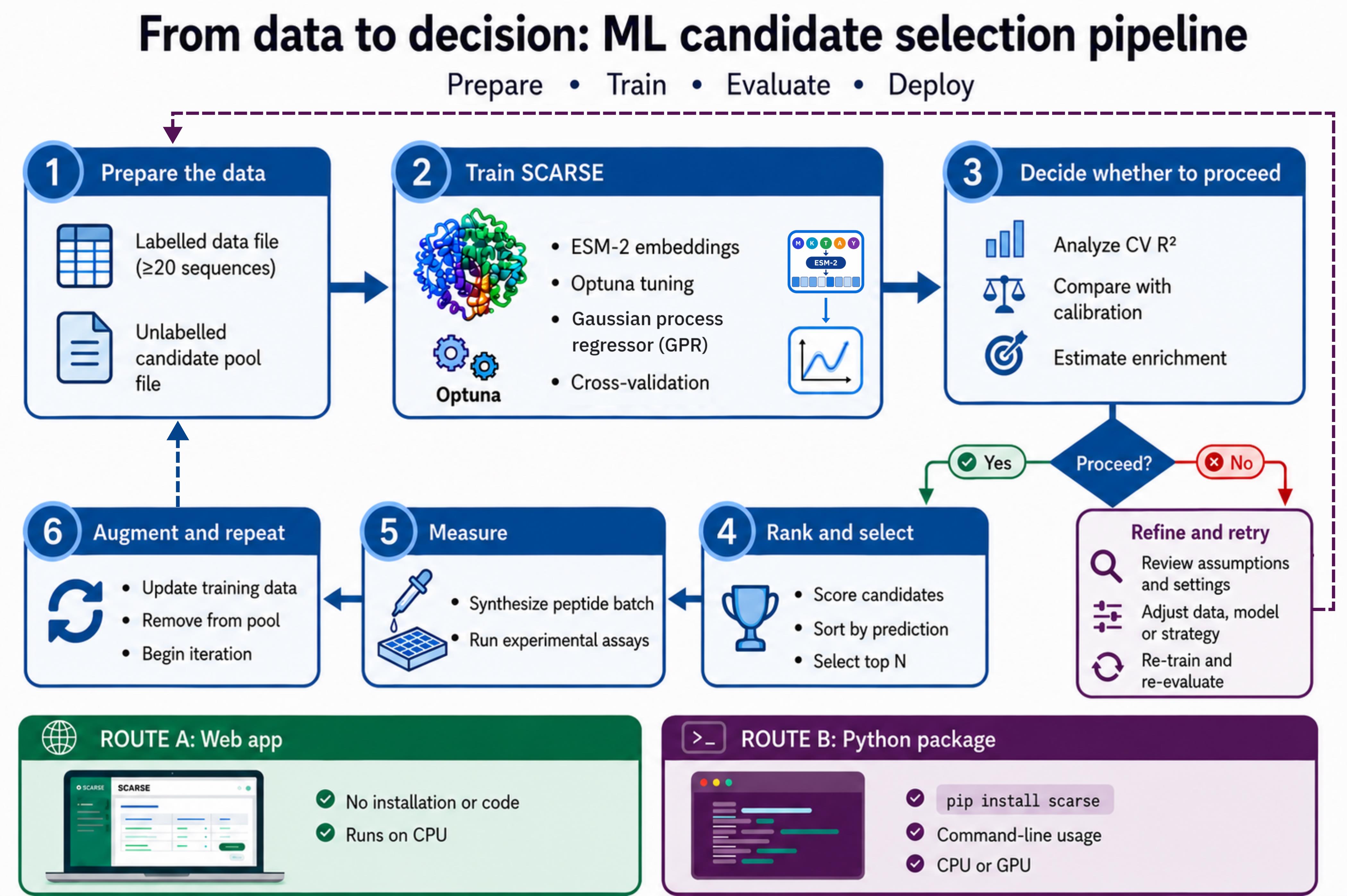
End-to-end workflow for AI-guided peptide engineering with SCARSE. The cycle begins with a small set of experimentally characterized peptides and an unlabeled candidate pool (step 1). Sequences are embedded with the ESM2 650M protein language model, and a downstream regressor [Gaussian process regressor (GPR)] is tuned by cross-validation hyperparameter search (step 2). The cross-validation (CV) R2 returned by training is compared with the published calibration curve (Figure 3h and Figure S16 of the source article [1]) in order to estimate, in advance, the enrichment of high-performing peptides the campaign will deliver relative to random screening (step 3). Every candidate is then scored, and the top N are selected (step 4), synthesized, and assayed (step 5), and the resulting labels are appended to the training set before the next round (step 6). Steps 2–4 can be performed either in the web application (Route A) or through the Python package (Route B).
Background
Peptide engineering is an inherently iterative process, in which experimental measurements accumulate gradually as candidate sequences are designed, tested, and refined. Early-stage campaigns therefore operate under a fundamental data constraint, with available measurements often comprising only a few tens or hundreds of sequences even when the ultimate objective is to explore a much larger sequence space [2,3]. This creates a substantial gap between the scale of data available in many peptide engineering campaigns and the larger datasets commonly used to develop and benchmark machine learning (ML) models. More importantly, having too few measurements to train a highly accurate model does not necessarily mean that ML is uninformative. The practical challenge is to determine whether the information contained in a small experimental dataset is sufficient to make model-guided selection more effective than unguided screening. Establishing this before investing in another round of synthesis and characterization is therefore an important part of deciding if and how to incorporate ML into a peptide engineering campaign.
Protein language models (PLMs) offer a potential way to address this data limitation by transferring information learned from large collections of unlabeled protein sequences to the peptide engineering problem at hand. Through self-supervised training, PLMs learn sequence representations that capture aspects of protein structure, function, and evolutionary relationships, which can then be used as inputs to relatively simple supervised models when only limited labeled data are available [4]. This strategy has been particularly promising in low-data protein engineering. For example, eUniRep adapts representations from the UniRep model to a target protein family, having demonstrated that useful sequence-function models could be trained from as few as 24 experimentally characterized variants, enabling the identification of improved variants in subsequent rounds of experimentation [3,5]. Related few-shot approaches have further explored how pretrained protein representations can be adapted using only small numbers of experimental measurements, while systematic benchmarking has shown that fine-tuning can improve performance across a range of protein sequence tasks [6,7].
PLM-based approaches have also been increasingly developed specifically for peptides. PeptideBERT uses pretrained sequence representations to predict properties including hemolysis, solubility, and antifouling activity, while Multi-Peptide combines sequence representations with graph-based molecular information through contrastive learning [8,9]. Other approaches, such as PepMNet, incorporate atom-level graph representations to better accommodate peptides containing non-canonical residues [10]. Beyond protein language models, a range of feature-based machine learning approaches have been applied to specific peptide activities; for example, antiviral activity has been predicted from periodicities of amino acid properties [11], and membranolytic anticancer activity has been modeled and optimized using descriptor-based classifiers [12]. Together, these studies demonstrate the growing potential of pretrained representations for peptide property prediction, but they also highlight an important practical question for experimental engineering. When only a small number of labeled peptides are available, it remains unclear whether the resulting model is sufficiently reliable to guide which candidates should be tested next.
Further practical limitations include the reliance of some methods on additional inputs that can be difficult to obtain for short peptides. Structure-aware models such as SaProt incorporate structural information alongside sequence, requiring experimentally determined or predicted structures for the sequences being evaluated [13,14]. Other approaches rely on multiple sequence alignments, for which short peptide sequences provide limited evolutionary information, and can make reliable homolog identification and alignment more challenging. These additional inputs introduce extra preprocessing steps and, in some cases, substantial computational requirements.
A more fundamental limitation concerns the low-data setting itself. Many existing methods have been developed and benchmarked using datasets that are considerably larger than those typically available at the beginning of an experimental peptide engineering campaign. Their performance in settings with only a few tens of labeled sequences is therefore less well characterized. More importantly, high predictive performance on a retrospective benchmark does not by itself indicate whether a model will provide useful guidance for selecting the next candidates to synthesize. A practical workflow therefore needs not only a model capable of learning from limited data but also a way to assess whether the available data contain sufficient signal to justify an ML-guided experimental campaign.
SCARSE (small-sample cross-validation-anchored regression solution for low-resource peptide engineering) was developed to address exactly this gap [1]. The framework uses ESM2 650M as a fixed sequence encoder, converting each peptide into a compact representation without model fine-tuning or multiple sequence alignment [4]. These design choices allow SCARSE to retain information learned during large-scale protein language model pretraining while avoiding additional structure prediction, alignment, or fine-tuning steps. The resulting representations are paired with a Gaussian process regressor, selected for its robustness on small datasets [15]. This combination provides a computationally lightweight approach for fitting sequence-to-function models when only limited experimental measurements are available.
The feature that makes SCARSE useful as a planning tool, rather than solely as a predictive model, is the relationship reported in the source study between cross-validation (CV) R2 calculated from the available labels and the endpoint performance of simulated active learning campaigns. Across diverse peptide and small-protein datasets spanning substitution and indel variants, antimicrobial peptides with minimal inhibitory concentration (MIC) endpoints, and hemolytic peptides, CV R2 was strongly correlated with active learning performance, with Pearson correlation coefficients ranging from 0.80 to 0.84 depending on the size of the labeled set [1,16–18]. The analysis further indicated that approximately 50 labeled peptides were sufficient for this relationship to provide a reasonably stable estimate. Thus, CV R2, which is obtained during routine model evaluation without additional experiments, can provide an early indication of whether model-guided selection is likely to outperform random screening. This observation forms the basis of the present protocol, which describes how to run SCARSE, interpret CV performance when deciding whether to proceed with an ML-guided campaign, and respond when the available data do not provide sufficient evidence that model-guided selection will be beneficial.
SCARSE operates exclusively on regression endpoints, for which the relationship between CV R2 and active learning performance was established.
The protocol is applicable to datasets in which a small set of peptides has been measured using a consistent assay, and a larger pool of untested candidates is available for selection. SCARSE does not generate new sequences or define the candidate search space. Instead, the candidate pool is supplied by the user and may consist of a mutational library around a lead sequence, a curated public library, or sequences generated using a separate design method. SCARSE currently operates on sequences composed of the 20 canonical amino acids and therefore does not directly support peptides containing modified side chains, covalent staples, cyclic topologies, or non-canonical residues. This limitation originates from the underlying protein language model, ESM2, which was designed to process conventional amino acid sequences. Although amino acid modifications are important in therapeutic peptide development, they fall outside the scope of the current SCARSE framework [1].
Software and datasets
All items listed in Table 1 are free of charge and openly licensed. No commercial software is required at any point. Version numbers give the configuration under which this protocol was written and verified.
Table 1. Software, model, datasets, and web application required to run the protocol.
| Type | Software/dataset/resource | Version | Date | License | Access |
|---|---|---|---|---|---|
| Code | SCARSE Python package (https://github.com/LeoAnd00/scarse) (accessed 29 Oct 2026) | 2.0.0 | 11 Oct 2026 | MIT | Free |
| Dataset | SCARSE Python package tutorial train data (https://github.com/LeoAnd00/scarse/blob/main/tutorial_data/train.csv) (accessed 29 Oct 2026) | 2.0.0 | 11 Oct 2026 | MIT | Free |
| Dataset | SCARSE Python package tutorial test data (https://github.com/LeoAnd00/scarse/blob/main/tutorial_data/test.csv) (accessed 29 Oct 2026) | 2.0.0 | 11 Oct 2026 | MIT | Free |
| Software | Python | 3.12.10 | 2025 | PSF, Python Software Foundation | Free |
| Model | ESM2 650M (facebook/esm2_t33_650M_UR50D) [4,19] (accessed 29 Oct 2026) | t33_650M_UR50D | 2023 | MIT | Free |
| Web application | SCARSE on HuggingFace Spaces (https://huggingface.co/spaces/SCARSE/scarse) | Current deployment | Accessed 4 Aug 2026 | MIT | Free |
Procedure
登录 / 注册后阅读全文
文章信息
稿件历史记录
提交日期: Aug 28, 2026
接收日期: Nov 8, 2026
在线发布日期: Nov 26, 2026
出版日期: Dec 5, 2026
版权信息
© 2026 The Author(s); This is an open access article under the CC BY license (https://creativecommons.org/licenses/by/4.0/).
如何引用
Andrekson, L. and Wenzel, M. (2026). AI-Guided Peptide Engineering From Small Experimental Datasets Using SCARSE. Bio-protocol 16(23): e5909. DOI: 10.21769/BioProtoc.5909.

 Download Citation in RIS Format
您对这篇实验方案有问题吗?
在此处发布您的问题,我们将邀请本文作者来回答。同时,我们会将您的问题发布到Bio-protocol Exchange,以便寻求社区成员的帮助。
 发布问题


