


Cost-Effective Transient Expression of Viral Glycoproteins Using Mammalian Expi293F Cells

(§Technical contact: h.nijhuis1@amsterdamumc.nl) 发布: 2026年12月05日第16卷第23期 DOI: 10.21769/BioProtoc.5899 浏览次数: 38
评审: David PaulSowmya GunasekaranAnonymous reviewer(s)
 PDF
 Q&A





Abstract
The efficacy of most recombinant viral vaccines relies on surface glycoproteins to induce immunity and protection from infection. However, many viral glycoproteins are notoriously difficult to manufacture both at lab and industrial scales for in vitro experiments and immunization studies. They usually comprise multiple subunits, the quaternary structure of which is often critical for the induction of relevant immune responses. Furthermore, they frequently contain complex, host-derived glycosylation patterns. Correct glycosylation, multimerization, and recapitulation of the native protein structure in a recombinant soluble form often depend on human-derived suspension cell culture. The associated high costs restrict the use of these systems to well-funded and/or specialized labs. Here, we describe the production of glycoproteins derived from diverse viruses (henipaviruses, filoviruses, human immunodeficiency virus, Andes virus, Crimean–Congo hemorrhagic fever virus, and hepatitis C virus) using human-derived Expi293F cells; we found these can be produced with existing infrastructure and commercially available components at less than 10% of the cost compared to conventional transfection protocols. This protocol combines general Expi293F cell culture principles with more economical and widely available reagents. First identified for the production of antibodies, it is now applied and expanded to produce a set of challenging recombinant viral proteins, not requiring any additional equipment beyond those necessary for basic suspension cell culture.
Key features
• Builds upon antibody production protocols and Expi293F transfection optimization previously examined by Zhou et al. [1] and Hederoth et al. [2].
• Uses BalanCD293 as medium, PEImax as transfection reagent, and glass flasks for culturing, which greatly reduce cost and plastic waste
• Minimal loss of expression for volumes between 5 and 600 mL.
• Provides additional information on cell supernatant storage and both StrepTagII and His-tag purification.
Keywords: Viral glycoproteins Expi293F culturing
Suspension cell culture
Transient protein expression
Tag-based purification
Graphical overview
Background
Several viral outbreaks in recent years have exemplified the importance of viral surface glycoproteins (VGPs) in vaccines and in immunological research. The Zaire ebolavirus outbreaks in West Africa in 2014–2015 and in the Democratic Republic of the Congo in 2018 are unlikely to recur because of two newly developed protein vaccines primarily based on VGPs [3]. SARS-CoV-2, the etiologic agent of COVID-19, was likewise eventually controlled by several vaccines that were based on VGPs [4–6]. In both cases, the relatively short time between outbreak and vaccine was reliant on decades of research on the form and function of similar viral proteins, not to mention their use in diagnostics and antibody discovery [5–8]. When recombinantly produced glycoproteins recapitulate their native form, they are instrumental in both fundamental research and clinical applications. Examples include, but are not limited to, structural biology, understanding viral entry mechanisms, determining tissue tropism, and (pre-)clinical applications, such as vaccine development, diagnostics, and antibody discovery.
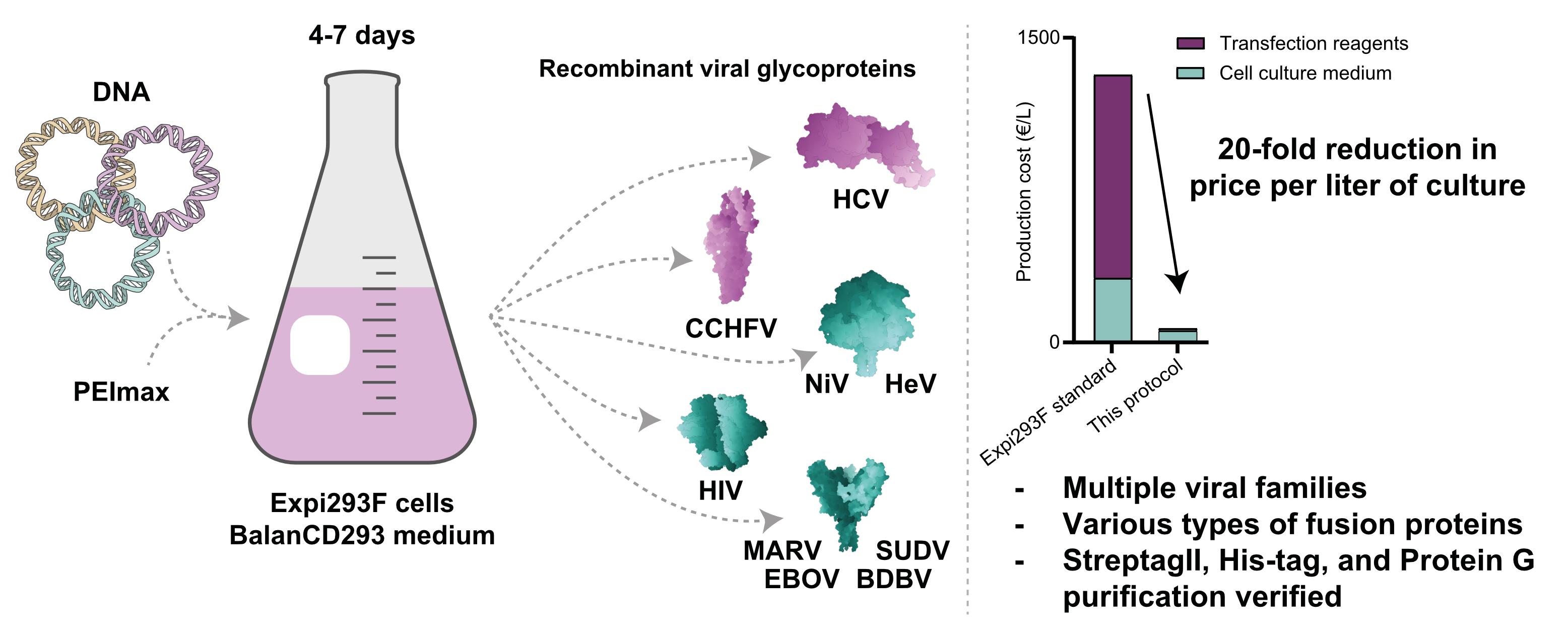
VGPs are often flexible and multimeric in nature, which can make achieving their native form difficult. Their main function of receptor engagement and membrane fusion hinges on a metastable protein complex that can exist in different conformations, often pH- or host protease-dependent [6–10]. Three classes of viral fusion proteins have been described, each with its own fusion mechanism. Humoral immunity is mostly effective against the protein conformation present at the surface of a virion prior to infection, less so against the conformations that arise after receptor engagement, during refolding, or after membrane fusion [11]. This conformational diversity greatly complicates manufacturability of a stable, unchanging, native-like glycoprotein. A second aspect that complicates the manufacturability of VGPs is the glycans present on their surface. Glycans form immunological shields against the host immune system, are frequently involved in the early stages of receptor binding, and are therefore essential to be correctly displayed on recombinant proteins in research or clinical settings [12]. Not all host species glycosylate their proteins, nor do glycosylating species do so identically. This quickly limits the production cell lines available for manufacturing VGPs to a human origin [12]. Combining these characteristics, flexible, multimeric, and correctly glycosylated VGPs are difficult to produce. Mammalian suspension cell lines, such as Expi293F cells, are paramount to purifying enough protein to allow downstream analyses. However, the associated consumable costs make employing these cell lines untenable for many labs. Here, we describe a low-cost production of VGPs in Expi293F cells without expensive investments beyond basic suspension cell culture equipment (Figure 1).
This protocol builds upon the work described by Zhou et al. [1] and Hederoth et al. [2], in which the cost-effectiveness of antibody production in Expi293F cells was optimized by using PEImax as the transfection reagent and BalanCD293 as the growth medium. They compared the use of PEImax and BalanCD293 with the efficient but expensive ExpiFectamine293 and Expi293F expression media, which are sold specifically for Expi293F culture. We have expanded on their work by producing numerous VGPs from a variety of species and adopted these principles to develop 15 mL Expi293F cultures that allow for sufficient purified recombinant VGPs. Additionally, our protocol details other avenues of long-term cost reduction and reduced environmental impact, such as the use of reusable glass culturing flasks and reusable plastic buckets for centrifugation. Our protocol is limited by its scope, as production yield per liter of culture is only one of the first steps in characterization of a recombinant VGP. While having a yield at all is necessary to start, yield by itself is a poor indicator of protein quality. VGP yields are not primarily dictated by production conditions, but rather by inherent protein complexity. Protein-specific optimization could combat or reduce complexity but needs to be assessed on a protein-individual basis. Several of the protein stability optimizations used for constructs produced in this protocol are described, though not exhaustively, by Rutten et al. [13] for filovirus GP stabilization, Loomis et al. [14] for henipavirus F stabilization, Sanders et al. [15] for HIV Env stabilization, and Capella-Pujol et al. [16] for HCV E1E2 stabilization. Like Zhou et al. [1] and Hederoth et al. [2], we have successfully used this protocol to produce monoclonal antibodies (mAbs) and Fabs at comparable yields. The diversity of VGPs we produce here suggests other proteins requiring mammalian expression could also be produced using our protocol.
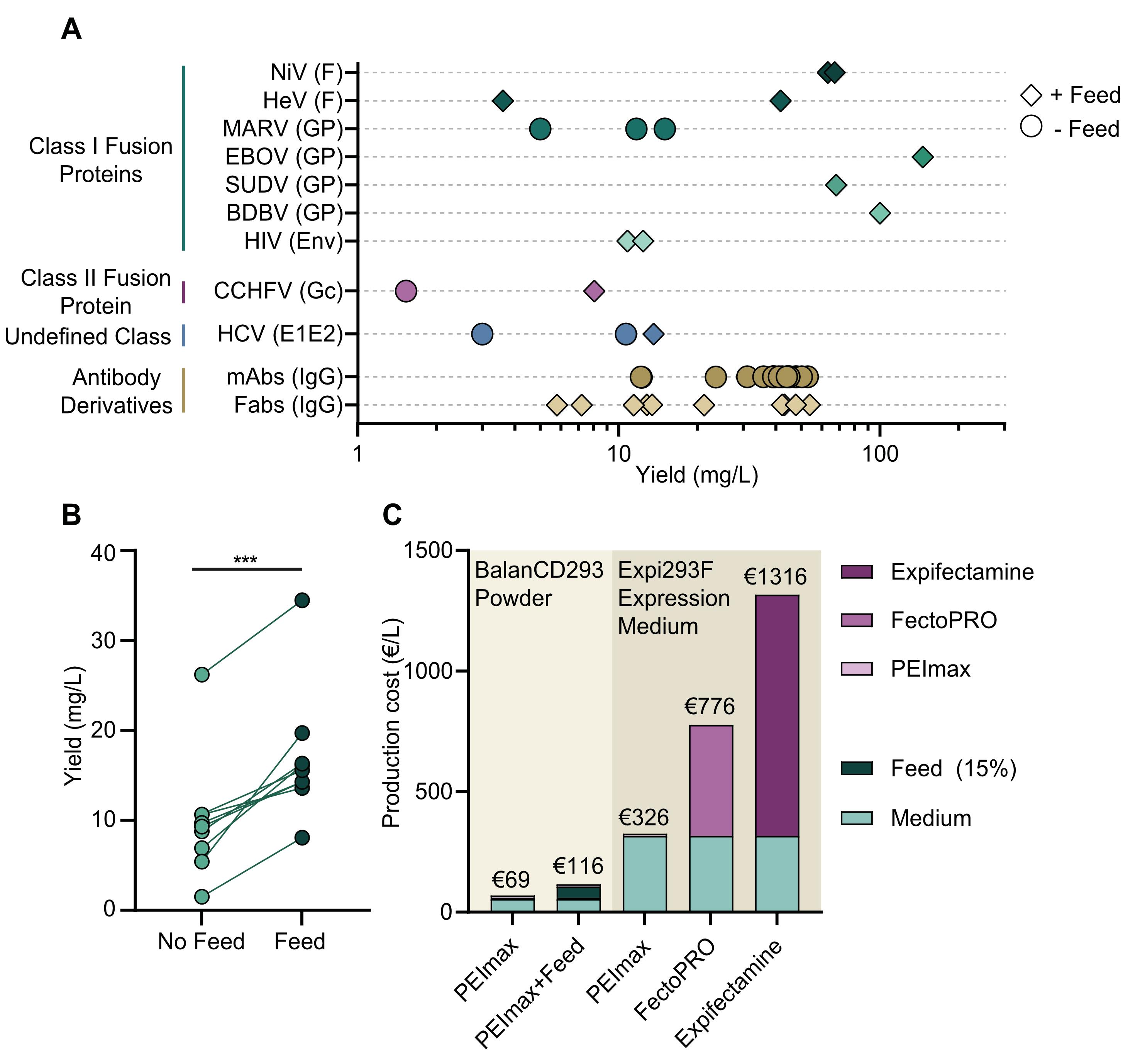
Figure 1. Viral surface glycoproteins from several families can be produced cost-effectively. (A) Production yield in milligrams of protein per liter of culture of glycoproteins derived from several viral families, with (diamond) or without feed (circle), and scaled from various smaller cultures. All data points shown are single biological replicates. Nipah virus (NiV), Hendra virus (HeV), Marburg virus (MARV), Zaire ebolavirus (EBOV), Sudan ebolavirus (SUDV), Bundibugyo ebolavirus (BDBV), human immunodeficiency virus (HIV), Crimean–Congo hemorrhagic fever virus (CCHFV), hepatitis C virus (HCV), monoclonal antibodies (mAbs), Fab-arm only antibodies (Fab), fusion protein (F), glycoprotein (G), envelope (Env), glycoprotein C/N-terminal (Gc/n), envelope protein 1 and 2 (E1E2). See General note 5 for elaboration on viral species. (B) Increased production yields by using BalanCD293 Feed of several unspecified VGPs and mAbs. ***p < 0.005 by paired t-test. (C) Cost of transfection in EUR per liter of Expi293F culture for various commercial options as of August 2026 at our location (the Netherlands).
Materials and reagents
Biological materials
1. Expi293F cells (Thermo Fisher, Gibco, catalog number: A14527)
Reagents
1. BalanCD 293 powder (Fuji Film, catalog number: 94137), storage: 4 °C
2. BalanCD feed (Fuji Film, catalog number: 91166), storage: 4 °C
3. L-glutamine (200 mM) (Fuji Film, catalog number: 9317), storage: -20 °C
4. Sodium bicarbonate (NaHCO3) (Sigma-Aldrich, catalog number: S5761)
5. PEImax hydrochloride (Kyfora Bio, catalog number: 24765-1)
6. OptiMEM (Gibco, catalog number: 31985-054), storage: 4 °C
7. Trypan Blue (Sigma-Aldrich, catalog number: T8154)
8. Hydrogen chloride (HCl) (Millipore, catalog number: 1.00317.1011)
Caution: This chemical is corrosive.
9. 70% ethanol (Added Pharma, catalog number: ROL1642610)
Caution: This chemical is flammable.
10. Ultrapure water (Elga, Purelab flex)
Optional reagents
11. Salmon semen DNA (Invitrogen, catalog number: 15632011)
12. Sodium azide (Sigma-Aldrich, catalog number: S2002)
Caution: This chemical is toxic.
13. Valproic acid (Sigma-Aldrich, catalog number: P4543)
Caution: This chemical is corrosive.
14. Peptone (Sigma-Aldrich, catalog number: P4963)
15. Glucose (Sigma-Aldrich, catalog number: G6152)
16. StraptactinXT beads (iba, catalog number: 2-5010-010)
17. Protein G beads (Thermo Fisher, catalog number: 20397)
18. Ni Sepharose excel resin (Cytiva, catalog number: 17371201)
Solutions
1. BalanCD Culture medium (see Recipes)
2. PEImax transfection reagent (see Recipes)
Recipes
1. BalanCD culture medium
| Reagent | Final concentration | Quantity or volume |
|---|---|---|
| BalanCD powder | 21.32 g/L | 213.2 g |
| NaHCO3 | 2.2 g/L | 22 g |
| L-Glutamine (200 mM stock) | 4 mM | 200 mL |
| Ultrapure water | n/a | 9.8 L |
| Total | n/a | 10 L |
Note: BalanCD293 is also available as a liquid, but the powdered form is more cost-effective. Preparation of the medium is also described by the manufacturer and can be done at room temperature [17].
a. Add 21.32 g/L BalanCD 293 powder medium to ultrapure water in an appropriately sized container.
Critical: Do not use demiwater.
b. Mix the solution at 300–350 rpm for 10 min or until the powder is fully dissolved.
Note: The solution may still appear cloudy at this stage.
c. Add 2.20 g/L NaHCO3 to the solution and mix at 300 rpm.
d. Adjust pH to 6.7–7.4 with HCl if needed.
e. Supplement with 20 mL/L of 200 mM L-Glutamine.
Note: L-Glutamine 200 mM should be kept at -20 °C prior to use and should be used within two weeks when stored at 4 °C.
f. Filter-sterilize through a 0.22 μm Steritop filter into a sterile bottle.
Critical: Filter inside a laminar flow hood or add/remove Steritop inside a laminar flow hood only.
Critical: Use one Steritop filter per 5 L of medium maximum, as more volume can compromise the membrane.
Note: The solution can be stored in the fridge (4 °C) for up to 1 year.
2. PEImax transfection reagent
| Reagent | Final concentration | Quantity or volume |
|---|---|---|
| PEImax hydrochloride (MW 40,000) | 1 g/L | 100 mg |
| HCl (37%) | n/a | Until pH 7.0 |
| Ultrapure water | n/a | 100 mL |
| Total | 100 mL |
a. Weigh 0.1 g of PEImax hydrochloride (MW 40,000).
b. Dissolve in 100 mL of ultrapure water.
c. Set pH to 7.0 using 37% HCl.
Note: pH affects transfection efficiency.
Caution: This chemical is corrosive.
d. Filter-sterilize using 0.22 μm filters and aliquot in the flow hood using sterile tubes.
Note: Aliquots of 1–5 mL are recommended.
e. Store at -20 °C for up to 2 years.
f. Can be stored at 4 °C for a week.
Note: Refreezing PEImax solution is not recommended.
Laboratory supplies
1. Tubes (sterile: to hold reagents during transfection; non-sterile: to store small volumes of clarified supernatant): 1.2 mL cryovials (Sarstedt, catalog number: 72.377), 1.5 mL Eppendorf (Sarstedt, catalog number: 72.069.001), 15 mL tubes (Sarstedt, catalog number: 62.554.502), 5 mL tubes (Eppendorf, catalog number: 0030119401), and 50 mL tubes (Sarstedt, catalog number: 62.547.254)
2. Pipette tips (sterile and non-sterile: to transfer small volumes): 10 μL (Greiner, catalog number: 771354), 20 μL (Greiner, catalog number: 775355), and 1,000 μL (Greiner, catalog number: 778354)
3. Serological pipettes (sterile and non-sterile: to transfer larger volumes): 5 mL (Corning, catalog number: 4051), 10 mL (Corning, catalog number: 4101), 25 mL (Corning, catalog number: 4251), and 50 mL (Corning, catalog number: 4501)
4. Centrifugation vessels (non-sterile: to centrifuge supernatant during harvesting): 250 mL plastic (Nalgene, catalog number: 3141-0250), 1 L plastic (Hettich, catalog number: 4239), and 2 L plastic (Hettich, catalog number: 550)
5. Syringes (sterile or non-sterile: to filter-sterilize transfection mix; sterile recommended): 5 mL (BD, catalog number: 309649), 10 mL (BD, catalog number: 300912), 20 mL (BD, catalog number: 300629), 30 mL (BD, catalog number: 301229), and 50 mL (BD, catalog number: 300865)
6. Filters (sterile: to filter-sterilize prepared BalanCD 293, transfection mix, and supernatant during harvesting): syringe filter 0.2 μm (Cytiva, catalog number: 10462200), Steritop 0.22 μm (Millipore, catalog number: S2GPT05RE), AcroPrep 24-wells 0.22 μm (Cytiva, catalog number: 97026), and Spin-X 0.22 μm (Costar, catalog number: 8160)
7. Culturing vessels (sterile: to culture Expi293F cells): 50 mL mini-bioreactors (Greiner, catalog number: 227245), 125 mL Plastic (Corning, catalog number: 431405), 250 mL plastic (Corning, catalog number: 431407), 500 mL plastic (Corning, catalog number: 431401), 1,000 mL plastic (Corning, catalog number: 431147), 2,000 mL plastic (Corning, catalog number: 431256), 250 mL glass (DWK Life Sciences, catalog number: 212833655), 500 mL glass (DWK Life Sciences, catalog number: 212834454), and 1,000 mL glass (DWK Life Sciences, catalog number: 212835459)
8. Bottles (sterile or non-sterile: to store supernatant after filtering/prior to purification; sterile recommended): 150 mL plastic (Corning, catalog number: 431175), 250 mL plastic (Corning, catalog number: 430281), 500 mL plastic (Corning, catalog number: 430282), 1,000 mL plastic (Corning, catalog number: 430518), 250 mL glass (VWR, catalog number: 215-1593), 500 mL glass (VWR, catalog number: 215-1594), and 1,000 mL glass (VWR, catalog number: 215-1595)
9. Counting slides (Bio-Rad, catalog number: 1450011) (non-sterile: to count cells during subculturing or prior to transfection)
10. pH strips (Millipore, catalog number: 1.00543.0001) (non-sterile: to measure BalanCD 293 pH)
11. 10 L buckets (Bel Art, catalog number: 15590986) (non-sterile: vessel to prepare one bottle of BalanCD 293 powder)
12. Magnetic stir bar (any brand) (non-sterile: to dissolve BalanCD 293 powder in ultrapure water)
13. 96-well plate U bottom (Sarstedt, catalog number: 53.3926) (non-sterile: to prepare Trypan Blue mixture prior to cell counting)
14. Tube rack (any brand) (non-sterile: used to hold tubes within or outside the flow hood)
Equipment
1. Incubator (Eppendorf, Newbrunswick S41i) (for culturing Expi293F cells) with mini-bioreactor rack insert (Eppendorf, model: M1289-0060) and sticky pads for flask culture (Eppendorf, model: M1250-9700)
2. Laminar flow hood (BioVanguard, Greenline) (for all handling of Expi293F cells, see General note 1)
3. Cell counter (Bio-Rad, model: TC20) (to count cells prior to subculturing or transfection)
4. Microscope (any brand) (to visually inspect cell health)
5. Water bath (Lauda, model: LD0726) (to prewarm culturing medium)
6. Fridge 2–8 °C (any brand) (to store culturing medium)
7. -20 °C freezer (any brand) (to store prepared PEImax solution)
8. -150 °C freezer (PHCBI, model: MDF-1156-PE) (to store Expi293F aliquots)
9. Pipettes (to transfer liquids within or outside the laminar flow hood): 2–20 μL (Gilson Pipetman), 20–200 μL (Gilson Pipetman), 100–1,000 μL (Gilson Pipetman), and Pipetboy (Hirschmann, Pipetus)
10. Stir plate (Heidolph, model: MR3002) (to dissolve BalanCD 293 powder in ultrapure water)
11. Vacuum pump (KNF Laboport, model: N840) (to filter-sterilize BalanCD 293 medium or cell supernatant)
12. Autoclave (HMC, model: HV85L) (to decontaminate biological waste)
13. Ultrapure water machine (Elga, Purelab flex) (to use for dissolving PEImax and BalanCD 293 powder)
14. Centrifuge (to centrifuge culture volumes during harvest): ≤250 mL buckets (Hettich, model: Rotanta 460R) and ≥250 mL buckets (Hettich, model: Roto Silenta 930 RS)
15. Centrifuge rotors (several sizes to accommodate several vessels): 15 or 50 mL tubes (Hettich, model: Rotanta 460R, Rotor 5699-R), 250 mL buckets (Hettich, model: Rotanta 460R, Rotor 5646), and 1 and 2 L buckets (Hettich, model: Roto Silenta 930 RS, Rotor 4176)
16. Scale(s) to measure 1 mg to 500 g (any brand) (to weigh PEImax and BalanCD 293 powder)
17. Mr. Frosty (Nalgene, model: 5100-0001) (to freeze Expi293F when storing aliquots)
18. NanoDrop One (Thermo Fisher, model: ND-ONE-W)
Procedure
登录 / 注册后阅读全文
文章信息
稿件历史记录
提交日期: Aug 26, 2026
接收日期: Oct 26, 2026
在线发布日期: Nov 18, 2026
出版日期: Dec 5, 2026
版权信息
© 2026 The Author(s); This is an open access article under the CC BY license (https://creativecommons.org/licenses/by/4.0/).
如何引用
Nijhuis, H., Oeverdieck, S., Snitselaar, J. L., Mulder, F., Olijhoek, W., Peters, S., Capella-Pujol, J., Silva, C. M., Bontjer, I., Caniels, T. G., van Gils, M. J., Sanders, R. W. and Sliepen, K. (2026). Cost-Effective Transient Expression of Viral Glycoproteins Using Mammalian Expi293F Cells. Bio-protocol 16(23): e5899. DOI: 10.21769/BioProtoc.5899.

 Download Citation in RIS Format
您对这篇实验方案有问题吗?
在此处发布您的问题,我们将邀请本文作者来回答。同时,我们会将您的问题发布到Bio-protocol Exchange,以便寻求社区成员的帮助。
 发布问题


