


Optimized Method for Studying Inflammasome Activation in Human Monocytes/Macrophages Derived From CRISPR-Engineered Cord Blood CD34+ Progenitors

(§Technical contact: maha.kamel@adelaide.edu.au) 发布: 2026年12月05日第16卷第23期 DOI: 10.21769/BioProtoc.5898 浏览次数: 30
评审: Durai SellegounderVigneshwari KumarKalpana Kalyanasundaram Bhanumathy
 PDF
 Q&A





Abstract
Monocytes and macrophages are key innate immune cells that can potently activate inflammasomes, including NLRP3, to promote the maturation and release of interleukin-1β (IL-1β) and other pro-inflammatory mediators. There is increasing recognition that monocyte-derived IL-1β drives many disease processes, including certain cancers, but techniques to study this regulation are lacking. Historically, inflammasome studies commonly use immortalized cell lines or murine macrophages, and direct editing of mature human monocytes is inefficient and hampered by limited proliferation. Here, we describe a primary human monocyte/macrophages model derived from differentiated CRISPR/Cas9-edited cord blood CD34+ hematopoietic stem/progenitor cells using TET2 disruption as an example. Editing is validated by polymerase chain reaction, Sanger sequencing, TIDE analysis, and western blotting, while monocyte/macrophage differentiation is confirmed by monitoring loss of CD34 and gain of CD14 expression. Inflammasome-associated responsiveness is evaluated by LPS/ATP stimulation and measurement of cellular NLRP3 and secreted mature IL-1β. This scalable, donor-matched protocol avoids direct manipulation of mature primary monocytes and macrophages and can be adapted to investigate other genetic alterations to study human inflammatory responses.
Key features
• Differentiation of CRISPR-engineered human stem/progenitor cells into functionally responsive monocytes/macrophages capable of exhibiting inflammasome responses.
• Generation of donor matched TET2-edited and AAVS1-edited control monocytes/macrophages.
Keywords: Inflammasome NLRP3
IL-1β
CRISPR/Cas9
Monocytes
Macrophages
TET2
HSPC
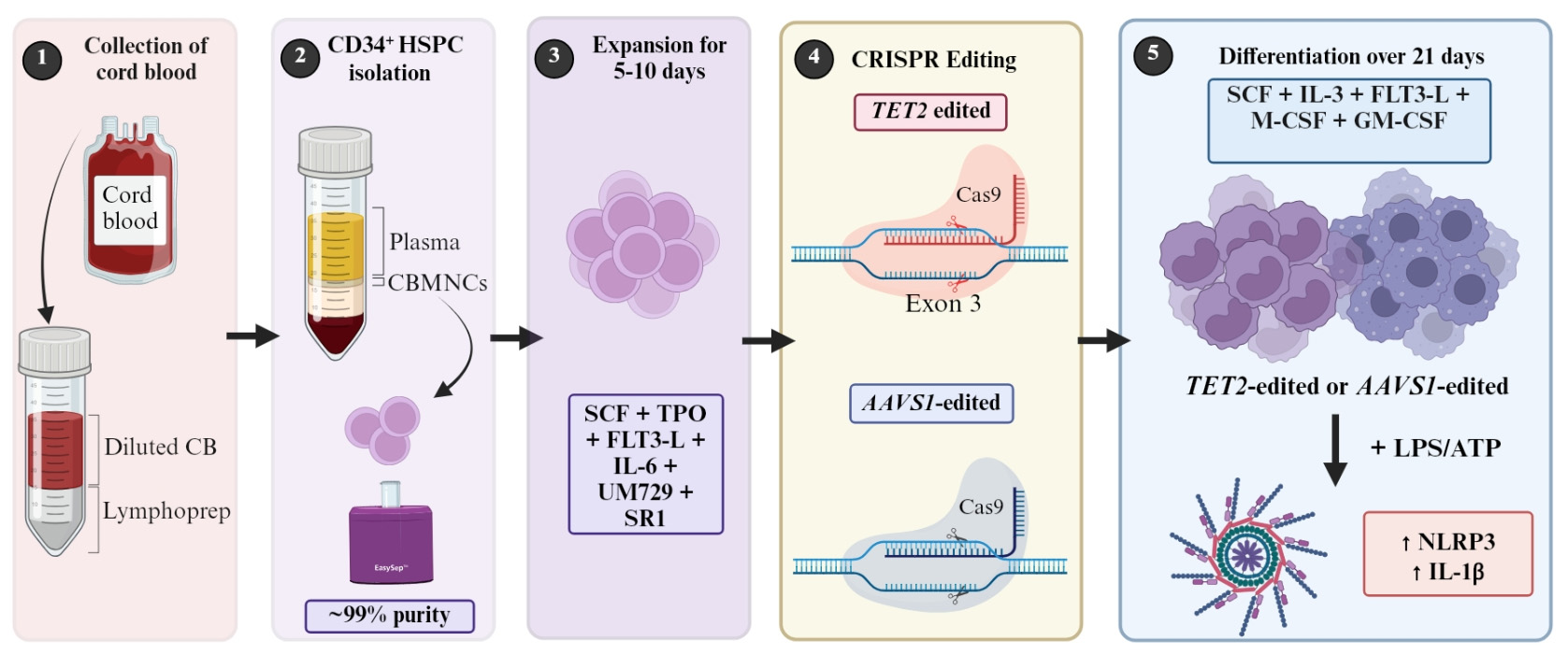
Graphical overview
Background
Monocytes and macrophages (mono/mac) are central components of innate immunity [1]. One of their key immune functions is to initiate and amplify inflammation in response to microbial and danger signals through the activation of inflammasomes, such as NLR family pyrin domain containing 3 (NLRP3), which promotes the maturation and release of interleukin-1 beta (IL-1β) [2]. Studies of NLRP3 inflammasome activation have commonly used murine bone marrow–derived macrophages and established human myeloid cell lines such as THP-1. However, these models may not fully recapitulate primary human mono/mac biology and signaling responses and are complicated by cancer-associated genetic backgrounds in THP-1 cells [3]. Studying the genetic regulation of inflammatory and inflammasome responses directly in primary human mono/mac is technically challenging due to their resistance to genetic manipulation and hypersensitivity to any exogenous stimuli or manipulation. As critical drivers of innate immunity, these myeloid cells utilize dense networks of nucleic acid sensors and restriction factors that trigger profound cytotoxicity or premature pyroptosis when exposed to foreign genetic material [4,5]. In addition, even with the limited number of successfully edited primary mono/mac, their limited proliferative capacity ex vivo prevents the expansion or enrichment of these engineered cells [6].
Editing hematopoietic stem and progenitor cells (HSPCs) before myeloid differentiation provides a practical strategy to circumvent these limitations. HSPCs can be expanded, genetically modified, and differentiated into mono/mac. Previous studies have demonstrated that HSPC-derived myeloid cells could acquire mono/mac-associated morphology and immunophenotypes and exhibit functions such as phagocytosis, cytokine production, and antigen presentation [7–9]. However, the reported protocols differ considerably in HSPC source, culture strategy and duration, mono/mac yield, and functional maturity. In addition, none of these HSPC-derived differentiation protocols specifically investigated inflammasome activation or established these cells as a model for assessing inflammasome responses following genetic modification. CRISPR/Cas9 editing at the HSPC stage therefore provides an opportunity to introduce genetic alterations before myeloid differentiation and subsequently investigate their effects on inflammasome function in donor-matched differentiated progeny.
This model is particularly relevant to TET2, an epigenetic regulator that contributes to the resolution of inflammatory responses and restrains inflammatory gene expression in macrophages [10,11]. TET2-deficient murine macrophages exhibit increased NLRP3 inflammasome-mediated IL-1β secretion, supporting the NLRP3/IL-1β pathway as a biologically relevant functional readout of TET2 disruption [12]. Mutations in TET2 are the second most common cause of clonal hematopoiesis of indeterminate potential present in >15% of elderly persons and are associated with a hyper-inflammatory state resulting in premature cardiovascular disease and increased risk of blood cancers [13,14].
This protocol establishes a scalable human platform for evaluating the functional impact of gene disruption on inflammasome responses in HSPC-derived mono/mac. By combining CRISPR/Cas9 editing in cord blood (CB) HSPCs, followed by a combination of macrophage colony-stimulating factor (M-CSF) and granulocyte-macrophage colony-stimulating factor (GM-CSF) differentiation regimen, we successfully generated genetically engineered mono/ mac lineages. Subsequent stimulation with lipopolysaccharide (LPS) and adenosine triphosphate (ATP) permits robust inflammasome activation. This approach allows for a direct, controlled comparison between gene-edited and wild-type cells generated from the same donor, reducing inter-donor genetic background variability.
Materials and reagents
Biological materials
1. Cord blood
2. CD34+ HSPC
3. HSPC-derived mono/mac
Reagents
1. 100-bp DNA ladder (New England Biolabs, catalog number: N3231L)
2. 2-Mercaptoethanol, ≥98% (Bio-Rad Laboratories, catalog number: 1610710)
3. 4′,6-Diamidino-2-phenylindole (DAPI) (Sigma-Aldrich, catalog number: D9542)
4. Acetic acid, glacial AR (Chem Supply, catalog number: AA009)
5. Adeno-associated virus integration site 1 (AAVS1) single-guide RNA (sgRNA) (Integrated DNA Technologies; see step D7)
6. Adenosine 5′-triphosphate (ATP) solution, 100 mM (Thermo Fisher Scientific, catalog number: R0441)
7. Agarose, low-EEO, molecular biology grade (Sigma-Aldrich, catalog number: A6013)
8. Ammonium bicarbonate, ReagentPlus, ≥99.0% (NH4HCO3) (Sigma-Aldrich, catalog number: A6141)
9. Ammonium chloride, ReagentPlus, ≥99.5% (NH4Cl) (Sigma-Aldrich, catalog number: A4514)
10. APC-conjugated anti-human CD14 REAfinity antibody, clone REA599 (Miltenyi Biotec, catalog number: 130-110-520)
11. APC-conjugated mouse anti-human CD34 antibody, clone 8G12 (BD Biosciences, catalog number: 340441)
12. β-Actin (13E5) rabbit monoclonal antibody (Cell Signaling Technology, catalog number: 4970)
13. Bovine serum albumin (BSA), lyophilized powder, BioReagent, suitable for cell culture (Sigma-Aldrich, catalog number: A9418)
14. Clarity Western enhanced chemiluminescence (ECL) substrate (Bio-Rad Laboratories, catalog number: 1705061)
15. Cleaved-IL-1 β (IL-1β) (Asp116) (D3A3Z) rabbit monoclonal antibody (Cell Signaling Technology, catalog number: 83186)
16. DC Protein Assay kit (Bio-Rad, catalog number: 5000111)
17. Deoxynucleoside triphosphate (dNTP) mix (25 mM each) (Thermo Fisher Scientific, catalog number: R1121)
18. Deoxyribonuclease I (DNase I), grade II, from bovine pancreas (Roche, catalog number: 10104159001)
19. Dimethyl sulfoxide (DMSO) (Sigma-Aldrich, catalog number: D4540)
20. DPBS (10×), without calcium, magnesium, or phenol red (Gibco, catalog number: 14200166)
21. EasySepTM Human Cord Blood CD34 Positive Selection Kit III (STEMCELL Technologies, catalog number: 17897)
22. Ethylenediaminetetraacetic acid disodium salt dihydrate (EDTA-Na2·2H2O) (Sigma-Aldrich, catalog number: E4884)
23. Fetal bovine serum (FBS) (PAN-Biotech, catalog number: P30-19475)
24. Gel loading dye, purple, 6× (New England Biolabs, catalog number: B7025S)
25. GelRed® nucleic acid gel stain, 10,000× in water (Biotium, catalog number: 41003)
26. Goat anti-rabbit IgG (H+L) secondary antibody, horseradish peroxidase (HRP)-conjugated (Thermo Fisher Scientific, catalog number: 31460)
27. GoTaq DNA polymerase (Promega, catalog number: M3005)
28. Glycine (Sigma-Aldrich, catalog number: G8898)
29. Hydrochloric acid (HCl), 32%, analytical reagent grade (RCI Labscan Limited, catalog number: RP1104-P-2.5L)
30. Human recombinant Flt3/Flk-2 ligand, E. coli–expressed (STEMCELL Technologies, catalog number: 78009)
31. Human recombinant granulocyte-macrophage colony-stimulating factor (GM-CSF) (STEMCELL Technologies, catalog number: 78015)
32. Human recombinant interleukin-3 (IL-3) (STEMCELL Technologies, catalog number: 78040)
33. Human recombinant interleukin-6 (IL-6) (STEMCELL Technologies, catalog number: 78050)
34. Human recombinant macrophage colony-stimulating factor (M-CSF) (STEMCELL Technologies, catalog number:78057)
35. Human recombinant stem cell factor (SCF) (STEMCELL Technologies, catalog number: 78062)
36. Human recombinant thrombopoietin (TPO) (STEMCELL Technologies, catalog number: 78210.1)
37. Human TruStain FcXTM Fc-receptor blocking solution (BioLegend, catalog number: 422302)
38. IGEPAL CA-630, an NP-40 substitute (Sigma-Aldrich, catalog number: I3021)
39. Iscove’s modified Dulbecco’s medium (IMDM) (PAN-Biotech, catalog number: P04-20450)
40. Laemmli sample buffer (4×) (Bio-Rad Laboratories, catalog number: 1610747)
41. L-Glutamine, 200 mM (Sigma-Aldrich, catalog number: 59202C)
42. Lipopolysaccharide (LPS) solution, 500× (Thermo Fisher Scientific, eBioscience, catalog number: 00-4976-93)
43. LymphoprepTM (STEMCELL Technologies, catalog number: 07801)
44. Magnesium chloride (MgCl2), 25 mM (Promega, catalog number: A3511)
45. Methanol (Chem Supply, catalog number: MA004)
46. Methyl violet (CI 42535) (Chem Supply, catalog number: ML055)
47. NLRP3 (D4D8T) rabbit monoclonal antibody (Cell Signaling Technology, catalog number: 15101)
48. Nuclease-free water (Qiagen, catalog number: 129115)
49. P3 Primary Cell 4D-Nucleofector X Kit S (Lonza, catalog number: V4XP-3032)
50. PCR forward and reverse primers (Integrated DNA Technologies; sequences provided in Table 1)
Table 1. Primer sequences used for PCR amplification of CRISPR/Cas9-targeted TET2 and AAVS1 loci
| Target gene | Primer | Sequence | PCR product size |
| TET2 | Forward | CAAGCGGAATCCCATCTAAA | 859 bp |
| Reverse | GGGTCTTGTTTCCTGCAAAA | ||
| AAVS1 | Forward | ATTCGGGTCACCTCTCACTC | 557 bp |
| Reverse | CAGGGTGGCCACTGAGAA |
51. PierceTM bovine serum albumin standard ampoules, 2 mg/mL (Thermo Fisher Scientific, catalog number: 23209)
52. Precision Plus ProteinTM KaleidoscopeTM standards (Bio-Rad Laboratories, catalog number: 161-0395)
53. Propan-2-ol (Chem supply, catalog number: PA013-2.5L-P)
54. Quick Extract DNA extraction solution (Lucigen, catalog number: QE09050)
55. Sodium chloride (NaCl) (Sigma-Aldrich, catalog number: S9888)
56. Sodium deoxycholate (Sigma-Aldrich, catalog number: D6750)
57. Sodium dodecyl sulfate (SDS) (Sigma-Aldrich, catalog number: 75746)
58. Sodium hydroxide (NaOH) (Sigma-Aldrich, catalog number: 55881)
59. StemRegenin 1 (SR1) (STEMCELL Technologies, catalog number: 72342)
60. StemSpan Serum-Free Expansion Medium II (SFEM II) (STEMCELL Technologies, catalog number: 09655)
61. Streptococcus pyogenes Cas9 containing two nuclear localization signals (SpCas9-2NLS) nuclease, 1,000 pmol (Synthego)
62. Ten-eleven translocation 2 (TET2) sgRNA1 and sgRNA2 (Integrated DNA Technologies; sequences provided in Table 2)
Table 2. sgRNA and protospacer-adjacent motif (PAM) sequences used for CRISPR/Cas9 targeting of TET2 and AAVS1 [15]
| Target gene | sgRNA | Sequence | PAM |
| TET2 | sgRNA1 | GCTCATGTGCAGTCACTGTG | TGG |
| sgRNA2 | CAAGTGCTGTTTCAACACTG | GGG | |
| AAVS1 | sgRNA | GGGGCCACTAGGGACAGGAT | TGG |
63. TET2 (D6B9Y) rabbit monoclonal antibody (Cell Signaling Technology, catalog number: 18950)
64. Trizma base, BioPerformance certified (Sigma-Aldrich, catalog number: T6066)
65. True-stain monocyte blocker (BioLegend, catalog number: 426102)
66. Trypan Blue solution, 0.4% (Gibco, catalog number: 15250-061)
67. TrypLE Express Enzyme (1×), no phenol red (Gibco, catalog number: 12604013)
68. Tween 20 (Sigma-Aldrich, catalog number: P2287)
69. UM729 (STEMCELL Technologies, catalog number: 72332)
Solutions
1. EDTA (0.5 M) (see Recipes)
2. Blood dilution buffer (see Recipes)
3. Red blood cell (RBC) lysis buffer (see Recipes)
4. White cell fluid (WCF) (see Recipes)
5. Freezing media (see Recipes)
6. Thawing media (see Recipes)
7. HSPC expansion medium (see Recipes)
8. Mono/mac differentiation medium (see Recipes)
9. FACS buffer (see Recipes)
10. TAE buffer (see Recipes)
11. Radioimmunoprecipitation assay (RIPA) buffer (see Recipes)
12. SDS-PAGE running buffer (see Recipes)
13. Transfer buffer (see Recipes)
14. TBS (see Recipes)
15. TBST (see Recipes)
Recipes
1. EDTA (0.5 M)
| Reagent | Final concentration | Quantity or volume |
|---|---|---|
| EDTA | 0.5 M | 37.224 g |
| NaOH (4 M) | Adjust pH to 8 | n/a |
| Sterile MilliQ water | n/a | n/a |
| Total | n/a | 200 mL (see General note 1) |
Store at room temperature for up to 6 months.
2. Blood dilution buffer
| Reagent | Final concentration | Quantity or volume |
|---|---|---|
| EDTA (see Recipe 1) | 2 mM | 4 mL |
| DPBS (10×) | 1× | 100 mL |
| Sterile MilliQ water | n/a | 896 mL |
| Total | n/a | 1,000 mL (see General note 1) |
Store at room temperature for up to 2 months.
3. RBC lysis buffer
| Reagent | Final concentration | Quantity or volume |
|---|---|---|
| NH4HCO3 | 10 mM | 0.791 g |
| NH4Cl | 144 mM | 7.703 g |
| Sterile MilliQ water | n/a | Bring to a final volume of 1,000 mL |
| Total | n/a | 1,000 mL (see General note 1) |
Store at room temperature for up to 6 months.
4. White cell fluid (WCF)
| Reagent | Final concentration | Quantity or volume |
|---|---|---|
| Glacial acetic acid | 2% | 1 mL |
| Methyl violet | A few crystals to produce a pale violet solution | n/a |
| MilliQ water | n/a | 49 mL |
| Total | n/a | 50 mL |
Store at room temperature for up to 6 months.
5. Freezing media
| Reagent | Final concentration | Quantity or volume |
|---|---|---|
| FBS | 90% | 9 mL |
| DMSO | 10% | 1 mL |
| Total | n/a | 10 mL (see General note 2) |
Prepare fresh before use.
6. Thawing media
| Reagent | Final concentration | Quantity or volume |
|---|---|---|
| FBS | 20% | 2 mL |
| DNAse I (100 mg/mL) | 100 μg/mL | 10 μL |
| IMDM | n/a | 7.99 mL |
| Total | n/a | 10 mL (see General note 2) |
Prepare fresh before use.
7. HSPC expansion medium
| Reagent | Final concentration | Quantity or volume |
|---|---|---|
| L-Glutamine (200 mM) | 2 mM | 500 μL |
| SCF (50 μg/mL) | 50 ng/mL | 50 μL |
| TPO (100 μg/mL) | 20 ng/mL | 10 μL |
| FLT3-L (100 μg/mL) | 20 ng/mL | 10 μL |
| IL-6 (100 μg/mL) | 20 ng/mL | 10 μL |
| UM729 (10 mM) | 1.75 μM | 8.75 μL |
| SR1 (1 mM) | 300 nM | 15 μL |
| Stemspan SFEM II | n/a | Bring to a final volume of 50 mL |
| Total | n/a | 50 mL (see General note 2) |
Store at 2–8 °C for up to 2 weeks.
8. Monocyte/macrophage differentiation media
| Reagent | Final concentration | Quantity or volume |
|---|---|---|
| FBS | 10% | 5 mL |
| L-Glutamine (200 mM) | 2 mM | 500 μL |
| SCF (50 μg/mL) | 50 ng/mL | 50 μL |
| FLT3L (100 μg/mL) | 20 ng/mL | 10 μL |
| IL-3 (100 μg/mL) | 20 ng/mL | 10 μL |
| GM-CSF (50 μg/mL) | 20 ng/mL | 20 μL |
| M-CSF (100 μg/mL) | 30 ng/mL | 15 μL |
| IMDM | n/a | Bring to a final volume of 50 mL |
| Total | n/a | 50 mL (see General note 2) |
Store at 2–8 °C for up to 2 weeks.
9. FACS buffer
| Reagent | Final concentration | Quantity or volume |
|---|---|---|
| DPBS (10×) | 1× | 100 mL |
| FBS | 2% | 20 mL |
| EDTA (see Recipe 1) | 2 mM | 4 mL |
| MilliQ water | n/a | 876 mL |
| Total | n/a | 1,000 mL |
Store at 2–8 °C for up to 1 month.
10. TAE buffer
| Reagent | Final concentration | Quantity or volume |
|---|---|---|
| Tris base | 40 mM | 4.84 g |
| Acetic acid | 20 mM | 1.142 mL |
| EDTA (see Recipe 1) | 1 mM | 2 mL |
| Reverse-osmosis (RO) water | n/a | Bring to a final volume of 1,000 mL |
| Total | n/a | 1,000 mL |
Store at room temperature for up to 1 month.
11. RIPA buffer
| Reagent | Final concentration | Quantity or volume |
|---|---|---|
| NaCl (1 M) | 150 mM | 3 mL |
| Tris-HCl (0.2 M, pH 7.6) | 25 mM | 2.5 mL |
| NP-40 | 1% | 200 μL |
| Sodium deoxycholate (10%) | 1% | 2 mL |
| SDS (10%) | 0.1% | 200 μL |
| RO water | n/a | Bring to a final volume of 20 mL |
| Total | n/a | 20 mL |
Store at 2–8 °C for up to 1 month.
12. SDS-PAGE running buffer
| Reagent | Final concentration | Quantity or volume |
|---|---|---|
| Tris base | 25 mM | 3.028 g |
| Glycine | 192 mM | 14.414 g |
| SDS | 0.1% | 1 g |
| RO water | n/a | Bring to a final volume of 1,000 mL |
| Total | n/a | 1,000 mL |
Store at room temperature for up to 1 month.
13. Transfer buffer
| Reagent | Final concentration | Quantity or volume |
|---|---|---|
| Tris base | 25 mM | 3.028 g |
| Glycine | 192 mM | 14.414 g |
| Methanol | 20% | 200 mL |
| RO water | n/a | Bring to a final volume of 1,000 mL |
| Total | n/a | 1,000 mL |
Store at 4 °C for up to 1 week.
14. TBS
| Reagent | Final concentration | Quantity or volume |
|---|---|---|
| Tris base | 20 mM | 2.423 g |
| NaCl | 150 mM | 8.766 g |
| RO water | n/a | Bring to a final volume of 1,000 mL(adjust pH to 7.5) |
| Total | n/a | 1,000 mL |
Store at room temperature for up to 1 month.
15. TBST
| Reagent | Final concentration | Quantity or volume |
|---|---|---|
| Tween 20 | 0.1% | 1 mL |
| TBS (see Recipe 14) | n/a | Bring to a final volume of 1,000 mL |
| Total | n/a | 1,000 mL |
Store at room temperature for up to 1 month.
Laboratory supplies
1. 4%–15% Criterion TGX stain-free protein gel (Bio-Rad Laboratories, catalog number: 5678084)
2. Axygen 1.7 mL Maxy Clear Snap Lock microcentrifuge tube (Corning, catalog number: MCT-175-C)
3. BD Plastipak 50 mL eccentric Luer slip tip syringes (BD, catalog number: 300866)
4. Corning 96-well tissue culture microplates (Corning, catalog number: 3596)
5. Corning Thermowell GOLD 0.2 mL polypropylene PCR tubes (Corning, catalog number: 3745)
6. Costar 6-well ultra-low attachment plates (Corning, catalog number: 3471)
7. Costar 24-well ultra-low attachment plates (Corning, catalog number: 3473)
8. EasySep Magnet (STEMCELL Technologies, catalog number: 18000)
9. Falcon 5 mL round-bottom polystyrene test tubes (Corning, catalog number: 352052)
10. Falcon 5 mL round-bottom polystyrene tubes, sterile (STEMCELL Technologies, catalog number: 38007)
11. Immobilon-P polyvinylidene fluoride transfer membrane (Merck Millipore, catalog number: IPVH00010)
12. Macopharma umbilical cord blood collection bag (Macopharma, catalog number: MSC1210PU)
13. Minisart NML sterile syringe filters, 0.2 μm (Sartorius, catalog number: 16534-K)
14. Mr. Frosty Freezing Container (Thermo Fisher Scientific, catalog number: 5100-0001)
15. Nalgene SYSTEM 100 1.5 mL general long-term storage cryogenic tube (Thermo Fisher Scientific, catalog number: 5000-1020)
16. Nunc 15 mL conical sterile polypropylene centrifuge tubes (Thermo Fisher Scientific, catalog number: 339650)
17. Nunc 50 mL conical sterile polypropylene centrifuge tube (Thermo Fisher Scientific, catalog number: 339652)
18. Samco transfer pipettes (Thermo Fisher Scientific, catalog number: 222-1S)
19. SPL 24-well cell culture plates (SPL Life Sciences, catalog number: 30024)
20. Sterile 15 mL polypropylene conical tube (SPL Life Sciences, catalog number: 50015)
21. Sterile cannulas (Fairmont Medical, catalog number: MIX1001)
22. Steritop vacuum bottle top filters, 0.22 (Merck Millipore, catalog number: S2GVT05RE)
23. Whatman Grade 3MM Chr cellulose blotting paper (Cytiva, catalog number: 3030-662)
Equipment
1. 4D-Nucleofector Core Unit and 4D-Nucleofector X Unit (Lonza)
2. AQUAline AL 25 water bath (LAUDA, model: AL 25)
3. BD FACSCanto II System with Fluidics Cart (BD Biosciences, catalog number: 338962)
4. ChemiDoc MP Imaging System (Bio-Rad Laboratories)
5. Class II, Type A2 biological safety cabinet (NuAire, model: NU-480-400E)
6. CryoCube F740hi ultra-low temperature freezer (Eppendorf, model: F740hi)
7. CX41 upright microscope (Olympus, model: CX41)
8. Digital vortex mixer (Westlab, catalog number: 664-740)
9. Dry block heater (Ratek Instruments, model: DBH30)
10. Gel Doc XR+ Gel Documentation System with Universal Hood II (Bio-Rad Laboratories)
11. Mastercycler nexus gradient thermal cycler (Eppendorf, model: 6331)
12. MediLine -20 °C laboratory freezer (Liebherr)
13. Medium rocking platform mixer, analog (Ratek Instruments, model: ERPM4)
14. PHCbi IncuSafe CO2 incubator (PHC Corporation, model: MCO-230AICL-PE)
15. PowerPac Basic Power Supply (Bio-Rad Laboratories, catalog number: 1645050)
16. Quick-spin mini centrifuge (Bioline Global, catalog number: Q57000)
17. Refrigerated microcentrifuge (Eppendorf, model: Centrifuge 5424 R)
18. Refrigerated swing bucket centrifuge (Eppendorf, model: Centrifuge 5810 R)
19. Roller mixer (Coulter Electronics Limited)
20. Starter 3100 pH bench meter (OHAUS, model: ST3100)
21. Synergy HTX Multi-Mode Microplate Reader (BioTek Instruments)
Software and datasets
1. Benchling https://www.benchling.com/
3. FlowJo v10.10.0
4. GraphPad Prism 10.1.0 (316)
5. Image Lab 5.0 (Bio-Rad)
6. Microsoft Excel 365 (Microsoft Corporation, version 2607, build 20228.20188)
7. R statistical software, version 4.4.1 (R Foundation for Statistical Computing, Vienna, Austria)
8. Tracking of Indels by Decomposition (TIDE) https://tide.nki.nl/
Procedure
登录 / 注册后阅读全文
文章信息
稿件历史记录
提交日期: Sep 6, 2026
接收日期: Nov 3, 2026
在线发布日期: Nov 23, 2026
出版日期: Dec 5, 2026
版权信息
© 2026 The Author(s); This is an open access article under the CC BY license (https://creativecommons.org/licenses/by/4.0/).
如何引用
Kamel, M., Nakauchi, Y., Robinson, N., Hiwase, D. and Thomas, D. (2026). Optimized Method for Studying Inflammasome Activation in Human Monocytes/Macrophages Derived From CRISPR-Engineered Cord Blood CD34+ Progenitors. Bio-protocol 16(23): e5898. DOI: 10.21769/BioProtoc.5898.

 Download Citation in RIS Format
您对这篇实验方案有问题吗?
在此处发布您的问题,我们将邀请本文作者来回答。同时,我们会将您的问题发布到Bio-protocol Exchange,以便寻求社区成员的帮助。
 发布问题


