


Rapid Purification of Ion-Transporter Proteins in Arabidopsis thaliana

(*Contributed equally to this work, §Technical contact: 22482385@life.hkbu.edu.hk) 发布: 2026年12月05日第16卷第23期 DOI: 10.21769/BioProtoc.5891 浏览次数: 28
评审: Yuko KuritaAbdul ShirajAnonymous reviewer(s)
 PDF
 Q&A




Abstract
Plant ion transporters are membrane-localized proteins that play critical roles in nutrient uptake and distribution, ion homeostasis, and stomatal movement. To date, the majority of research on ion transporters has focused on regulation of their activity, post-translational modifications, and endomembrane trafficking. In such work, it is often necessary to purify the full-length proteins. However, these transporters typically contain multiple transmembrane (TM) domains and exhibit low solubility, making conventional purification methods inefficient. Thus, there is an urgent need to develop simple, rapid, and cost-effective approaches for extracting and purifying these proteins. Here, we present a detailed protocol for the extraction and purification of full-length ion transporters and demonstrate its utility by isolating the Na+/H+ antiporter SOS1 and the vacuolar metal transporter NRAMP3.
Key features
• Requires no density gradient and ultracentrifugation.
• Can be completed in 50 min.
• Extracted proteins are directly compatible with western blotting.
Keywords: Arabidopsis thaliana Protein purification
Ion transporter
Plasma membrane protein
Vacuolar membrane protein
Tonoplast protein
SOS1
NRAMP3
Graphical overview
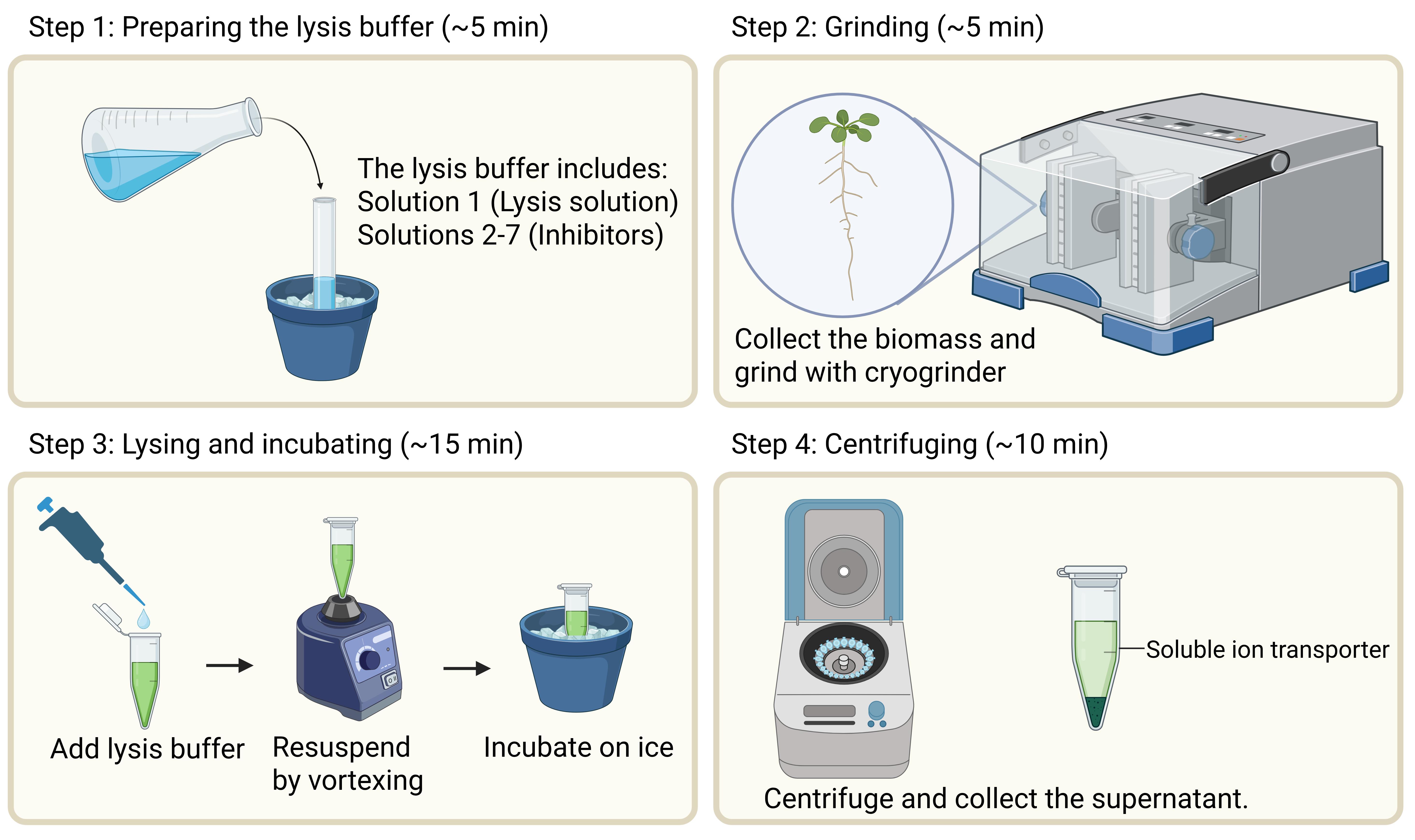
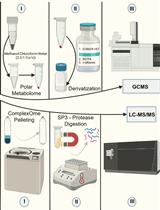
Overview of the workflow of purifying ion transporters from Arabidopsis. This protocol consists of four steps: 1) Mixing seven solutions to prepare the lysis buffer (~5 min), 2) grinding biomass (~5 min), 3) lysing and incubating (~15 min) the samples, and 4) centrifuging the mixtures (~10 min). The whole workflow can be completed within 1 h.
Background
Plant ion transporters are a class of membrane-localized proteins that play critical roles in diverse physiological processes [1]. In ion transporter studies, it is often required to purify the full-length transporter proteins [2,3]. However, ion transporters usually contain multiple transmembrane (TM) domains and exhibit low solubility, and purifying full-length plant ion transporters remains challenging. Therefore, there is an urgent need to develop a simple, rapid, and cost-effective protein extraction method.
Currently, the methods for purifying these ion transporters can be broadly categorized into two categories. The first is the two-phase partitioning method. For instance, the purification of the Na+/H+ antiporter SOS1 starts with low-speed centrifugation to remove cellular debris, followed by dextran-polyethylene glycol (PEG) ultracentrifugation [4]. While the SOS1 protein purified through this method is highly pure, the procedure involves multiple steps, is time-consuming, and is not suitable for routine experiments, such as co-immunoprecipitation (Co-IP) or phosphorylation assays. The second category is to purify the soluble fragment without transmembrane domains. For instance, when studying the phosphorylation of H+-ATPase 1 (AHA1), a common strategy is to divide full-length AHA1 into several fragments, including the soluble intracellular domains [5]. However, this strategy may miss other potential phosphorylation events that occur within the loop or TM domain. It also fails to preserve the native structure, leading to artificial folding or the unnatural exposure of cryptic residues and the generation of artifacts in biochemical assays.
Here, we synthesize and simplify several ion transporter purification protocols reported in published articles [6–8], eliminating the need for density gradients and ultracentrifugation. In contrast to the published protocols, our method provides a simpler and faster workflow with lower equipment requirements. Nevertheless, this method does not distinguish transporters from different organelles. Therefore, it should be used with caution when downstream experiments require organelle-specific ion transporters or highly purified protein preparations.
Materials and reagents
Biological materials
1. SOS1::SOS1:GFP in sos1: Transgenic Arabidopsis plants in the sos1 mutant background expressing SOS1 fused with GFP under the control of the SOS1 promoter (T2 homozygous plants were previously generated by Prof. FU Haiqi [2])
2. 35S::NRAMP3:mRFP: Transgenic Arabidopsis plants in the Col-0 background expressing NRAMP3 fused with mRFP under the control of the 35S promoter (T2 homozygous plants were generated by our laboratory)
Reagents
1. HEPES (Sigma-Aldrich, catalog number: H4034-100G)
2. NaOH (VWR, catalog number: 28244.295)
3. MgCl2 (Sigma-Aldrich, catalog number: M8266-1KG)
4. Glycerol (Sangon Biotech, catalog number: A100854-0500)
5. Triton X-100 (USBiological, catalog number: 9002-93-1)
6. NaCl (Sigma-Aldrich, catalog number: S3014-1KG)
7. NaF (Aladdin, catalog number: S111590-100G)
8. Na2MoO4 (Sigma-Aldrich, catalog number: 243655-100G)
9. Na2C4H4O6 (Sigma-Aldrich, catalog number: 6106-24-7)
10. Na3VO4 (Sigma-Aldrich, catalog number: S6508-50G)
11. DTT (Sigma-Aldrich, catalog number: 3483-12-3)
12. Protease inhibitor cocktail, mini-tablet (EDTA-free) (MCE, catalog number: HY-K0011)
13. Radioimmunoprecipitation assay buffer (Beyotime, catalog number: P0013B)
Solutions
1. HEPES-NaOH lysis solution (see Recipes)
2. 100× NaF stock (see Recipes)
3. 100× Na2MoO4 stock (see Recipes)
4. 100× Na2C4H4O6 stock (see Recipes)
5. 100× Na3VO4 stock (see Recipes)
6. 200× DTT stock (see Recipes)
7. 10× cocktail stock (see Recipes)
Recipes
1. HEPES-NaOH lysis solution (pH 7.2)
| Reagent | Final concentration | Quantity or volume |
|---|---|---|
| HEPES | 50 mM | 5.96 g |
| NaOH | 50 mM | 1.01 g |
| MgCl2 | 1.5 mM | 0.071 g |
| Glycerol | 10% (v/v) | 50 mL |
| Triton X-100 | 1% (v/v) | 5 mL |
| NaCl | 150 mM | 4.38 g |
| ddH2O | n/a | Fill up to 500 mL |
| Total | n/a | 500 mL |
Role of solution: Membrane lysis and solubilization matrix.
Vial specifics: Sterile glass bottle (500 mL).
Shelf life: 3–6 months at 4 °C.
2. 100× NaF stock (100 mM)
| Reagent | Final concentration | Quantity or volume |
|---|---|---|
| NaF | 100 mM | 0.21 g |
| ddH2O | n/a | Fill up to 50 mL |
| Total | n/a | 50 mL |
Role of solution: Acid phosphatase inhibitor.
Vial specifics: Sterile polypropylene conical tube (50 mL).
Shelf life: 3–6 months at 4 °C. Check for any precipitates before use. If present, vortex it until the precipitates are completely dissolved.
3. 100× Na2MoO4 stock (200 mM)
| Reagent | Final concentration | Quantity or volume |
|---|---|---|
| Na2MoO4 | 200 mM | 2.06 g |
| ddH2O | n/a | Fill up to 50 mL |
| Total | n/a | 50 mL |
Role of solution: Acid phosphatase inhibitor.
Vial specifics: Sterile polypropylene conical tube (50 mL).
Shelf life: 3–6 months at 4 °C. Check for any precipitates before use. If present, vortex it until the precipitates are completely dissolved.
4. 100× Na2C4H4O6 stock (400 mM)
| Reagent | Final concentration | Quantity or volume |
|---|---|---|
| Na2C4H4O6 | 400 mM | 4.60 g |
| ddH2O | n/a | Fill up to 50 mL |
| Total | n/a | 50 mL |
Role of solution: Acid phosphatase inhibitor.
Vial specifics: Sterile polypropylene conical tube (50 mL).
Shelf life: 3–6 months at 4 °C. Check for any precipitates before use. If present, vortex it until the precipitates are completely dissolved.
5. 100× Na3VO4 stock (200 mM) (optional)
| Reagent | Final concentration | Quantity or volume |
|---|---|---|
| Na3VO4 | 200 mM | 9.20 g |
| ddH2O | n/a | Fill up to 50 mL |
| Total | n/a | 50 mL |
Role of solution: Tyrosine phosphatase and alkaline phosphatase inhibitor.
Vial specifics: Sterile polypropylene conical tube (50 mL).
Shelf life: 3–6 months at 4 °C. Check for any yellow precipitates before use. If present, discard it and prepare a fresh solution.
6. 200× DTT stock (1 M)
| Reagent | Final concentration | Quantity or volume |
|---|---|---|
| DTT | 1 M | 0.15 g |
| ddH2O | n/a | Fill up to 1 mL |
| Total | n/a | 1 mL |
Role of solution: Reducing agent.
Vial specifics: Sterile polypropylene conical tube (1.5 mL)
Shelf life: 1 month at -20 °C. Aliquot into 100 μL to avoid repeated freeze/thaw cycles.
7. 10× Cocktail stock
| Reagent | Final concentration | Quantity or volume |
|---|---|---|
| Protease inhibitor cocktail tablet | n/a | 1 pellet |
| ddH2O | n/a | Fill up to 1 mL |
| Total | n/a | 1 mL |
Role of solution: Protease inhibitor.
Vial specifics: Sterile polypropylene conical tube (1.5 mL).
Shelf life: 1 month at -20 °C, protected from light. Aliquot into 100 μL to avoid repeated freeze/thaw cycles.
Laboratory supplies
1. 3 mm stainless steel grinding beads
2. 1.5 mL polypropylene conical tubes (Eppendorf, catalog number: HS4325)
3. 50 mL polypropylene conical tubes (Falcon, catalog number: 352070)
Equipment
1. Eppendorf tabletop centrifuge 5418R (Sigma-Aldrich, catalog number: EP5401000137)
2. Vortex-Genie mixer (Sigma-Aldrich, catalog number: Z258415)
3. Cryogenic grinder (Jingxin, catalog number: JXFSTPRP-24)
Procedure
登录 / 注册后阅读全文
文章信息
稿件历史记录
提交日期: Jul 14, 2026
接收日期: Oct 25, 2026
在线发布日期: Nov 15, 2026
出版日期: Dec 5, 2026
版权信息
© 2026 The Author(s); This is an open access article under the CC BY-NC license (https://creativecommons.org/licenses/by-nc/4.0/).
如何引用
Zhang, Z., Li, J., Xia, Y. and Xiong, L. (2026). Rapid Purification of Ion-Transporter Proteins in Arabidopsis thaliana. Bio-protocol 16(23): e5891. DOI: 10.21769/BioProtoc.5891.

 Download Citation in RIS Format
分类
植物科学 > 植物生物化学 > 蛋白质 > 分离和纯化
生物化学 > 蛋白质 > 分离和纯化
您对这篇实验方案有问题吗?
在此处发布您的问题,我们将邀请本文作者来回答。同时,我们会将您的问题发布到Bio-protocol Exchange,以便寻求社区成员的帮助。
 发布问题


