


Establishment and Proliferation of Primary Nilgai Fibroblast Cultures from Adult Tissue
成年蓝牛羚组织来源成纤维细胞的原代培养与扩增

发布: 2026年11月20日第16卷第22期 DOI: 10.21769/BioProtoc.5888 浏览次数: 37
评审: Samantha HallerXuesong SuiThirupugal Govindarajan
 PDF
 Q&A





Abstract
Primary fibroblast cultures provide a renewable source of living cells that support a wide range of molecular, genomic, and conservation applications. For understudied species such as the nilgai (Boselaphus tragocamelus), establishing primary fibroblast cultures creates a valuable biological resource for long-term biobanking and comparative genomic research. Here, we describe a reproducible protocol for the isolation, establishment, proliferation, and cryopreservation of primary fibroblast cultures from nilgai ear tissue. The protocol includes tissue processing, cell culture establishment, routine maintenance, passaging, and long-term storage of viable cells. The resulting cultures provide a sustainable source of DNA, RNA, chromatin, and protein, enabling downstream applications such as whole-genome sequencing, transcriptomics, epigenetic profiling, and other sequencing-based analyses. As a member of the Bovidae family, the nilgai offers opportunities for comparative genomic studies with domestic cattle and other bovids, providing insights into genome evolution and conserved regulatory mechanisms. This protocol establishes a reliable resource for wildlife biobanking and facilitates future research in comparative genomics, conservation biology, and livestock-related genomic studies.
Key features
• Adapted from previously described methods in domestic livestock species [1].
• Describes a reproducible workflow for the establishment, proliferation, and preservation of nilgai primary fibroblast cell cultures.
• Uses tissue explant culture for gentle tissue processing and minimizes cellular damage.
Keywords: Fibroblast (成纤维细胞) Cell culture (细胞培养)
Nilgai (蓝牛羚)
Explant culture (组织块培养)
Ruminant (反刍动物)
Graphical overview
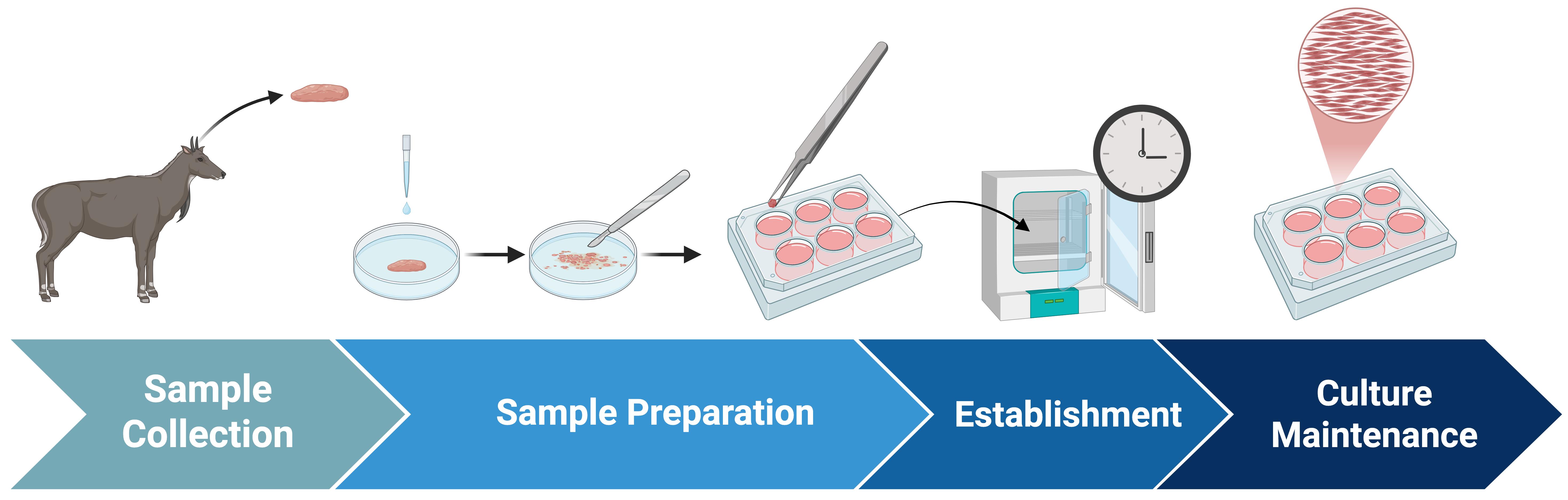
Experimental overview of nilgai primary fibroblast cell culture establishment, proliferation, and maintenance
Background
The nilgai (Boselaphus tragocamelus), the largest Asian antelope, is a member of the Bovidae family and shares an evolutionary relationship with domestic cattle (Bos taurus) [2]. Despite this relationship, genomic and cellular resources for nilgai remain limited compared with those available for domestic livestock species. The establishment of primary fibroblast cultures provides a sustainable source of biological material for whole-genome sequencing, comparative genomics, epigenetic profiling, and other functional applications [3]. Because fibroblasts can be expanded over multiple passages and cryopreserved for long-term storage, they represent an important component of wildlife biobanking and genetic resource conservation [4].
Comparative studies between nilgai and domestic cattle may also provide insight into the evolution of bovine genomes, chromosomal organization, species-specific adaptations, and disease susceptibility. As both species belong to Bovidae, comparative analyses may improve our understanding of conserved regulatory elements, genomic variation, and mechanisms underlying traits relevant to livestock biology [2]. Furthermore, properly preserved fibroblast cultures establish a renewable resource that can support future technologies, including genome assembly, gene editing, and reproductive biotechnology [3,5,6].
The protocol presented here describes a reproducible method for establishing, expanding, and preserving primary fibroblast cultures from nilgai ear tissue. The resulting cultures provide a valuable cellular resource for conservation biology, comparative genomics, and future applications in wildlife and livestock research.
Materials and reagents
Biological materials
1. Nilgai tissue samples (ear or skin biopsy)
Reagents
1. Dulbecco’s phosphate-buffered saline without calcium and magnesium (DPBS) (Gibco, catalog number: 14190-144)
2. Dulbecco’s modified Eagle medium (DMEM) (Gibco, catalog number: 11885-084)
3. Fetal bovine serum (FBS) (Gibco, catalog number: 12483-020)
4. Antibiotic-antimycotic 100× (anti-anti 100×) (Gibco, catalog number: 15240-062)
5. 0.05% Trypsin-EDTA (Sciencell Research Laboratories, catalog number: NC1672820)
6. Dimethyl sulfoxide Hybri-Max (DMSO) (Millipore Sigma, catalog number: D2650-5X5ML)
7. Skin prep solution Betadine 4 oz. bottle 10% strength (Fisher Scientific, catalog number: 503043366)
8. 75% Ethanol
9. Commercial antibacterial soap such as Dial Antibacterial or Hibiclens
Alternative: Diluted commercial detergent, such as 10%–20% Dawn detergent, may also be used; however, it can be less effective at reducing microbial contamination than antibacterial alternatives.
Solutions
1. Ruminant fibroblast medium, 20% FBS (RFM-20%) (see Recipes)
2. DPBS wash (see Recipes)
3. Freezing media (see Recipes)
4. Collection media (optional) (see Recipes)
Recipes
Before you begin: Aliquot frozen reagents (i.e., FBS, trypsin-EDTA 0.05%, dimethyl sulfoxide, anti-anti 100×) into appropriate volumes before storage at -20 °C to minimize multiple freeze/thaw cycles. When possible, use freshly thawed aliquots for each recipe and store mixed solutions in small volumes (indicated on individual recipe instructions) once mixed. Doing so will preserve the integrity of solutions and allow for longer storage and more consistent results.
1. RFM-20%
| Reagent | Final concentration | Volume | Volume |
|---|---|---|---|
| DMEM | 79% v/v | 39.5 mL | 197.5 mL |
| FBS | 20% v/v | 10 mL | 50 mL |
| Anti-anti 100× | 1% v/v (1× final concentration) | 500 μL | 2.5 mL |
| Total | n/a | 50 mL | 250 mL |
Mix the reagents to the desired volume of RFM-20% under a sterile flow hood, adding anti-anti 100× last. Ensure thorough mixing of each reagent before adding. Filter through a 0.2 μm vacuum filter within 20 min of mixing. Store in 20–50 mL aliquots at 4 °C for up to 30 days. Media should be orange-red in color. Do not use if media becomes yellow, turbid, or putrid.
2. DPBS wash
| Reagent | Final concentration | Volume | Volume |
|---|---|---|---|
| DPBS | 99% v/v | 49.5 mL | 247.5 mL |
| Anti-anti 100× | 1% v/v (1× final concentration) | 500 μL | 2.5 mL |
| Total | n/a | 50 mL | 250 mL |
Mix the reagents to the desired volume of DPBS wash under a sterile flow hood, adding anti-anti 100× last. Ensure thorough mixing of reagents before adding. Optional: Filter through a 0.2 μm vacuum filter if desired. Store in 20–50 mL aliquots at 4 °C for up to 30 days. Do not use if wash becomes colored or turbid.
3. Freezing media
| Reagent | Final concentration | Volume |
|---|---|---|
| DMEM* | 80% v/v | 1.2 mL |
| FBS | 10% v/v | 150 μL |
| DMSO | 10% v/v | 150 μL |
| Total | n/a | 1.5 mL |
*You may use FBS, PBS, or DPBS in place of DMEM, but ideal results are obtained with DMEM or FBS.
Make fresh for each use. Mix cold reagents under a sterile flow hood to make 1.5 mL of freezing medium for each cryo vial. Store at 4 °C until immediately before use. Do not use older than 12 h.
4. Collection media (optional)
| Reagent | Final concentration | Volume |
|---|---|---|
| DMEM | 99% v/v | 9.9 mL |
| Anti-anti 100× | 1% v/v | 100 μL |
| Total | n/a | 10 mL |
Mix reagents to the desired volume of collection medium under a sterile flow hood, adding anti-anti 100× last. Ensure thorough mixing of reagents before adding. Store at 4 °C for up to two weeks. For ideal results, use within three days of mixing.
Laboratory supplies
1. 15 mL conical centrifuge tube (Thermofisher Scientific, catalog number: 12565269)
2. 50 mL conical centrifuge tube (Thermofisher Scientific, catalog number: 12565271)
3. Falcon 6-well flat-bottom plates with lids (Corning, catalog number: 21100-002)
4. SureOne aerosol barrier pipette tips, 1,000 μL, filtered (Fisher Scientific, catalog number: 02707404)
5. T25 EasYFlask, TC surface, filter cap, 25 cm2 (Thermofisher Scientific, catalog number: 2565351)
6. Cryo vial, int thread, 2 mL (Corning, catalog number: 1232E26)
7. 60 mm × 15 mm Petri dish (Bellco Glass Corporate, catalog number: 23A00L845)
8. Carbon steel scalpel blades #10 (VWR International, catalog number: 76457-448)
9. Scalpel knife handle No.3 (VWR International, catalog number: 76457-416)
10. Metal tweezers (United Scientific Supplies Inc., catalog number: S111016), autoclave-sterilized
11. Sterile polystyrene serological pipettes, 10 mL (Fisher Scientific, catalog number: 1367610J)
12. 250 mL vacuum filter/storage bottle system, 0.2 μm, nylon (Corning, catalog number: 097612)
13. Scissors, sterilized
Equipment
1. HeracellTM 150i CO2 incubator 150 L (ThermoFisher Scientific, catalog number: 50116047), set to 37–38 °C and 5% CO2
2. Laminar flow hood, e.g., AirClean 600 PCR Workstation Flow Hood (AirClean Systems, model number: AC632LFUVC)
3. Water bath, e.g., PrecisionTM General Purpose Water Bath (Fisher Scientific, catalog number: TSFP10PMO, supplier number: TSGP10DUCK), set to 37–38 °C
4. Inverted microscope, e.g., Motic AE31 Elite 30W Trinocular Inverted Microscope (Motic Microscopy, SKU: 1100100200841)
Procedure
登录 / 注册后阅读全文
文章信息
稿件历史记录
提交日期: Aug 24, 2026
接收日期: Oct 28, 2026
在线发布日期: Nov 18, 2026
出版日期: Nov 20, 2026
版权信息
© 2026 The Author(s); This is an open access article under the CC BY-NC license (https://creativecommons.org/licenses/by-nc/4.0/).
如何引用
McKendrick, M., Moulder, C. and Hagen, D. (2026). Establishment and Proliferation of Primary Nilgai Fibroblast Cultures from Adult Tissue. Bio-protocol 16(22): e5888. DOI: 10.21769/BioProtoc.5888.

 Download Citation in RIS Format
分类
细胞生物学 > 细胞分离和培养 > 单层培养
细胞生物学 > 细胞分离和培养 > 低温贮存
您对这篇实验方案有问题吗?
在此处发布您的问题,我们将邀请本文作者来回答。同时,我们会将您的问题发布到Bio-protocol Exchange,以便寻求社区成员的帮助。
 发布问题


