


A Simplified Method for Verifying Tocopherol Biosynthesis-Related Genes by Transient Expression in Nicotiana benthamiana

发布: 2026年12月05日第16卷第23期 DOI: 10.21769/BioProtoc.5887 浏览次数: 38
评审: Shweta PanchalPooja VermaAnonymous reviewer(s)
 PDF
 Q&A





Abstract
Tocopherols are lipid-soluble antioxidants essential for both plants and animals that are present in all photosynthetic organisms. While most enzymes involved in the tocopherol biosynthesis pathway have been identified, those responsible for phytol production remain incompletely characterized, particularly across different plant species. To facilitate rapid screening of candidate genes involved in tocopherol synthesis, we present a protocol that combines Agrobacterium-mediated transient expression of exogenous proteins in Nicotiana benthamiana leaves with subsequent western blotting, subcellular colocalization analysis, and HPLC-based tocopherol quantification. This protocol allows researchers to assess whether a candidate protein is expressed, localizes to the chloroplast (the site of tocopherol biosynthesis), and alters tocopherol accumulation within 5–7 days. This method can also be applied for studying various other metabolites in transient assays, especially when stable transgenic lines are challenging to acquire.
Key features
• Combines transient expression, protein detection, subcellular localization, and functional assay in a single pipeline.
• Enables rapid screening of candidate enzymes for tocopherol biosynthesis within one week with no need for time-consuming generation of stable transgenic lines.
• Uses the well-established Nicotiana benthamiana agroinfiltration system for high-level transient protein expression.
• Allows parallel testing of multiple candidate genes or constructs.
Keywords: Tocopherol Vitamin E
Transient expression
Nicotiana benthamiana
Agroinfiltration
Western blotting
Confocal imaging
HPLC
Graphical overview
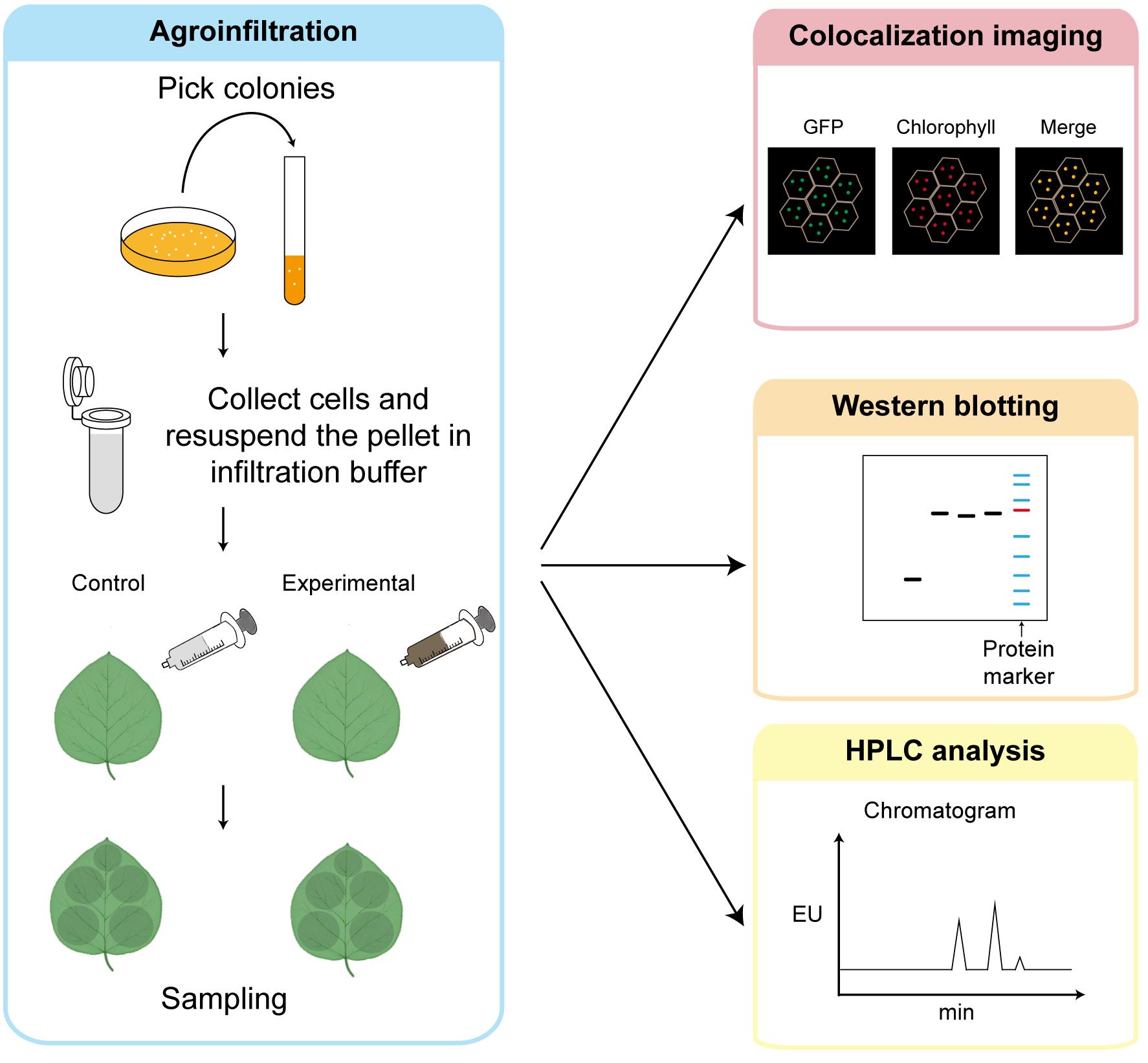
Simplified workflow for transient assay in tobacco. Agroinfiltration, sample collection, colocalization imaging, western blotting, and HPLC analysis.
Background
Tocopherols (vitamin E) are essential lipid-soluble antioxidants that protect photosynthetic organisms from oxidative stress [1,2]. The tocopherol biosynthesis pathway in plants has been largely elucidated, with most enzymatic steps identified [3–5]. However, the complete set of enzymes responsible for generating phytol—a key substrate for tocopherol synthesis—has not been fully characterized [6–8]. Whether different species employ distinct enzymes for phytol production remains an open question [9–11].
Traditional approaches for identifying enzymes involved in tocopherol biosynthesis rely on stable genetic transformation, which is time-consuming and labor-intensive [6,12–15]. Transient expression via Agrobacterium-mediated infiltration of Nicotiana benthamiana leaves offers a rapid alternative. This system has been widely used for protein subcellular localization, protein–protein interaction studies, and recombinant protein production. By combining transient expression with western blotting, fluorescent microscopy, and HPLC-based tocopherol quantification, researchers can quickly evaluate whether a candidate protein is expressed, correctly localizes to the plastid, and functionally impacts tocopherol accumulation.
This protocol provides a streamlined workflow for the rapid functional screening of candidate proteins potentially involved in tocopherol biosynthesis, addressing the need for efficient tools to mine novel enzymes in this important metabolic pathway. However, it has several limitations. Heterologous overexpression in Nicotiana benthamiana may not fully reproduce endogenous expression levels, tissue-specific regulation, or species-specific protein interactions in the species of origin. In addition, fluorescent tags and transient overexpression may affect protein localization or stability, while Agrobacterium-mediated infiltration itself may influence plant physiology and metabolite accumulation. Therefore, this protocol is intended primarily as a rapid screening approach, and promising candidate genes should be further validated using stable genetic materials and/or biochemical assays in the corresponding plant species.
Materials and reagents
Biological materials
1. Tobacco (Nicotiana benthamiana) plants (4–6 weeks old, grown in soil under a 16/8 h light/dark cycle at 22–24 °C, light density at 90 μmol m-2·s-1)
2. Agrobacterium tumefaciens strain GV3101 carrying a construct expressing the gene of interest fused to YFP (which is detectable with confocal imaging or western blotting); the vector used in this protocol is pCAMBIA1300 carrying kanamycin resistance in bacteria
Reagents
1. Tryptone (Sangon Biotech, catalog number: A505250-0500)
2. Yeast extract (Sangon Biotech, catalog number: A515245-0500)
3. Sodium chloride (NaCl) (Sangon Biotech, catalog number: A501218-0005)
4. MES [2-(N-morpholino) ethanesulfonic acid] (Sangon Biotech, catalog number: A420766-0500)
5. MgCl2·6H2O (Sigma-Aldrich, catalog number: M9272)
6. AS (acetosyringone) (Coolaber Science & Technology, catalog number: CA1061-10g)
7. SDS (sodium dodecyl sulfate) (Sigma-Aldrich, catalog number: L5750-500G)
8. Tris (Sangon Biotech, catalog number: A501492-0005)
9. HCl (Sinopharm Chemical Reagent, catalog number: 10011018)
10. 30% acrylamide (Sangon Biotech, catalog number: B546018-0500)
11. Ammonium persulfate (APS) (Sangon Biotech, catalog number: A600072-0025)
12. Tetramethylethylenediamine (TEMED) (Beyotime, catalog number: ST728)
13. Glycine (Sangon Biotech, catalog number: A502065-0005)
14. Kanamycin sulfate (Sangon Biotech, catalog number: A600286-0025)
15. Gentamycin sulfate (Sangon Biotech, catalog number: A620217-0005)
16. Rifampicin (Sangon Biotech, catalog number: A600812-0025)
17. Tween-20 (Sangon Biotech, catalog number: A600560-0500)
18. KCl (Bidepharm, catalog number: BD148754-500g)
19. Na2HPO4 (Jiuding Chemical Reagent, catalog number: SR443-500g)
20. KH2PO4 (Sangon Biotech, catalog number: A501728-0500)
21. Glycerol (Sangon Biotech, catalog number: A100854-0500)
22. Coomassie Brilliant Blue R-250 (Sangon Biotech, catalog number: A610037-0025)
23. Glacial acetic acid (Sinopharm Chemical Reagent, catalog number: 10000218)
24. Methanol (Titan Scientific, catalog number: G75851C)
25. 5× protein loading buffer (with β-mercaptoethanol) (Coolaber Science & Technology, catalog number: SL1180-10ml)
26. Non-fat milk (Wondersun)
27. Liquid nitrogen
28. Rabbit anti GFP-Tag pAb (ABclonal, catalog number: AE011)
29. HRP-conjugated goat anti-rabbit IgG (H+L) (ABclonal, catalog number: AS014)
30. ECL western blotting detection substrate (Share-bio, catalog number: SB-WB011)
31. HPLC-grade methanol (Sangon Biotech, catalog number: A601618-0004)
32. HPLC-grade chloroform (Adamas-beta, catalog number: 75915R)
33. HPLC-grade H2O (Amethyst Chemicals, catalog number: 187553)
34. HPLC-grade tert-Butyl methyl ether (MTBE) (Innochem, catalog number: M9010)
35. α-tocopherol standard (Solarbio, catalog number: ST9440-20mg)
36. γ-tocopherol standard (TargetMol, catalog number: T8293-5mg)
37. DL-α-tocopherol acetate (internal standard) (TargetMol, catalog number: TMSM-1050_1-25mg)
38. Butylated hydroxytoluene (BHT) (Sinopharm Chemical Reagent, catalog number: 31000628)
Solutions
1. LB medium (see Recipes)
2. Infiltration buffer (see Recipes)
3. 10× PBS buffer (see Recipes)
4. 1× PBST buffer (see Recipes)
5. Lysis buffer (see Recipes)
6. 10× running buffer (see Recipes)
7. 10× transfer buffer (see Recipes)
8. Protein gel (2 gels) (see Recipes)
9. Coomassie Brilliant Blue R250 protein stain reagent (see Recipes)
10. Coomassie Brilliant Blue R250 protein destain reagent (see Recipes)
11. Tocopherol extraction buffer (see Recipes)
Recipes
1. LB medium
| Reagent | Final concentration | Quantity or volume |
|---|---|---|
| Tryptone | 10 g/L | 10 g |
| Yeast extract | 5 g/L | 5 g |
| NaCl | 5 g/L | 5 g |
| Total | n/a | 1,000 mL |
Adjust the pH to 7.0 with 1 M NaOH and autoclave at 121 °C for 20 min.
2. Infiltration buffer
| Reagent | Final concentration | Quantity or volume |
|---|---|---|
| 1 M MgCl2 | 10 mM | 200 μL |
| 0.5 M MES pH 5.7 | 10 mM | 400 μL |
| 100 mM acetosyringone | 150 μM | 30 μL |
| Total | n/a | 20 mL |
Prepare fresh.
3. 10× PBS buffer
| Reagent | Final concentration | Quantity or volume |
|---|---|---|
| NaCl | 80 g/L | 80 g |
| KCl | 2 g/L | 2 g |
| Na2HPO4 | 14 g/L | 14 g |
| KH2PO4 | 2.4 g/L | 2.4 g |
| Total | n/a | 1,000 mL |
Adjust the pH to 7.4 with 1 M NaOH or KOH.
4. 1× PBST buffer
| Reagent | Final concentration | Quantity or volume |
|---|---|---|
| 10× PBS buffer | n/a | 100 mL |
| Tween-20 | n/a | 1 mL |
| Total | n/a | 1,000 mL |
5. Lysis buffer
| Reagent | Final concentration | Quantity or volume |
|---|---|---|
| 1 M Tris-HCl pH 7.5 | 50 mM | 50 mL |
| NaCl | 11.7 g/L | 11.7 g |
| Glycerol | 10% (v/v) | 100 mL |
| Total | n/a | 1,000 mL |
6. 10× running buffer
| Reagent | Final concentration | Quantity or volume |
|---|---|---|
| Tris | 30.3 g/L | 30.3 g |
| Glycine | 144.4 g/L | 144.4 g |
| SDS | 10 g/L | 10 g |
| Total | n/a | 1,000 mL |
7. 10× transfer buffer
| Reagent | Final concentration | Quantity or volume |
|---|---|---|
| Tris | 30.25 g/L | 30.25 g |
| Glycine | 144.1 g/L | 144.1 g |
| SDS | 2.5 g/L | 2.5 g |
| Total | n/a | 1,000 mL |
8. Protein gel (2 gels)
| Resolving gel 10 mL | 10% | Stacking gel 5 mL | 5% |
|---|---|---|---|
| 1.5 M Tris-HCl (pH 8.8) | 2.5 mL | 1.5 M Tris-HCl (pH 6.8) | 1.25 mL |
| 30% acrylamide | 3.3 mL | 30% acrylamide | 0.85 mL |
| ddH2O | 4.1 mL | ddH2O | 2.85 mL |
| 10% SDS | 100 μL | 10% SDS | 50 μL |
| 10% APS | 75 μL | 10% APS | 37.5 μL |
| TEMED | 12 μL | TEMED | 6 μL |
After adding and mixing the first four components, add 10% APS and TEMED, mix briefly, and immediately pour the gel into the gel cassette before polymerization begins.
9. Coomassie Brilliant Blue R250 protein stain reagent
| Reagent | Final concentration | Quantity or volume |
|---|---|---|
| Coomassie brilliant blue R250 | 1 g/L | 1 g |
| Methanol | n/a | 300 mL |
| Glacial acetic acid | n/a | 100 mL |
| Total | n/a | 1,000 mL |
10. Coomassie Brilliant Blue R250 protein destain reagent
| Reagent | Final concentration | Quantity or volume |
|---|---|---|
| Methanol | n/a | 300 mL |
| Glacial acetic acid | n/a | 100 mL |
| Total | n/a | 1,000 mL |
11. Tocopherol extraction buffer
| Reagent | Final concentration | Quantity or volume |
|---|---|---|
| HPLC-grade methanol | n/a | 30 mL |
| HPLC-grade chloroform | n/a | 15 mL |
| BHT | 1% (w/v) | 450 mg |
| 5 mg/mL tocopherol acetate | 100 μg/mL | 900 μL |
Prepare fresh.
Laboratory supplies
1. Needleless 1 mL syringe
2. 0.22 μm organic syringe filter (BKMAM)
3. Polyvinylidene difluoride transfer membranes, 0.22 μm (PVDF membranes) (Merck Millipore, catalog number: IPVH00010)
4. 1.5/2 mL centrifuge tubes (LENGRUI)
5. 10 mL bacterial culture tubes (SUPIN)
6. Coverslips (CITOTEST)
7. Microscope slides (CITOTEST)
8. Glass beads
Equipment
1. Spectrophotometer for OD600 measurement (Eppendorf BioPhotometer Plus)
2. Centrifuge (Sangon Biotech, model: HICO 21)
3. 4 °C centrifuge (DLAB, model: D1524R)
4. Gel electrophoresis chamber (Share-bio)
5. Tissue homogenizer (SCIENTZ-48)
6. Transference decoloring shaker (Kylin-Bell, model: TS-8S)
7. SDS-PAGE electrophoresis apparatus (Share-bio)
8. Western blotting electrotransfer apparatus (Share-bio)
9. Chemiluminescence imaging system (Tanon, model: 4160)
10. Confocal laser scanning microscope (Olympus, model: FV3000)
11. HPLC system (Waters, model: e2695)
12. Fluorescence detector for HPLC detection (Waters, model: e2475)
13. HPLC column (Waters YMC Carotenoid S-3 3.0 × 100 mm Column, catalog number: HCAC358555YMC)
14. HPLC vial (JIEDAO)
15. Rotary evaporator (Scientific Products, model: Genevac EZ-2 4.0)
16. Ultrasonic cleaner (Kunshanshumei, model: KQ-500DM)
Procedure
登录 / 注册后阅读全文
文章信息
稿件历史记录
提交日期: Aug 19, 2026
接收日期: Oct 22, 2026
在线发布日期: Nov 12, 2026
出版日期: Dec 5, 2026
版权信息
© 2026 The Author(s); This is an open access article under the CC BY-NC license (https://creativecommons.org/licenses/by-nc/4.0/).
如何引用
Xu, K. and Bao, Y. (2026). A Simplified Method for Verifying Tocopherol Biosynthesis-Related Genes by Transient Expression in Nicotiana benthamiana. Bio-protocol 16(23): e5887. DOI: 10.21769/BioProtoc.5887.

 Download Citation in RIS Format
您对这篇实验方案有问题吗?
在此处发布您的问题,我们将邀请本文作者来回答。同时,我们会将您的问题发布到Bio-protocol Exchange,以便寻求社区成员的帮助。
 发布问题


