


A New PCR-Based Method for the Diagnosis of Leishmania tropica, Leishmania infantum, and Leishmania major Infections

发布: 2026年12月05日第16卷第23期 DOI: 10.21769/BioProtoc.5883 浏览次数: 44
评审: Anonymous reviewer(s)
 PDF
 Q&A





Abstract
Leishmaniases are neglected vector-borne diseases caused by protozoan parasites of the genus Leishmania, affecting both humans and animals in endemic regions worldwide. Beyond confirming the presence or absence of the parasite, accurate species identification is further essential for patient management, epidemiological surveillance, and monitoring of parasite circulation in natural reservoirs and vectors. Current molecular diagnostic approaches mainly rely on conventional PCR or qPCR assays, which frequently require additional post-amplification procedures, such as amplicon sequencing or RFLP analysis, to identify the Leishmania species. Moreover, species-identification methods based solely on amplicon size discrimination can lack sufficient resolution to reliably distinguish the diverse Leishmania species circulating in endemic regions, particularly those found in Morocco. The TIM assay (an acronym for tropica, infantum, major) provides a sensitive, robust, and flexible approach based on conventional PCR for the detection and identification of Leishmania parasites. It offers three complementary and adaptable strategies: enhanced sensitivity through an optional nested pre-amplification step (TIM1), rapid screening using a single multiplex reaction (TIM2), and accurate species discrimination through species-specific amplification (TIM3). Although initially developed to address human cutaneous leishmaniasis (CL) diagnostic needs in Morocco, the assay is broadly applicable to other endemic regions and can also be used for the detection of visceral leishmaniasis (VL) caused by L. infantum species. Its adaptability to field applications further supports its use in parasite surveillance and One Health strategies involving both wild and domestic animal reservoirs.
Key features
• Method developed to detect and identify endemic Leishmania species present in Morocco: L. tropica, L. infantum, and L. major.
• Primers used in this protocol are based on conserved kDNA minicircle sequences, which opens up their utilization in other endemic areas.
• This method allows detection of mixed infections/hybrid species.
• This method can detect L. infantum parasites in canine blood samples from different endemic countries.
Keywords: Leishmania PCR
Diagnostic
Species identification
Hybrids
Coinfections
Graphical overview
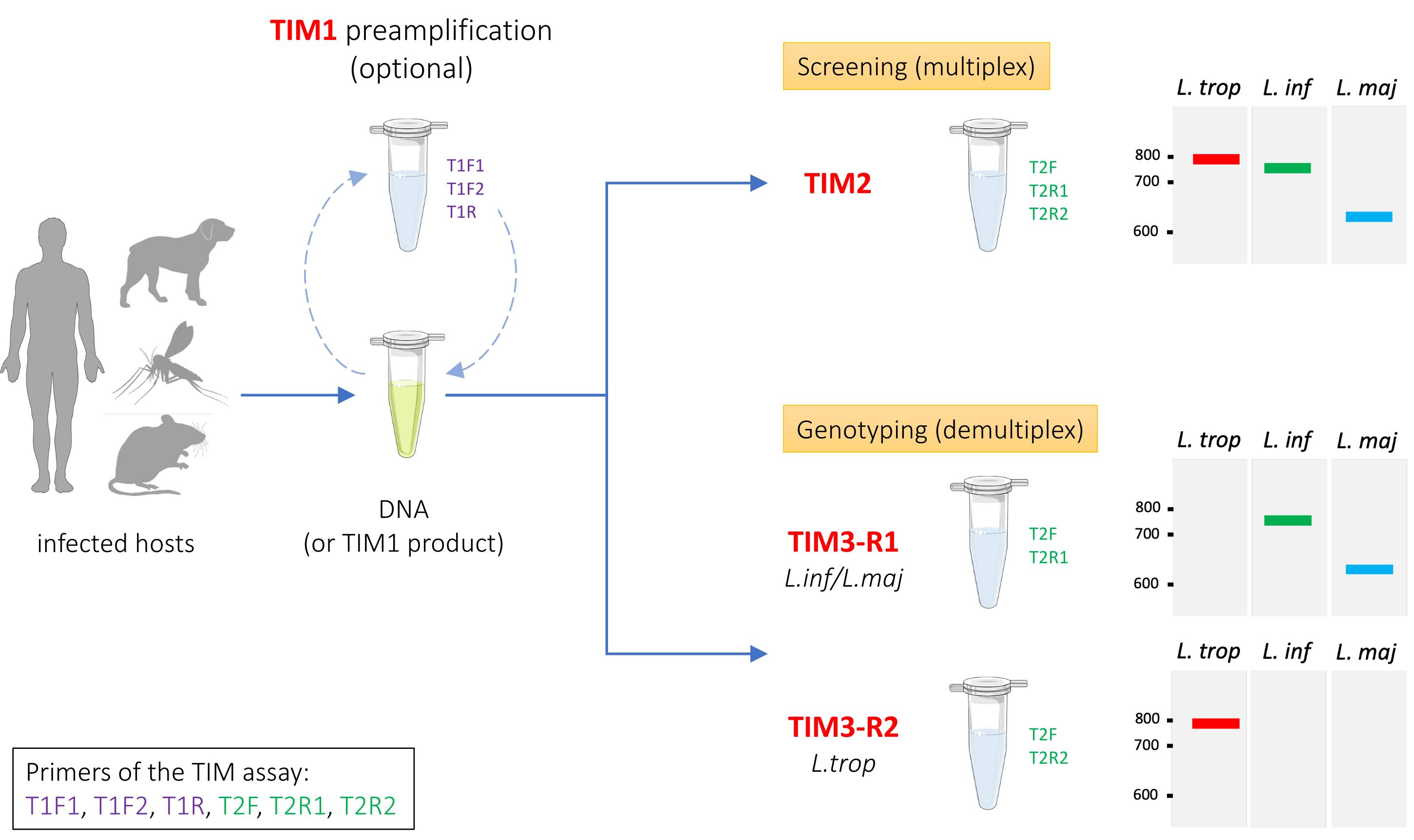
Graphical overview of the TIM assay
Background
Cutaneous leishmaniasis (CL) is one of the most widespread vector-borne parasitic diseases worldwide, with up to one million new cases reported annually. In Morocco, CL is caused by three endemic Leishmania species (Leishmania major, Leishmania tropica, and Leishmania infantum), each presenting with distinct epidemiological and clinical characteristics [1]. From 2023 to 2024, a 28% increase in the number of cases of CL was documented by the Moroccan Ministry of Health and Social Welfare, while the number of visceral leishmaniasis (VL) cases remained stable [2]. On the whole, L. tropica has the widest geographical distribution and is still considered anthroponotic despite recordings of L. tropica infection in animal hosts [3,4]. On the other hand, L. infantum is responsible for both CL and VL cases, primarily reported in the northern regions [5]. Domestic and stray dogs are its main reservoirs; the latter being difficult to monitor or treat. The epidemiology of leishmaniases in Morocco is therefore complex, significantly influenced by human mobility and climate change [6], which will further complicate efforts to control and manage the disease. In this context, accurate parasite detection and species identification are therefore essential for epidemiological surveillance, outbreak monitoring, and the implementation of effective control strategies.
Molecular diagnosis of leishmaniasis has largely relied on PCR-based approaches targeting either ribosomal DNA (rDNA) regions, such as the internal transcribed spacer 1 (ITS1), or kinetoplast DNA (kDNA) minicircles. Among the most commonly used methods, ITS1-PCR followed by restriction fragment length polymorphism analysis (ITS1-RFLP) enables species discrimination but requires an additional enzymatic digestion step and may provide limited resolution when restriction profiles are poorly amplified [7]. Likewise, the Noyes nested PCR assay targeting kDNA minicircles offers high analytical sensitivity but involves a two-step amplification procedure, increasing turnaround time and the risk of contamination [8]. Furthermore, species identification with the Noyes assay relies solely on amplicon size differences, which may be difficult to distinguish when species such as L. tropica and L. infantum produce similar-sized amplicons.
The TIM (Tropica–Infantum–Major) molecular toolbox was developed to overcome these limitations by providing a flexible PCR-based framework for the detection and identification of the three Leishmania species circulating in Morocco [9]. TIM targets specific motifs within kDNA minicircle sequences and can be implemented in three complementary formats: TIM1, an optional nested amplification strategy designed to maximize sensitivity; TIM2, a single multiplex PCR assay for rapid screening; and TIM3, a species-discrimination assay enabling precise identification and genotyping through two parallel reactions (TIM3-R1 and TIM3-R2). Compared with conventional ITS1-RFLP and Noyes PCR methods, TIM offers improved sensitivity, simplified workflows, and enhanced discriminatory power while requiring only standard PCR equipment and a limited set of six primers. Importantly, TIM can also detect mixed interspecific profiles directly from clinical samples, a feature that may facilitate the identification of coinfections or natural Leishmania hybrids that are often missed by traditional diagnostic approaches.
Although this protocol still requires access to molecular biology basic infrastructure and trained personnel, TIM represents a practical, robust, and cost-effective alternative for routine diagnosis in large-scale epidemiological investigations. Beyond its application to human CL, we demonstrate here that TIM is also suitable for monitoring VL caused by L. infantum in canine reservoirs from different endemic countries. Overall, the versatility of TIM broadens its potential use in surveillance programs targeting animal reservoirs, vector monitoring, investigations of parasite population dynamics, and the detection of mixed/hybrid species within a One Health framework.
Materials and reagents
Reagents
1. Molecular-weight size marker, such as the 1 kb DNA ladder 500 μg/mL (New England Biolabs, catalog number: N3232S)
2. 6× gel loading dye (New England Biolabs, catalog number: B7025) supplied with the 1 kb DNA ladder (New England Biolabs, catalog number: N3232S)
3. Standard agarose–type LE for routine gel electrophoresis (BioConcept Ltd, Amimed, catalog number: 7-01P02-R) stored at room temperature
4. Nuclease-free water (NFW) (New England Biolabs, catalog number: B1500S)
5. TAE 50× (1 L) (Euromedex, catalog number: EU0201-A)
6. DNA staining dye, such as GelGreen® nucleic acid stain (10,000× in water; 0.5 mL) (Millipore, catalog number: SCT125), stored at room temperature and compatible with the myGelTM InstaView LED blue-light transilluminator (Accuris instruments, model: E1201)
Specific reagents
1. Q5® Hot Start High-Fidelity 2× Master Mix (New England Biolabs, catalog number: M0494S/L); any other Taq polymerase or master mix can be used but will require further optimization
2. TIM primer stocks (supplied or prepared at 100 μM in H2O or TE buffer); primer sequences include degenerate nucleotides (Y, S, R, N, M) designated according to the IUPAC nucleotide code.
T1F1: 5′ GTGCAGAAAYCCCGTTCA 3′
T1F2: 5′ SATACAGAAACCCCGTTCA 3′
T1R: 5′ GCAGAACGCCCCTACC 3′
T2F: 5′ CTRGGGGTTGGTGTAAAATAG 3′
T2R1: 5′ CGNRGGACCAGAAAAGTTTG 3′
T2R2: 5′ TACCCGGAGGGCTACTM 3′
Laboratory supplies
1. 0.2 mL PCR tubes or PCR tube strips (nuclease-free)
2. Filtered pipette tips (nuclease-free)
3. 1.5 mL microcentrifuge tubes (nuclease-free)
4. Nitrile gloves
Equipment
1. PCR thermocycler (Eppendorf Mastercycler EP Gradient 5341)
2. Horizontal gel electrophoresis system with power supply (myGelTM InstaView Mini Electrophoresis System, Accuris instruments, model: E1201)
3. Gel imaging system (UV or blue-light transilluminator with camera) (myGelTM InstaView Mini Electrophoresis System, Accuris instruments, model: E1201)
4. Precision balance (Ohaus® Scout®)
5. Microwave for agarose gel preparation
6. Micropipettes (P10, P20, P200, P1000 (Eppendorf Reasearch®)
7. Mini centrifuge and vortex mixer
8. Refrigerator (4 °C), freezer (-20 °C)
9. PCR workstation or clean bench for PCR setup, if available
Procedure
登录 / 注册后阅读全文
文章信息
稿件历史记录
提交日期: Sep 11, 2026
接收日期: Oct 25, 2026
在线发布日期: Nov 11, 2026
出版日期: Dec 5, 2026
版权信息
© 2026 The Author(s); This is an open access article under the CC BY-NC license (https://creativecommons.org/licenses/by-nc/4.0/).
如何引用
Lemkhayar, K., El Idrissi Saik, I., Bañuls, A. L., Lemrani, M., Ravel, C., Riyad, M. and Vergnes, B. (2026). A New PCR-Based Method for the Diagnosis of Leishmania tropica, Leishmania infantum, and Leishmania major Infections. Bio-protocol 16(23): e5883. DOI: 10.21769/BioProtoc.5883.

 Download Citation in RIS Format
您对这篇实验方案有问题吗?
在此处发布您的问题,我们将邀请本文作者来回答。同时,我们会将您的问题发布到Bio-protocol Exchange,以便寻求社区成员的帮助。
 发布问题


