


Producing High-Purity, Immobilized Enzymes on Inactivated Bacillus subtilis Using the Coated Bacterial Enzyme (CBE) Platform

发布: 2026年12月05日第16卷第23期 DOI: 10.21769/BioProtoc.5880 浏览次数: 15
评审: Mirela Tkalcic CavuzicAnonymous reviewer(s)
 PDF
 Q&A





Abstract
The purification of industrial enzymes, such as β-galactosidase for lactose-reduced milk production, typically requires costly and time-consuming multi-step chromatography. Most purification protocols use two or more column fractionation steps and involve techniques such as gel filtration, ion exchange, and affinity chromatography, which are expensive and generally result in low yields. To address this limitation, we developed the Coated Bacterial Enzymes (CBEs) platform, which enables one-step purification and immobilization of recombinant enzymes fused to the SlpA cell wall-binding domain using chemically inactivated Bacillus subtilis as a low-cost biological carrier. This protocol describes the expression of the chimeric enzyme BbgII-SlpA (a β-galactosidase from Bifidobacterium bifidum) in Escherichia coli, the preparation of the bacterial carrier, the direct capture of the target enzyme from crude cell lysate onto the carrier surface, and the functional characterization of the resulting immobilized biocatalyst. The entire purification and immobilization process is completed in approximately 2 h after cell lysis. The procedure also includes an optional elution step to recover the purified enzyme in soluble form. The CBE platform offers a one-step, cost-effective, and scalable alternative for obtaining high-purity, immobilized enzymes with enhanced thermal stability and tolerance to inhibitory cations, making it suitable for industrial applications such as lactose hydrolysis.
Key features
• This protocol requires basic experience in recombinant protein expression in E. coli for successful implementation.
• The protocol enables simultaneous purification and immobilization in a single incubation step, reducing processing time to ~2 h after cell lysis.
• This protocol delivers high-purity immobilized enzyme with enhanced thermal stability, retaining ~80% activity after 390 min at 45 °C.
• The bacterial carrier can be prepared in bulk and stored at 4 °C up to 6 months, allowing flexible scheduling and repeated use.
Keywords: β-galactosidase Enzyme purification
Enzyme immobilization
Lactose hydrolysis
Coated Bacterial Enzymes
SlpA domain
Inactivated Bacillus subtilis
Low-cost biological carrier
Graphical overview
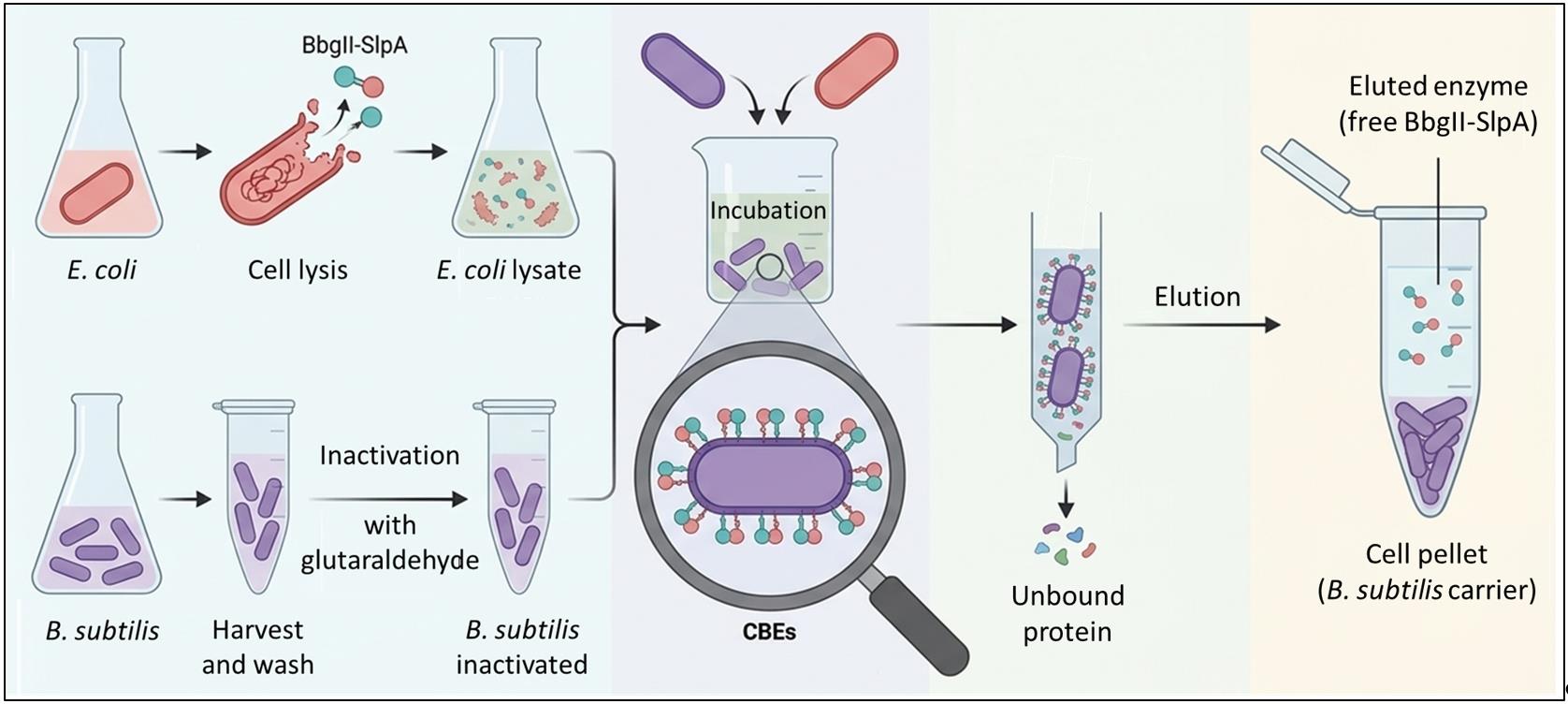
Schematic of Coated Bacterial Enzyme (CBE) production. The recombinant BbgII-SlpA enzyme is expressed in E. coli, and the cell lysate is incubated with chemically inactivated B. subtilis to immobilize the enzyme on its surface. Optionally, the enzyme can be eluted from the carrier to obtain purified enzyme.
Background
The enzymatic hydrolysis of lactose is the most widely adopted strategy for producing lactose-reduced milk, a product that addresses the dietary needs of the estimated 70% of the global population with some degree of lactose intolerance [1,2]. The process requires high-purity β-galactosidase to avoid contaminating proteases, which can generate bitter off-flavors and undesirable Maillard reaction products [3]. Conventional purification protocols rely on two or more chromatographic steps, such as gel filtration, ion exchange, and affinity chromatography, that are time-consuming, expensive, and generally result in low overall yields [4,5]. To overcome these limitations, one-step affinity purification strategies have been developed, typically involving the fusion of a polypeptide tag to the target protein, enabling selective capture onto a specific ligand matrix. Commonly used tags include poly-histidine for Ni2+-affinity chromatography, as well as chitin-binding, cellulose-binding, and starch-binding domains [6–8]. While effective, these methods still require costly affinity matrices or specialized supports. For instance, Gennari et al. achieved one-step purification and immobilization of a β-galactosidase using a cellulose-binding domain (CBD) tag on magnetic cellulose supports, which enhanced thermal stability but required the preparation of functionalized magnetic particles [9]. Similarly, immobilization on live bacteria using peptidoglycan-binding motifs such as LysM, or via surface display systems, has also been reported [10,11], yet these approaches rely on recombinant microorganisms that must maintain enzyme expression while alive, introducing metabolic burden and regulatory concerns regarding genetically modified organisms. To address these challenges, we recently developed the Coated Bacterial Enzymes (CBEs) platform, which builds upon the SlpA cell wall–binding domain from Lactobacillus acidophilus [12]. This tag enables specific and high-affinity binding to the cell wall of Bacillus subtilis, mediated by recognition of teichoic and lipoteichoic acids [13,14]. The CBE platform employs chemically inactivated B. subtilis as a low-cost, non-recombinant biological carrier for the simultaneous purification and immobilization of recombinant enzymes fused to the SlpA domain. This approach decouples enzyme production from the final biocatalyst, avoiding GMO-related limitations and providing a stable, ready-to-use affinity matrix. The primary advantage of the CBE platform lies in its operational simplicity and time-saving ability—purification and immobilization are achieved in a single step, eliminating the need for separate chromatographic and immobilization procedures—rather than in achieving a higher final purity than in optimized conventional methods. Our protocol is based on a simple two-step workflow: expression of the chimeric enzyme BbgII-SlpA (a β-galactosidase from Bifidobacterium bifidum) in Escherichia coli, and direct capture of the target enzyme from crude lysate onto the inactivated B. subtilis carrier. The entire purification and immobilization process is completed in approximately 2 h after cell lysis. After incubation and washing, the resulting CBE biocatalyst retains high catalytic activity and exhibits enhanced thermal stability, retaining ~80% activity after 390 min at 45 °C. Importantly, the CBEs platform is adaptable to other SlpA-tagged proteins and includes an optional elution step for recovering the purified enzyme in soluble form, making it a versatile tool for diverse biotechnological applications where high-purity, immobilized enzymes are required.
Materials and reagents
Biological materials
1. Escherichia coli BL21-CodonPlus (DE3)-RIPL competent cells (Agilent Technologies, catalog number: 230280)
2. Bacillus subtilis var. natto (ATCC, catalog number: 15245)
3. pET-29c(+) plasmid (EMD Biosciences, catalog number: 69873-3)
4. pET-BbgII-SlpA expression plasmid (custom synthesized)
Note: The BbgII-SlpA DNA sequence was codon-optimized for E. coli expression using J-Cat software, chemically synthesized by General Biosystems, Inc., and subsequently cloned into the pET-29c(+) plasmid using NdeI and XhoI restriction enzymes to yield the expression plasmid (pET-BbgII-SlpA). The SlpA sequence comprises amino acids 310–470 of the carboxy-terminal fragment of the SlpA protein from L. helveticus (GenBank ID: MBW7998749.1), and the BbgII amino acid sequence (GenBank ID: WP_270548944.1) was used. The construct has been described in detail in Harguindeguy et al. [15].
Reagents
1. Tryptone (Thermo Fisher Scientific, catalog number: LP0042B)
2. Yeast extract (Merck Millipore, catalog number: 92144)
3. Sodium chloride (NaCl) (Sigma-Aldrich, catalog number: S9888)
4. Agar (Merck Millipore, catalog number: 05040)
5. Kanamycin sulfate (Genbiotech, catalog number: K-120-25)
6. Isopropyl β-D-1-thiogalactopyranoside (IPTG) (Sigma-Aldrich, catalog number: I6758)
7. Tris base (Sigma-Aldrich, catalog number: T1503)
8. Ethylenediaminetetraacetic acid (EDTA) (Sigma-Aldrich, catalog number: E9884)
9. Lysozyme from chicken egg white (Inbio Highway, catalog number: E1405)
10. Sodium phosphate dibasic (Na2HPO4) (Sigma-Aldrich, catalog number: S9763)
11. Potassium phosphate monobasic (KH2PO4) (Sigma-Aldrich, catalog number: P0662)
12. Potassium chloride (KCl) (Sigma-Aldrich, catalog number: P3911)
13. TritonTM X-100 (Sigma-Aldrich, catalog number: T8787); store at room temperature; irritant: handle with gloves and eye protection
14. Urea (Sigma-Aldrich, catalog number: U1250)
15. Glutaraldehyde solution, 25% (v/v) (Sigma-Aldrich, catalog number: G4004); store at 4 °C; toxic and irritant: handle in a fume hood with appropriate personal protective equipment
16. Sodium bicarbonate (NaHCO3) (Sigma-Aldrich, catalog number: S6014)
17. Sodium carbonate (Na2CO3) (Sigma-Aldrich, catalog number: S7795)
18. Citric acid (Sigma-Aldrich, catalog number: C0759)
19. Glycerol (Sigma-Aldrich, catalog number: G5516)
20. Sodium dodecyl sulfate (SDS) (Sigma-Aldrich, catalog number: L3771)
21. Bromophenol blue (Sigma-Aldrich, catalog number: B0126)
22. 2-Mercaptoethanol (Sigma-Aldrich, catalog number: M6250)
23. Bovine serum albumin (BSA) (Sigma-Aldrich, catalog number: A9647)
24. PierceTM BCA Protein Assay kit (Thermo Fisher Scientific, catalog number: 23225)
25. Goat anti-mouse IgG antibody Alexa FluorTM 488 (Thermo Fisher Scientific, catalog number: A11001)
26. Propidium iodide (Thermo Fisher Scientific, catalog number: P1304MP)
27. Anti-SlpA mouse serum (generated in-house [15])
28. Coomassie Brilliant Blue R-250 (Sigma-Aldrich, catalog number: 27816)
29. Methanol (Sigma-Aldrich, catalog number: 34860); toxic and flammable: handle in a fume hood
30. Glacial acetic acid (Sigma-Aldrich, catalog number: 695092); corrosive and flammable: handle in a fume hood
31. SOC medium (Thermo Fisher Scientific, catalog number: 15544034)
Note: All other reagents are stored according to the manufacturer’s instructions.
Solutions
1. Luria-Bertani (LB) broth (see Recipes)
2. LB agar (see Recipes)
3. Kanamycin 50 mg/mL (1,000× solution) (see Recipes)
4. IPTG 1 M (10,000× solution) (see Recipes)
5. Tris-HCl 1 M, pH 7.5 (see Recipes)
6. NaCl 5 M (see Recipes)
7. EDTA 0.5 M (see Recipes)
8. Lysis buffer (see Recipes)
9. Phosphate-buffered saline (PBS) 10× (see Recipes)
10. Wash buffer (see Recipes)
11. Solubilization buffer (see Recipes)
12. Glutaraldehyde 2.5% v/v (see Recipes)
13. Carbonate-bicarbonate buffer 400 mM, pH 9.0 (see Recipes)
14. Citric acid 0.1 M (see Recipes)
15. Sodium phosphate dibasic 0.1 M (see Recipes)
16. Citrate-phosphate buffer 100 mM, pH 6.0 (see Recipes)
17. Elution buffer (see Recipes)
18. Tris-HCl 1 M, pH 6.8 (see Recipes)
19. SDS-PAGE loading buffer 5× (see Recipes)
20. Coomassie Brilliant Blue dye (see Recipes)
21. Destaining solution (see Recipes)
22. BSA 0.1 μg/μL (see Recipes)
23. SDS-PAGE running buffer 1× (see Recipes)
Recipes
1. LB broth
| Reagent | Final concentration | Quantity or volume |
|---|---|---|
| Tryptone | 10 g/L | 10 g |
| Yeast extract | 5 g/L | 5 g |
| NaCl | 10 g/L | 10 g |
| Distilled water | n/a | Up to 1,000 mL |
Dissolve the reagents in 800 mL of distilled water. Adjust pH to 7.0 with 5 M NaOH. Bring the volume up to 1 L with distilled water. Autoclave at 121 °C for 20 min. Store at room temperature (15–25 °C) for up to 6 months. Ensure the medium is clear and free of precipitates before use.
2. LB agar
| Reagent | Final concentration | Quantity or volume |
|---|---|---|
| LB broth | n/a | 200 mL |
| Agar | 15 g/L | 3 g |
Prepare LB broth as described in Recipe 1. Add 15 g/L of agar, autoclave at 121 °C for 20 min, and cool to ~55 °C. When necessary, add kanamycin to a final concentration of 50 μg/mL from a stock solution of 1,000× (Recipe 3). Mix gently to avoid bubbles and pour approximately 20–25 mL into sterile Petri dishes (100 mm). Allow plates to solidify at room temperature for 30 min. Store plates at 4 °C for up to 4 weeks, sealed in plastic bags to prevent drying.
3. Kanamycin 50 mg/mL (1,000× solution)
| Reagent | Final concentration | Quantity or volume |
|---|---|---|
| Kanamycin sulfate | 50 mg/mL | 250 mg |
| Milli-Q water | n/a | Up to 5 mL |
Weigh 250 mg of kanamycin sulfate on an analytical balance, add approximately 4 mL of Milli-Q water, and gently mix with a magnetic stirrer or by vortexing until the antibiotic is completely dissolved. Bring the volume up to 5 mL with Milli-Q water. Sterilize the solution by passing it through a 0.22 μm syringe filter into a sterile container. Divide the solution into small volumes (e.g., 1 mL aliquots) to avoid repeated freeze/thaw cycles. Store the aliquots at -20 °C for up to one year.
4. IPTG 1 M (10,000× solution)
| Reagent | Final concentration | Quantity or volume |
|---|---|---|
| IPTG | 1 M | 1.19 g |
| Distilled water | n/a | Up to 5 mL |
Weigh 1.19 g of IPTG on an analytical balance, add approximately 4 mL of distilled water, and gently mix with a magnetic stirrer until the IPTG is completely dissolved. Bring the volume up to 5 mL with distilled water. Sterilize the solution by passing it through a 0.22 μm syringe filter into a sterile container. Divide the solution into small volumes (e.g., 1 mL aliquots) to avoid repeated freeze/thaw cycles. Store the aliquots at -20 °C for up to one year.
5. Tris-HCl 1 M, pH 7.5
| Reagent | Final concentration | Quantity or volume |
|---|---|---|
| Tris base | 1 M | 24.22 g |
| Distilled water | n/a | Up to 200 mL |
Adjust pH to 7.5 with HCl.
6. NaCl 5 M
| Reagent | Final concentration | Quantity or volume |
|---|---|---|
| NaCl | 5 M | 58.44 g |
| Distilled water | n/a | Up to 200 mL |
7. EDTA 0.5 M
| Reagent | Final concentration | Quantity or volume |
|---|---|---|
| EDTA | 0.5 M | 18.61 g |
| Distilled water | n/a | Up to 100 mL |
8. Lysis buffer
| Reagent | Final concentration | Quantity or volume |
|---|---|---|
| Tris-HCl 1 M, pH 7.5 | 50 mM | 5 mL |
| NaCl 5 M | 150 mM | 3 mL |
| EDTA 0.5 M | 1 mM | 0.2 mL |
| Lysozyme | 0.3 mg/mL | 30 mg |
| Distilled water | n/a | Up to 100 mL |
Add lysozyme just before use, as the enzyme loses activity over time in solution. Store at 4 °C.
9. PBS, 10×
| Reagent | Final concentration | Quantity or volume |
|---|---|---|
| Na2HPO4 | 100 mM | 14.4 g |
| NaCl | 1.37 M | 80 g |
| KCl | 27 mM | 2 g |
| KH2PO4 | 18 mM | 2.45 g |
| Distilled water | n/a | Up to 1,000 mL |
Dissolve reagents in 800 mL of distilled water. Adjust pH to 7.4 with 1 M NaOH or HCl. Bring the volume up to 1,000 mL with distilled water. Autoclave at 121 °C for 20 min or filter-sterilize through a 0.22 μm filter. Store at room temperature (15–25 °C) for up to 6 months.
10. Wash buffer
| Reagent | Final concentration | Quantity or volume |
|---|---|---|
| PBS 10× | 1× | 10 mL |
| TritonTM X-100 | 2% (v/v) | 2 mL |
| Urea | 1 M | 6.0 g |
| Distilled water | n/a | Up to 100 mL |
Dissolve and mix reagents in 50 mL of distilled water. Adjust pH to 7.4 with 1 M NaOH or HCl. Bring the volume up to 100 mL with distilled water. Store at room temperature (15–25 °C) for up to 1 month. If precipitates form, warm the buffer to 37 °C and mix until dissolved.
11. Solubilization buffer
| Reagent | Final concentration | Quantity or volume |
|---|---|---|
| PBS 10× | 1× | 10 mL |
| Urea | 8 M | 48.0 g |
| Distilled water | n/a | Up to 100 mL |
Dissolve and mix reagents in 30 mL of distilled water. Adjust pH to 7.4 with 1 M NaOH or HCl. Bring the volume up to 100 mL with distilled water. Store at room temperature (15–25 °C) for up to 1 month. Urea may require heating to 37 °C to dissolve completely.
12. Glutaraldehyde 2.5% (v/v)
| Reagent | Final concentration | Quantity or volume |
|---|---|---|
| Glutaraldehyde 25% (stock) | 2.5% (v/v) | 10 mL |
| PBS 10× | 1 × | 10 mL |
| Distilled water | n/a | Up to 100 mL |
Prepare fresh immediately before use. Handle in a fume hood with appropriate personal protective equipment (gloves, goggles, lab coat). Use a 25% glutaraldehyde stock solution.
13. Carbonate-bicarbonate buffer 400 mM, pH 9.0
| Reagent | Final concentration | Quantity or volume |
|---|---|---|
| NaHCO3 | 382 mM | 3.21 g |
| Na2CO3 | 18 mM | 189 mg |
| Distilled water | n/a | Up to 100 mL |
Dissolve reagents in 80 mL of distilled water. Adjust pH to 9.0 with 1 M NaOH or HCl. Bring the volume up to 100 mL with distilled water. Store at 4 °C for up to 1 month. Bring to room temperature before use.
14. Citric acid 0.1 M
| Reagent | Final concentration | Quantity or volume |
|---|---|---|
| Citric acid | 0.1 M | 1.92 g |
| Distilled water | n/a | Up to 100 mL |
15. Sodium phosphate dibasic 0.1 M
| Reagent | Final concentration | Quantity or volume |
|---|---|---|
| Na2HPO4 | 0.1 M | 1.42 g |
| Distilled water | n/a | Up to 100 mL |
16. Citrate-phosphate buffer 100 mM, pH 6.0
| Reagent | Final concentration | Volume |
|---|---|---|
| Citric acid 0.1 M | 22.6 mM | 22.6 mL |
| Sodium phosphate dibasic 0.1 M | 77.4 mM | 77.4 mL |
| Total | 100 mM | 100 mL |
Adjust pH to 6.0 with 1 M NaOH or HCl. Store at room temperature (15–25 °C) for up to 1 month. If precipitates form, warm to 37 °C and stir until dissolved.
17. Elution buffer
| Reagent | Final concentration | Volume |
|---|---|---|
| Carbonate-bicarbonate buffer 400 mM, pH 9.2 | 200 mM | 100 mL |
| Citrate-phosphate buffer 100 mM, pH 6.0 | 50 mM | 100 mL |
Prepare fresh by mixing equal volumes of both buffers (Recipes 13 and 16) immediately before use. The pH of the final mixture should be approximately 6.0; adjust with NaOH or HCl if necessary.
18. Tris-HCl 1 M, pH 6.8
| Reagent | Final concentration | Quantity or volume |
|---|---|---|
| Tris base | 1 M | 12.11 g |
| Distilled water | n/a | Up to 100 mL |
Adjust pH to 6.8 with HCl.
19. SDS-PAGE loading buffer 5×
| Reagent | Final concentration | Quantity or volume |
|---|---|---|
| Tris-HCl 1 M, pH 6.8 | 250 mM | 2.5 mL |
| Glycerol | 50% (v/v) | 5 mL |
| SDS | 10% (w/v) | 1 g |
| Bromophenol blue | 0.1% (w/v) | 10 mg |
| 2-Mercaptoethanol | 5% (v/v) | 0.5 mL |
| Distilled water | n/a | Up to 10 mL |
Dissolve SDS and bromophenol blue in 5 mL of distilled water. Add Tris-HCl, glycerol, and 2-mercaptoethanol. Bring the volume up to 10 mL with distilled water. Mix until all components are dissolved. Store in aliquots at -20 °C for up to 6 months. Avoid repeated freeze/thaw cycles. Handle 2-mercaptoethanol in a fume hood.
20. Coomassie Brilliant Blue dye
| Reagent | Final concentration | Quantity or volume |
|---|---|---|
| Coomassie Brilliant Blue R-250 | 0.25% (w/v) | 1.25 g |
| Methanol | 50% (v/v) | 250 mL |
| Glacial acetic acid | 10% (v/v) | 50 mL |
| Distilled water | n/a | Up to 500 mL |
Dissolve 1.25 g of Coomassie Brilliant Blue R-250 in 250 mL of methanol, 50 mL of glacial acetic acid, and 200 mL of distilled water. Stir with a magnetic stirrer until the dye is completely dissolved. Filter the solution through Whatman No. 1 filter paper to remove any undissolved particles. Store in a dark glass bottle at room temperature (15–25 °C) for up to 6 months. Protect from light.
Note: Methanol and acetic acid are toxic and flammable. Prepare the solution in a fume hood and wear appropriate personal protective equipment (gloves, safety goggles, and lab coat). If precipitates form, filter the solution again before use.
21. Destaining solution
| Reagent | Final concentration | Quantity or volume |
|---|---|---|
| Methanol | 20% (v/v) | 200 mL |
| Glacial acetic acid | 10% (v/v) | 100 mL |
| Distilled water | n/a | Up to 1,000 mL |
Mix 200 mL of methanol, 100 mL of glacial acetic acid, and 700 mL of distilled water. Store at room temperature (15–25 °C) for up to 6 months.
22. BSA 0.1 μg/μL
| Reagent | Final concentration | Quantity or volume |
|---|---|---|
| BSA | 0.1 μg/μL | 0.5 mg |
| Distilled water | n/a | Up to 5 mL |
Weigh 0.5 mg of BSA on an analytical balance and transfer to a 15 mL conical tube. Add approximately 4 mL of distilled water and gently mix by vortexing until the BSA is completely dissolved. Bring the volume up to 5 mL with distilled water. Store the aliquots at -20 °C for up to 6 months. Avoid repeated freeze/thaw cycles, as they may cause protein aggregation.
23. SDS-PAGE running buffer 1×
| Reagent | Final concentration | Quantity or volume |
|---|---|---|
| Glycine | 192 mM | 14.4 g |
| Tris base | 25 mM | 3 g |
| SDS | 0.1% (w/v) | 1 g |
| Distilled water | n/a | Up to 1,000 mL |
Dissolve reagents in 800 mL of distilled water. Adjust pH to 8.3 with 1 M NaOH or HCl. Bring the volume up to 1,000 mL with distilled water. Store at 4 °C for up to 6 months. Bring to room temperature before use.
Laboratory supplies
1. Erlenmeyer flasks, 50 mL (Corning, catalog number: 4980-50)
2. Erlenmeyer flasks, 500 mL (Corning, catalog number: 4995-500)
3. Petri dishes, sterile, 100 mm (Greiner Bio-One, catalog number: 664161)
4. Polycarbonate centrifuge tube with sealing cap, 30 mL (Thermo Fisher Scientific, catalog number: 3138-0030)
5. Polypropylene centrifuge tubes, 50 mL (Corning, catalog number: 430829)
6. Polypropylene centrifuge tubes, 15 mL (Corning, catalog number: 430790)
7. Microcentrifuge tubes, 1.5 mL (Eppendorf, catalog number: 0030120086)
8. Serological pipettes, 10 mL (Greiner Bio-One, catalog number: 607180)
9. Pipette tips, sterile, various volumes (10, 20, 200, 1,000 μL)
10. Cellulose dialysis tubing, 12.4 kDa cutoff (Sigma-Aldrich, catalog number: D9777)
11. Poly-L-lysine-coated coverslips (Corning, catalog number: 354085)
12. Syringe filters, 0.22 μm pore size, PES membrane (Thermo Fisher Scientific, catalog number: 15206869)
13. Syringes, 50 mL (Chirana T. Injecta, catalog number: CH03050LL)
14. Precast SDS-PAGE gels, 15% (Bio-Rad, catalog number: 4561084); contain a 4% stacking gel and a 15% resolving gel
15. Cuvettes for spectrophotometry, polystyrene, 1.5 mL (Brand, catalog number: 759015)
16. Cryovials, 2 mL (Maxxline, catalog number: MLC2B)
17. WhatmanTM filter paper, Grade No. 1 (Cytiva, catalog number: 1001-125)
Equipment
1. Biological safety cabinet, Class II (ESCO, catalog number: NC2-L)
2. New Brunswick Innova 44 shaking incubator with temperature control (Eppendorf, catalog number: M1282-0004)
3. Sorvall Legend XTR refrigerated centrifuge with rotors for 15 and 50 mL conical tubes, used for low-speed steps (up to 5,000× g) (Thermo Fisher Scientific, catalog number: 75004521)
4. Sorvall RC 6 Plus refrigerated centrifuge with SS-34 rotor, required for high-speed centrifugation steps (up to 32,000× g) (Thermo Fisher Scientific, catalog number: 46915)
5. Microcentrifuge for 1.5 mL tubes (Eppendorf, model 5424R, catalog number: 5404000014)
6. Ultrasonic homogenizer equipped with a No. 6 tip (Numak model HUZ-JY96, catalog number: EQL-01780)
7. Mini-PROTEAN Tetra Cell electrophoresis system (Bio-Rad, catalog number: 1658004)
8. PowerPacTM Basic power supply for electrophoresis (Bio-Rad, catalog number: 1645050)
9. Flatbed scanner (Epson Stylus, model: CX3700)
10. Olympus BX51 epifluorescence microscope with appropriate filter sets (Olympus, catalog number: BX51TRF)
11. Dry bath with temperature control (Benchmark Scientific, catalog number: BSH1000)
12. Water bath with agitation and temperature control (Thermo Fisher Scientific, catalog number: TSSWB15)
13. Orion Star A111 pH meter (Thermo Fisher Scientific, catalog number: 1115000)
14. Analytical balance (Ohaus, model PA213C, catalog number: 30421610)
15. Magnetic stirrer with heating capability (IKA, C-MAG HS7, catalog number: 3581925)
16. Spectrophotometer (Shimadzu, UV-1600, catalog number: 206-70840-92)
17. Freezer (-80 °C)
18. Freezer (-20 °C)
19. Refrigerator (2-8 °C)
20. Racks (for tubes, pipettes, and microcentrifuge tubes)
21. Automatic pipettes, adjustable volume, covering 0.2–20 μL, 20–200 μL, 100–1,000 μL, and 1,000–5,000 μL (Eppendorf Research plus, catalog numbers: 3123000020; 3123000055; 3123000063; and 3123000071, respectively)
22. Rotator (Grant Bio, PTR-35, catalog number: PTR-35)
23. Vortex mixer (VWR, catalog number: 97043-566)
Software and datasets
1. J-Cat software (online codon adaptation tool; https://www.jcat.de); used for codon optimization of the BbgII-SlpA DNA sequence for expression in E. coli. Free to use; no license required.
2. ImageJ (National Institutes of Health, USA; https://imagej.nih.gov/ij/); used for densitometric analysis of SDS-PAGE gels to quantify protein yields and binding capacity. Version 1.54. Free to use; open-source software.
Procedure
登录 / 注册后阅读全文
文章信息
稿件历史记录
提交日期: Sep 1, 2026
接收日期: Oct 26, 2026
在线发布日期: Nov 15, 2026
出版日期: Dec 5, 2026
版权信息
© 2026 The Author(s); This is an open access article under the CC BY-NC license (https://creativecommons.org/licenses/by-nc/4.0/).
如何引用
Harguindeguy, I., Cavalitto, S. F. and Ortiz, G. E. (2026). Producing High-Purity, Immobilized Enzymes on Inactivated Bacillus subtilis Using the Coated Bacterial Enzyme (CBE) Platform. Bio-protocol 16(23): e5880. DOI: 10.21769/BioProtoc.5880.

 Download Citation in RIS Format
您对这篇实验方案有问题吗?
在此处发布您的问题,我们将邀请本文作者来回答。同时,我们会将您的问题发布到Bio-protocol Exchange,以便寻求社区成员的帮助。
 发布问题


