


Identification of Proteins Interacting With Target lncRNAs Using In Vitro Biotinylated RNA Pull-Down Assay and Mass Spectrometry

发布: 2026年11月20日第16卷第22期 DOI: 10.21769/BioProtoc.5879 浏览次数: 46
评审: Marion HoggWei DaiJoel Praneeth
 PDF
 Q&A





Abstract
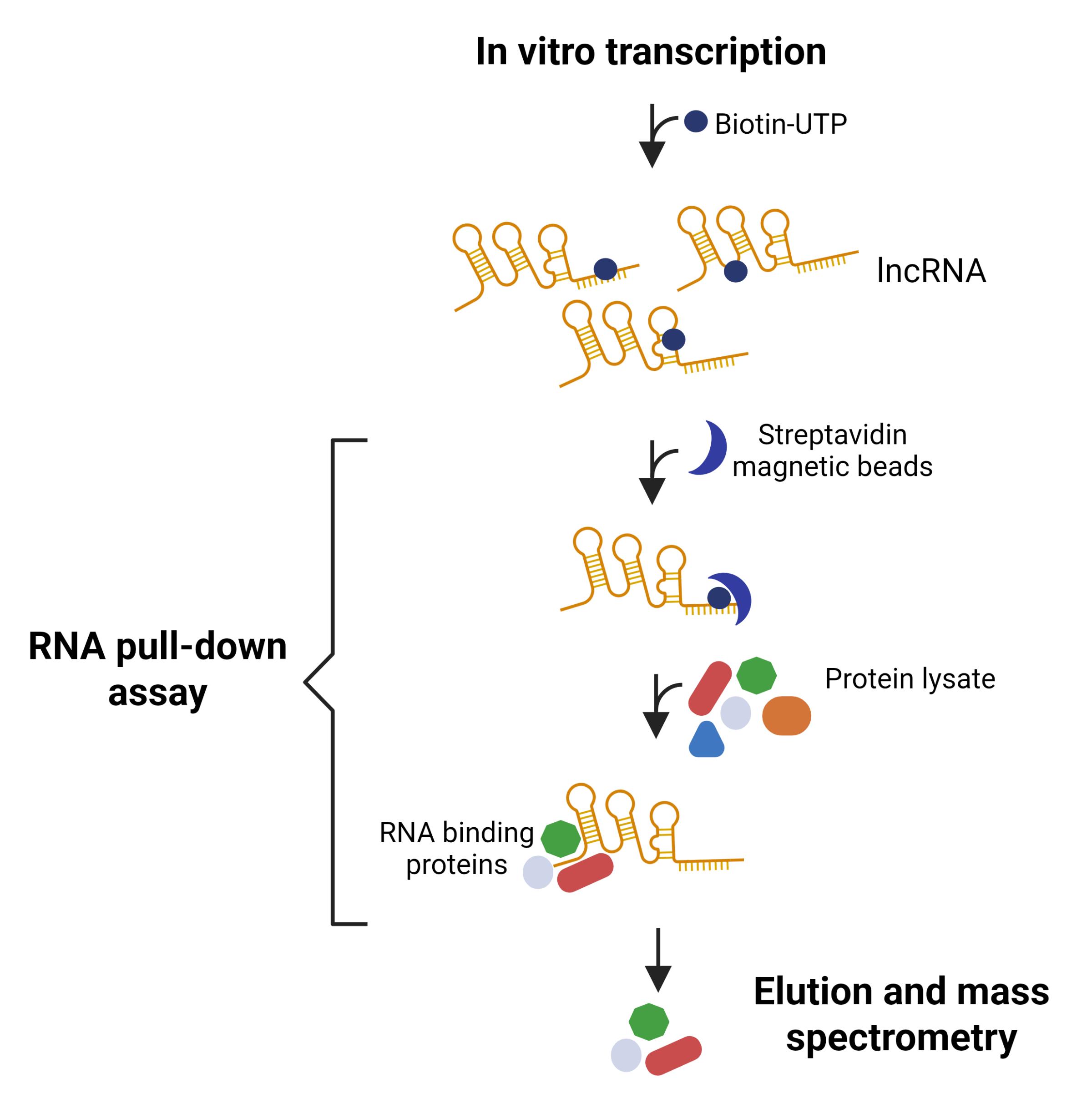
Once considered “junk” transcription, long noncoding RNAs (lncRNAs) are now known to play key regulatory roles within biological processes such as transcription and translation. As lncRNAs have low translational potential, they often interact with proteins to exert their molecular functions. Therefore, identifying the protein interacting network of a lncRNA is critical to investigating its potential function. While in vivo methods exist to identify RNA–protein partners, these often require high cell inputs and RNA expression, which can be challenging for lowly expressed lncRNAs. Alternatively, in vitro methods require lower inputs, but many of these methods do not use a standardized protocol across publications or describe how the identified proteins are prioritized for further validation. Here, we describe an RNA pull-down assay using the lncRNA VILMIR as an example, which can be adapted for other lncRNA targets. First, the lncRNA was in vitro transcribed and internally biotinylated and then incubated with cellular lysate to identify interacting proteins by mass spectrometry. In addition, we describe the resulting mass spectrometry analysis and how the identified proteins were prioritized for further validation and follow-up experiments. This protocol has been successfully reproduced for multiple proteins and can be scaled up or down as needed.
Key features
• LncRNA–protein partners can be successfully identified and validated in vitro.
• Step-by-step in vitro transcription and biotinylation of a lncRNA.
• Robust RNA pull-down assay that can be scaled up or down.
• Description of mass spectrometry analysis and prioritization of proteins.
Keywords: Pull-down assay lncRNA
In vitro transcription
RNA–protein interactions
Mass spectrometry
Graphical overview
Background
Despite there being 35,885 long noncoding RNA (lncRNA) genes annotated in the human genome [1], their functions within human biology still remain largely unknown. LncRNAs are defined as transcripts greater than 500 nucleotides with low protein-coding potential, meaning that they lack open reading frames (ORFs) by both computational prediction and experimental validation, such as ribosome profiling [2,3]. They have been historically challenging to study due to their low expression levels, context-specific transcription, and low evolutionary conservation [4]. The advancement of next-generation sequencing technology has led to the rapid discovery of novel lncRNAs with key regulatory functions in biological processes [5–7]. The majority of these regulatory functions involve lncRNAs interacting with RNA-binding proteins (RBPs), such as transcription factors [8] or translation factors [9]. Therefore, understanding the protein interactome of a lncRNA is critical to characterizing its function.
Several methods have been developed to identify protein partners of a lncRNA in vivo, such as RNA affinity purification (RAP) [10] and chromatin isolation by RNA purification (ChIRP) [11]. However, as in vivo methods rely on endogenous expression of the lncRNA and high cell numbers, capturing the lncRNA and its protein partners can be challenging for lowly expressed lncRNAs. When selecting an in vivo method to validate lncRNA–protein interactions, several factors should be considered. RNA-centric methods such as RAP and ChIRP rely on oligonucleotide probes and high input cell numbers to ensure successful isolation of the lncRNA–protein complex, which can be difficult for low-abundance lncRNAs [12]. On the other hand, protein-centric methods such as RNA immunoprecipitation (RIP) rely on antibodies to target the protein and its interacting RNA, which can be detected via RT-qPCR [13]. However, protein-centric methods may lead to more noise, as the protein’s entire interactome will be isolated with that protein. Therefore, the benefits and challenges of each in vivo method, as well as the abundance of the lncRNA, should be carefully considered for each lncRNA target. Alternatively, in vitro methods, such as RNA pull-down assays, can be used as a starting point for studying lncRNA–protein interactions, which can later be validated in vivo [14].
RNA pull-down assays have been used in several lncRNA publications [15–17], but the conditions of this method often vary, making it difficult to find a standardized protocol to use. For example, the optimization and efficiency of RNA biotin labeling are often not described in detail. Some protocols perform internal biotin labeling [17], while others perform end-labeling [16]. If performing internal biotin labeling, in vitro transcription kits often suggest a high molar ratio of labeled nucleotides to non-labeled nucleotides, which is not optimal for longer RNA molecules where less biotin is preferred to conserve secondary structure. In addition, the concentration of protein lysate used in pull-down protocols is not always given, leading researchers to perform additional optimization steps. Finally, how the identified proteins are prioritized for validation after an RNA pull-down assay is often not described. Therefore, a description of how a candidate protein list was prioritized in a validated study provides a helpful example for researchers prioritizing their own protein list.
We previously identified the lncRNA VILMIR (virus-inducible lncRNA modulator of interferon response), which was found to be an interferon-stimulated gene (ISG) involved in viral infection and interferon responses [18,19]. To better predict its molecular function within the interferon response, we established a robust RNA pull-down assay by compiling several known pull-down methods [14,20–23], as well as optimizing within our own system. First, we in vitro transcribed and internally biotinylated the 900-nucleotide lncRNA VILMIR and bound it to streptavidin-conjugated magnetic beads. After incubating the lncRNA-bound beads with cellular lysate from A549 human epithelial cells, we eluted the interacting proteins and analyzed these by mass spectrometry. By using the antisense sequence of VILMIR as a negative control RNA, we also described how we prioritized the VILMIR-specific interacting proteins for validation [19]. This protocol has been used successfully for several proteins and can be adjusted for other cell types and lncRNA targets as needed.
Materials and reagents
Biological materials
1. GC10 competent cells, 20 × 50 μL/unit (Genesee Scientific, catalog number: 42-658)
2. Cell line of interest for protein extraction
Reagents
1. pGEM-3Z vector (Promega, catalog number: P2151)
2. Custom gene-specific primers (Integrated DNA Technologies)
3. BamHI enzyme (New England Biolabs, catalog number: R0136T)
4. EcoRI enzyme (New England Biolabs, catalog number: R0101T)
5. TRIzol reagent (Invitrogen, catalog number: 15596026)
6. Isopropanol, Molecular Biology Grade (Fisher BioReagents, catalog number: BP2618500)
7. Ethanol, molecular biology grade (Fisher BioReagents, catalog number: BP2818500)
8. Chloroform, 100 mL (Thermo Scientific Chemicals, catalog number: 364321000)
9. QuantiTect Reverse Transcription kit (Qiagen, catalog number: 205311)
10. Q5® high-fidelity DNA polymerase (New England Biolabs, catalog number: M0491L)
11. dNTP mix (10 mM each) (Thermo Scientific, catalog number: R0192)
12. Tris-acetate-EDTA (TAE), 50× solution (Fisher BioReagents, catalog number: FLBP1332500)
13. Agarose, molecular biology grade (Fisher BioReagents, catalog number: BP160100)
14. QIAquick Gel Extraction kit (Qiagen, catalog number: 28704)
15. General Purpose Industrial Razor Blade (Surgical Design, catalog number: 270B)
16. Water, ultrapure, 4 × 1 L/unit (Genesee Scientific, catalog number: 18-196)
17. T4 DNA ligase (Takara Bio, catalog number: 2011A)
18. SOC medium (Quality Biological, catalog number: 340-031-671)
19. LB agar, 500 g (Genesee Scientific, catalog number: 11-119)
20. Carbenicillin (Fisher BioReagents, catalog number: BP26481)
21. RattlerTM Plating Beads, 230 g (Zymo Research Corporation, catalog number: S1001)
22. LB broth (Gibco, catalog number: 10855021)
23. QIAprep Spin Miniprep kit (Qiagen, catalog number: 27104)
24. SPRIselect DNA size selection reagent, 60 mL (Beckman Coulter, catalog number: B23318)
25. TranscriptAid T7 High Yield Transcription kit (Thermo Scientific, catalog number: K0441)
26. Biotin-16-UTP, 25 μL (10 mM) (ApexBio Technology, catalog number: B8154)
27. RNeasy Plus Mini kit (Qiagen, catalog number: 74134)
28. BiodyneTM B nylon membrane, 0.45 μm, 8 cm × 12 cm (Thermo Scientific, catalog number: 77016)
29. Chemiluminescent Nucleic Acid Detection Module kit (Thermo Scientific, catalog number: 89880)
30. NE-PERTM Nuclear and Cytoplasmic Extraction Reagents (Thermo Scientific, catalog number: 78835)
31. Bovine serum albumin (BSA) 20 mg/mL (Thermo Scientific, catalog number: B14)
32. Tris (1 M), pH 8.0, RNase-free, 500 mL (Thermo Scientific, catalog number: AM9856)
33. 1 M Tris-HCI buffer, pH 7.5, 1 L (Thermo Scientific, catalog number: 15567027)
34. EDTA (0.5 M), pH 8.0, RNase-free, 100 mL (Thermo Scientific, catalog number: AM9260G)
35. Sucrose, molecular biology grade, 500 g (Thermo Scientific, catalog number: J65148.36)
36. KCl (2 M), RNase-free, 100 mL (Thermo Scientific, catalog number: AM9640G)
37. HEPES, 1 M solution, pH 7.3, molecular biology grade, 100 mL (Thermo Scientific, catalog number: J16924.AE)
38. NaCl (5 M), RNase-free, 100 mL (Thermo Scientific, catalog number: AM9760G)
39. cOmpleteTM protease inhibitor cocktail, 20 tablets (Roche, catalog number: 11697498001)
40. SUPERase·InTM RNase Inhibitor, 20 U/μL (Invitrogen, catalog number: AM2696)
41. Calcium chloride dihydrate (Fisher BioReagents, catalog number: BP510-250)
42. Glycerol, molecular/proteomic grade, 500 mL (Genesee Scientific, catalog number: 18-205)
43. Sodium hydroxide, 1.00 Normal, 120 mL (Genesee Scientific, catalog number: 72-719)
44. DynabeadsTM Streptavidin magnetic beads, 10 mL (Thermo Scientific, catalog number: 11206D)
45. tRNA for LightShiftTM Chemiluminescent RNA EMSA kit (Thermo Scientific, catalog number: 20159) or equivalent tRNA
46. 4× Laemmli sample buffer (Bio-Rad, catalog number: 1610747)
47. 2-Mercaptoethanol ≥99% for biotechnology (VWR, catalog number: 97064-588)
48. 40% Acrylamide/Bis solution, 29:1 (Bio-Rad, catalog number: 1610146)
49. 10× Tris/Glycine/SDS electrophoresis buffer (Bio-Rad, catalog number: 1610732)
50. 10% SDS solution (Bio-Rad, catalog number: 1610416)
51. Resolving gel buffer for PAGE, 1.5 M Tris-HCl, pH 8.8 (Bio-Rad, catalog number: 1610798)
52. TEMED (Bio-Rad, catalog number: 1610800)
53. Ammonium persulfate (APS) (Bio-Rad, catalog number: 1610700)
54. Precision Plus ProteinTM WesternCTM blotting standards (Bio-Rad, catalog number: 1610376)
55. Coomassie Brilliant Blue, G-250 protein stain (Genesee Scientific, catalog number: 18-446)
56. Glacial acetic acid (Fisher BioReagents, catalog number: BP1185-500)
57. Methanol, 1 L (VWR, catalog number: BDH1135-1LP)
58. RNase AWAYTM surface decontaminant (Thermo Scientific, catalog number: 7002)
Solutions
1. 0.5 M TE buffer, pH 8.0 (see Recipes)
2. THES buffer (see Recipes)
3. 5× BS buffer (see Recipes)
4. BS/THES buffer (see Recipes)
5. 2× B/W buffer (see Recipes)
6. Solution A for Dynabeads® (see Recipes)
7. Solution B Dynabeads® (see Recipes)
8. 6% SDS-PAGE Gel (see Recipes)
9. 1× Tris-glycine running buffer with 0.1% SDS (See Recipes)
10. De-stain buffer (See Recipes)
Recipes
Note: It is critical that all buffers and reagents for RNA pull-down are prepared in DNase/RNase/protease-free conditions. Ensure that all reagents are molecular grade. Before preparing the buffers, spray down the lab bench and pipettes with RNase Away and wear a lab coat. It is recommended to prepare all buffers the day before proceeding with the RNA pull-down protocol, in consideration of time.
1. 0.5 M TE buffer, pH 8.0
| Reagent | Final concentration | Quantity or volume |
|---|---|---|
| 1 M Tris-HCl, pH 8.0 | 0.5 M | 25 mL |
| 0.5 M EDTA | 1 mM | 0.1 mL |
| Ultrapure H2O | n/a | 24.9 mL |
| Total | n/a | 50 mL |
TE is stable at room temperature. Check pH of the buffer prior to use.
2. THES buffer
| Reagent | Final concentration | Quantity or volume |
|---|---|---|
| 1 M Tris-HCl, pH 7.5 | 50 mM | 2.5 mL |
| 0.5 M EDTA | 10 mM | 1.0 mL |
| Sucrose | 20% | 10 g |
| 5 M NaCl | 140 mM | 1.4 mL |
| cOmplete protease inhibitor tablet | 1× | One tablet |
| Ultrapure H2O | n/a | To 50 mL |
| Total | n/a | 50 mL |
It is recommended to store the protease inhibitor (PI) tablets at -80 °C for long-term storage, with one tablet per microcentrifuge tube. Dissolve one PI tablet in THES buffer by rigorous vortexing. Once the THES buffer is made, store at 4 °C for two weeks. After two weeks, make fresh buffer with a new PI tablet.
3. 5× BS buffer
| Reagent | Final concentration | Quantity or volume |
|---|---|---|
| 1 M HEPES buffer, pH 7.5 | 50 mM | 2.5 mL |
| CaCl2 | 25 mM | 0.184 g |
| 2 M KCl | 250 mM | 6.25 mL |
| 100% glycerol | 60% | 30 mL |
| Ultrapure H2O | n/a | To 50 mL |
| Total | n/a | 50 mL |
BS buffer is stable at room temperature.
4. BS/THES buffer
| Reagent | Final concentration | Quantity or volume |
|---|---|---|
| THES buffer | 44.3% | 22.15 mL |
| 5× BS buffer | 20% | 10 mL |
| Ultrapure H2O | 35.7% | 17.85 mL |
| Total | 100% | 50 mL |
Make BS/THES buffer by combining the THES and 5× BS buffer at the indicated concentrations. Once made, BS/THES buffer should be stored at 4 °C for two weeks. After two weeks, make fresh BS/THES buffer.
5. 2× B/W buffer
| Reagent | Final concentration | Quantity or volume |
|---|---|---|
| 1 M Tris-HCl, pH 7.5 | 10 mM | 0.5 mL |
| 0.5 M EDTA | 1 mM | 0.1 mL |
| 5 M NaCl | 2 M | 20 mL |
| Ultrapure H2O | n/a | 29.4 mL |
| Total | n/a | 50 mL |
B/W buffer is stable at room temperature.
6. Solution A for Dynabeads®
| Reagent | Final concentration | Quantity or volume |
|---|---|---|
| 1 M NaOH | 0.1 M | 1 mL |
| 5 M NaCl | 0.05 M | 0.1 mL |
| Ultrapure H2O | n/a | 8.9 mL |
| Total | n/a | 10 mL |
Solutions A and B are recommended to prepare Dynabeads® (Thermo Scientific) for RNA manipulation, as Dynabeads® are not supplied in RNase-free solutions. NaOH should be stored in a corrosive cabinet and handled in a fume hood. Once diluted to 0.1 M in Solution A, it is stable on the bench at room temperature.
7. Solution B for Dynabeads®
| Reagent | Final concentration | Quantity or volume |
|---|---|---|
| 5 M NaCl | 0.1 M | 0.2 mL |
| Ultrapure H2O | n/a | 9.8 mL |
| Total | n/a | 10 mL |
Solution B is stable at room temperature.
8. 6% SDS-PAGE gel
| Reagent | Final concentration | Quantity or volume |
|---|---|---|
| Ultrapure H2O | n/a | 4.6 mL |
| 40% (29:1) Bis/Acrylamide solution | 6% | 1.2 mL |
| 1.5 M Tris-HCl, pH 8.8 | 2.0 mL | |
| 10% SDS solution | 80 μL | |
| TEMED | 10 μL | |
| 10% APS solution | 100 μL | |
| Total | n/a | 8 mL |
Make the gel immediately before use. Add all reagents into a 15 mL centrifuge tube in the order listed. Add the TEMED in a chemical fume hood. After adding the APS, vortex briefly and immediately pour into a gel casting tray, as the gel will start to solidify. 10% APS solution is stable at 4 °C for two weeks, enabling gels to solidify within 15 min.
9. 1× Tris-glycine running buffer with 0.1% SDS
| Reagent | Final concentration | Quantity or volume |
|---|---|---|
| 10× Tris/glycine/SDS buffer | 1× | 100 mL |
| dH2O | n/a | 900 mL |
| Total | n/a | 1 L |
Stable at room temperature.
10. De-stain buffer
| Reagent | Final concentration | Quantity or volume |
|---|---|---|
| dH2O | 50% | 25 mL |
| Glacial acetic acid | 10% | 5 mL |
| Methanol | 40% | 20 mL |
| Total | 100% | 50 mL |
Add the glacial acetic acid in a chemical fume hood. When done, discard the de-stain buffer per the institution’s EHS waste disposal protocol.
Laboratory supplies
1. Olympus Premium 1.7 mL snap cap microcentrifuge tubes (Genesee Scientific, catalog number: 24-282S)
2. Olympus Premium 2.0 mL snap cap microcentrifuge tubes (Genesee Scientific, catalog number: 24-283A)
3. Olympus 8-Strip PCR tubes with caps, 0.2 mL (Genesee Scientific, catalog number: 27-125)
4. 10 μL XL filtered pipette tips (Genesee Scientific, catalog number: 23-401C)
5. 20 μL filtered pipette tips (Genesee Scientific, catalog number: 23-404C)
6. 200 μL filtered pipette tips (Genesee Scientific, catalog number: 23-412C)
7. 1,000 μL filtered pipette tips (Genesee Scientific, catalog number: 23-430C)
8. 15 mL conical centrifuge tubes (Genesee Scientific, catalog number: 28-101)
9. 50 mL conical centrifuge tubes (Genesee Scientific, catalog number: 28-106)
Equipment
Note: Listed are the equipment utilized in this study, but similar accessible equipment can also be used.
1. 4150 TapeStation System
2. T100 Thermal Cycler (Bio-Rad, catalog number: 1861096)
3. Bio-Rad ChemiDoc MP UV Imaging System
4. Thermo Scientific NanoDrop One Spectrophotometer
5. Water bath
6. 37 °C bacterial shaker
7. 37 °C bacterial incubator
8. BenchWaver Orbital shaker (Benchmark, catalog number: B3D5000)
8. Mini-PROTEAN Tetra Vertical Electrophoresis for Handcast Gels (1.0 mm) (Bio-Rad, catalog number: 1658001)
9. Freezer (-80 °C)
10. Freezer (-20 °C)
11. Refrigerator (2–8 °C)
12. Magnetic rack for 1.5 mL centrifuge tubes
13. Magnetic rack for 0.2 mL PCR tubes
14. Tube racks
Procedure
登录 / 注册后阅读全文
文章信息
稿件历史记录
提交日期: Aug 18, 2026
接收日期: Oct 14, 2026
在线发布日期: Nov 11, 2026
出版日期: Nov 20, 2026
版权信息
© 2026 The Author(s); This is an open access article under the CC BY-NC license (https://creativecommons.org/licenses/by-nc/4.0/).
如何引用
John, K., Diveley, K., Mahmood, N., Istishin, A. and Peng, X. (2026). Identification of Proteins Interacting With Target lncRNAs Using In Vitro Biotinylated RNA Pull-Down Assay and Mass Spectrometry. Bio-protocol 16(22): e5879. DOI: 10.21769/BioProtoc.5879.

 Download Citation in RIS Format
您对这篇实验方案有问题吗?
在此处发布您的问题,我们将邀请本文作者来回答。同时,我们会将您的问题发布到Bio-protocol Exchange,以便寻求社区成员的帮助。
 发布问题


