


Elimination of cis-cleavage in CRISPR Diagnostics for One-Pot Rapid Nucleic Acid Detection

(*contributed equally to this work) 发布: 2026年12月05日第16卷第23期 DOI: 10.21769/BioProtoc.5870 浏览次数: 30
评审: Navnita DuttaGyan Prakash SrivastavaSAPTARSHI MAJI
 PDF
 Q&A






Abstract
CRISPR/Cas12a-based nucleic acid detection enables rapid molecular diagnostics, yet conventional two-step assays are slow and contamination-prone, while one-pot methods suffer from Cas12a cis-cleavage of amplicons. This protocol presents a one-pot, cis-cleavage-free SCas12a system using a bipartite split crRNA—comprising a scaffold and 20-nt spacer—that directs Cas12a to PAM-free double-stranded DNA with no detectable cis-cleavage under the tested conditions while maintaining trans-cleavage of ssDNA reporters. We detail RNA/primer design, ortholog expression and purification, RNP assembly, and integration with RPA, RT-RPA, or LAMP for unified detection and single-nucleotide variant (SNV) genotyping. The original study demonstrated improved sensitivity and single-base discrimination in selected model assays, with clinical application examples involving HPV16, SARS-CoV-2, and TP53. These results support potential point-of-care adaptation; broader clinical performance and portable readout remain to be validated.
Key features
• PAM-independent split-crRNA design frees target-site selection from canonical and suboptimal PAM sequence constraints.
• Absence of detectable cis-cleavage under the tested conditions prevents amplicon degradation, enabling simultaneous isothermal amplification and CRISPR detection in a single tube.
• Compatible with RPA/RT-RPA using AsCas12a at 37 °C and LAMP using thermostable CtCas12a at 55 °C; LbCas12a was also examined in the original biochemical characterization.
• Attomolar sensitivity within 30 min and single-base resolution (up to 91-fold distinguishing factor) for SNV genotyping; these values apply to the reported model assays.
Keywords: CRISPR/Cas12a Split crRNA
SCas12a
One-pot detection
Isothermal amplification
RPA
LAMP
Point-of-care diagnostics
Graphical overview
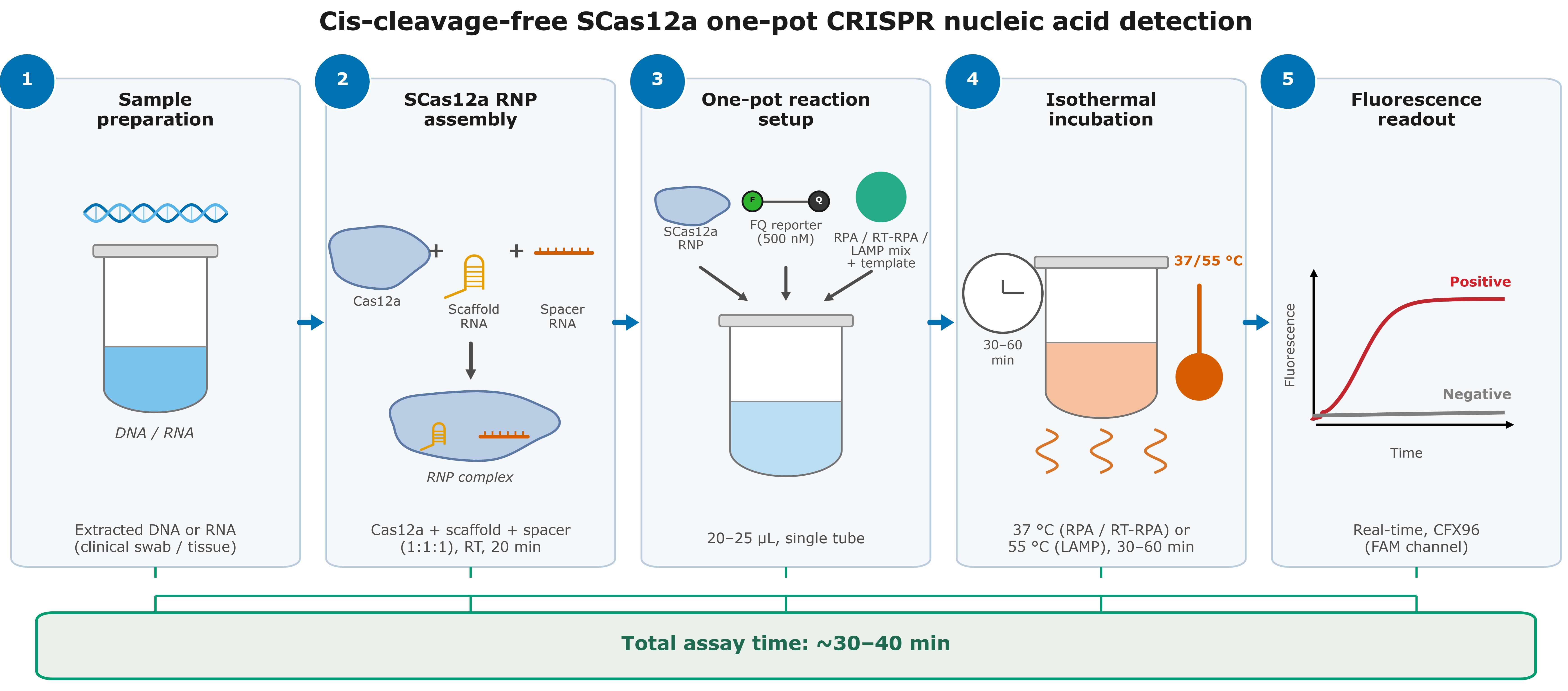
Workflow of the cis-cleavage-free SCas12a one-pot nucleic acid detection assay. The diagram is schematic: The experimental Cas12a:scaffold RNA:spacer RNA input ratio is 1:2:2 (section B). DNA and RNA templates follow sections C and D, respectively; RPA/RT-RPA uses AsCas12a at 37 °C, whereas LAMP uses CtCas12a at 55 °C.
Background
Nucleic acid diagnostics are essential for controlling infectious diseases, genetic screening, and environmental monitoring, yet gold-standard methods such as PCR and sequencing remain confined to centralized laboratories. Isothermal nucleic acid amplification technologies, including recombinase polymerase amplification (RPA) [1] and loop-mediated isothermal amplification (LAMP) [2], eliminate the need for thermocycling and enable portable, cost-effective testing. The discovery of the collateral cleavage activity of CRISPR effectors, such as Cas12a, has enabled highly specific detection of amplified products, giving rise to diagnostic platforms such as DETECTR [3], HOLMES [4], and SHERLOCK [5]. However, these early CRISPR diagnostics employ a two-step procedure—nucleic acid amplification followed by the addition of CRISPR reagents—which increases procedural complexity, prolongs testing time, and heightens the risk of contamination from nucleic acid aerosols.
Combining isothermal amplification and Cas12a-mediated detection in a single tube (one-pot assay) is highly desirable, but a major challenge remains: the cis-cleavage activity of Cas12a, triggered upon PAM-dependent target recognition, degrades amplicons as they are generated and thereby severely interferes with amplification. Several mitigation strategies have been developed, each with limitations. Targeting suboptimal PAM sequences (e.g., NTTV, TTTN) attenuates LbCas12a cis-cleavage kinetics and improves one-pot performance [6], but PAM compatibility constraints and residual cis-cleavage remain [6,7]. Sodium heparin can tune Cas12a cis-cleavage by disrupting Cas12a–crRNA binding, allowing amplicon accumulation [8]; photocaged crRNAs permit light-controlled activation of Cas12a after amplification [9]; and spatial segregation of amplification and detection reagents using glycerol or sucrose phases [10], or physical separation of components in all-in-one formats [11,12], can reduce premature cleavage. Despite these advances, existing one-pot systems still face prolonged detection times, operational complexity, and residual collateral damage, because the nuclease remains inherently capable of cis-cleavage.
Our group previously developed the SCas12a assay, which integrates Cas12a with a split crRNA—comprising a scaffold RNA and a separate spacer RNA—to enable direct RNA detection without reverse transcription [13,14]. In the underlying study of this protocol [15], we reevaluated the system for DNA detection and unexpectedly found that SCas12a maintains robust trans-cleavage activity on double-stranded DNA (dsDNA) even in the complete absence of canonical or reported suboptimal PAM sequences, while exhibiting negligible cis-cleavage activity toward dsDNA targets. The split-crRNA architecture therefore renders Cas12a simultaneously PAM-independent and cis-cleavage-free, effectively decoupling signal generation from target degradation in one-pot reactions (Figure 1). No target cis-cleavage was detectable under the tested PAM-free conditions (Figure 1 and Supplementary Figure S1 from [15]). Strand invasion is a proposed mechanism: terminal sites and lower duplex stability may facilitate spacer access and preserve amplification; the pathway has not been directly resolved.
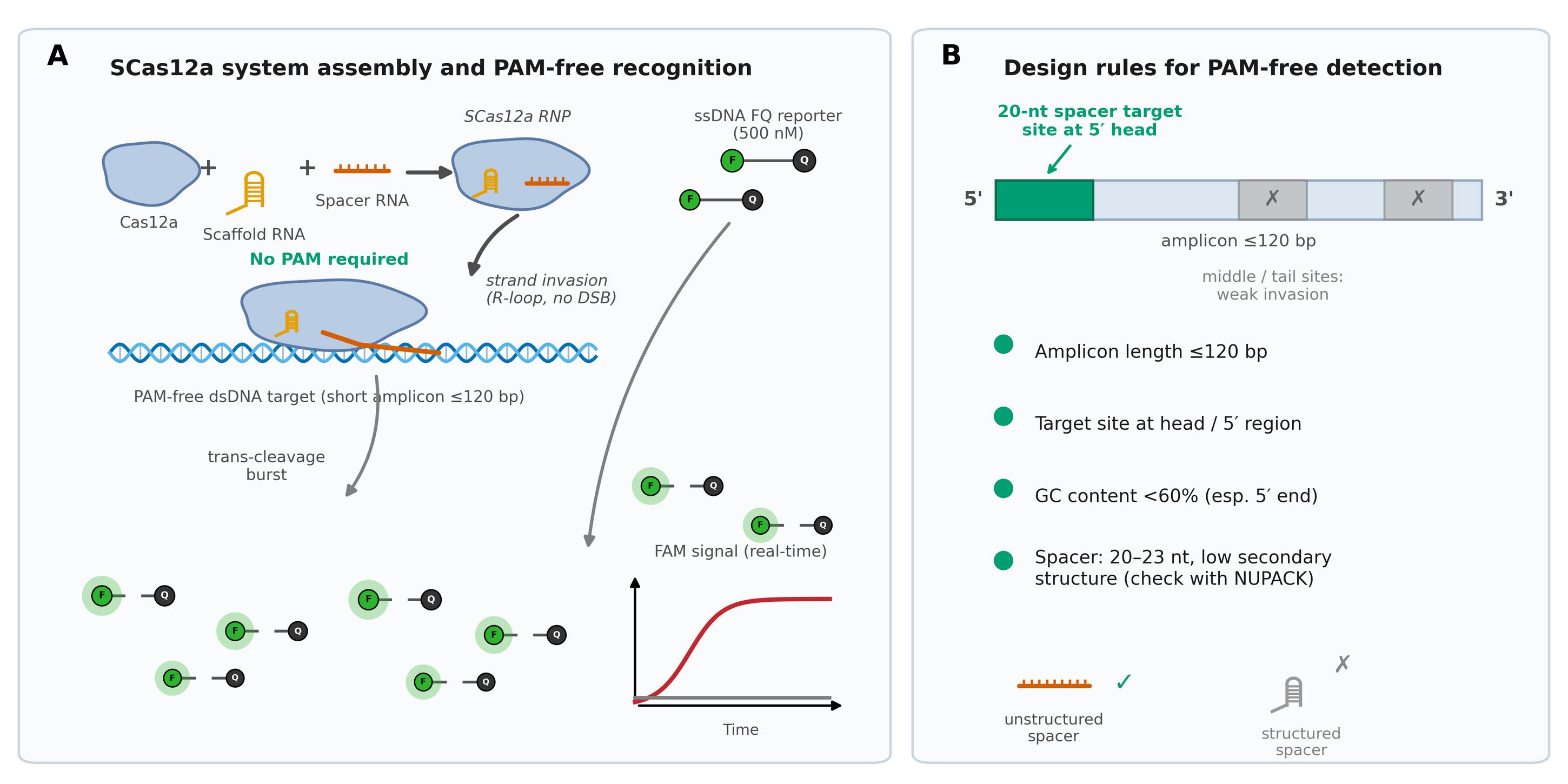
Figure 1. Assembly and design rules of the SCas12a system. (A) The SCas12a RNP is assembled from the Cas12a protein, a scaffold RNA, and a 20-nt spacer RNA. (B) For PAM-free dsDNA detection, the spacer preferably targets a PAM-free site located at the head (5′) region of an amplicon of ≤120 bp with GC content below 60%; spacer secondary structure should be minimized as predicted by NUPACK. The length and GC values are empirical design preferences, not universal cutoffs [15, Figure 2].
Materials and reagents
Reagents
1. RPA kit and RT-RPA (Weifang Amp-Future Biotech, Changzhou, China, catalog number: WLB8201KIT); contains lyophilized RPA pellets and buffer A; store lyophilized pellets at -20 °C
2. WarmStart® LAMP Kit (DNA & RNA) (New England Biolabs, catalog number: E1700S); store at -20 °C
3. 10× NEBuffer r2.1 (New England Biolabs, catalog number: B6002S); store at -20 °C
4. SuperScript IV reverse transcriptase (Thermo Fisher Scientific, catalog number: 18090010); store at -20 °C
5. RNase H (New England Biolabs, catalog number: M0297S); the original study used a 50 U/μL working stock; verify the supplied activity concentration; store at -20 °C
6. Proteinase K (Takara, catalog number: 9034); store at -20 °C
7. qPCR Detection kit (GenePharma, Suzhou, China, catalog number: QPG-040); used for orthogonal qPCR/RT-qPCR validation; store at -20 °C
8. FAM–BHQ1 ssDNA FQ reporter, 5′-FAM-TTATT-BHQ1-3′ or 5′-FAM-TTATTATT-3′-BHQ1 [synthesized by Sangon Biotech, Shanghai, China; HOLMES-Fluo ssDNA reporter 1 (FAM) is available from TOLOBIO, catalog number: 31101]; store the 100 μM stock at -20 °C in the dark. Reconstitute lyophilized reporter in nuclease-free water to 100 μM; for a supplied solution, use the stated concentration. Use the same reporter sequence throughout a comparison
9. Scaffold RNA, spacer RNAs, full-length crRNAs, RPA and LAMP primers, and dsDNA targets/gene fragments (synthesized by Sangon Biotech, Shanghai, China; HPLC- or PAGE-purified); dissolve in DEPC-treated water or nuclease-free water and store at -20 °C (RNA stocks may be stored at -80 °C for extended periods); the sequences used in the original study are listed in Supplementary Table S1 of [15]
10. 6×His-pET-28a(+) expression plasmids encoding AsCas12a, LbCas12a, and CtCas12a; constructs are available from Yi Liu
11. Ni-NTA resin (Qiagen, catalog number: 36113)
12. 100 kDa molecular weight cutoff (MWCO) centrifugal filters (Merck Millipore, Amicon Ultra, catalog number: UFC910024)
13. GoldView nucleic acid stain (Yeasen, catalog number: 10201ES)
14. Ultrapure water (18.2 MΩ·cm, from a Milli-Q purification system; used throughout all buffer and solution preparation)
15. Tris base (Trizma® base) (Sigma-Aldrich, catalog number: T1503); used to prepare 1 M Tris-HCl stocks (pH 7.9 and pH 8.8) and 50× TAE buffer; store at room temperature
16. 1 M Tris-HCl, pH 7.5 (Invitrogen, catalog number: 15567027); alternatively prepared in-house from Tris base adjusted with HCl; store at room temperature
17. Hydrochloric acid (HCl) (Sigma-Aldrich, catalog number: H1758); used for pH adjustment of Tris-HCl stocks; store at room temperature
18. 5 M NaCl, RNase-free (Invitrogen, catalog number: AM9759); store at room temperature
19. Glycerol, molecular biology grade (Sigma-Aldrich, catalog number: G5516); store at room temperature
20. 1 M MgCl2, RNase-free (Invitrogen, catalog number: AM9530G); store at room temperature
21. Bovine serum albumin (BSA), 20 mg/mL, molecular biology grade (New England Biolabs, catalog number: B9000S); store at -20 °C
22. Ammonium sulfate [(NH4)2SO4] (Sigma-Aldrich, catalog number: A4418); store at room temperature
23. 1 M MgSO4 solution, for molecular biology (Sigma-Aldrich, catalog number: M3409); also used for the additional 8 mM MgSO4 supplementation in the one-pot reaction; store at room temperature
24. Tween® 20, molecular biology grade (Sigma-Aldrich, catalog number: P9416); store at room temperature
25. Nuclease-free water, not DEPC-treated (Invitrogen, catalog number: AM9937); store at room temperature
26. Glacial acetic acid (Fisher Scientific, catalog number: A38-212); store at room temperature
27. 0.5 M EDTA, pH 8.0 (Invitrogen, catalog number: 15575020); store at room temperature
Storage of critical items: Purified Cas12a proteins are flash-frozen in liquid nitrogen and stored at -80 °C; a quantitative shelf life has not been established. Oligonucleotides (DNA primers, dsDNA targets) are stored at -20 °C; RNA oligonucleotides (scaffold RNA, spacer RNAs, crRNAs) are stored at -20 °C for routine use and at -80 °C for long-term storage. Lyophilized RPA/RT-RPA pellets and kit enzymes are stored at -20 °C.
Solutions
1. Cas12a storage buffer (see Recipes)
2. 10× NEBuffer r2.1 equivalent (see Recipes)
3. 10× LAMP reaction buffer (see Recipes)
4. 10 μM FQ reporter working stock (see Recipes)
5. 50× TAE buffer (see Recipes)
Recipes
1. Cas12a storage buffer (100 mL)
| Reagent | Final concentration | Quantity or volume |
|---|---|---|
| 1 M Tris-HCl, pH 7.5 | 20 mM | 2 mL |
| 5 M NaCl | 250 mM | 5 mL |
| Glycerol | 5% (v/v) | 5 mL |
| Ultrapure water | n/a | to 100 mL |
| Total | n/a | 100 mL |
Sterilize by filtration (0.22 μm) and store at 4 °C for up to 3 months.
2. 10× NEBuffer r2.1 equivalent (50 mL)
| Reagent | Final concentration | Quantity or volume |
|---|---|---|
| 5 M NaCl | 500 mM | 5 mL |
| 1 M Tris-HCl, pH 7.9 | 100 mM | 5 mL |
| 1 M MgCl2 | 100 mM | 5 mL |
| Recombinant albumin (e.g., 20 mg/mL BSA stock) | 100 μg/mL | 250 μL |
| Ultrapure water | n/a | to 50 mL |
| Total | n/a | 50 mL |
Adjust to pH 7.9 at 25 °C. Sterilize by filtration (0.22 μm), aliquot, and store at -20 °C for up to 1 year. This is also commercially available (NEB, catalog number: B6002S).
3. 10× LAMP reaction buffer (50 mL)
| Reagent | Final concentration | Quantity or volume |
|---|---|---|
| 1 M Tris-HCl, pH 8.8 | 200 mM | 10 mL |
| (NH4)2SO4 | 100 mM | 0.66 g |
| 1 M MgSO4 | 20 mM | 1 mL |
| Tween 20 | 1% (v/v) | 500 μL |
| Ultrapure water | n/a | to 50 mL |
| Total | n/a | 50 mL |
Adjust to pH 8.8 at 25 °C. Sterilize by filtration (0.22 μm), aliquot, and store at -20 °C for up to 1 year. Note that the additional 8 mM MgSO4 supplemented in the LAMP/SCas12a one-pot reaction (section E) is provided separately and is not part of this buffer. The nominal total MgSO4 concentration is therefore 10 mM, including 2 mM from the 1× buffer.
4. 10 μM FQ reporter working stock (100 μL)
| Reagent | Final concentration | Quantity or volume |
|---|---|---|
| 100 μM FQ reporter stock | 10 μM | 10 μL |
| Nuclease-free water | n/a | 90 μL |
| Total | n/a | 100 μL |
Prepare in a low-binding microtube, protect from light, and store at -20 °C in aliquots. Avoid repeated freeze/thaw cycles.
5. 50× TAE buffer (1 L)
| Reagent | Final concentration | Quantity or volume |
|---|---|---|
| Tris base | 2 M | 242 g |
| Glacial acetic acid | 1 M | 57.1 mL |
| 0.5 M EDTA, pH 8.0 | 50 mM | 100 mL |
| Ultrapure water | n/a | to 1 L |
| Total | n/a | 1 L |
Store at room temperature. Dilute to 1× TAE in ultrapure water before use for agarose gel electrophoresis.
Laboratory supplies
1. Pipette tips (filtered) (Thermo, catalog numbers: TF112-1000-Q, T104RS-Q, TF140-200-Q)
2. 0.2 mL PCR tubes (Thermo, catalog number: 431-MIXED-Q)
3. 1.5 mL microtubes (AXYGEN, catalog number: MCT-150-L-C)
Equipment
1. Real-time PCR system (Bio-Rad, model: CFX96 touch, as used in [15]; alternative instruments require verification of thermal control and FAM detection)
2. Microcentrifuge (mySPINTM 6 Mini, Thermo, model: 75004061 or equivalent)
3. Thermal cycler (VeritiPro PCR, Thermo, model: A48141)
4. Vortex mixer (Eppendorf mixer, Eppendorf, model: 5382000074)
5. Variable volume pipettes (P10, P200, P1000)
6. Freezer (-80 °C) (Thermo, model: 905)
7. Standard laboratory equipment (analytical balance, pH meter, etc.)
Software and datasets
1. CFX Maestro software (Bio-Rad, version 2.3 or compatible; supplied with the CFX96 Touch system; requires a license bundled with the instrument) for real-time fluorescence acquisition and baseline analysis
2. NUPACK (http://www.nupack.org/; accessed January 12, 2026; free for academic use) for screening spacer RNA sequences for minimal secondary structure. Free alternatives: RNAfold (http://rna.tbi.univie.ac.at/cgi-bin/RNAWebSuite/RNAfold.cgi) and Mfold (http://unafold.rna.albany.edu/?q=mfold)
3. AlphaFold3 Server (https://alphafoldserver.com/; free for non-commercial use; optional) for predictive structural modeling of the Cas12a/split crRNA/DNA complex
4. GraphPad Prism (version 8 or later; commercial license required) for plotting fluorescence kinetics, bar charts, and heatmaps. Alternatives: Microsoft Excel (commercial), R/RStudio, or Python (matplotlib). Record the actual software versions and prediction settings used; the listed versions are reference implementations
5. Oligonucleotide sequences (scaffold RNA, spacer RNAs, primers, and targets) used in the original study are listed in Supplementary Table S1 of Yin et al. [15] (Nucleic Acids Research, DOI: 10.1093/nar/gkag267). The complete source list is accessible through the Supplementary data link at https://doi.org/10.1093/nar/gkag267
Procedure
登录/注册后免费查看全文
文章信息
稿件历史记录
提交日期: Aug 21, 2026
接收日期: Oct 14, 2026
在线发布日期: Oct 28, 2026
出版日期: Dec 5, 2026
版权信息
© 2026 The Author(s); This is an open access article under the CC BY license (https://creativecommons.org/licenses/by/4.0/).
如何引用
Hu, L., Hu, Z., Pei, Y., Hu, T., Zhang, Y., Yu, R., Zhao, J. and Liu, Y. (2026). Elimination of cis-cleavage in CRISPR Diagnostics for One-Pot Rapid Nucleic Acid Detection. Bio-protocol 16(23): e5870. DOI: 10.21769/BioProtoc.5870.

 Download Citation in RIS Format
您对这篇实验方案有问题吗?
在此处发布您的问题,我们将邀请本文作者来回答。同时,我们会将您的问题发布到Bio-protocol Exchange,以便寻求社区成员的帮助。
 发布问题


