


Transcriptomic Signature-Guided EGFP Labeling of Alveolar Epithelial Cells via RNA Sensing in Mouse Lungs In Vivo and Human Idiopathic Pulmonary Fibrosis Lung Slices Ex Vivo

发布: 2026年11月05日第16卷第21期 DOI: 10.21769/BioProtoc.5863 浏览次数: 58
评审: Kirsten A. CoprenGururaj KidiyoorAnonymous reviewer(s)
 PDF
 Q&A






Abstract
Single-cell RNA sequencing has revealed transient and disease-associated alveolar epithelial states that are difficult to access with conventional transgenic approaches. Here, we describe a programmable RNA-sensing workflow based on CellREADR [cell access through RNA sensing by endogenous adenosine deaminases acting on RNA (ADAR)] to couple a selected cellular RNA signature to enhanced green fluorescent protein (EGFP) translation. The protocol covers sequence-encoded sensing RNA (sesRNA) design and cloning, in vitro validation of sesRNA-dependent EGFP expression in HEK293T cells, production and heparin-column purification of adeno-associated virus variant 6.2FF (AAV6.2FF), delivery to mouse lungs, and application to human idiopathic pulmonary fibrosis (IPF) precision-cut lung slices (PCLS). Sensors targeting Sftpc, Pdpn, or Sprr1a can be used to label alveolar type 2, alveolar type 1, and injury-induced Krt8+ alveolar differentiation intermediate cells in mice and KRT17+KRT5- aberrant basaloid cells in humans, respectively. Because cell specificity is programmed by the sensor sequence rather than a cell type–specific promoter or newly generated mouse line, this approach can be rapidly adapted to emerging transcriptomic targets in both experimental mouse models and human lung tissues, enabling cross-species validation and translational investigation of disease-associated epithelial states.
Key features
• Programmable sesRNAs convert endogenous RNA signatures into ADAR-dependent EGFP translation without requiring a new transgenic mouse line.
• Includes candidate sensor design, in vitro validation of target-dependent EGFP expression in HEK293T cells, and AAV6.2FF production and purification using a heparin column.
• Supports in vivo labeling of AT2, AT1, and Sprr1a-positive transitional alveolar epithelial cells in mice.
• Extends the workflow to human IPF PCLS for ex vivo assessment of SPRR1A-guided reporter expression in KRT17+KRT5- aberrant basaloid cells.
Keywords: RNA sensing CellREADR
EGFP labeling
Alveolar epithelial cells
Pulmonary fibrosis
Adeno-associated virus
Precision-cut lung slices
Heparin-column purification
Graphical overview
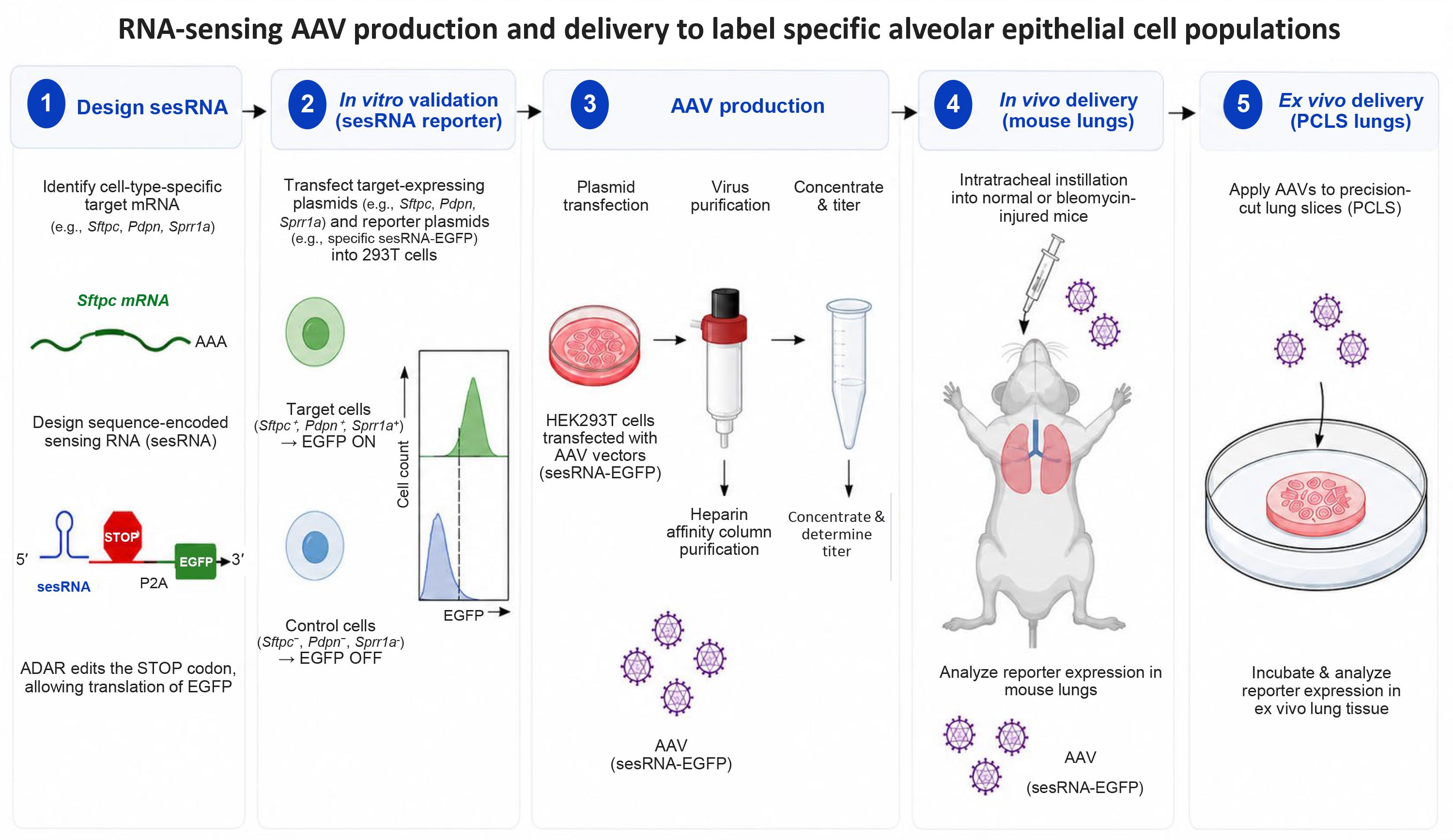
Graphical overview of transcript-guided RNA sensing and AAV delivery. (1) Select a cell-enriched target RNA and design a sequence-encoded sensing RNA (sesRNA). (2) Validate target-dependent reporter translation in HEK293T cells. (3) Produce and purify AAV6.2FF carrying the sesRNA-EGFP cassette. (4) Deliver AAV vectors to normal or bleomycin-injured mouse lungs for in vivo labeling. AAV icons beneath the mouse denote the administered vector; reporter-positive cells are evaluated in lung tissue downstream. (5) Apply AAV vectors to human precision-cut lung slices (PCLS) for ex vivo labeling. Approximate timing: sesRNA design and cloning, 3–7 days; in vitro screening, 3–4 days; AAV production and purification, 5–7 days; in vivo reporter expression, at least 6 days after AAV delivery; human PCLS workflow, 14 days. AAV, adeno-associated virus; ADAR, adenosine deaminase acting on RNA; BFP, blue fluorescent protein; EGFP, enhanced green fluorescent protein; PCLS, precision-cut lung slice.
Background
Alveolar type 2 (AT2) cells function as facultative progenitors that proliferate and differentiate into alveolar type 1 (AT1) cells after injury. During fibrotic repair, AT2 cells can accumulate in transitional states, including Krt8-positive alveolar differentiation intermediates in mice and KRT5-negative/KRT17-positive aberrant basaloid cells in human IPF lungs [1–4]. These populations are heterogeneous and incompletely represented by conventional lineage markers, making their functional analysis technically challenging. Established approaches include Cre/lox-based lineage tracing and conditional genetic manipulation, promoter- or enhancer-driven reporter vectors, RNA in situ hybridization, and single-cell transcriptomic profiling. Lineage tracing provides durable cell-fate information but requires prior identification of a suitable regulatory element and, in many cases, generation and breeding of new mouse lines [1,5]. RNA in situ hybridization and single-cell RNA sequencing can define disease-associated states at high molecular resolution; however, these are endpoint assays and do not by themselves provide prospective access to living cells for isolation or manipulation. These limitations are particularly important when transcriptomic studies identify newly emerging or transient cell states.
CellREADR uses a programmable sesRNA that base-pairs with a selected cellular RNA [6]. The sensor contains an engineered UAG stop codon positioned within the translated sensor sequence. After the sensor hybridizes to its target RNA, endogenous ADAR edits adenosine to inosine. The ribosome interprets inosine as guanosine, permitting translation through the edited codon and into the downstream effector RNA encoding EGFP. Changing the antisense sensor sequence therefore redirects reporter expression to cells that contain the selected target transcript, providing a way to convert an RNA-defined cellular state into live-cell reporter or effector expression [6].
For lung delivery, this protocol uses AAV6.2FF, an AAV6-derived capsid with efficient respiratory epithelial transduction [7–9]. The combined workflow provides a rapid, transcript-guided alternative to creating a new cell type–specific mouse line.
Materials and reagents
Biological materials
1. HEK293T cells (ATCC, catalog number: CRL-11268)
2. Pathogen-free 12-week-old C57BL/6 mice (The Jackson Laboratory, stock number: 000664); use both sexes for reporter-labeling studies unless the experimental design specifies otherwise
3. Krt8-CreERT2;Rosa26-tdTomato mice, generated by crossing Tg(Krt8-cre/ERT2)17Blpn/J mice with B6.Cg-Gt(ROSA)26Sortm14(CAG-tdTomato)Hze/J reporter mice (The Jackson Laboratory; stock numbers: 017947 and 007914)
4. Sftpc-CreERT2;Rosa26-tdTomato mice, generated by crossing B6.129S-Sftpctm1(cre/ERT2)Blh/J mice with the Rosa26-tdTomato reporter line (The Jackson Laboratory; stock numbers: 028054 and 007914)
5. Human PCLS from nonfibrotic donor and IPF lungs (Baylor College of Medicine Chronic Lung Disease Tissue Repository)
Reagents
1. Dulbecco's modified Eagle medium (DMEM) (Gibco, catalog number: 11965-118)
2. Roswell Park Memorial Institute (RPMI) medium (Corning, catalog number: 15-040-CV)
3. Fetal bovine serum (FBS) (Gibco, catalog number: 26140-079)
4. Penicillin-streptomycin (Gibco, catalog number: 15140-122)
5. Polyethyleneimine (PEI) (Polysciences, catalog number: NC2073514)
6. Opti-MEM reduced-serum medium (Gibco, catalog number: 31985-070)
7. Pierce protease inhibitor tablets (Thermo Fisher Scientific, catalog number: A32963)
8. Sodium deoxycholate (Sigma-Aldrich, catalog number: D6750-25G)
9. Benzonase nuclease (Sigma-Aldrich, catalog number: E1014-5KU)
10. Bleomycin sulfate (Almirall, catalog number: B1141000)
11. pCL245 mammalian expression/lentiviral vector containing the EF1α promoter and mCherry coding sequence (gift from Dr. Chao Li, Department of Biochemistry and Molecular Genetics, University of Alabama at Birmingham)
Note: The pCL245 backbone itself is not essential; an equivalent custom plasmid expressing mCherry-T2A-target cDNA from a constitutive promoter may be used instead.
12. pAAV-CAG-mTagBFP2-P2A-EGFP backbone (Addgene plasmid #184943)
13. pDGM6.2FF helper plasmid, derived from pDGM6 (Addgene plasmid #110660)
14. AgeI restriction enzyme and compatible reaction buffer (New England Biolabs, catalog number: R3552S)
15. Gibson Assembly Cloning kit (New England Biolabs, catalog number: E5510S)
16. Synthetic sesRNA DNA fragments (gBlocks or equivalent; Integrated DNA Technologies)
17. Sterile phosphate-buffered saline (PBS), pH 7.4 (Gibco, catalog number: 10010-023)
18. Sodium chloride (NaCl), molecular biology grade (Sigma-Aldrich, catalog number: S7653)
19. Sterile 0.9% sodium chloride (NaCl) for animal administration (BD, catalog number: 221819)
20. Tamoxifen for CreERT2 induction (Fisher Scientific, catalog number: 50-149-0596)
21. Paraformaldehyde (PFA), 4% solution (Electron Microscopy Sciences, catalog number: 15710-S, or equivalent)
22. Optimal cutting temperature (OCT) compound (Sakura Finetek, Tissue-Tek O.C.T., catalog number: 4583)
23. Normal goat serum (Jackson ImmunoResearch, catalog number: 005-000-121)
24. Triton X-100 (Millipore, catalog number: 1086431000)
25. 4',6-Diamidino-2-phenylindole (DAPI) nuclear stain (Thermo Fisher Scientific, catalog number: D1306)
26. Anti-Krt8 antibody (Thermo Fisher Scientific, clone TS1, catalog number: MA5-14467)
27. Anti-SFTPC antibody (Abnova, clone 1C9, catalog number: H00006447-M01)
28. Anti-KRT17 antibody (Proteintech, catalog number: 10543-1-AP)
29. Anti-KRT5 antibody (Proteintech, catalog number: 905501-AP)
30. Species-appropriate Alexa Fluor 488-, 555-, and 647-conjugated secondary antibodies (Invitrogen, catalog numbers: A-11008, A-11001, A-21428, A-21422, A-21245)
31. Sodium azide (Sigma-Aldrich, catalog number: S2002)
32. Low-melting-point agarose (Thermo Fisher Scientific, UltraPure Low Melting Point Agarose, catalog number: 16520050)
33. Antifade mounting medium (Thermo Fisher Scientific, ProLong Gold Antifade Mountant, catalog number: P36930, or equivalent)
Solutions
1. Complete DMEM (see Recipes)
2. PEI transfection solution, 1 mg/mL (see Recipes)
3. Sodium deoxycholate stock solution, 10% (w/v) (see Recipes)
4. Heparin-column wash and elution buffers (see Recipes)
5. Complete RPMI medium (see Recipes)
6. Low-melting-point agarose in DMEM, 2% (w/v) (see Recipes)
7. Immunofluorescence blocking buffer (see Recipes)
8. Immunofluorescence antibody diluent (see Recipes)
Recipes
1. Complete DMEM
| Reagent | Final concentration | Volume |
|---|---|---|
| DMEM | 90% | 445 mL |
| FBS | 10% | 50 mL |
| Penicillin-streptomycin | 1× | 5 mL |
| Total | n/a | 500 mL |
Mix aseptically. Store at 2–8 °C for up to 2 weeks; discard if contamination, precipitation, or marked color change is observed.
2. PEI transfection solution (1 mg/mL)
| Reagent | Final concentration/endpoint | Quantity or volume |
|---|---|---|
| Linear PEI, MW 25,000 | 1 mg/mL | 100 mg |
| Milli-Q water | n/a | 90 mL initially; bring final volume to 100 mL |
| Hydrochloric acid (HCl), 12 M | As required to reach pH < 2.0 | ~160 μL |
| Sodium hydroxide (NaOH), 10 N | As required to reach pH ~7.0 | ~100 μL |
| Total | n/a | 100 mL |
a. Suspend 100 mg of linear PEI in 90 mL of Milli-Q water in a clean beaker.
b. While stirring, add 12 M HCl dropwise until the pH is < 2.0 (approximately 160 μL total).
c. Cover the beaker and stir for 3 h at room temperature, or until the solution is mostly clear.
d. Add 10 N NaOH dropwise while monitoring the pH until the solution reaches approximately pH 7.0 (approximately 100 μL total).
e. Adjust the final volume to 100 mL with Milli-Q water and mix thoroughly.
f. Filter-sterilize the solution through a 0.22 μm membrane filter.
g. Aliquot into single-use volumes and store at -80 °C for up to 6 months. Avoid repeated freeze/thaw cycles.
Critical: Add HCl and NaOH slowly while continuously monitoring the pH. The indicated acid and base volumes are approximate and may vary between preparations.
3. Sodium deoxycholate stock solution [10% (w/v)]
| Reagent | Final concentration | Quantity or volume |
|---|---|---|
| Sodium deoxycholate | 10% (w/v) | 10 g |
| Double-distilled water | n/a | Bring to 100 mL |
Dissolve completely. Store the 10% sodium deoxycholate stock at room temperature for up to 1 month. If precipitation occurs, warm gently and mix until the solution is clear before use.
4. Heparin-column wash and elution buffers (50 mL each; prepared from 5 M NaCl)
| Buffer | 5 M NaCl | PBS |
|---|---|---|
| 200 mM NaCl wash buffer | 0.648 mL | 49.352 mL |
| 300 mM NaCl elution buffer | 1.68 mL | 48.32 mL |
| 350 mM NaCl elution buffer | 2.19 mL | 47.81 mL |
| 450 mM NaCl elution buffer | 3.22 mL | 46.78 mL |
Mix and sterilize by filtration. Store heparin-column wash and elution buffers at 2–8 °C for up to 1 month.
5. Complete RPMI medium
| Reagent | Final concentration | Volume |
|---|---|---|
| RPMI | 90% | 445 mL |
| FBS | 10% | 50 mL |
| Penicillin-streptomycin | 1× | 5 mL |
| Total | n/a | 500 mL |
Mix aseptically. Store at 2–8 °C for up to 2 weeks; discard if contamination, precipitation, or marked color change is observed.
6. Low-melting-point agarose in DMEM [2% (w/v)]
Dissolve 2 g of low-melting-point agarose in DMEM to a final volume of 100 mL by heating until fully dissolved. Cool to approximately 37–42 °C before lung inflation and use on the day of preparation. Do not store the prepared agarose/DMEM solution.
7. Immunofluorescence blocking buffer
5% normal goat serum in PBS. Prepare freshly.
8. Immunofluorescence antibody diluent
1% normal goat serum, 0.3% Triton X-100, and 0.01% sodium azide in PBS. Prepare freshly.
Laboratory supplies
1. 12-well cell culture plates (Fisher Scientific, catalog number: 07-200-82)
2. 10-cm tissue culture dishes (Thermo Fisher Scientific, catalog number: 130182)
3. Amicon Ultra-4 centrifugal filters, 100 kDa molecular-weight cutoff (Millipore, catalog number: UFC801024)
4. Sterile 0.2 micrometer syringe filters (Millipore, catalog number: SLGPM33RS)
5. Sterile 15 and 50 mL conical tubes (any)
6. Sterile serological pipettes (5, 10, and 25 mL) and filtered micropipette tips compatible with 10, 20, 200, and 1,000 μL pipettes (any)
7. Sterile syringes compatible with the syringe filters and animal instillation procedure (any)
8. Cell scrapers (any)
9. Cryovials for AAV aliquots (any)
10. Microscope slides and coverslips (any)
11. Humidified staining chambers (any)
12. Animal intubation/instillation supplies approved by the institutional animal program (any)
13. 24-well plates for PCLS culture (any)
14. Sterile 60 mL syringes for lung inflation (any)
15. Sterile 10 Fr airway catheter (any)
16. Sterile 10 mm biopsy punch (any)
17. Tissue adhesive compatible with the VF-300-0Z specimen holder (any)
18. Fine forceps and scissors for PCLS handling (any)
19. PCLS culture inserts or plates as required by the local tissue-slice workflow (any)
20. HiTrap heparin affinity column (Cytiva, catalog number: 45-000-057)
Equipment
1. Peristaltic pump (Millipore, model: XX8020EL0)
2. Inverted fluorescence microscope (Nikon, model: Eclipse Ts2-FL)
3. Class II biological safety cabinet (Thermo Fisher Scientific or equivalent)
4. Humidified 37 °C, 5% CO2 incubator (Thermo Fisher Scientific or equivalent)
5. Refrigerated centrifuge with rotors for 15 and 50 mL tubes and speeds up to 4,000× g (Eppendorf or equivalent)
6. LSM710 confocal laser-scanning microscope (Carl Zeiss) or equivalent sequential-scanning confocal microscope
7. Cryostat for lung sectioning (Leica Biosystems or equivalent)
8. FACSymphony S6 cell sorter (BD Biosciences) or equivalent instrument capable of detecting EGFP, BFP, and tdTomato, if flow analysis is performed
9. Quantitative real-time PCR instrument compatible with SYBR Green detection (Applied Biosystems/Thermo Fisher Scientific or equivalent) for AAV genome titration
10. VF-300-0Z vibrating microtome (Precisionary Instruments, USA) for preparation of 500 μm PCLS
Software and datasets
1. CellREADR design portal (Duke University; https://cellreadr.neuro.duke.edu; accessed September 20, 2026)
2. ImageJ (NIH; version 1.54u8; free) for fluorescence-image inspection, manual/ROI-assisted cell counting, and colocalization measurements
3. GraphPad Prism 8 (GraphPad Software) for statistical analysis and graphing; equivalent statistical software may be used if the same analyses are performed
Procedure
登录/注册后免费查看全文
文章信息
稿件历史记录
提交日期: Aug 10, 2026
接收日期: Oct 2, 2026
在线发布日期: Oct 21, 2026
出版日期: Nov 5, 2026
版权信息
© 2026 The Author(s); This is an open access article under the CC BY-NC license (https://creativecommons.org/licenses/by-nc/4.0/).
如何引用
Zheng, Z., Jiang, C., Shan, D., He, C., Rosas, I. O., Lasky, J. A., Thannickal, V. J. and Zhou, Y. (2026). Transcriptomic Signature-Guided EGFP Labeling of Alveolar Epithelial Cells via RNA Sensing in Mouse Lungs In Vivo and Human Idiopathic Pulmonary Fibrosis Lung Slices Ex Vivo. Bio-protocol 16(21): e5863. DOI: 10.21769/BioProtoc.5863.

 Download Citation in RIS Format
您对这篇实验方案有问题吗?
在此处发布您的问题,我们将邀请本文作者来回答。同时,我们会将您的问题发布到Bio-protocol Exchange,以便寻求社区成员的帮助。
 发布问题


