


Radial Water Loss Assay in Rice Roots Grown in Different Media
不同培养基质中水稻根系径向失水的测定方法

发布: 2026年10月05日第16卷第19期 DOI: 10.21769/BioProtoc.5845 浏览次数: 46
评审: Samik BhattacharyaAmit SRIVASTAVAKumiko Okazaki
 PDF
PDF  Q&A
Q&A
参见作者原研究论文
The authors used this protocol in:
Jun 2025




Abstract
Plants growing in soil are exposed to several environmental stresses, such as soil compaction, flooding, or drought, and need to quickly acclimate to these conditions to survive. Such acclimations include suberization and lignification of the outer and inner parts of the root. Visualization of suberin and lignin depositions in roots can be done with several well-established staining techniques followed by microscopy, but these methods are mostly qualitative. Radial water loss assays provide a quick, robust, and quantitative method to evaluate the formation of suberized and/or lignified outer apoplastic barriers and how tightly they regulate water loss. Here, we provide a detailed step-by-step protocol, from harvesting the roots from soil conditions and cleaning them, to preparing them for water loss measurements, while using basic lab equipment. Since the data obtained is water loss as mass, quantitative and statistical comparisons can be performed. Finally, while in this protocol roots were grown in soil, the method can be applied to roots growing in hydroponics, agar plates, or any other growth conditions that allow non-destructive harvesting of roots. In summary, the protocol provides a fast and reliable method to assess differences in outer apoplastic barrier development of root tissues, allowing for fast root tissue screenings while obtaining quantitative data without expensive or highly specialized equipment.
Key features
• Ideal for root tissues of similar diameter.
• Few preparation steps, and only simple lab equipment is needed.
• Data can be obtained in three days.
Keywords: Abiotic stress (非生物胁迫) Gas diffusion (气体扩散)
Lignin (木质素)
Suberin (栓质)
Outer apoplastic barrier (外层质外体屏障)
Water vapor (水蒸气)
Gas diffusion (气体扩散)
Lignin (木质素)
Suberin (栓质)
Outer apoplastic barrier (外层质外体屏障)
Water vapor (水蒸气)
Graphical overview
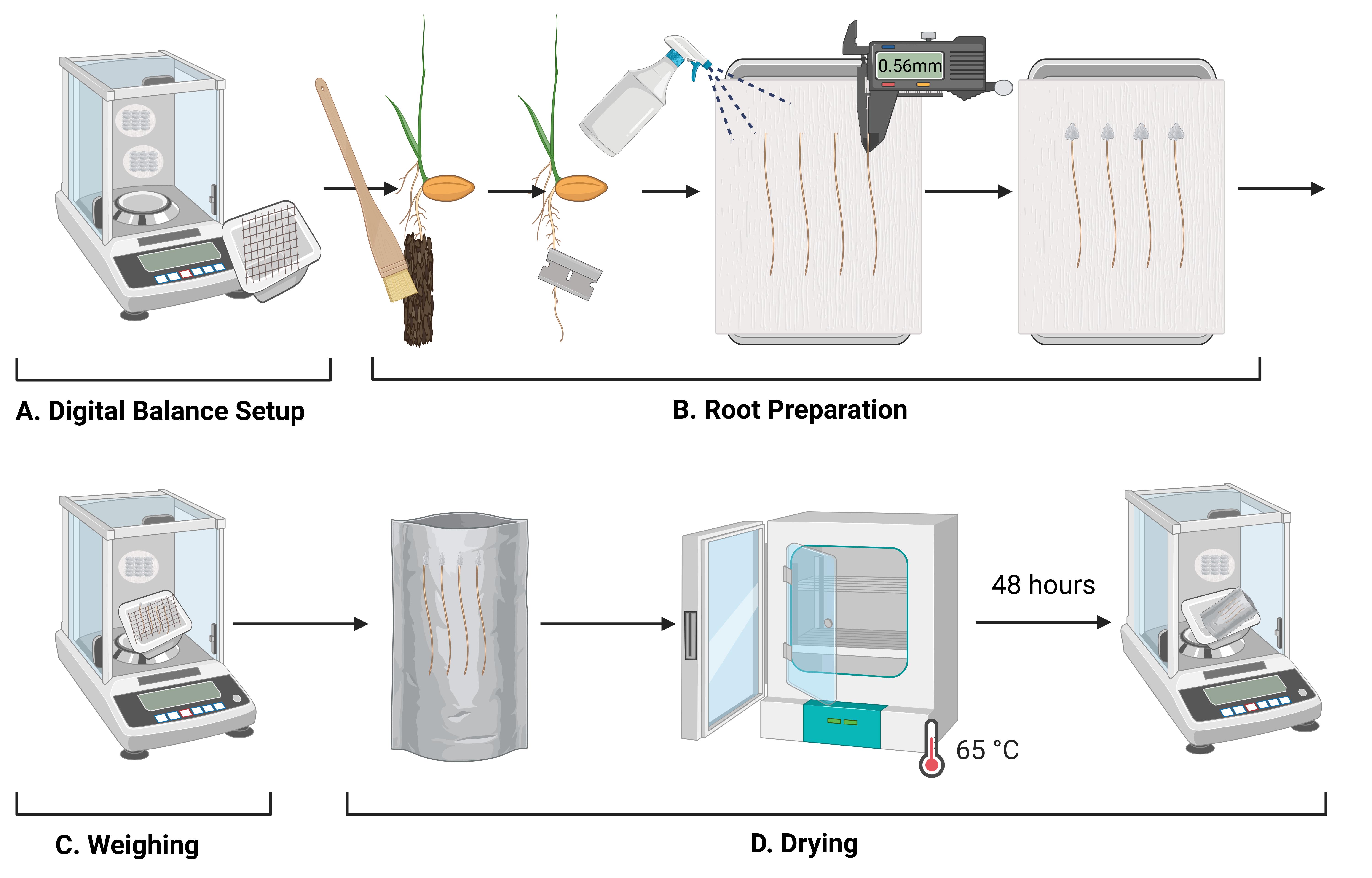
Overview of the radial water loss assay in rice roots
Background
Climate change is the driving force behind the shift of rain patterns across the globe, subjecting areas to flooding or drought conditions that were not prone to such stresses before, or even exacerbating water stress conditions in those already experiencing them [1]. Moreover, the growth of the global population is increasing the pressure on agricultural areas in terms of food production, often requiring the use of heavy machinery [2,3]. This machinery, while necessary for food production, can cause compaction of the farmland soil, reducing root penetration and, ultimately, impacting the yield of such crops [4]. Roots are evidently exposed to a wide array of challenging soil and environmental conditions, which can be overcome with the suberization and lignification of the outer root tissues and the formation of outer apoplastic barriers [4,5].
Several well-established methods allow the assessment of suberized and lignified tissues with various staining fluorescent dyes, such as fluorol yellow (suberin) or basic fuchsin (lignin) [6]. While these methods provide useful spatial indication of suberized and lignified tissues of the roots, they remain mainly qualitative and do not allow the assessment of the strength or tightness of such root tissues to prevent gas diffusion in relevant contexts, such as oxygen loss during soil flooding (hypoxic stress [7]), water loss during soil compaction, or water deficiency stress [8].
These limitations are solved by radial water loss measurements from root tissues. Suberized and lignified outer root tissues become hydrophobic and limit the loss of water (as well as other gases) from the root to the external environment [5]. Moreover, the water loss measured as mass provides quantitative data with good temporal resolution (in the range of seconds). Other factors can drive the rate of water loss, such as root thickness; therefore, a comparison between roots should aim for similar diameters. While normalizing the data to root diameter is possible, it might not be adequate if the diameters differ greatly [7]. Alternatively, mutants deficient in suberization/lignification of tissues and/or formation of outer apoplastic barriers [8,9] could be applied to avoid this issue, provided that the differences in root diameters between the wild type and mutants remain constant across treatments.
Radial water loss data obtained can be used to compare the tightness of the outer apoplastic barriers. Suberized and/or lignified outer apoplastic barriers reduce radial water loss (e.g., non-compacted vs. compacted soil conditions in rice and mhz5 [8], and well-drained vs. stagnant conditions in rice species from diverse natural habitats [1]). This method has been tested between species (e.g., rice, wheat) as well as with various diameters of agar cylinders to mimic roots [10]. Finally, the method was applied to roots without or with a root exodermis, including maize, wheat, Rhodes grass, or sorghum, and the results showed that the presence of an exodermis reduces radial water loss [11].
Materials and reagents
Biological materials
1. Rice line cv Nipponbare
Rice seeds were dehusked and surface-sterilized using 25% sodium hypochlorite with 0.01% Triton for 5 min, followed by five rinses in sterile water. The seeds were then incubated in moist filter paper at 28–30 °C in the dark for 48 h to allow for germination. Germinated rice seedlings were transferred into three-dimensionally printed soil columns (15 cm height, 3.3 cm diameter) for 3 days. The soil used was loamy sand soil, and the bulk density was 1.2 g/cm3. The soil was sprayed with water (roughly adding 7% of moisture to the dry soil) before preparing the soil columns. Then, the columns were hydrated via capillarity from the bottom of the column for at least 2 h and then gravity-drained to reach field capacity. For more details, see [3]. A small hole for each seed was made in the topsoil before transferring the seedlings to provide space for the already emerged radicle. Once transferred to the soil columns, rice seedlings grew under the following conditions: 12/12 h photoperiod, 300 μmol m2/s light, and 70% relative humidity. To calculate the bulk density, we used the following formula:
Bulk density (g/cm3) = dry soil (g) / volume of soil container (cm3).
In this case, as the soil container is a cylinder, the volume is:
Cylinder volume (cm3) = π × radius2 (cm2) × height (cm)
Laboratory supplies
1. High-vacuum grease (Dow Corning, catalog number: 1597418); store at room temperature, in a cool, dry place, and ensure that the grease lid is tightly closed once finished using
2. Silica gel self-indicating (FisherbrandTM, catalog number: S/0761/60); store at room temperature, in a cool, dry place, and tightly close the lid of the container after using
Note: Any silica gel is acceptable as long as it can maintain the relative humidity constant inside the balance chamber throughout the measurements.
3. Aluminum foil (Scientific Laboratory Supplies, catalog number: ALU1011)
4. Weighing boat (Sigma-Aldrich, catalog number: HS1420AA)
5. Soft hairbrush 4 mm (Scientific Laboratory Supplies LTD, UK); as long as the brush is soft, other sizes can be used
6. Razor blades (Wilkinson Sword, UK)
7. Tweezers (FisherbrandTM Dumont #5 Fine Tip Tweezers, catalog number: 15483542)
8. Thin nylon mesh (nylon dress net fabric, Fabric Land, UK); any mesh of a material that does not absorb water (e.g., nylon, metal) can be used
9. Tea bags (round or square, e.g., Bird and Blend, UK, catalog number not available)
10. Tape (e.g., 3M Micropore Surgical Tape, Scientific Laboratory Supplies, catalog number: 4702)
11. Spatula (VWR International LTD, catalog number: RSGA830.500) (there is no specific spatula for this)
12. Ruler (Scientific Laboratory Supplies, catalog number: GW510) (there is no specific ruler for this)
13. Paper towels (e.g., Kimberly-ClarkTM ScottTM Slimfold Hand Towels, Fischer Scientific, catalog number: 11715254); any paper towel is acceptable provided it is soft and kept moist while covering root segments
Equipment
1. Closed chamber, five-digit balance (Mettler Toledo, model: AX105DR)
Note: A five-digit balance allows for more precise measurements even if the root tissue mass is not ideal. Moreover, since water loss is gradual in small amounts of mass, a 4-digit balance might not capture these small changes within the timeframe of the assessment.
2. Pre-calibrated humidity and temperature indicator (Digi-sense, Fischer Scientific UK LTD, catalog number: 15890036)
3. Digital Timer (FisherBrandTM, catalog number: 17951662)
4. Digital caliper 150 mm (RS PRO, UK, catalog number: 243-6808)
5. Drying oven (Mini 6L CLAD)
Software and datasets
1. Microsoft Excel, included in the Microsoft 365 Apps; any open-source spreadsheet editor will work
Procedure
登录/注册后免费查看全文
文章信息
稿件历史记录
提交日期: Apr 22, 2026
接收日期: Jul 30, 2026
在线发布日期: Sep 23, 2026
出版日期: Oct 5, 2026
版权信息
© 2026 The Author(s); This is an open access article under the CC BY license (https://creativecommons.org/licenses/by/4.0/).
如何引用
Peralta Ogorek, L. L., Jamieson, S. and Pandey, B. K. (2026). Radial Water Loss Assay in Rice Roots Grown in Different Media. Bio-protocol 16(19): e5845. DOI: 10.21769/BioProtoc.5845.

 Download Citation in RIS Format
分类
植物科学 > 植物生理学 > 非生物胁迫
生物科学 > 生物技术
您对这篇实验方案有问题吗?
在此处发布您的问题,我们将邀请本文作者来回答。同时,我们会将您的问题发布到Bio-protocol Exchange,以便寻求社区成员的帮助。
 发布问题
发布问题


