


Immune-Complex-Based In Vitro Deubiquitination Assay
基于免疫复合物的体外去泛素化活性检测方法

发布: 2026年10月05日第16卷第19期 DOI: 10.21769/BioProtoc.5824 浏览次数: 660
评审: Ágnes Judit JuhászManasi BarathAnonymous reviewer(s)
 PDF
PDF  Q&A
Q&A
参见作者原研究论文
The authors used this protocol in:
Feb 2026




Abstract
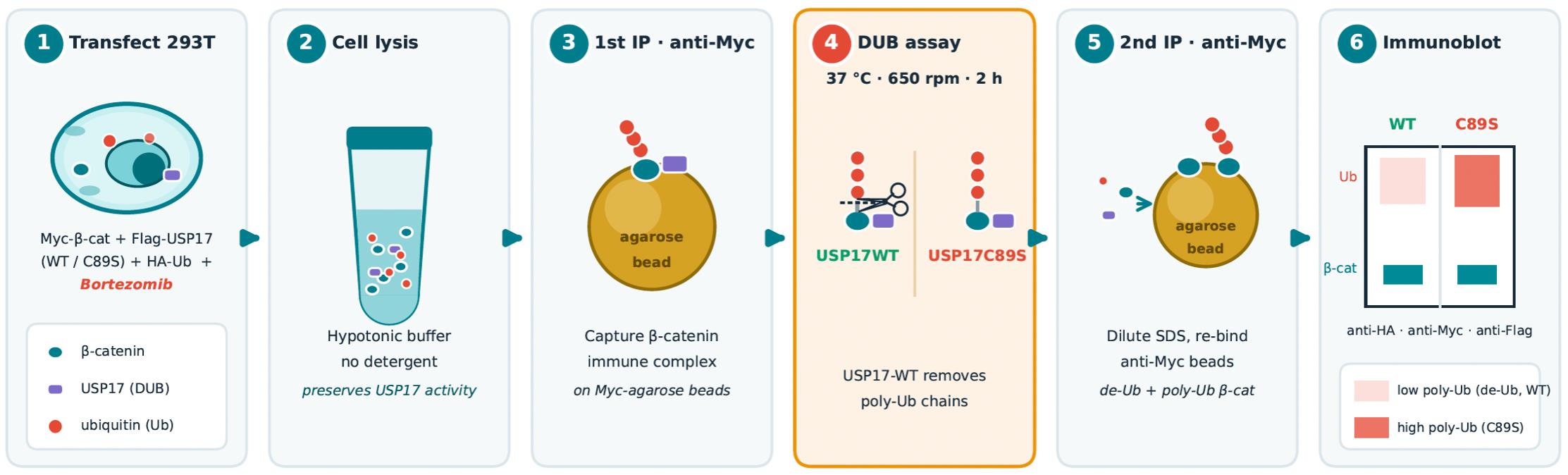
Deubiquitinases (DUBs) are attractive therapeutic targets within the ubiquitin-proteasome system, in part because four of the five DUB subfamilies are cysteine proteases amenable to the development of potent, selective inhibitors, as recently demonstrated for USP7. Identifying DUBs that deubiquitylate and stabilize specific human oncogenic proteins is therefore a promising approach to discovering new mechanism-based targets for cancer therapy. Several complementary experimental strategies are typically required to identify bona fide DUB–substrate pairs. Here, we present an efficient, straightforward in vitro immune-complex protocol to validate USP17-mediated deubiquitylation of the transcriptional co-activator β-catenin. In this assay, both β-catenin and USP17 are immunopurified from transiently transfected 293T cells and then combined to assess USP17 enzymatic activity. The protocol describes the in vitro enzymatic assay performed on immunopurified complexes and the immunoblot-based readout. It can be readily adapted to other DUBs and substrates for mechanistic studies.
Key features
• Requires prior experience with cell culture, immunoprecipitation, and immunoblot analysis.
• Uses plasmids encoding epitope-tagged DUB (here, USP17), the substrate of the DUB of interest (here, β-catenin), and ubiquitin, which are transiently expressed in 293T cells.
• Expression in mammalian cells preserves DUB (here, USP17) essential post-translational modifications.
• Adaptable to other DUB–substrate pairs.
Keywords: USP17 (USP17) β-catenin (β-连环蛋白)
Deubiquitinating enzymes (去泛素化酶)
Immunoprecipitation (免疫沉淀)
In vitro deubiquitinase assay (体外去泛素化酶活性检测)
β-catenin (β-连环蛋白)
Deubiquitinating enzymes (去泛素化酶)
Immunoprecipitation (免疫沉淀)
In vitro deubiquitinase assay (体外去泛素化酶活性检测)
Graphical overview
Background
Ubiquitination is a reversible post-translational modification that regulates protein turnover, subcellular localization, enzymatic activity, and protein–protein interactions [1]. The covalent attachment of ubiquitin is reversed by deubiquitinating enzymes (DUBs), also known as deubiquitinases, a functionally diverse class of proteases that remove ubiquitin from mono- and polyubiquitinated proteins [2]. This activity thereby modulates the stability and function of signaling properties and fine-tunes numerous cellular pathways. The human genome encodes approximately 100 DUBs, and dysregulation of their expression has been implicated in many diseases, including cancer and neurodegeneration [2].
Oncogenic transcription factors and co-activators, including MYC, KLF4, SNAIL, ELK1, and β-catenin, are often stabilized by reduced polyubiquitination-mediated proteasomal degradation [3–8]. Therefore, increasing their polyubiquitination by inhibiting DUBs is an attractive strategy to reduce their expression. DUBs are broadly classified into two principal groups based on their catalytic mechanisms: cysteine proteases and metalloproteases. The cysteine protease group includes ubiquitin-specific proteases (USPs), ubiquitin C-terminal hydrolases (UCHs), ovarian tumor domain proteases (OTUs), and Machado–Josephin domain-containing proteins (MJDs). Metalloprotease DUBs are generally referred to as JAMM proteases [2].
Using a genome-wide loss-of-function RNAi screen targeting 99 human DUBs, we recently identified USP17 as a key regulator of β-catenin stability and oncogenic growth in colorectal cancer (CRC) cells [8]. For enzymes such as USP17, target validation typically relies on gain- and loss-of-function approaches in cultured cells and animal models. Although correlations between USP17 expression and functional readouts, such as β-catenin protein levels, transcriptional activity, CRC cell growth, and tumor growth, are essential, additional in vitro biochemical approaches are necessary to establish a direct enzyme–substrate relationship. Therefore, biochemical evidence, including co-immunoprecipitation experiments, co-localization studies, and in vitro deubiquitination assays, is required to directly test whether the candidate DUB can deubiquitinate the putative substrate.
In vitro deubiquitination assays for USP17 have been reported using recombinant USP17 protein purified from bacterial expression systems [9]. However, USP17 requires phosphorylation by cyclin-dependent kinases in mammalian cells to become fully active [4], a requirement that is not recapitulated in bacterial expression systems. Here, we describe a method to directly measure USP17 deubiquitinase activity by immunopurifying both USP17 and its substrate, β-catenin, from mammalian cells. The assay is technically simple and adaptable to other DUBs and substrates.
Materials and reagents
Biological materials
1. HEK 293T/17 (American Type Culture Collection, CRL-11268)
Antibodies and plasmids
1. Pierce Anti-c-Myc agarose: agarose-conjugated anti-c-Myc (9E10) mouse monoclonal antibody (Pierce, catalog number 20168)
2. Purified anti-HA.11 Epitope Tag Antibody (clone 16B12) (BioLegend/Revvity, catalog number: 901502) (previously Covance, catalog number: MMS-101P)
3. Rabbit polyclonal Anti-c-Myc (A-14) antibody, 100 μg/mL (Santa Cruz, catalog number: Sc-789)
4. Rabbit polyclonal Anti-Flag antibody (Sigma, catalog number: F7425)
5. Goat anti-rabbit IgG (H + L), HRP-conjugated (KPL, catalog number: 074-1506)
6. Goat anti-mouse IgG (H + L), HRP-conjugated (KPL, catalog number: 074-1806)
7. pCDNA3.1-Myc-β-catenin, pCDNA3.1-Flag-USP17WT, and pCDNA3.1-Flag-USP17C89S, recently described [8]
8. pCDNA3.1-HA-ubiquitin plasmid, described in [10]
Reagents
1. DMEM Hi-glucose, L-glutamine, Na pyruvate (Wisent, catalog number: 319-005)
2. Fetal bovine serum (FBS), Premium, low endotoxin (Wisent, catalog number: 090-150, lot number: 112733)
3. Trypsine-EDTA (0.05%) (Wisent, catalog number: 325-542-CL)
4. Trypan Blue 0.4% solution (Wisent, catalog number: 609-130-EL)
5. Extreme MEM 1× with Earle’s salts, L-glutamine, and hormones (Wisent, catalog number: 390-005-CL)
6. Methanol 20 L (VWR, catalog number: CAMX0485-5)
7. Hydrochloric acid (HCl) concentrate, 10N ACS (certified) (Fisher, catalog number: SA49_6×100mL)
8. Sodium hydroxide (NaOH) solution (10N certified) (Fisher, catalog number: SS2551)
9. Acetic acid glacial (Fisher, catalog number: 351271500)
10. Anhydrous ethyl alcohol (Greenfield Global, catalog number: P016EAAN)
11. ContecTM PREemptTM concentrate disinfectant (Fisher Scientific, catalog number: 296366215)
12. Polyethylenimine, linear, MW 25000, transfection grade (PEI 25KTM) (Polysciences, catalog number: 23966)
13. Glycerol (Wisent, catalog number: 800-040-LL)
14. Glycine (Wisent, catalog number: 800-045-IK)
15. Tris (hydroxymethyl) aminomethane (Wisent, catalog number: 600-125-IK)
16. Sodium chloride anhydrous (NaCl) (Wisent, catalog number: 600-082 IK)
17. Potassium chloride (KCl) (molecular biology, ≥99.0%) (Sigma, catalog number: P9541)
18. Sodium phosphate dibasic heptahydrate (Na2HPO4·7H2O) (Sigma, catalog number: S9390)
19. Potassium phosphate monobasic (KH2PO4) (molecular biology, anhydrous) (Sigma, catalog number: 60218)
20. Magnesium chloride hexahydrate (MgCl2·6H2O) (Sigma, catalog number: M2670)
21. Sodium fluoride (NaF) (Sigma, catalog number: S7920)
22. β-Glycerophosphate disodium salt hydrate (Sigma, catalog number: G6251)
23. Aprotinin from bovine lung (Roche, catalog number: 10236624001)
24. Pepstatin A from Streptomyces species (Roche, catalog number: 11359053001)
25. Sodium orthovanadate (Na3VO4) (Sigma, catalog number: 567540)
26. DL-Dithiothreitol (DTT) (Sigma, catalog number: D9779)
27. SDS 10% solution (Wisent, catalog number: 880-550-CL)
28. EDTA 0.5 M (pH 8.0) (Wisent, catalog number: 809-163 EL)
29. BSA standard 2 mg/mL (Thermo ScientificTM PierceTM, catalog number: 23209)
30. Triton X-100 (Sigma, catalog number: X100-1L)
31. Tween-20 (Sigma, catalog number: P9416)
32. SDS (sodium dodecyl sulfate) (Wisent, catalog number: 800-100 CG)
33. Ponceau S (Sigma, catalog number: P3504-10G)
34. Sodium azide (NaN3) (EM Science, MilliporeSigma, catalog number: SX0299-1)
35. Dry milk (Carnation, Skim Milk Fat-Free, 500 g)
36. Ammonium persulfate (APS) (Sigma, catalog number: A3678-100G)
37. Bromophenol blue (Bio-Rad, catalog number: 1610404)
38. TEMED (Sigma, catalog number: T9281-25ML)
39. DMSO (Sigma, catalog number: D8418)
40. Bortezomib (Sigma, catalog number: SKU 503140001)
41. Protein assay dye reagent concentrate (Bio-Rad, catalog number: 5000006)
42. 30% Acrylamide/Bis solution 37.5:1 (Bio-Rad, catalog number: 1610158)
43. Western Lightning ECL Pro 340 mL (Revvity; formerly, PerkinElmer’s Life Sciences and Diagnostics; catalog number: NEL121001EA)
44. Super Signal West Femto Maximum Sensitivity Substrate (Pierce, catalog number: 34095)
45. ProtranTM Premium Western blotting membrane, nitrocellulose, 0.2 μm (AmershamTM, catalog number: GE10600001)
46. Parafilm® M sealing film (VWR, catalog number: 52858-000)
47. Plastic film (Saran Wrap)
48. BLUelf Prestained Protein Ladder (Froggabio, catalog number: PM008-0500)
Note: For reagent storage conditions and expected shelf life, please refer to Supplementary File 1.
Solutions
1. 1× PBS buffer (see Recipes)
2. PEI (1 mg/mL) (see Recipes)
3. Bortezomib 10 mM (see Recipes)
4. NaCl 5 M (see Recipes)
5. MgCl2 2 M (see Recipes)
6. NaF 0.5 M (see Recipes)
7. β-Glycerophosphate 1 M (see Recipes)
8. Aprotinin 2 mg/mL (see Recipes)
9. Pepstatin A 1 mg/mL (see Recipes)
10. Na3VO4 0.1 M (see Recipes)
11. DTT 1 M (see Recipes)
12. 10% Triton X-100 (see Recipes)
13. 1 M Tris-HCl pH 7.5 (see Recipes)
14. 1 M Tris-HCl pH 7.4 (see Recipes)
15. Hypotonic buffer + protease inhibitor cocktail (PIC) (see Recipes)
16. Lysis buffer (see Recipes)
17. DUBS assay buffer 5× (see Recipes)
18. 2% SDS in DUBS assay buffer (see Recipes)
19. DUBS assay buffer 1× (see Recipes)
20. 1.5 M Tris pH 8.8 (see Recipes)
21. 2 M Tris pH 6.8 (see Recipes)
22. 0.5 M Tris pH 6.8 (see Recipes)
23. 10% APS (see Recipes)
24. 30% Acrylamide 37.5:1 (see Recipes)
25. 10% SDS-PAGE (see Recipes)
26. 4% SDS-PAGE stacking gel (see Recipes)
27. Sample buffer 5× (see Recipes)
28. 10× Tris-glycine running buffer (see Recipes)
29. 10× transfer buffer (see Recipes)
30. Ponceau S solution (see Recipes)
31. 10% NaN3 (see Recipes)
32. 10× TBS (see Recipes)
33. Stripping solution (see Recipes)
Recipes
1. 10× PBS buffer
| Reagent | Final concentration | Quantity |
|---|---|---|
| NaCl | 1.37 M | 80 g |
| KCl | 26.8 mM | 2 g |
| Na2HPO4·7H2O | 43 mM | 11.5 g |
| KH2PO4 | 14.7 mM | 2 g |
| Milli-Q H2O | Complete to 1 L |
Complete to 1 L with Milli-Q water to make 10×.
2. PEI (1 mg/mL)
| Reagent | Final concentration | Quantity |
|---|---|---|
| PEI | 1 mg/mL | 50 mg |
| Milli-Q H2O | Complete to 50 mL |
Start with 50 mg of PEI + 45 mL of H2O + 12 μL of HCl 10N. Dissolve completely, adding HCl if necessary, but do not drop the pH below 7.0. The final pH should be between 6.5 and 7.5. Adjust the volume to 50 mL. Once the PEI is dissolved and the volume is adjusted, filter-sterilize the solution (0.22 μm), aliquot, and freeze at -20 °C. Stable at 4 °C for 1 month; it may be freeze-thawed five times.
3. Bortezomib 10 mM
| Reagent | Final concentration | Quantity |
|---|---|---|
| Bortezomib | 10 mM | 2.5 mg |
| DMSO | 651 μL |
To prepare a 10 mM stock solution from a 2.5 mg vial of bortezomib (molecular weight: 384.24 g/mol), add 651 μL of DMSO. Aliquot the stock solution into single-use vials and store at -20 °C for up to 6 months.
4. NaCl 5 M
| Reagent | Final concentration | Quantity |
|---|---|---|
| NaCl (54.88 MW) | 5 M | 29.22 g |
| Milli-Q H2O | Complete to 100 mL |
Dissolve completely in 75 mL of Milli-Q water, then dilute to a final volume of 100 mL.
5. MgCl2 2 M
| Reagent | Final concentration | Quantity |
|---|---|---|
| MgCl2·6H2O (203.30 MW) | 2 M | 40.66 g |
| Milli-Q H2O | Complete to 100 mL |
Dissolve completely in 80 mL of Milli-Q water, then dilute to a final volume of 100 mL. Autoclave or filter through 0.22 μm.
6. NaF 0.5 M
| Reagent | Final concentration | Quantity |
|---|---|---|
| NaF (41.99 MW) | 0.5 M | 1.05 g |
| Milli-Q H2O | Complete to 50 mL |
Dissolve completely in 40 mL of Milli-Q water, then dilute to a final volume of 50 mL. Keep at 4 °C.
7. β-Glycerophosphate 1 M
| Reagent | Final concentration | Quantity |
|---|---|---|
| β-Glycerophosphate disodium salt hydrate (216.04 MW) | 1 M | 21.6 g |
| Milli-Q H2O | Complete to 100 mL |
Dissolve completely in 80 mL of Milli-Q water, then dilute to a final volume of 100 mL.
8. Aprotinin 2 mg/mL
| Reagent | Final concentration | Quantity |
|---|---|---|
| Aprotinin | 2 mg/mL | 10 mg |
| Milli-Q H2O | Complete to 5 mL |
Dissolve the contents of the vial in 4 mL of Milli-Q water, then bring the final volume to 5 mL. Divide into aliquots of 75 μL and use at a 1/1,000 dilution (2 μg/mL). Store stocks at -80 °C.
9. Pepstatin A 1 mg/mL
| Reagent | Final concentration | Quantity |
|---|---|---|
| Pepstatin A | 1 mg/mL | 10 mg |
| 100% ethanol | 10 mL |
Dissolve the contents of the vial in 10 mL of 100% ethanol and rotate overnight at 4 °C. Then, prepare 75 μL aliquots and use at a 1/1,000 dilution (1 μg/mL). Store aliquots at -80 °C.
10. Na3VO4 0.1 M
| Reagent | Final concentration | Quantity |
|---|---|---|
| Na3VO4 (183.91 MW) | 0.1 M | 0.92 g |
| Milli-Q H2O | Complete to 50 mL |
a. Dissolve 0.92 g of sodium orthovanadate in 20 mL of Milli-Q water in a 50 mL tube.
b. Adjust the pH to 10 (the solution will turn yellow).
c. Boil the solution in a water bath for 5–10 min (until the solution becomes colorless).
d. Let the solution sit until it cools down to room temperature (RT).
e. Readjust pH to 10.0.
f. Repeat steps c–e until the pH is stable at 10.0 and the solution is colorless.
g. Fill up to 50 mL with Milli-Q H2O to obtain 0.1 M.
h. Prepare 750 μL aliquots and freeze stocks at -80 °C. Refreeze tubes at -20 °C for routine assay.
11. DTT 1 M
| Reagent | Final concentration | Quantity |
|---|---|---|
| DTT (124.25 MW) | 1 M | 248.5 mg |
| Milli-Q H2O | Complete to 2 mL |
Dissolve 248.5 mg of DTT powder into 1.5 mL of Milli-Q water. Once completely dissolved, add water to bring the final volume to 2 mL. Prepare aliquots of 100 μL. Keep at -80 °C. Once thawed, refreeze at -20 °C 3–4 times.
12. 10% Triton X-100
| Reagent | Final concentration | Quantity |
|---|---|---|
| 100% Triton-X-100 | 10% | 1 mL |
| Milli-Q H2O | 9 mL |
With a P1000 tip, take 1 mL of Triton X-100 by releasing the push button of the pipettor very slowly. Wipe the excess viscous solution from the tip with a Kimtech lint-free wipe, add to the water, and rinse the contents of the tip with a few up/down strokes as needed. Store at 4 °C.
13. 1 M Tris pH 7.4
| Reagent | Final concentration | Quantity or volume |
|---|---|---|
| Tris (hydroxymethyl) aminomethane | 1 M | 121.10 g |
| HCl 10N | Up to pH 7.4 | |
| Milli-Q H2O | Complete to 1 L |
Dissolve Tris in approximately 800 mL of MilliQ water. Adjust pH to 7.4 using 10N HCl. Store at 4 °C to cool the solution. Once the solution reaches 4 °C, readjust the pH to 7.4, then fill to 1 L and store at 4 °C.
14. 1 M Tris pH 7.5
| Reagent | Final concentration | Quantity or volume |
|---|---|---|
| Tris (hydroxymethyl) aminomethane | 1 M | 121.10 g |
| HCl 10N | Up to pH 7.5 | |
| Milli-Q H2O | Complete to 1 L |
Dissolve Tris in approximately 800 mL of Milli-Q water. Adjust pH to 7.5 using 10N HCl. Store at 4 °C to cool the solution. Once the solution reaches 4 °C, readjust the pH to 7.5, then fill to 1 L and store at 4 °C.
15. Hypotonic buffer + PIC
| Reagent | Final concentration | Quantity or volume |
|---|---|---|
| 1 M Tris-HCl pH 7.5 (4 °C) | 10 mM | 0.5 mL |
| 5 M NaCl | 10 mM | 0.1 mL |
| 2 M MgCl2 | 1.5 mM | 0,0375 mL |
| 0.5 M NaF | 10 mM | 1 mL |
| 1 M beta-Glycerol-2-phosphate | 10 mM | 0.5 mL |
| 2 mg/mL Aprotinin | 2 μg/mL (1/1,000) | 50 μL |
| 1 mg/mL Pepstatin A | 1 μg/mL (1/1,000) | 50 μL |
| 0.1 M Sodium ortho-vanadate | 100 nM (1/100) | 500 μL |
| Milli-Q H2O | 47.2625 mL (Vt = 50 mL) |
Prepare the buffer freshly as indicated and keep it on ice. The buffer may be frozen.
16. Lysis buffer
| Reagent | Final concentration | Quantity or volume |
|---|---|---|
| 1 M Tris-HCl, pH 7.4 (4 °C) | 50 mM | 2.5 mL |
| 5 M NaCl | 120 mM | 1.2 mL |
| 0.5 M EDTA pH 8 | 1 mM | 0.1 mL |
| 10% Triton-X-100 | 1% | 5 mL |
| 0.5 M NaF | 10 mM | 1.0 mL |
| 1 M β-Glycerophosphate | 10 mM | 0.5 mL |
| Milli-Q H2O | 39.7 mL (Vt = 50 mL) |
Add all the reagents to the Milli-Q water, mix, and keep on ice; no protease inhibitors are added.
17. DUBS assay buffer 5×
| Reagent | Final concentration | Quantity or volume |
|---|---|---|
| 1 M Tris-HCl, pH 7.4 (4 °C) | 750 mM | 2.250 mL |
| 5 M NaCl | 250 mM | 150 μL |
| 0.5 M EDTA | 5 mM | 30 μL |
| 1 M DTT | 25 mM | 75 μL |
| Milli-Q H2O | 495 μL (Vt = 3 mL) |
Add all the reagents to the Milli-Q water, mix, and keep on ice. Freeze the stock at -20 °C.
18. 2% SDS in DUBS assay buffer
| Reagent | Final concentration | Quantity or volume |
|---|---|---|
| 5× DUBS | 1× | 300 μL |
| 10% SDS | 2% | 300 μL |
| Milli-Q H2O | 900 μL (Vt = 1.5 mL) |
Dilute the 5× DUBS assay buffer with water to 1×. Add the SDS, prepare freshly, and use at RT to avoid SDS precipitation.
19. DUBS assay buffer 1×
| Reagent | Final concentration | Quantity or volume |
|---|---|---|
| 1 M Tris pH 7.5 (4 °C) | 150 mM | 2.250 mL |
| 5 M NaCl | 50 mM | 150 μL |
| 0.5 M EDTA | 1 mM | 30 μL |
| 1 M DTT | 5 mM | 75 μL |
| Milli-Q H2O | 12,495 mL (Vt = 15 mL) |
Add all the reagents to the Milli-Q water, mix, and keep on ice. No protease inhibitor is added.
20. 1.5 M Tris pH 8.8
| Reagent | Final concentration | Quantity or volume |
|---|---|---|
| Tris (hydroxymethyl) aminomethane | 1.5 M | 181.7 g |
| HCl 10N | Up to pH 8.8 | |
| Milli-Q H2O | Complete to 1 L |
Dissolve 181.7 g of Tris base in 850 mL of Milli-Q water. Adjust the pH to 8.8 using concentrated HCl (approximately 28 mL). Readjust the pH to 8.8 at room temperature. Add H2O to 1 L. Store the buffer at 4 °C.
21. 2 M Tris pH 6.8
| Reagent | Final concentration | Quantity or volume |
|---|---|---|
| Tris (hydroxymethyl) aminomethane | 2 M | 121.1 g |
| HCl 10N | Up to pH 6.8 | |
| Milli-Q H2O | Complete to 500 mL |
Dissolve 121.1 g of Tris in 400 mL of Milli-Q water. Adjust the pH to 6.8 using concentrated HCl (approximately 40–45 mL). Readjust the pH to 6.8 at room temperature. Add Milli-Q H2O to 500 mL. Store the buffer at 4 °C.
22. 0.5 M Tris pH 6.8
| Reagent | Final concentration | Quantity or volume |
|---|---|---|
| Tris (hydroxymethyl) aminomethane | 0.5 M | 60.55 g |
| HCl 10N | Up to pH 6.8 | |
| Milli-Q H2O | Complete to 1 L |
Dissolve 60.5 g of Tris base in 850 mL of Milli-Q water. Adjust the pH to 6.8 using concentrated HCl (approximately 40– 45 mL). Readjust the pH to 6.8 at room temperature. Add Milli-Q H2O to 1,000 mL. Store the buffer at 4 °C.
23. 10% APS (w/v)
| Reagent | Final concentration | Quantity or volume |
|---|---|---|
| APS | 10% | 1 g |
| Milli-Q H2O | 10 mL |
Dissolve 1 g of APS in 10 mL of Milli-Q H2O. Store at 4 °C. Stable for three months.
24. 30% Acrylamide 37.5:1
| Reagent | Final concentration | Quantity or volume |
|---|---|---|
| Acrylamide/Bis 37.5:1 premixed powder | 30% | 150 g |
| Milli-Q H2O | Add 362 mL |
Add 362 mL of Milli-Q water directly into the bottle, then add a magnetic stirrer (small to medium size) and mix on the magnetic plate for 30 min on medium speed. Once dissolved completely, filter through a 0.45 μm filter unit.
Note: To minimize contact with acrylamide powder or solution, please follow the company protocol. The recommended shelf life of the solution is 1 month at 4 °C in a dark bottle.
Acrylamide, whether in powder or solution, is toxic. The proper use of gloves and masks is highly recommended.
25. 10% SDS-PAGE
| Reagent | Final concentration | Quantity or volume |
|---|---|---|
| 1 M Tris pH 8.8 | 375 mM | 2.5 mL |
| 10% SDS | 0.1% | 100 μL |
| 30% Acrylamide (37.5:1) | 10% | 3.33 mL |
| Milli-Q H2O | 3.96 mL (Vt = 10 mL) | |
| TEMED | 1/1,000 | 10 μL |
| 10% APS | 1/100 | 100 μL |
In a clean tube, add all the solutions except TEMED and APS. At the last minute, when the glass setup is ready, add these last two reagents. Mix with a pipette controller without any bubbles; up/down movements may be performed. Then, disperse onto the casting setup, moving from one side to the other (left to right). Gently add 500 μL of Milli-Q water on top of the acrylamide; there is no need to use any saturated solvent to delimit the top of the gel. Let it polymerize for at least 1 h at RT.
26. 4% SDS-PAGE stacking gel
| Reagent | Final concentration | Quantity or volume |
|---|---|---|
| 0.5 M Tris pH 6.8 | 125 mM | 625 μL |
| 10% SDS | 0.1% | 25 μL |
| 30% Acrylamide (37.5:1) | 4% | 325 μL |
| Milli-Q H2O | 1.5 mL (Vt = 2.5 mL) | |
| TEMED | 1/1,000 | 2.5 μL |
| 10% APS | 1/100 | 25 μL |
Proceed as for Recipe 25; let it polymerize for at least 30 min.
27. Sample buffer 5×
| Reagent | Final concentration | Quantity or volume |
|---|---|---|
| 2 M Tris pH 6.8 | 312.5 mM | 7.8 mL |
| 100% Glycerol | 50% | 25 mL |
| SDS | 10% | 5 g |
| β-Mercaptoethanol* | 25% | 12.5 mL |
| Bromophenol Blue (BPB) | 0.05% | 0.025 g |
| Milli-Q H2O | 4.3 mL |
*Manipulate the solution under the chemical hood when adding β-mercaptoethanol and after.
In a 50 mL conical tube, add Tris, glycerol, SDS, β-mercaptoethanol, and Milli-Q water, then slowly agitate (rocker) until the solution is clear at RT (overnight).
Weigh the BPB and add it to the 50 mL tube; close tightly. Incubate in a closed container filled with warm tap water. Leave the tube on the rocker until the solution is homogeneous. Aliquot in 500 μL and keep stock at -20 °C.
28. 10× Tris-glycine running buffer
| Reagent | Final concentration | Quantity or volume |
|---|---|---|
| Tris (hydroxymethyl) aminomethane | 250 mM | 30 g |
| Glycine | 1,920 mM | 144 g |
| SDS | 1% | 10 g |
| Milli-Q H2O | To 1 L |
Wear a mask and gloves, as SDS is volatile and harmful. In a large beaker, add 600 mL of Milli-Q water, Tris base, glycine, and SDS slowly. Protect with plastic film and agitate on a magnetic stirrer overnight or until dissolved at RT. Complete to 1 L by adding water without creating bubbles.
Note: Mixing the solution produces a lot of foam. Pour gently into the stock bottle.
Prepare 400 mL of 1× SDS running buffer (25 mM Tris, 192 mM Glycine, 0.1% SDS) per montage when ready for electrophoresis. Dilute 40 mL of 10× with 360 mL of Milli-Q water; mix thoroughly.
29. 10× Transfer buffer 1 L
| Reagent | Final concentration | Quantity or volume |
|---|---|---|
| Tris (hydroxymethyl) aminomethane | 250 mM | 30.25 g |
| Glycine | 192 mM | 144 g |
| Milli-Q H2O | To 1 L |
In a 1 L beaker, add Tris and glycine to 350 mL of Milli-Q water. Protect with a plastic film; agitate at RT on a magnetic stirrer until dissolved. Complete to 1 L by adding water. Store at 4 °C.
When ready to transfer, dilute the transfer buffer by adding 100 mL of 10× transfer buffer to 700 mL of cold water, then add 200 mL of methanol (under the chemical hood), mix, and keep at 4 °C. The buffer may be reused once.
30. Ponceau S solution
| Reagent | Final concentration | Quantity or volume |
|---|---|---|
| Ponceau S | 0.1% | 0.5 g |
| Acetic acid glacial | 5% | 15 mL |
| Milli-Q H2O | 475 mL |
In a 475 mL bottle of Milli-Q water, add 0.5 g of Ponceau S and agitate on a magnetic stirrer until fully dissolved. Finally, add 25 mL of acetic acid slowly, close the bottle, keep at RT, and reuse this solution until the staining becomes faint.
31. 10% NaN3 (w/v)
| Reagent | Final concentration | Quantity or volume |
|---|---|---|
| NaN3 | 10% | 1 g |
| 1× PBS | 10 mL |
Dissolve 1 g of sodium azide in 10 mL of 1× PBS. Store at 4 °C. Use at 0.02% final concentration (20 μL of NaN3 in 10 mL of first-antibody dilution).
32. 10× TBS 2 L
| Reagent | Final concentration | Quantity or volume |
|---|---|---|
| Tris (hydroxymethyl) aminomethane | 200 mM | 48.4 g |
| NaCl | 1.37 M | 160.1 g |
| Milli-Q H2O | To 1.5 L | |
| Adjust to pH 8.0 | ||
| Milli-Q H2O | To 2 L |
Before filling to 2 L with Milli-Q water, adjust pH to 8.0. This requires approximately 22 mL of 10N HCl. When pH has been adjusted to 8.0, wait 30 min and take another measurement. If the pH is still at 8.0, fill the solution to 2 L with Milli-Q water. If not, adjust it to 8.0 and wait another 30 min to make sure the pH is stable.
Prepare 1× TBS + Tween-20 (0.1%) (TBST) for all western blot experiments. Dilute 200 mL of 10× TBS in 1,798 mL of Milli-Q water and mix on a magnetic stirrer. With a 5 mL pipette, very slowly retrieve 2 mL of Tween-20 from the 100% solution; wait until the pipettor stops aspirating to the 2 mL volume. With a clean wipe tissue (Kimtech), remove any excess Tween-20 from the outside of the 5 mL pipette, then dispense the 2 mL volume into the solution with many up-and-down strokes until none remains. Continue mixing for at least 15 min.
33. Stripping buffer
| Reagent | Final concentration | Quantity or volume |
|---|---|---|
| 62.5 mM Tris pH 6.8 | 62.5 mM | 1.25 mL |
| 10% SDS | 2% | 2 mL |
| 14.3 M β-mercaptoethanol | 100 mM | 70 μL |
| Milli-Q H2O | 6.68 mL |
Prepare freshly. Add the mercaptoethanol at the last minute, under the chemical hood. Dispose of the waste accordingly.
Laboratory supplies
1. Cell scraper (M) (Sarstedt, catalog number: 83.3951)
2. Four-channel alarm timer with clock (VWR, catalog number: 62344-641)
3. Petri dishes, 10 and 15 cm (Sarstedt, catalog numbers: 83.3902, 83.3903)
4. Pipettes, 5, 10, and 25 mL (Sarstedt, catalog numbers: 86.1253.001, 86.1254.001, 86.1685.001)
5. Tips, 10, 200, 1,000 μL (Ultident, catalog numbers: 87-A10, 87-A200C, 87-A1000B)
6. Glass Pasteur pipette 9 po (VWR, catalog number: 14673-043)
7. Blot paper (Bio-Rad, catalog number: 1650921)
8. Nitrocellulose membrane, 0.45 μm (Bio-Rad, catalog number: 1620115)
9. Kimtech lint-free wipe (Ultident, catalog number: 14-05511)
10. Microplate, clear 96-well, flat-bottom, with cover (Corning, catalog number: 3370)
11. 13 mL × 100 mm borosilicate tubes (Fisherbrand, catalog number: 14-961-27)
12. Microcentrifuge tubes 1.7 mL (Froggabio, catalog number: LMCT1.7B10)
13. Microcentrifuge tubes 5 mL snap cap (Froggabio, catalog number: LMCT5.OB10)
14. Conical centrifuge tubes, 15 and 50 mL (Froggabio, catalog numbers: TB15-500, TB50-500)
15. Filtration unit (500 mL), 0.45 and 0.22 μm (Sarstedt, catalog numbers: 83.3941, 83.3941.001)
16. Polystyrene rectangular dish with four compartments (Thermo Fisher Scientific, catalog number: 267061)
17. Antibody incubation boxes (Servicebio, catalog numbers: G6026-4, G6025-2, and G6020-9)
18. Filter forceps (Sigma, catalog number: XX6200006P)
19. Multiflex gel loading tip (ESBE, catalog number: SRS-2848)
Equipment
1. Hemacytometer (Sigma, model: Bright-Line)
2. Benchtop centrifuge (Sorvall, model: Legend RT)
3. Pipette controller (BrandTech, model: Accu-jet Pro)
4. Pipetman (Gilson, model: P2, P20, P200, P1000)
5. Microplate reader (BioTek, model: SynergyH1)
6. Mini centrifuge with 2 rotors (Benchmark Scientific, catalog number: Z742582)
7. Vortex (MBI-Scientific Industries SI, model: Genie 2)
8. Antibody incubation box (Servicebio Inc, catalog numbers: G6026-4, G6025-2, G6020-9)
9. Rectangular 4-well plate with cover (ThermoFisher, catalog number: 267061)
10. pH meter (Accumet, model: AB150)
11. Isotemp Magnetic Hotplate (Fisher Scientific, model: 11-600-100SH)
12. Dry Bath Incubator BenchMark (Sigma, catalog number: Z742509)
13. Refrigerated centrifuge (Eppendorf, model: 5417R)
14. Tube rotator (Fisher Scientific, model: 346 Chemistry Hematology Mixer test Tube rotator)
15. Hood Class II Type A2 (ESCO, model: LA2-6A2)
16. Cell incubator (Heraeus HERAcell 150i, catalog number: SVH-51022394)
17. Inverted microscope (Hund, model: Wilovert S)
18. Vacusafe (aspiration system) (Mandel, catalog number: TM-158310)
19. Molecular Image ChemiDoc with Universal Hood II (Bio-Rad, model: XRS+)
20. Refrigerated Incubator Max-Q 6000-7 (Barnstead, catalog number: BDI-SHKE6000-7)
21. Freezer -80 °C (REVCO, model: ULTIMA II ULT2586-9S)
22. Freezer -20 °C, 18 cu. ft. refrigerator (Frigidaire, model: FFTR1817LW)
23. Mini-PROTEAN Tetra Electrophoresis system (Bio-Rad, catalog number: 1658006)
24. CriterionTM Blotter with plate electrode (Bio-Rad, catalog number: 1704070)
25. Power supply (Bio-Rad, model: Power PAC 200)
26. Eppendorf Thermomixer Compact (Sigma, catalog number: T1317)
27. Precision reciprocating digital water bath (Thermo Scientific, catalog number: 2870)
28. Rocker dual platform (Bio-Rad, catalog number: 1660709)
29. Digital dry bath (Sigma/Milipore, catalog number: Z742505)
30. Balances (Mettler Toledo, model: PG2002-S and AG204 Delta Range)
31. Spectrophotometer UV visible (GE Amersham, model: Ultrospec 2100 pro)
Software and datasets
1. Image Lab, version 6.1 (Bio-Rad)
Procedure
登录/注册后免费查看全文
文章信息
稿件历史记录
提交日期: Jun 30, 2026
接收日期: Aug 19, 2026
在线发布日期: Sep 3, 2026
出版日期: Oct 5, 2026
版权信息
© 2026 The Author(s); This is an open access article under the CC BY-NC license (https://creativecommons.org/licenses/by-nc/4.0/).
如何引用
Dô, F., Meloche, S. and Servant, M. J. (2026). Immune-Complex-Based In Vitro Deubiquitination Assay. Bio-protocol 16(19): e5824. DOI: 10.21769/BioProtoc.5824.

 Download Citation in RIS Format
分类
癌症生物学 > 增殖信号转导 > 生物化学试验 > 蛋白质分析
生物化学 > 蛋白质 > 翻译后修饰
分子生物学 > 蛋白质 > 泛素化
您对这篇实验方案有问题吗?
在此处发布您的问题,我们将邀请本文作者来回答。同时,我们会将您的问题发布到Bio-protocol Exchange,以便寻求社区成员的帮助。
 发布问题
发布问题


