


A Protocol for Accelerating Homozygous Line Screening in Arabidopsis thaliana
拟南芥纯合株系快速筛选方法

(*contributed equally to this work) 发布: 2026年09月20日第16卷第18期 DOI: 10.21769/BioProtoc.5819 浏览次数: 700
评审: Nazrin Abd AzizAnonymous reviewer(s)
 PDF
PDF  Q&A
Q&A




Abstract
Obtaining homozygous mutant and transgenic lines is a critical yet time-consuming step in Arabidopsis thaliana research. Conventional breeding procedures require seeds to undergo complete maturation and natural desiccation before harvest, followed by cold stratification to overcome seed dormancy. This process substantially prolongs generation turnover and delays genetic screening. Here, we describe a rapid germination strategy based on the use of partially dehydrated seeds collected approximately 15 days after pollination (DAP). At this developmental stage, embryos have reached physiological maturity, while the seeds have not yet entered deep desiccation-induced dormancy. After surface sterilization and short-term cold treatment (2–3 days at 4 °C), these seeds readily germinate on 1/2 MS medium and develop into normal seedlings. By bypassing the prolonged maturation and dormancy phases associated with naturally dried seeds, this protocol shortens each generation cycle by approximately 1–2 weeks. The method is particularly useful for accelerating the propagation of transgenic materials and the identification of homozygous mutant lines in Arabidopsis.
Key features
• The time-consuming and tedious screening of transgenic homozygous plants is a bottleneck limiting gene function research.
• Provides a simple and effective approach for accelerating homozygous line identification in Arabidopsis thaliana.
• Seeds harvested at 15 days after pollination can germinate normally, shortening the screening cycle by approximately 10 days per generation.
• Applicable to T-DNA insertion mutants and transgenic lines carrying GFP or selectable markers, without requiring specialized equipment.
Keywords: Arabidopsis thaliana (拟南芥) Homozygous screening (纯合筛选)
Seed dormancy (种子休眠)
Rapid generation cycling (快速世代循环)
Transgenic line (转基因株系)
T-DNA mutant (T-DNA 突变体)
Homozygous screening (纯合筛选)
Seed dormancy (种子休眠)
Rapid generation cycling (快速世代循环)
Transgenic line (转基因株系)
T-DNA mutant (T-DNA 突变体)
Graphical overview
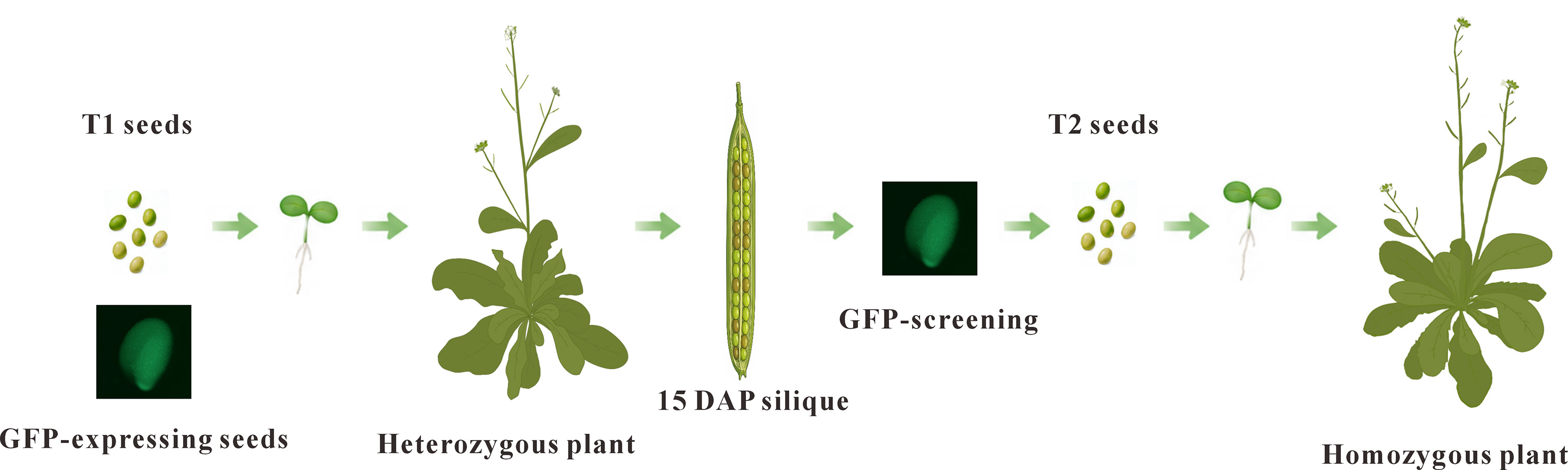
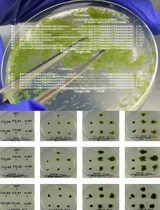
Protocol for accelerating homozygous line screening using uncompleted mature seeds in developing siliques. Artwork co-created with Procreate and AI-assisted design tools.
Background
Obtaining homozygous mutants and stable transgenic lines is a fundamental yet time-consuming step in plant genetics and molecular biology research. For Arabidopsis thaliana, the period from sowing to complete seed maturation and natural drying typically lasts 8–9 weeks or even longer. During this late stage of natural development, seeds undergo intense dehydration accompanied by significant accumulation of abscisic acid (ABA), entering a state of primary dormancy [1–4]. Conventional experimental protocols require researchers to patiently wait until the plants turn yellow and dry, followed by several days of low-temperature vernalization to reawaken dormancy. Previous studies have shown that at 9 days after flowering (DAF), the ABA content per gram of dry weight in seeds is approximately twice that in siliques at the first peak of ABA accumulation. At this stage, the majority of ABA accumulated in siliques is concentrated in seeds, a distribution that is unfavorable for seed germination. By 12 DAF, the ABA level in seeds decreases to one-third of that at 9 DAF; at 15 DAF, ABA levels further decline compared to those at 12 DAF (see Figure 1), thereby creating more favorable conditions for seed germination in vitro [5]. Based on the physiological dynamics of seed development, approximately 15 days after pollination (DAP), Arabidopsis young seeds in developing siliques reach the cotyledon stage, possessing the morphological foundation for germination due to relatively lower ABA levels; simultaneously, the maturing seed coat begins to show signs of browning, but the seeds are not yet fully dehydrated. At this stage, seeds have not yet established deep dormancy induced by severe dehydration (Figure 1). By exploiting this transient developmental window, seeds can be harvested before entering deep dormancy and germinated directly on 1/2 MS medium. This approach overcomes conventional limitations on Arabidopsis generation times and reduces the duration of each generation by approximately 1–2 weeks. In all, in the three generations (nearly reaching T3) to screen homozygous transgenic lines, the total screening time can be reduced by 30 days. Furthermore, through antibiotic screening plus GFP observation, the homozygous transgenic lines can be obtained at the T2 generation. Reducing the time required for tedious homozygous plant screening can facilitate gene function research.
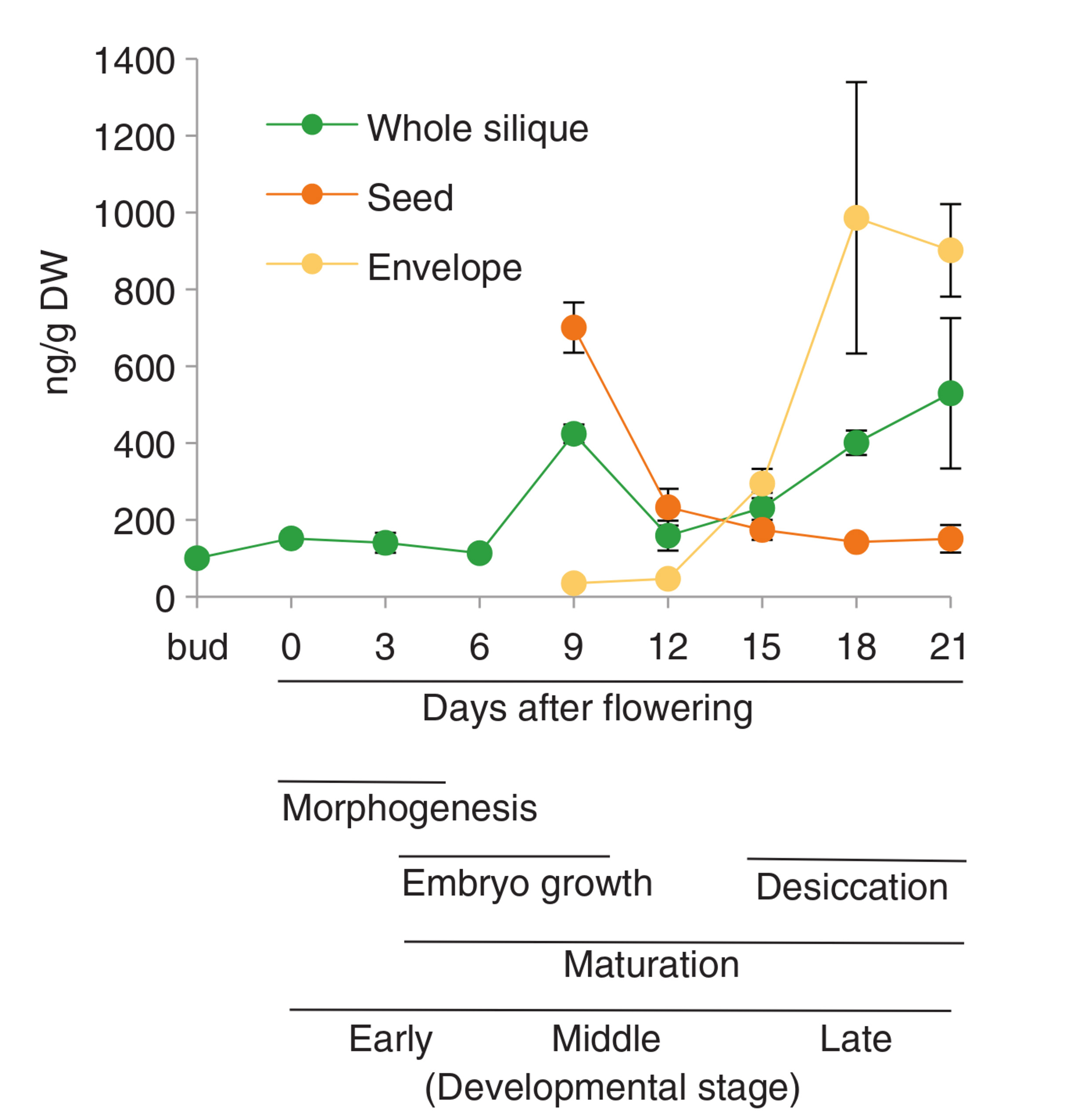
Figure 1. Abscisic acid (ABA) levels during wild-type seed development. ABA levels (ng/g DW) in wild-type flower buds (bud), flowers (0 days after flowering, DAF), whole siliques (3, 6, 9, 12, 15, 18, and 21 DAF), seeds (9, 12, 15, 18, and 21 DAF) and silique envelopes (9, 12, 15, 18, and 21 DAF) were analyzed. Values are the means ± SD of three biological replicates. Developmental events corresponding to DAF are indicated below the graph. Reproduced with permission from Kanno et al. [5].
Materials and reagents
Biological materials
1. Arabidopsis thaliana Columbia-0 wild type or transgenic seeds/plants
Reagents
1. Phosphate-buffered saline (PBS), powder (Biosharp, catalog number: BL601A)
2. Agar (Coolaber, catalog number: CA1331)
3. Sucrose (HUSHI SCR, catalog number: 57-50-1, F.W.342.3)
4. NaOH (HUSHI SCR, catalog number: 1310-73-2, F.W.40.00)
5. 1/2 MS base salts powder (Coolaber, catalog number: PM1060-50L)
6. Sodium hypochlorite (XiLONG SCIENTIFIC, catalog number: 7681-52-9)
7. Sterile double-distilled water (ddH2O); autoclave ddH2O at 121°C and 15 psi for 20 min
Solutions
1. 1/2 MS solid culture medium (see Recipes)
2. 25% (v/v) sodium hypochlorite solution (see Recipes)
3. 10% (v/v) Triton X-100 (see Recipes)
4. 1× PBS (see Recipes)
Recipes
1. 1/2 MS solid culture medium (100 mL)
| Reagent | Final concentration | Quantity or volume |
|---|---|---|
| 1/2 MS base salts powder | 2.185 g/L | 0.2185 g |
| Sucrose | 10 g/L | 1 g |
| Agar powder | 6 g/L | 0.6 g |
Dissolve 0.2185 g of 1/2 MS base salts powder and 1 g of sucrose in 90 mL of ddH2O, adjust the pH to 5.8–5.9 with NaOH, and make up to 100 mL with ddH2O. Add 0.6 g of agar powder and then autoclave at 121 °C and 15 psi (approximately 103 kPa) for 20 min. Allow the medium to cool to approximately 50–60 °C at room temperature before adding the appropriate sterile antibiotic stock solution for selection. For example, for kanamycin-based selection, add sterile kanamycin stock solution to a final concentration of 25 mg/L and mix thoroughly to ensure even distribution.
2. 25% (v/v) sodium hypochlorite solution (5 mL)
| Reagent | Final concentration | Quantity or volume |
|---|---|---|
| Sodium hypochlorite | 156 mM | 1 mL |
| 10% (v/v) Triton X-100 | 1.53 mM | 0.05 mL |
Add 4 mL of ddH2O to 1 mL of sodium hypochlorite to adjust the volume to 5 mL, then add 50 μL of 10% (v/v) Triton X-100.
3. 10% (v/v) Triton X-100
| Reagent | Final concentration | Quantity or volume |
|---|---|---|
| Triton X-100 | 154 mM | 1 mL |
| 1× PBS solution | 10 mM | 9 mL |
Add 9 mL of 1× PBS solution to 1 mL of Triton X-100.
4. 1× PBS
| Reagent | Final concentration | Quantity or volume |
|---|---|---|
| PBS powder | 10 g/L | 10 g |
Dissolve the PBS powder in 1,000 mL of ddH2O and mix well.
Laboratory supplies
1.1.5 mL sterile centrifuge tube (Biosharp, catalog number: BS-15-M)
2. Fine pointed forceps (VETUS, catalog number: ST-11)
3. Anatomical needle
4. Parafilm (Bemis, catalog number: PM-996)
5. Sterile pipette tips (Biosharp, catalog number: BS-200-T, BS-1000-T)
6. 90-mm sterile culture dishes (Biosharp, catalog number: BS-90-D)
7. 100 mL conical flask (SHUNIU)
Equipment
1. Stereomicroscope (SOPTOP, model: SZN71)
2. Refrigerator (SIEMENS)
3. Centrifuge (Eppendorf, model: 5427R)
4. Autoclave (TOMY, model: SX-700)
5. 200 and 1,000 μL pipettes (Eppendorf)
6. Ultra-clean workbench (MEGSTEMAN scientific, model: MCB-1300VA9N)
7. Phase fluorescence microscope (ZEISS, model: HZFL-UBG-110-Z3)
8. Light-controlled constant temperature incubator (ZHUJIANG, model: LRH-1000-G)
Procedure
登录/注册后免费查看全文
文章信息
稿件历史记录
提交日期: Jun 6, 2026
接收日期: Aug 6, 2026
在线发布日期: Sep 3, 2026
出版日期: Sep 20, 2026
版权信息
© 2026 The Author(s); This is an open access article under the CC BY-NC license (https://creativecommons.org/licenses/by-nc/4.0/).
如何引用
Zhang, Q., Wang, Y., Jiang, C., Zhou, X., Zhong, W. and Yu, G. (2026). A Protocol for Accelerating Homozygous Line Screening in Arabidopsis thaliana. Bio-protocol 16(18): e5819. DOI: 10.21769/BioProtoc.5819.

 Download Citation in RIS Format
分类
植物科学 > 植物育种 > 栽培技术
植物科学 > 植物分子生物学 > 遗传分析
植物科学 > 植物生理学 > 植物生长
您对这篇实验方案有问题吗?
在此处发布您的问题,我们将邀请本文作者来回答。同时,我们会将您的问题发布到Bio-protocol Exchange,以便寻求社区成员的帮助。
 发布问题
发布问题


