


A Protocol for Colorectal Tumor Spheroid Culture in Tunable Stiffness Alginate-Based Hydrogels and Subsequent Immunohistochemical Analysis
刚度可调海藻酸盐基水凝胶中的结直肠肿瘤球培养及后续免疫组织化学分析

(*contributed equally to this work) 发布: 2026年08月05日第16卷第15期 DOI: 10.21769/BioProtoc.5786 浏览次数: 181
评审: Dipak Kumar PoriaAnonymous reviewer(s)
 PDF
PDF  Q&A
Q&A




Abstract
Tumor mechanical microenvironment, particularly extracellular matrix stiffness, plays a critical role in regulating cancer cell behavior, including proliferation, quiescence, and drug resistance. Conventional 2D culture or stiff 3D scaffolds fail to recapitulate the physiological soft (normal) or pathologically stiff (tumoral) mechanical niches. Here, we present a detailed protocol for establishing a tunable 3D tumor spheroid culture system using sodium alginate–based hydrogels crosslinked with calcium ions at different concentrations to achieve soft or stiff conditions that mimic normal colon and colorectal cancer tissues, respectively. We describe the step-by-step procedures for fabricating stiffness-tunable hydrogels, culturing colorectal cancer spheroids, releasing spheroids for downstream analysis, and performing immunohistochemical staining on intact spheroids. This protocol enables the reproducible investigation of mechanosensitive pathways and drug resistance mechanisms in a physiologically relevant 3D context.
Key features
• Tunable stiffness hydrogel system based on sodium alginate and calcium carbonate crosslinking.
• 3D tumor spheroid culture that recapitulates normal and tumor mechanical microenvironments.
• Gentle spheroid release using sodium citrate chelation, preserving morphology and viability.
• Compatible with immunohistochemistry.
Keywords: Tumor spheroid (肿瘤球) Alginate hydrogel (海藻酸盐水凝胶)
Matrix stiffness (基质刚度)
3D culture (三维培养)
Immunohistochemistry (免疫组织化学)
Alginate hydrogel (海藻酸盐水凝胶)
Matrix stiffness (基质刚度)
3D culture (三维培养)
Immunohistochemistry (免疫组织化学)
Graphical overview
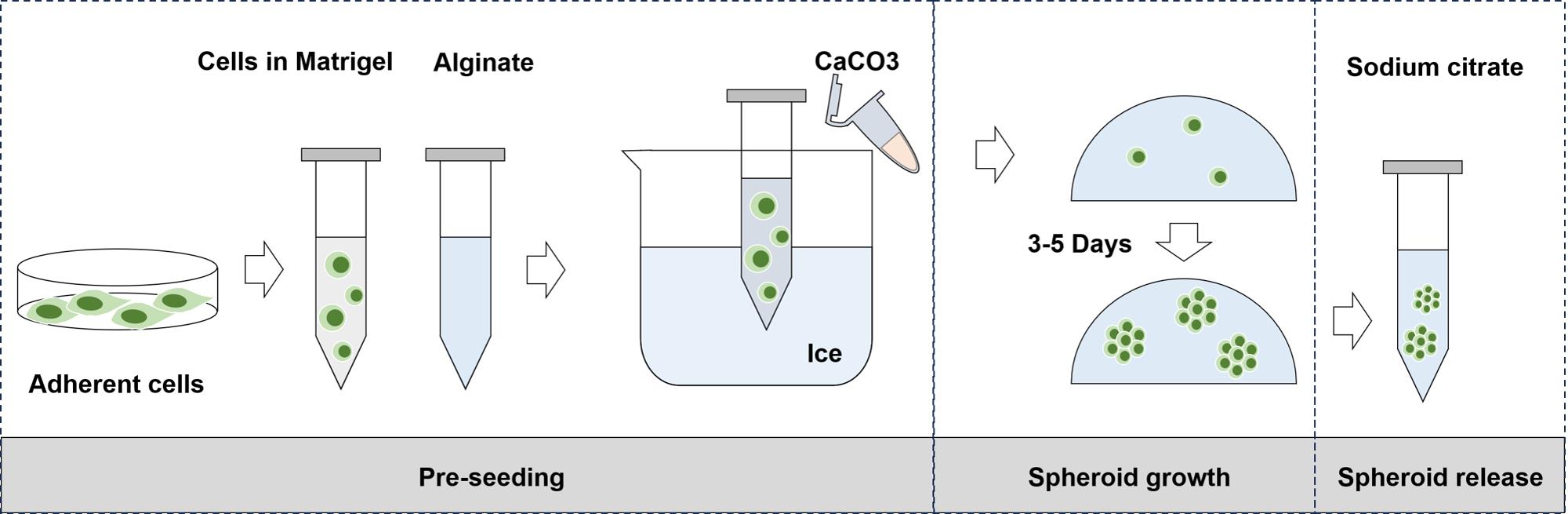
Tumor spheroid culture and release based on sodium alginate hydrogel
Background
Colorectal cancer (CRC) is the third most common cancer worldwide, with metastasis and recurrence remaining the primary causes of mortality [1,2]. The tumor microenvironment (TME) plays a crucial role in inducing poor prognosis in CRC [3]. Among various TME factors, increased matrix stiffness resulting from excessive collagen deposition and crosslinking is a fundamental physical hallmark of solid tumors [4–6]. Normal colon tissue has a stiffness of <0.5 kPa, whereas CRC tissue typically exhibits a stiffness of 1–4 kPa [7]. Elevated stiffness levels are associated with poor prognosis and drug resistance. However, most existing in vitro models fail to recapitulate this stiffness range, often using supraphysiological stiffness that does not reflect in vivo conditions. Moreover, most studies use cells seeded on the surface of hydrogels with different stiffnesses to simulate the impact of this mechanical environment on tumor behavior [8]. Yet, this two-dimensional mechanical cue differs greatly from the true in vivo environment, potentially introducing bias into the conclusions.
Sodium alginate is widely used for three-dimensional cell culture due to its excellent biocompatibility and crosslinkability [9]. To address the gap mentioned above, we employed a tunable alginate-based 3D hydrogel system that independently mimics soft (normal) and stiff (tumor) mechanical niches. Here, we provide a detailed optimized protocol for preparing stiffness-tunable hydrogels, culturing tumor spheroids, releasing them without disrupting their morphology, and performing immunohistochemical (IHC) analysis on paraffin-embedded sections. In this protocol, we use the human colorectal cancer HCT-116 and SW-620 cell lines for tumor spheroid culture and compare, via IHC, the expression of the ANXA2 protein—an annexin closely associated with the extracellular microenvironment—in tumor spheroids grown in hydrogels of different stiffnesses. This protocol offers a robust platform for investigating mechanobiology in a physiologically relevant context.
Materials and reagents
Biological materials
1. Colorectal cancer cell lines HCT-116 (ATCC, catalog number: CCL-247) and SW-620 (ATCC, catalog number: CCL-227)
Reagents
1. Sodium alginate (Sigma, catalog number: A0682)
2. Calcium carbonate (CaCO3) (Aladdin, catalog number: C100633)
3. Growth factor reduced Matrigel (Corning, catalog number: 356231)
4. Dulbecco’s modified Eagle medium (DMEM) (Gibco, catalog number: 11965092)
5. Fetal bovine serum (FBS) (Gibco, catalog number: 10099141)
6. Penicillin-streptomycin (PS), 100× (Gibco, catalog number: 15140122)
7. Phosphate-buffered saline (PBS) (Cytiva, catalog number: SH30028.FS)
8. Sodium citrate (Sigma, catalog number: S1804)
9. Paraformaldehyde (PFA), 16% EM grade (Electron Microscopy Sciences, catalog number: 15710-S)
10. Low-melting-point agarose (Sigma, catalog number: A4018)
11. Ethanol, absolute (Sinopharm, catalog number: 10009218)
12. Xylene (Sinopharm, catalog number: 10023418)
13. Citrate antigen retrieval buffer (Beyotime, catalog number: P0083)
14. Hydrogen peroxide (H2O2), 30% (Sigma, catalog number: H1009)
15. Normal goat serum (Thermo Fisher, catalog number: 16210064)
16. ANXA2 primary antibody (Cell Signaling Technology, catalog number: 8235)
17. HRP-conjugated secondary antibody (Cell Signaling Technology, catalog number: 7074)
18. DAB Substrate kit (Vector Laboratories, catalog number: SK-4100)
19. Hematoxylin (Sigma, catalog number: MHS32-1L)
20. Cytoseal 60 (Fisher Scientific, catalog number: 23-244256)
21. Tween-20 (Sigma, catalog number: P1379)
22. HCl (Bolinda, catalog number: 7647-01-0)
23. Paraffin (CITOTEST, catalog number: 80200-0015)
Solutions
1. Sodium alginate stock solution (see Recipes)
2. CaCO3 suspension (see Recipes)
3. Cell–alginate–Matrigel mixture (see Recipes)
4. Crosslinking CaCO3 volumes for stiffness tuning (see Recipes)
5. Sodium citrate release solution (see Recipes)
6. 4% PFA fixative solution (see Recipes)
7. Low-melting-point agarose for spheroid embedding (see Recipes)
8. Citrate antigen retrieval buffer (see Recipes)
9. IHC blocking buffer (see Recipes)
10. DAB substrate working solution (see Recipes)
11. Graded ethanol series for dehydration (see Recipes)
Recipes
1. Sodium alginate stock solution (2% w/v, 50 mL)
| Reagent | Final concentration | Quantity or volume |
|---|---|---|
| Sodium alginate powder | 2% (w/v) | 1 g |
| Ultrapure water | n/a | to 50 mL |
Note: Dissolve by stirring overnight at 4 °C. Adjust pH to 7.4 with 1 M NaOH. Autoclave or filter sterilize through a 0.22 μm PES membrane. Store at 4 °C for up to 3 months.
2. CaCO3 suspension (0.5 M, 10 mL)
| Reagent | Final concentration | Quantity or volume |
|---|---|---|
| CaCO3 powder | 0.5 M | 0.5 g |
| Ultrapure water | n/a | to 10 mL |
Note: Autoclave the suspension. Vortex vigorously for 1 min immediately before each use to ensure a uniform particle suspension. Do not store for more than one week.
3. Cell–alginate–Matrigel mixture (for 2 mL gel)
| Reagent | Volume per 2 mL gel |
|---|---|
| Cells in DMEM (2.5 × 10⁵ cells/mL) | 500 μL |
| Growth factor reduced Matrigel | 500 μL |
| 2% sodium alginate solution | 1 mL |
4. Crosslinking CaCO3 volumes for stiffness tuning (per 2 mL gel)
| Stiffness | Final Ca2+ concentration | Volume |
|---|---|---|
| Soft | 10 mM | 40 μL |
| Stiff | 20 mM | 80 μL |
5. Sodium citrate release solution (100 mM, 50 mL)
| Reagent | Final concentration | Quantity or volume |
|---|---|---|
| Sodium citrate | 100 mM | 1.47 g |
| 1× PBS | n/a | to 50 mL |
Note: Adjust pH to 7.4. Sterilize by filtration through a 0.22 μm PES membrane. Store at 4 °C for up to one month.
6. 4% PFA fixative solution (100 mL)
| Reagent | Final concentration | Volume |
|---|---|---|
| 16% PFA, EM grade | 4% | 25 mL |
| 1× PBS | n/a | 75 mL |
Note: Prepare fresh or store at 4 °C for up to one week, protected from light.
7. Low-melting-point agarose for spheroid embedding (2%, 50 mL)
| Reagent | Final concentration | Quantity or volume |
|---|---|---|
| Low-melting-point agarose | 2% (w/v) | 1 g |
| 1× PBS | n/a | to 50 mL |
Note: Heat in a microwave or on a hot plate until completely dissolved. Cool and maintain at 40–42 °C in a heat block before use.
8. Citrate antigen retrieval buffer (10 mM, pH 6.0, 1 L)
| Reagent | Final concentration | Quantity or volume |
|---|---|---|
| Sodium citrate tribasic dihydrate | 10 mM | 2.94 g |
| Tween-20 | 0.05% | 500 μL |
| Distilled water | to 1 L |
Note: Adjust pH to 6.0 with 1 M HCl. Store at room temperature for up to 3 months.
9. IHC blocking buffer (for peroxidase and protein blocking, 50 mL)
| Reagent | Final concentration | Volume |
|---|---|---|
| 30% H2O2 | 3% | 5 mL |
| Normal goat serum | 5% | 2.5 mL |
| 1× PBS | to 50 mL |
Note: Prepare fresh. The H2O2 blocks endogenous peroxidase, and the goat serum blocks nonspecific protein binding.
10. DAB substrate working solution (1 mL)
| Reagent | Volume |
|---|---|
| DAB chromogen concentrate | 1 drop (approximately 30 μL) |
| DAB buffer | 1 mL |
Note: Prepare fresh. Mix immediately before use. Protect from light. Discard after 30 min.
11. Graded ethanol series for dehydration (each 100 mL)
| Solution | Volume |
|---|---|
| 70% ethanol | 70 mL absolute ethanol + 30 mL distilled water |
| 80% ethanol | 80 mL absolute ethanol + 20 mL distilled water |
| 95% ethanol | 95 mL absolute ethanol + 5 mL distilled water |
| 100% ethanol | 100 mL absolute ethanol |
Laboratory supplies
1. 50 mL centrifuge tube, sterile (Celltreat, catalog number: 229106)
2. 15 mL centrifuge tube, sterile (Celltreat, catalog number: 229411)
3. 1.5 mL microcentrifuge tube, sterile (Eppendorf, catalog number: 0030120086)
4. 25 mL serological pipette, individually wrapped (Thermo Fisher, catalog number: 170357N)
5. 10 mL serological pipette, individually wrapped (Thermo Fisher, catalog number: 170356N)
6. 5 mL serological pipette, individually wrapped (Thermo Fisher, catalog number: 170355N)
7. 1,000 μL pipette tip, with filter (VWR, catalog number: 89082-350)
8. 200 μL pipette tip, with filter (VWR, catalog number: 89082-366)
9. 20 μL pipette tip, with filter (VWR, catalog number: 89082-338)
10. Wide-bore 200 μL pipette tip (VWR, catalog number: 89082-366, cut with sterile scissors)
11. Low-attachment 35 mm culture dish (NoninBio, catalog number: NBH2035)
12. Low-attachment 24-well plate (NoninBio, catalog number: NBH1124)
13. 0.22 μm PES syringe filter, 33 mm diameter (Millipore, catalog number: SLGP033RB)
14. 10 mL sterile syringe (Fisher Scientific, catalog number: 14-823-435)
15. Sterile cell scraper (Fisher Scientific, catalog number: 08-100-241)
16. Plastic embedding mold for histology (VWR, catalog number: 25608-922)
17. Tissue cassette for paraffin embedding (VWR, catalog number: 18000-134)
18. Superfrost Plus microscope slide (Thermo Fisher, catalog number: 12-550-15)
19. Coverslip, 24 × 60 mm (Fisher Scientific, catalog number: 12-543-5)
20. Microtome blade, disposable, high profile (Leica, catalog number: 819)
21. Pap pen or hydrophobic barrier pen (Vector Labs, catalog number: H-4000)
22. Humidified staining chamber (Thermo Fisher, catalog number: 50-195-9078)
23. Glass staining dish with slide rack (Thermo Fisher, catalog number: 900200)
24. Cytoseal 60 mounting medium (Fisher Scientific, catalog number: 23-244256)
25. Sterile spatula (Fisher Scientific, catalog number: 21-401-10)
26. Forceps, fine tip (Fisher Scientific, catalog number: 08-953G)
Equipment
1. Laminar flow hood (Baker, model: SterilGARD)
2. CO2 incubator (Thermo, model: Forma SteriCycle i160) (for cell culture at 37 °C, 5% CO2)
3. Benchtop centrifuge for 15/50 mL tubes (Thermo, model: Sorvall Legend X1)
4. Microcentrifuge for 1.5 mL tubes (Eppendorf, model: 5425)
5. Horizontal shaker with temperature control (Thermo Fisher, model: 88880022) (for gel dissolution and washes)
6. Heat block, capable of 40–42 °C and 65 °C (VWR, model: 13259-036)
7. Water bath, capable of 37 °C and 40 °C (Thermo Fisher, model: ISOTEMP 215)
8. Pressure cooker or electric pressure steamer for antigen retrieval (Instant Pot, model: Duo Plus) (achieves ~120 °C for 2 min)
9. Microtome (Leica, model: RM2255)
10. Tissue floatation water bath for section mounting (Leica, model: HI1210)
11. Slide drying oven (Thermo Fisher, model: 131481)
12. Light microscope for routine inspection (Olympus, model: CK2)
13. Digital light microscope for IHC imaging (Olympus, model: BX43)
14. Magnetic stirrer with heating function (Thermo Fisher, model: SP131830)
15. Analytical balance (Mettler Toledo, model: ML204T)
16. pH meter (Mettler Toledo, model: FE28)
17. Autoclave (Tuttnauer, model: 3870E)
18. Vacuum filtration system (Millipore, model: Stericup Quick Release)
19. Refrigerator (4 °C) and freezer (-20 and -80 °C) (for reagent storage)
20. Liquid nitrogen dewar for long-term storage (Taylor-Wharton, model: LS750)
Procedure
登录/注册后免费查看全文
文章信息
稿件历史记录
提交日期: Apr 18, 2026
接收日期: Jun 28, 2026
在线发布日期: Jul 21, 2026
出版日期: Aug 5, 2026
版权信息
© 2026 The Author(s); This is an open access article under the CC BY-NC license (https://creativecommons.org/licenses/by-nc/4.0/).
如何引用
Liu, T., Guo, Y., Wang, Q. and Jia, Y. (2026). A Protocol for Colorectal Tumor Spheroid Culture in Tunable Stiffness Alginate-Based Hydrogels and Subsequent Immunohistochemical Analysis. Bio-protocol 16(15): e5786. DOI: 10.21769/BioProtoc.5786.

 Download Citation in RIS Format
分类
癌症生物学 > 微环境
细胞生物学 > 细胞分离和培养 > 3D细胞培养
您对这篇实验方案有问题吗?
在此处发布您的问题,我们将邀请本文作者来回答。同时,我们会将您的问题发布到Bio-protocol Exchange,以便寻求社区成员的帮助。
 发布问题
发布问题


