


MORECOVERY: A Swab-Based Surface Sampling Protocol Incorporating a Nutrient-Free Resuscitation Step for the Detection of Clinically Relevant Gram-Negative Pathogens in the Viable but Non-Culturable State
MORECOVERY:一种结合无营养复苏步骤的拭子表面采样方法,用于检测处于存活但不可培养状态的临床相关革兰阴性病原菌

(*contributed equally to this work) 发布: 2026年08月20日第16卷第16期 DOI: 10.21769/BioProtoc.5782 浏览次数: 210
评审: Alba BlesaRodrigo de Siqueira MeloAnonymous reviewer(s)
 PDF
PDF  Q&A
Q&A
参见作者原研究论文
The authors used this protocol in:
Mar 2026
Advertisement





Abstract
Difficult-to-treat Gram-negative bacteria are a major cause of healthcare-associated infections due to multidrug resistance and limited therapeutic options. The hospital environment plays a central role in the persistence and transmission of infection, making environmental monitoring an essential component of infection prevention and control plans. Standard surface sampling techniques, including swabs, contact plates, and sponges, are widely used for environmental surveillance and are all based on culture-dependent methods. However, these techniques may underestimate the actual level of bacterial contamination since they fail to detect bacteria in the viable but non-culturable (VBNC) state, a reversible physiological condition in which bacterial cells remain viable but do not grow on conventional culture media. An innovative environmental sampling protocol, herein named MORECOVERY, has been developed to improve the detection of VBNC bacteria. The protocol integrates an essential resuscitation step, which improves the recovery of VBNC Gram-negative bacteria by a few orders of magnitude, into the standard swab-based sampling workflow. Following sample collection, swabs are incubated for 24 h at 37 °C in a carbon-free resuscitation buffer before plating, enabling the recovery of VBNC bacterial pathogens that would otherwise remain undetectable. By improving the recovery of VBNC cells, the MORECOVERY protocol allows a more accurate assessment of bacterial contamination of critical surfaces in healthcare settings. Its simplicity and minimal variation from standard workflows facilitate easy implementation in routine environmental monitoring.
Key features
• Enables the detection of Gram-negative bacteria in the viable but non-culturable (VBNC) state, allowing the recovery of otherwise undetectable bacterial contaminants.
• Is compatible with standard swab-based environmental sampling workflows and routine microbiological procedures.
• Relies on low-cost materials and standard laboratory equipment and can easily be implemented in healthcare facilities and other settings requiring careful monitoring of bacterial contamination.
• Enhances the sensitivity of culture-based environmental surveillance methods through a simple resuscitation step prior to plating.
• Combines a carbon-free resuscitation buffer and 24-h incubation at 37 °C, preventing bacterial growth while ensuring VBNC resuscitation without bacterial replication.
Keywords: Biocontamination (生物污染) Culturability (可培养性)
Environmental sampling (环境采样)
Gram-negative bacteria (革兰阴性菌)
Resuscitation (复苏)
Viable but non-culturable (存活但不可培养状态)
Difficult-to-treat healthcare-associated infections (难治性医疗相关感染)
Swab-based sampling (拭子采样)
Culturability (可培养性)
Environmental sampling (环境采样)
Gram-negative bacteria (革兰阴性菌)
Resuscitation (复苏)
Viable but non-culturable (存活但不可培养状态)
Difficult-to-treat healthcare-associated infections (难治性医疗相关感染)
Swab-based sampling (拭子采样)
Graphical overview
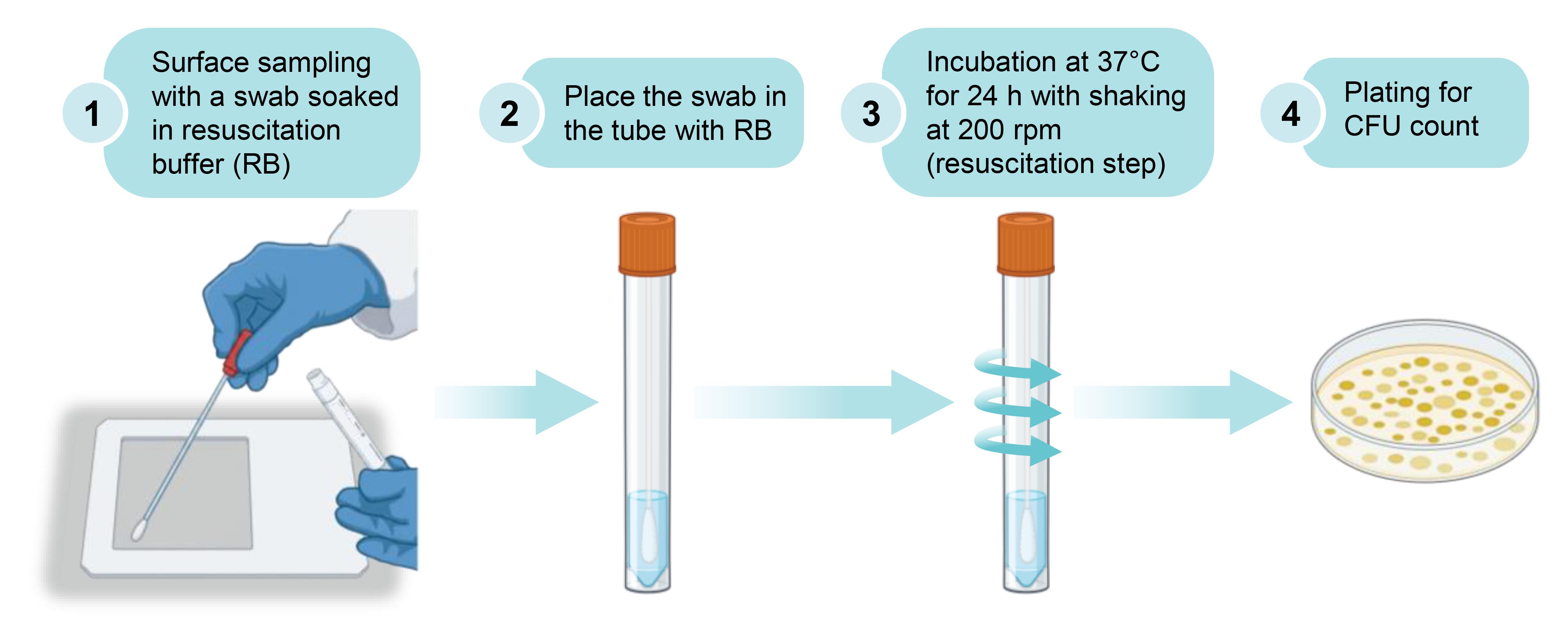
Schematic overview of the MORECOVERY surface sampling protocol, including the resuscitation step
Background
Difficult-to-treat (DTR) infections caused by some Gram-negative bacteria, including Acinetobacter baumannii, Pseudomonas aeruginosa, Klebsiella pneumoniae, and other antibiotic-resistant Enterobacterales, are a major challenge in healthcare settings due to multidrug resistance [1]. Although the introduction of newer antimicrobial agents has broadened treatment options and increased their use in recent years, clinical outcomes have remained largely unchanged, with no significant reduction in mortality observed for most DTR Gram-negative infections, underscoring the need for complementary prevention and control strategies [2].
Hospital surfaces and medical devices constitute well-established reservoirs for healthcare-associated microorganisms and play a central role in their transmission [3]. In this context, environmental surveillance represents a critical component of effective infection prevention strategies [4]. However, standard biocontamination control methods rely predominantly on culture-based techniques, which may fail to detect bacteria capable of entering a viable but non-culturable (VBNC) state [5].
The VBNC state is a reversible physiological condition in which bacterial cells remain viable and metabolically active but lose the ability to grow in conventional culture media. It can be induced by environmental stressors commonly encountered in hospital settings, including nutrient limitation, exposure to disinfectants and antimicrobial agents, and prolonged desiccation. Among these, long-term desiccation represents a particularly critical challenge, as sustained water loss can severely impair survival and trigger a range of biochemical, metabolic, and physiological adaptations [6]. Evidence indicates that DTR Gram-negative pathogens exposed to desiccation on abiotic hospital surfaces can enter the VBNC state, thereby losing their ability to generate colonies on standard microbiological media. Culturability can, however, be restored upon rehydration in a carbon-free isotonic buffer, a process referred to as resuscitation [7]. Notably, VBNC cells may retain pathogenic potential despite being undetectable by standard culture-based methods [5,8], representing a hidden reservoir for infection transmission to susceptible patients.
Hereafter, the MORECOVERY protocol for the detection and quantification of Gram-negative bacteria in the VBNC state on abiotic surfaces is described. The protocol is adapted from and validated in [7]. According to the BS EN 17141:2020 standard for “Cleanrooms and associated controlled environments—Biocontamination control,” environmental sampling can be performed using different devices, including contact plates, sponges, and swabs, with swabs being the most frequently used in healthcare settings [9,10]. Within this framework, the MORECOVERY protocol differs from conventional surface sampling protocols only by the inclusion of an additional step, consisting of a 24-h incubation at 37 °C in a resuscitation buffer (RB) before plating. RB is a buffer devoid of any carbon sources to prevent bacterial growth during the resuscitation step, thereby ensuring that the increase in CFU is attributable to VBNC resuscitation rather than proliferation of culturable cells. Despite minimal modifications compared with standard protocols [9,10], the resuscitation step allows the recovery of VBNC cells by restoring their cultivability, ultimately enabling a more accurate estimation of the bacterial load on sampled surfaces. Owing to its simplicity and compatibility with existing workflows, this approach can readily be implemented on a large scale in routine environmental monitoring and may contribute to improved infection control strategies.
Materials and reagents
Reagents
1. Tryptic soy agar (TSA) (Becton, Dickinson and Company, catalog number: 212305)
2. M9, minimal salts, 5× (Merck, catalog number: M6030)
3. Calcium chloride (CaCl2) (Merck, catalog number: C7902)
4. Magnesium sulfate (MgSO4) (Merck, catalog number: M2643)
Solutions
1. Tryptic soy agar (TSA) (see Recipes)
2. Resuscitation buffer (RB) (see Recipes)
Recipes
1. TSA
To prepare 1 L of TSA, suspend 40 g of dehydrated TSA culture medium in 1 L of distilled (type II) water in a suitable flask or beaker under magnetic stirring and heat with agitation until completely dissolved. Sterilize by autoclaving at 121 °C for 15 min. After cooling to ~45–50 °C, aseptically pour into sterile Petri dishes (25 mL per plate) and allow to solidify.
Note: Commercially prepared TSA plates, purchased by many companies, may be used as an alternative.
2. Resuscitation buffer (RB)
| Reagent | Final concentration | Quantity or volume |
|---|---|---|
| 5× M9, minimal salts (56.4 g/L) | 11.28 g/L | 200 mL |
| 500× CaCl2 (10 g/L) | 0.02 g/L | 2 mL |
| 500× MgSO4 (60 g/L) | 0.12 g/L | 2 mL |
| Double-distilled (type I) water (ddH2O) | - | 796 mL |
Before preparing the RB, stock solutions of 5× M9 minimal salts solution, CaCl2 (500×, 10 g/L), and MgSO4 (500×, 60 g/L) should be made in advance. To prepare 1 L of M9 minimal salts solution (5×), dissolve 56.4 g of dehydrated powder in approximately 800 mL of ddH2O in a suitable flask or beaker under magnetic stirring until completely dissolved. Adjust the final volume to 1 L with ddH2O and sterilize by autoclaving at 121 °C for 15 min. The M9 basal salts solution contains KH2PO4 (15 g/L), NaCl (2.5 g/L), Na2HPO4 (33.9 g/L), and NH4Cl (5 g/L) [11]. The sterile M9 minimal salts solution (5×) can be stored at 4 °C for up to 6 months. Before use, inspect for precipitation or signs of contamination. The pre-mixed M9 minimal salts are also available from Merck (see Reagents).
For the CaCl2 stock solution (500×, 10 g/L), dissolve 0.20 g of CaCl2 in 20 mL of ddH2O in a 50 mL tube and sterilize by 0.2 μm filtration or by autoclaving. Similarly, prepare the MgSO4 stock solution (500×, 60 g/L) by dissolving 1.20 g of MgSO4 in 20 mL of ddH2O in a 50 mL tube, followed by sterilization through 0.2 μm filtration or by autoclaving. The sterile CaCl2 and MgSO4 stock solutions are stable and can be stored for extended periods at room temperature, when properly sealed; however, storage at 4 °C is recommended for long-term use.
The required volume of RB depends on the number of surfaces to be sampled. Considering that each swab contains 2 mL of RB, 1 L of RB is sufficient for 500 swabs. For RB preparation, combine the appropriate volumes of sterile stock solutions in a sterile container under aseptic conditions. As an example, to prepare 200 mL of RB, mix 40 mL of 5× M9 minimal salts solution, 400 μL of 500× CaCl2 stock solution, and 400 μL of 500× MgSO4 stock solution, then adjust the final volume to 200 mL with sterile ddH2O. Mix thoroughly to ensure homogeneity.
When needed, fresh preparation of RB from sterile stock solutions under aseptic conditions is recommended to avoid potential contamination. However, RB remains stable for up to five weeks at room temperature, and it must be used at room temperature to ensure optimal handling conditions and to avoid any potential thermal shock to stressed bacterial cells.
Laboratory supplies
1. Sterile nylon swabs (FLOQSwabs, Copan, catalog number: 519C)
2. Sampling templates (10 × 10 cm) (Copan, catalog number: T2905)
3. Sampling templates (5 × 4 cm) (Copan, catalog number: T2906)
4. Sterile Petri dishes (Sarstedt, catalog number: 82.1472)
5. Sterile disposable spreader (Sarstedt, catalog number: 86.1569.005)
6. Disposable sterile 10 mL syringe (Biosigma, catalog number: 050840)
7. Syringe filters 0.2 μm (Sarstedt, catalog number: 83.1826.001)
8. 1.5 mL tubes (Sarstedt, catalog number: 72.690.001)
9. 15 mL conical tubes (Sarstedt, catalog number: 62.554.001)
10. 50 mL conical tubes (Sarstedt, catalog number: 62.547.255)
11. 200 μL pipette tips (Sarstedt, catalog number: 70.3030)
Equipment
1. Vertical laminar flow hood (Bioair, model: TopSafe 1.2)
2. Vortex (Merck, catalog number: Z258423)
3. Microbiological incubator (Merck, catalog number: CLS6754)
4. Magnetic stirrer with heating plate (Carl Roth, catalog number: XT23.1)
5. Pipette P200 (Gilson, catalog number: FA10005M)
6. Refrigerator (4 °C) (Miele, catalog number: KFN 7795C)
7. Analytical balance (Merck, catalog number: Z742879)
8. Autoclave (ASAL, catalog number: 29960018)
9. Nitrile gloves (Merck, catalog number: Z677272)
10. Felt marker, waterproof (Sarstedt, catalog number: 95.954)
Procedure
登录/注册后免费查看全文
文章信息
稿件历史记录
提交日期: May 17, 2026
接收日期: Jul 8, 2026
在线发布日期: Jul 16, 2026
出版日期: Aug 20, 2026
版权信息
© 2026 The Author(s); This is an open access article under the CC BY-NC license (https://creativecommons.org/licenses/by-nc/4.0/).
如何引用
Visaggio, D., Spagnoli, C., Lucidi, M., Beccarini, M., Imperi, F. and Visca, P. (2026). MORECOVERY: A Swab-Based Surface Sampling Protocol Incorporating a Nutrient-Free Resuscitation Step for the Detection of Clinically Relevant Gram-Negative Pathogens in the Viable but Non-Culturable State. Bio-protocol 16(16): e5782. DOI: 10.21769/BioProtoc.5782.

 Download Citation in RIS Format
分类
微生物学 > 微生物细胞生物学 > 细胞活力
微生物学 > 微生物细胞生物学 > 细胞分离和培养
环境生物学 > 细菌 > 分离
您对这篇实验方案有问题吗?
在此处发布您的问题,我们将邀请本文作者来回答。同时,我们会将您的问题发布到Bio-protocol Exchange,以便寻求社区成员的帮助。
 发布问题
发布问题


