


Assessment of Saccharomyces cerevisiae Survival Upon Exposure to Transient High Pressure and Temperature in a High-Intensity Shock Tube for Astrobiology (HISTA)
利用天体生物学高强度激波管(HISTA)评估酿酒酵母在瞬时高压高温条件下的存活情况

发布: 2026年07月20日第16卷第14期 DOI: 10.21769/BioProtoc.5766 浏览次数: 201
评审: Joyce ChiuRamya VisvanathanIsmail Tahmaz
 PDF
PDF  Q&A
Q&A
参见作者原研究论文
The authors used this protocol in:
Oct 2025
Advertisement





Abstract
Understanding microbial survival under extreme planetary conditions is critical for astrobiology and stress biology. Several experimental platforms, including radiation, desiccation, and microgravity, have been used to mimic extraterrestrial environments; however, controlled simulation of high-intensity shock waves has not been used to assess microbial survival. Here, we describe a detailed protocol for shock processing of Saccharomyces cerevisiae using the high-intensity shock tube for astrochemistry (HISTA), which generates high-Mach-number shock waves under inert gas conditions. Yeast cells are drop-casted onto a metal flange, exposed to transient high-pressure shock waves, and recovered for downstream survival and cellular analyses. Shock intensity can be precisely tuned by adjusting driver pressure, diaphragm thickness, and driven gas pressure. This protocol provides a platform to investigate microbial adaptation to shock waves.
Key features
• Recreates impact-like shock events under controlled laboratory conditions.
• Compatible for performing post-shock analysis through growth assay, fluorescence imaging, and transcriptomic analysis.
• Shock intensity can be adjusted by modifying operational parameters of the shock tube.
Keywords: Saccharomyces cerevisiae (酿酒酵母) Shock tube (激波管)
Shock waves (冲击波)
Yeast survival (酵母存活)
HISTA (HISTA)
Mars (火星)
Stress conditions (应激条件)
Astrobiology (天体生物学)
Shock tube (激波管)
Shock waves (冲击波)
Yeast survival (酵母存活)
HISTA (HISTA)
Mars (火星)
Stress conditions (应激条件)
Astrobiology (天体生物学)
Graphical overview
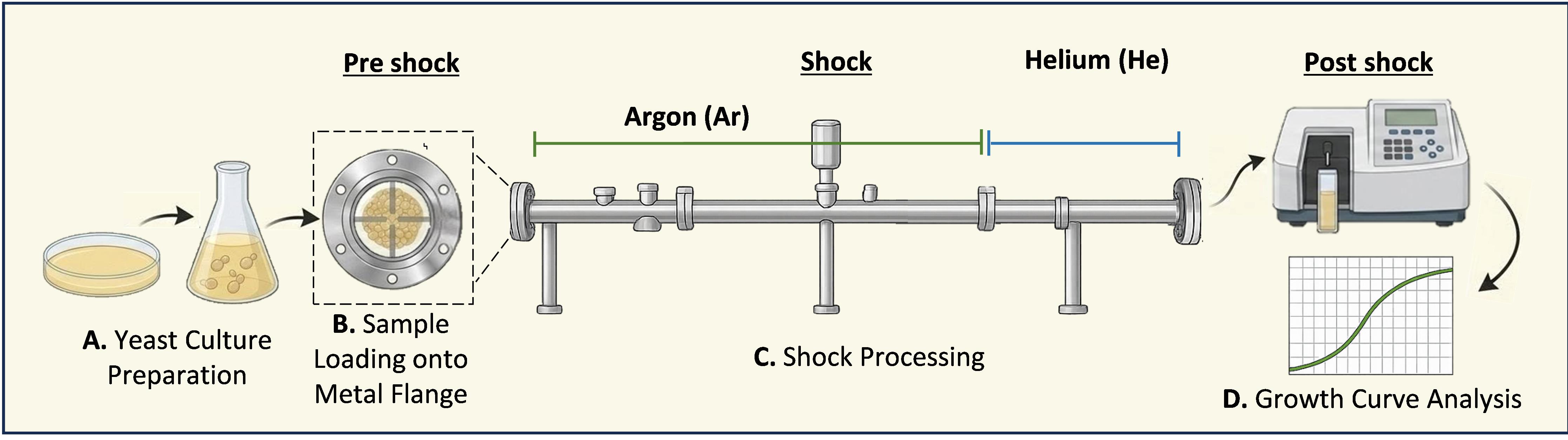
Experimental workflow for shock treatment followed by growth analysis of yeast. (A) Yeast cultures are prepared under standard growth conditions. (B) Cells are loaded onto the metal flange of the shock tube. (C) Samples are subjected to shock in the shock tube, with the driven section filled with argon, and shock generated using helium in the driver section. (D) Following treatment, cell growth is monitored and analysed by measuring optical density over time to generate growth curves.
Background
Understanding how life responds to extreme planetary stressors is an important question in astrobiology, especially in the context of microbial survival under Mars-like environmental conditions. Several experimental platforms have been used to simulate extraterrestrial stresses, including ionising radiation, desiccation, microgravity, and extreme temperature [1–3]. However, transient high-intensity shock waves generated during impact events remain comparatively underexplored in biological systems. Previous studies investigating microbial survival under impact conditions have primarily used hypervelocity gun-based systems, including light gas guns in which microbial samples are enclosed within projectiles and physically accelerated towards a rigid surface [4]. While such setups can achieve high velocity, they may not adequately reproduce the high pressure experienced during natural impact events. Alternative shock generation approaches have utilised diaphragm-less shock tubes to expose biological samples to transient high pressure generated by rapid gas expansion. Such setups might provide limited flexibility in tuning experimental parameters to achieve desired shock intensities. Other applications of shock waves, such as in a therapeutic context, use setups that are fundamentally different, producing shock intensities far lower than those used to study shock waves associated with simulating planetary impact events.
The protocol described here utilises a diaphragm-based shock tube system to generate controlled, high-Mach shock waves in inert gas atmospheres. Our protocol was derived from a previously published method that employed a shock tube for shock processing of amino acids and amorphous carbon nano-dust [5,6]. In brief, shock waves were generated by the rupture of a calibrated diaphragm separating a high-pressure helium driver section from a low-pressure argon driven section. This setup enabled reproducible propagation of shock waves across yeast samples while allowing precise modulation of shock intensity via driver pressure, diaphragm thickness, and driven gas pressure. This setup facilitates recovery of samples for further downstream assays and simultaneous exposure to extreme pressure and transient high temperature. Beyond studying microbial survival under such conditions, this methodology can be adapted to explore stress responses on diverse biological systems such as nucleic acid integrity and protein stability, thereby expanding its utility to astrobiology and synthetic biology research.
Materials and reagents
Biological materials
| Description | Genotype | Source |
|---|---|---|
| Wild-type (BY4741) yeast cells | MATa his3Δ1 leu2Δ0 met15Δ0 ura3Δ0 (BY4741) | Laboratory stocks |
| yPIR58 | MATα leu2Δ0 trp1Δ0 ura3Δ0 lys2Δ0 his4Δ0 cup1::LEU2/PGK1pG/MFA2pG Lsm4Dc::NEO edc3::NEO (edc3∆lsm4∆C) | [7] |
| Plasmid name | Description | Vector | Source |
|---|---|---|---|
| pPIR50 | Used to express Dcp2-mCherry and Pab1 GFP protein under its own promoter (CEN) | pRS416 | Gift from Roy Parker |
Reagents
1. Yeast nitrogen base w/ ammonium sulphate (MP Biomedicals, catalog number: 4027522)
2. Adenine (HiMedia, catalog number: PCT0801)
3. L-Arginine monohydrochloride (Sigma-Aldrich, catalog number: 11039)
4. L-Histidine monohydrochloride monohydrate (Sigma-Aldrich, catalog number: H8125)
5. L-Leucine (HiMedia, catalog number: GRM054)
6. L-Lysine monohydrochloride (HiMedia, catalog number: TC079)
7. L- Methionine (Sigma-Aldrich, catalog number: M9625)
8. L-Phenylalanine (Sigma-Aldrich, catalog number: P2126)
9. L-Threonine (HiMedia, catalog number: RM065)
10. L-Tryptophan (HiMedia, catalog number: GRM067)
11. L-Tyrosine (Sigma-Aldrich, catalog number: T3754)
12. L-Isoleucine (HiMedia, catalog number: GRM053)
13. L-Valine (HiMedia, catalog number: GRM070)
14. D-Glucose (SRL, catalog number: 51758)
15. Agar (HiMedia, catalog number: RM301)
16. Ethanol, molecular biology grade (BioLiqua, catalog number: 1170)
17. 16% Paraformaldehyde (MP Biomedicals, catalog number: 02199983)
18. Na2HPO4 (SRL, catalog number: 61707)
19. NaH2PO4 (Sigma-Aldrich, catalog number: S7907)
20. NaCl (Sigma-Aldrich, catalog number: S9888)
Solutions
1. Ura- mix (see Recipes)
2. SD Ura- media (synthetic defined uracil dropout media) (see Recipes)
3. 40% glucose (see Recipes)
4. 70% ethanol (see Recipes)
5. 1× PBS (see Recipes)
Recipes
1. Ura- mix
| Reagent | Final concentration (mg/L) | Quantity (mg) |
|---|---|---|
| Adenine | 20 | 800 |
| L-Arginine | 20 | 800 |
| L-Histidine | 20 | 800 |
| L-Isoleucine | 80 | 3,200 |
| L-Leucine | 80 | 3,200 |
| L-Lysine | 60 | 2,400 |
| L-Methionine | 20 | 800 |
| L-Phenylalanine | 50 | 2,000 |
| L-Threonine | 200 | 8,000 |
| L-Tryptophan | 80 | 3,200 |
| L-Tyrosine | 20 | 800 |
| L-Valine | 150 | 6,000 |
| Total | 840 | 33,600 |
Note: The dry amino acid mixture was prepared by combining the components listed above in the given amount, followed by thorough manual grinding to ensure uniform mixing. The quantity (mg) indicates the mass of each component used to prepare a bulk amino acid mix equivalent for 40 L. This amino acid mix was then used to make Ura- liquid media as mentioned in Recipe 2.
2. SD Ura- media
| Reagent | Final concentration | Quantity |
|---|---|---|
| Yeast nitrogen base | 6.7 g/L | 6.7 g |
| Ura- mix | 0.9 g/L | 0.9 g |
| Milli-Q water | up to 1,000 mL |
Autoclave at 121 °C with a pressure of 15 psi for at least 20 min and store at room temperature (RT).
Note: The pH of the medium after preparation was in the range of 6 and was not further adjusted. For ease of weighing, 840 mg/L was rounded off to 0.9 g/L of Ura- mix.
3. 40% glucose
| Reagent | Final concentration | Quantity or volume |
|---|---|---|
| Glucose | 40% | 40g |
| Milli-Q water | n/a | Make up to 100 mL |
Autoclave at 121 °C with a pressure of 15 psi for at least 20 min and store at RT.
Note: To avoid caramelisation of glucose, autoclave it as a solution by adding glucose to preheated water. Also, do not add glucose directly to the media before autoclaving.
4. 70% ethanol
| Reagent | Final concentration | Quantity or volume |
|---|---|---|
| Ethanol (100%) | 70% | 70 mL |
| Milli-Q water | n/a | 30 mL |
5. 1× PBS
| Reagent | Final concentration | Quantity or volume |
|---|---|---|
| Na2HPO4 | 1.42 g/L | 0.142 g |
| NaH2PO4 | 0.26 g/L | 0.026 g |
| NaCl | 0.9 g/L | 0.9 g |
| Milli-Q water | n/a | 100 mL |
Adjust pH to 7.4. Autoclave and store at RT.
Laboratory supplies
1. 96-well plate (Costar, catalog number: 3370)
2. Petri plates 90 mm × 14 mm (Tarsons, catalog number: 460091)
3. 50 mL conical flasks (Durasil, catalog number: G-252-03)
4. 1.5 mL microcentrifuge tubes (Genaxy, catalog number: GEN-MT-200-C)
5. 50 mL centrifuge tubes (LabServ Thermo Fisher Scientific, catalog number: LSCT50BS)
6. 15 mL centrifuge tubes (LabServ Thermo Fisher Scientific, catalog number: LSCT15BS)
7. Pipette set (Thermo Scientific, catalog number: 4700880)
8. Pipette tips 1,000, 200, 0.1–10 μL (Abdos, catalog numbers: P10106, P10130, 910115)
Equipment
1. HISTA (custom-made; designed in PRL Ahmedabad, made by MachStar)
2. 30 °C plate incubator (Shalom, model: SLM-INCR-70)
3. 30 °C shaker incubator (Shalom, model: SLM-INC-OS-250)
4. Plate reader (TECAN Infinite M Nano)
5. Helium and argon gas cylinders (Vadilal Chemical Ltd.)
6. Diaphragm (custom-made on PRL Ahmedabad, aluminium 5 sheets, 2 mm thick with a groove depth of 0.5 mm)
7. Tabletop centrifuge (Eppendorf, model: 5424R)
8. Laminar hood (BioBee Tech, model: LMNR-V)
9. Milli-Q purification system (Millipore MilliQ, model: HX7040)
Software and datasets
1. GraphPad Prism 9.0
2. Excel Office 2019
3. TECAN i-control
Procedure
登录/注册后免费查看全文
文章信息
稿件历史记录
提交日期: Mar 9, 2026
接收日期: May 17, 2026
在线发布日期: Jun 30, 2026
出版日期: Jul 20, 2026
版权信息
© 2026 The Author(s); This is an open access article under the CC BY-NC license (https://creativecommons.org/licenses/by-nc/4.0/).
如何引用
Dhage, R., Roy, A., Sivaraman, B. and Rajyaguru, P. I. (2026). Assessment of Saccharomyces cerevisiae Survival Upon Exposure to Transient High Pressure and Temperature in a High-Intensity Shock Tube for Astrobiology (HISTA). Bio-protocol 16(14): e5766. DOI: 10.21769/BioProtoc.5766.

 Download Citation in RIS Format
分类
微生物学 > 微生物生理学 > 胁迫反应
微生物学 > 微生物细胞生物学 > 细胞活力
环境生物学 > 真菌
您对这篇实验方案有问题吗?
在此处发布您的问题,我们将邀请本文作者来回答。同时,我们会将您的问题发布到Bio-protocol Exchange,以便寻求社区成员的帮助。
 发布问题
发布问题


