


Optimized Field Collection and Gut Dissection Workflows for Microbiome Studies of the Citrus Root Weevil, Diaprepes abbreviatus
Diaprepes abbreviatus 微生物组研究的野外采集与肠道解剖流程优化

(§Technical contact: paolafigueroapratts@gmail.com) 发布: 2026年07月20日第16卷第14期 DOI: 10.21769/BioProtoc.5761 浏览次数: 254
评审: MEGHNA SUHAGAnonymous reviewer(s)
 PDF
PDF  Q&A
Q&A
参见作者原研究论文
The authors used this protocol in:

Oct 2025
Advertisement





Abstract
Careful dissection of insect gut tissues is essential for microbiome studies to ensure accurate characterization of internal microbial communities and preservation of DNA integrity. Because insect-associated microbiomes are highly sensitive to contamination, effective removal of external microbes prior to dissection is critical to minimize bias in downstream analyses. While ethanol- and bleach-based surface sterilization methods are commonly used, standardized workflows integrating field collection, sterilization, and dissection remain limited. Here, we present a step-by-step protocol for the field collection, surface sterilization, and dissection of gut tissues from the agricultural pest Diaprepes abbreviatus (Coleoptera: Curculionidae), optimized for genomic DNA extraction and microbiome analyses. Using wild-caught specimens, this workflow incorporates a rigorous surface sterilization and dissection strategy that minimizes external contamination while preserving biologically relevant microbial signatures and DNA integrity for downstream microbiome analyses. The protocol provides a standardized framework for insect gut microbiome studies and can be broadly adapted to other wild-caught insect species requiring careful collection, disinfection, and sterile dissection prior to molecular analysis. The protocol integrates field collection and laboratory processing steps into a streamlined workflow that minimizes contamination while preserving tissue integrity for downstream applications.
Key features
• Designed for wild-caught Diaprepes abbreviatus collected directly from agricultural host trees, this protocol can also be adapted for other insect species.
• Integrates field collection, surface sterilization, and sterile gut dissection into a single workflow to minimize contamination.
• Sequential ethanol and diluted bleach treatment effectively removes external microbes prior to dissection.
• Enables isolation of intact gut tissues suitable for high-quality DNA extraction and downstream microbiome sequencing.
Keywords: Diaprepes abbreviatus (Diaprepes abbreviatus) Field collection (野外采集)
Gut anatomy (肠道解剖)
Insect microbiome (昆虫微生物组)
Contamination control (污染控制)
Field collection (野外采集)
Gut anatomy (肠道解剖)
Insect microbiome (昆虫微生物组)
Contamination control (污染控制)
Graphical overview
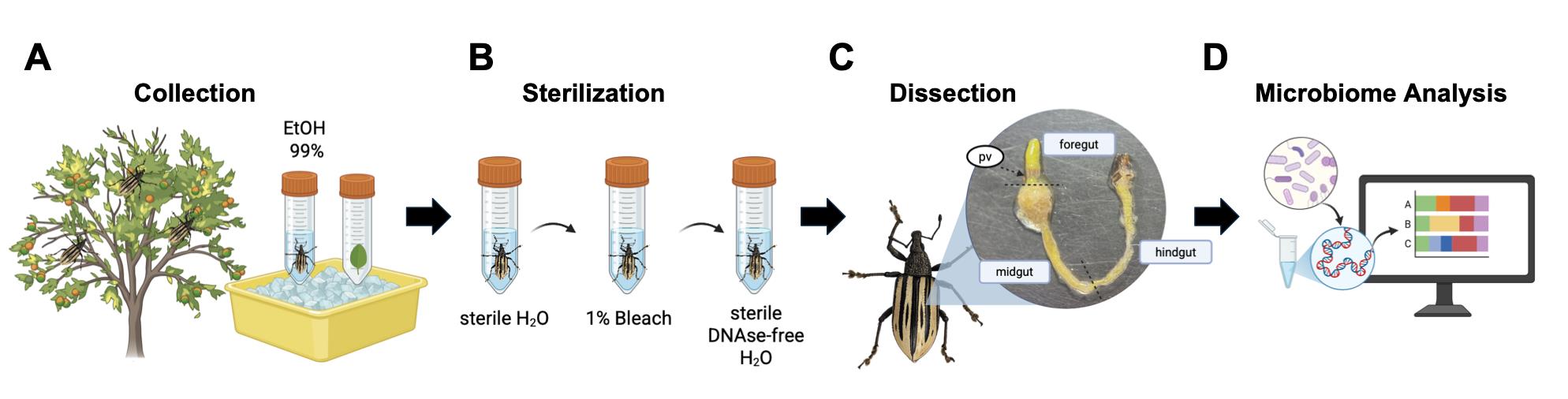
Protocol overview. Illustration of the workflow including field collection (A), surface sterilization (B), gut dissection (C), and downstream applications for microbiome studies (D). Figure created using Biorender.
Background
The citrus root weevil, Diaprepes abbreviatus, is an agricultural pest that affects a wide range of plant species and presents significant challenges for crop production in the Caribbean and the United States [1,2]. As an invasive species with resistance to multiple control strategies, there is a growing need to better understand its biology to identify alternative management approaches [3,4]. Insect gut microbiome studies have highlighted the importance of microbial communities in digestion, nutrient acquisition, and host fitness, suggesting that characterization of these communities may provide insights into pest survival and adaptation [5]. Advances in genomic technologies, such as 16S rRNA gene and shotgun metagenomic sequencing, have enabled analysis of insect-associated microbiota. However, the successful use of these technologies and the accuracy of the resulting data rely on proper sample collection, handling, preparation, and dissection.
Previous studies have employed ethanol preservation and bleach-based surface sterilization to minimize external contamination prior to microbiome analyses. While these methods are widely used, there is limited standardization of workflows that integrate field collection, surface sterilization, and gut dissection, particularly for D. abbreviatus. Variability in sample handling and sterilization approaches can influence microbial profiles, particularly in low-biomass samples, highlighting the need for reproducible protocols [6,7].
Here, we present a protocol that combines field collection of wild-caught insects, ethanol-based preservation, sequential bleach surface sterilization, and sterile dissection techniques to isolate gut tissues for downstream DNA extraction and microbiome analysis. This integrated workflow minimizes external contamination while preserving internal microbial communities and provides a reproducible framework for insect microbiome studies [8]. A limitation of this protocol is the requirement for sterile handling conditions during dissection, and optimization may be necessary for other insect species with different anatomical characteristics. Nevertheless, this approach can be adapted for use in additional insect systems where accurate characterization of gut-associated microbiota is required.
Materials and reagents
Biological materials
1. Adult Diaprepes abbreviatus insects (collected in the field; 18.3722° N, 66.5328° W, Florida, Puerto Rico)
Reagents
1. 10× phosphate-buffered saline (PBS) (Fisher Scientific, catalog number: BP399500)
2. Ultrapure H2O, sterile, autoclaved
3. Clorox bleach with 3.65% sodium hypochlorite (NaOCl) (The Clorox Company)
4. DNA-free water, sterile (nuclease-free DEPC-treated water) (VWR, catalog number: 10220-382)
5. Ethanol 99% molecular grade (Sigma-Aldrich, catalog number: E7023)
Solutions
1. 1× PBS (see Recipes)
2. 1% commercial bleach solution (see Recipes)
Recipes
1. 1× PBS
| Reagent | Final concentration | Quantity or volume |
|---|---|---|
| Ultrapure H2O | - | 900 mL |
| PBS | 10× | 100 mL |
| Total | 1× | 1,000 mL |
Sterilize using a syringe filter (0.22 μm) and store at room temperature.
2. 1% commercial bleach solution
| Reagent | Final concentration | Quantity or volume |
|---|---|---|
| Clorox bleach | 3.65% NaOCl | 68.5 mL |
| Distilled H2O | - | 181.5 mL |
| Total | 1% | 250 mL |
Store at room temperature.
Laboratory supplies
1. 50 mL Falcon® centrifuge tubes, polypropylene, sterile (Corning, VWR/Avantor, catalog number: 21008-940)
2. Premium microcentrifuge tubes, 2.0 mL, sterilized by autoclaving (FisherbrandTM, Fisher ScientificTM, catalog number: 05-408-138)
3. Premium microcentrifuge tubes, 1.5 mL, sterilized by autoclaving (FisherbrandTM, Fisher ScientificTM, catalog number: 05-408-129)
4. Pyrex beaker 600 mL with foil lid, sterile (Corning, Fisher ScientificTM, catalog number: 02-540M)
5. Syringe filters, sterile, mixed cellulose ester, 25 mm, 0.20 μm (BasixTM, Fisher ScientificTM, catalog number: 13-1001-02)
6. Sterile disposable syringe (10 mL) without needle (Nipro Corporation, Osaka Jan, catalog number: 531-8510)
7. Petri dishes with clear lid 100 mm × 15 mm, sterile (FisherbrandTM, Fisher ScientificTM, catalog number: FB0875712)
8. Ice
9. Dry ice
10. Alcohol burners
11. Ruler
12. KimwipesTM Delicate task wipers (Kimberly-Clark Professional, Fisher ScientificTM, catalog number: 06-666)
Equipment
1. Complete 10GSM Medical Student Anatomy Dissection Kit, sterile, autoclaved, containing 4.5-inch dissecting forceps (medium point) and 4.5-inch 1 × 2 teeth tissue forceps (DR Instruments, model: 10GSM) (Amazon Standard Identification Number: B0091N6QF0)
2. Fine Dumont #5 Forceps, Dumostar, biological (Electron Microscopy Sciences, catalog number: 72705-12)
3. Smart Phone, iPhone 14 Pro Max (Apple, model: MQ8V3LL/A) with Weather application by Apple, Inc. to collect environmental conditions
4. Nikon stereomicroscope (zoom: 0.7–4.5×, eyepiece: 10×)
5. Analytical balance
6. Refrigerator (4 °C)
7. Ultra-low freezer (-80 °C)
Procedure
登录/注册后免费查看全文
文章信息
稿件历史记录
提交日期: Apr 24, 2026
接收日期: Jun 4, 2026
在线发布日期: Jun 24, 2026
出版日期: Jul 20, 2026
版权信息
© 2026 The Author(s); This is an open access article under the CC BY license (https://creativecommons.org/licenses/by/4.0/).
如何引用
Figueroa-Pratts, P. G., Santiago-Rodriguez, T. M. and Rodriguez-Fernandez, I. A. (2026). Optimized Field Collection and Gut Dissection Workflows for Microbiome Studies of the Citrus Root Weevil, Diaprepes abbreviatus. Bio-protocol 16(14): e5761. DOI: 10.21769/BioProtoc.5761.

 Download Citation in RIS Format
分类
微生物学 > 群落分析 > 宏基因组学
分子生物学 > DNA > DNA 测序
微生物学 > 微生物-宿主相互作用
您对这篇实验方案有问题吗?
在此处发布您的问题,我们将邀请本文作者来回答。同时,我们会将您的问题发布到Bio-protocol Exchange,以便寻求社区成员的帮助。
 发布问题
发布问题


