


Isolation of Mononucleated and Binucleated Hepatocytes by Flow Cytometry
利用流式细胞术分离单核与双核肝细胞

发布: 2026年07月20日第16卷第14期 DOI: 10.21769/BioProtoc.5760 浏览次数: 328
评审: Vinit SharmaAnonymous reviewer(s)
 PDF
PDF  Q&A
Q&A
参见作者原研究论文
The authors used this protocol in:

Jul 2026
Advertisement





Abstract
Polyploid hepatocytes are one of the unique features of the liver. Some polyploid hepatocytes have chromosomes in a single nucleus (e.g., 1x4n, 1x8n), while others separate their chromosomes into two nuclei (e.g., 2x2n, 2x4n). In ploidy research, hepatocytes are typically sorted according to their cellular ploidy, revealing their contribution to tumorigenesis and cellular senescence. However, the conventional sorting method fails to distinguish 1x4n from 2x2n, or 1x8n from 2x4n cells, leaving it unclear whether hepatocytes with the same cellular ploidy but different nuclear configurations are identical or phenotypically different. Here, we describe a detailed protocol for fractionating mononucleated and binucleated hepatocytes. First, we present the method for isolating primary mouse hepatocytes and staining them with the DNA dye Hoechst 33342. Flow cytometry is then used to detect fluorescence differences between mononucleated and binucleated hepatocytes. This protocol enables the discrimination of hepatocyte subpopulations with identical cellular ploidy, providing a useful tool to investigate the functional heterogeneity of polyploid hepatocytes.
Key features
• This protocol summarizes a method for isolating primary mouse hepatocytes.
• This protocol enables us to isolate mononucleated and binucleated subpopulations from mixed primary hepatocytes.
Keywords: Polyploid hepatocyte (多倍体肝细胞) Binucleated hepatocyte (双核肝细胞)
Liver perfusion (肝脏灌流)
Flow cytometry (流式细胞术)
Doublet (双联体)
Binucleated hepatocyte (双核肝细胞)
Liver perfusion (肝脏灌流)
Flow cytometry (流式细胞术)
Doublet (双联体)
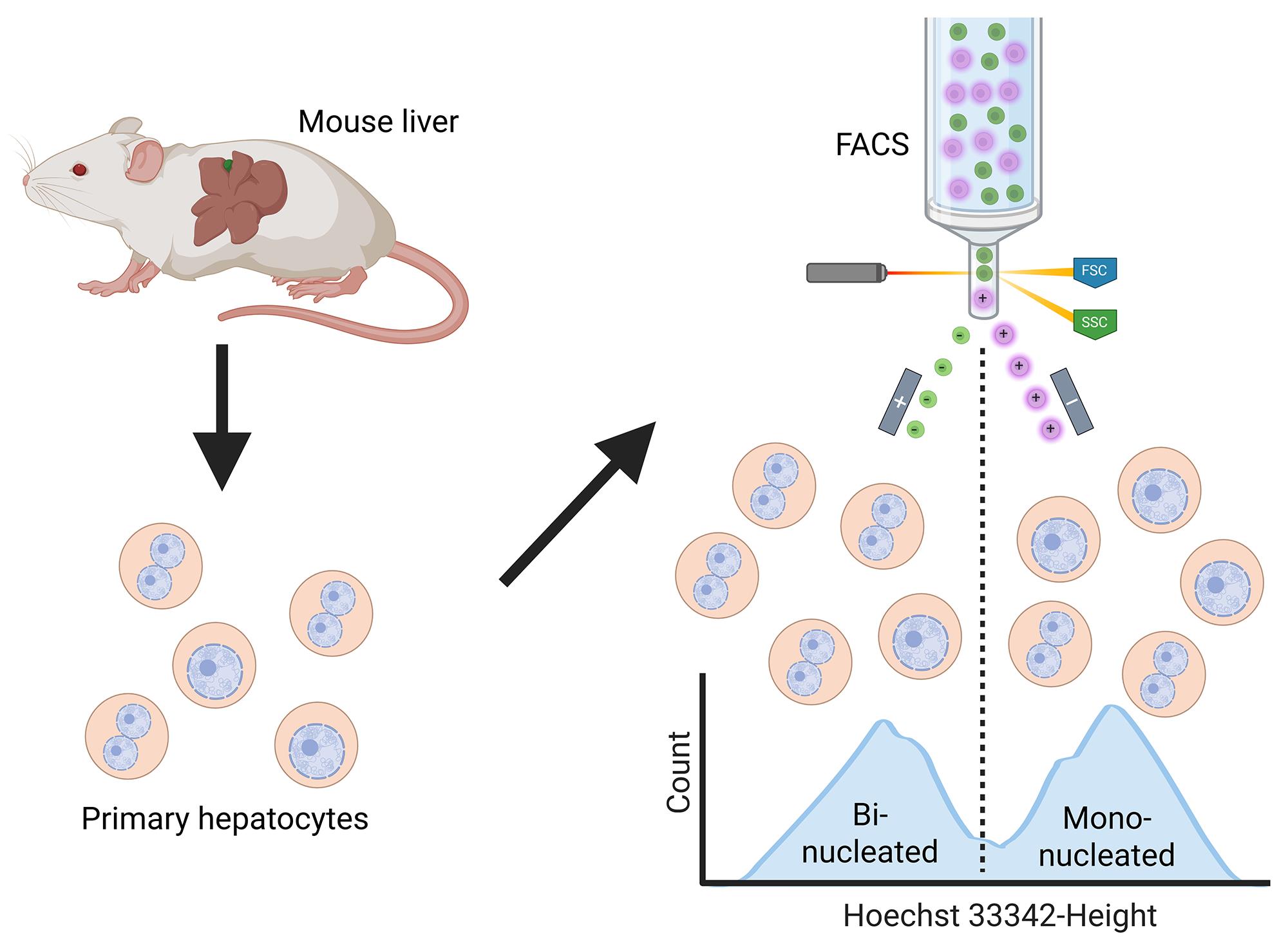
Graphical overview
Background
Hepatocytes, which comprise approximately 70%–80% of the liver cell population, exhibit a unique ploidy status [1,2]. While most other mammalian cell types possess two copies of the genome, a state known as diploidy (2n), hepatocytes often contain more than two copies. In the adult mouse liver, tetraploid (4n) hepatocytes are the most abundant population, followed by octoploid (8n) cells, whereas diploid (2n) cells account for only approximately 10% of the total [3,4]. Earlier studies have explored the differences among hepatocytes with different cellular ploidy levels, revealing that polyploid hepatocytes are more prone to senescence and more resistant to tumorigenesis caused by loss of heterozygosity [5–8]. In addition to the variation in cellular ploidy status, polyploid hepatocytes are further classified based on the number of nuclei [9–11]. Specifically, tetraploid hepatocytes exist either as mononucleated cells containing four genomic copies within a single nucleus (1x4n) or as binucleated cells containing two genomic copies in each of two nuclei (2x2n). Similarly, 8n hepatocytes can be classified into 1x8n and 2x4n hepatocytes. Since these hepatocytes have the same cellular ploidy levels, they have generally been treated as equivalent populations, and their differences remain poorly understood [12,13].
The major limitation for this has been the lack of a method to isolate these subpopulations. In conventional ploidy research, hepatocytes are commonly stained with a DNA-binding dye and distinguished according to total DNA content (2n, 4n, and 8n) in flow cytometry [6, 8–11,13,14]. Fluorescence signals are characterized by three parameters—width, height, and area—with area signals most commonly used due to their stability [14,15]. Height vs. area plots of the forward scatter (FSC) signal are widely applied for doublet discrimination, as doublet events typically exhibit lower height values than singlets. Based on this principle, our protocol leverages the height parameter to distinguish and isolate mononucleated and binucleated hepatocytes. Freshly isolated mouse hepatocytes are stained with the DNA-binding dye Hoechst 33342 and sorted by flow cytometry. Microscopy confirms the successful isolation of 1x4n mononucleated and 2x2n binucleated hepatocytes.
Materials and reagents
Biological materials
1. Adult male mice (purchased from CLEA Japan, bred, and housed in our laboratory)
Note: Female mice can also be used; however, all data in this study were obtained from male mice.
Reagents
1. Sterile distilled water [purified by an Elix system and Milli-Q purification system (Merck Millipore) and sterilized by autoclaving prior to use]
2. Ethanol (Wako Pure Chemical Corporation, catalog number: 055-00457)
3. Isoflurane (VTRS, Viatris Healthcare)
4. HBSS (10×), no calcium, no magnesium, no phenol red [HBSS (-)] (Thermo Fisher Scientific, GibcoTM, catalog number: 14185052)
5. 10× PBS (-) (Wako Pure Chemical Corporation, catalog number: 163-25265)
6. Liver perfusion medium (Thermo Fisher Scientific, GibcoTM, catalog number: 17701038)
7. CaCl2 (Wako Pure Chemical Corporation, catalog number: 038-24985)
8. Collagenase (Wako Pure Chemical Corporation, catalog number: 032-22364)
9. D-MEM (high glucose) with L-glutamine and phenol red (Wako Pure Chemical Corporation, catalog number: 044-29765)
10. Fetal bovine serum (FBS) (BioWest, catalog number: S1810-500)
Note: FBS should be heat-inactivated at 56 °C for 30 min and kept at 4 °C before use.
11. Penicillin-streptomycin-amphotericin B suspension (100×) (PSA) (Wako Pure Chemical Corporation, catalog number: 161-23181)
12. DNase I (Roche, catalog number: 10104159001)
13. PercollTM density gradient media (Cytiva, catalog number: 17089101)
14. Trypan Blue solution, 0.4% (Thermo Fisher Scientific, GibcoTM, catalog number: 15250061)
15. Bisbenzimide H33342 trihydrochloride (Hoechst 33342) (Wako Pure Chemical Corporation, catalog number: 080-09981)
16. Reserpine (Wako Pure Chemical Corporation, catalog number: 184-00691)
17. DMSO (Wako Pure Chemical Corporation, catalog number: 031-24051)
18. HEPES (Sigma-Aldrich, catalog number: H3375)
19. Magnesium chloride (MgCl2) (Wako Pure Chemical Corporation, catalog number: 136-03995)
20. D-(+)-glucose (Sigma-Aldrich, catalog number: G7528)
21. MEM non-essential amino acids solution (100×) (NEAA) (Wako Pure Chemical Corporation, catalog number: 139-15651)
22. GlutaMAXTM supplement (Thermo Fisher Scientific, GibcoTM, catalog number: 35050061)
23. Sodium pyruvate solution (100×) 100 mmol/L (Wako Pure Chemical Corporation, catalog number: 190-14881)
24. Sodium hydroxide solution (NaOH) 5 mol/L (Wako Pure Chemical Corporation, catalog number: 196-05375)
25. Monomeric cyanine nucleic acid stains TO-PRO-3 iodide (Thermo Fisher Scientific, InvitrogenTM, catalog number: T3605)
Solutions
1. HBSS (-) (1×) (see Recipes)
2. PBS (-) (1×) (see Recipes)
3. Collagenase stock solution (see Recipes)
4. CaCl2 stock solution (see Recipes)
5. Collagenase solution (see Recipes)
6. Wash medium (see Recipes)
7. DNase stock solution (see Recipes)
8. Complete Percoll solution (see Recipes)
9. Staining medium (see Recipes)
10. Hoechst stock solution (see Recipes)
11. Reserpine stock solution (see Recipes)
12. HEPES stock solution (see Recipes)
13. MgCl2 stock solution (see Recipes)
14. Glucose stock solution (see Recipes)
15. Flow buffer (see Recipes)
16. Collection buffer (see Recipes)
17. Plating medium (see Recipes)
Recipes
1. HBSS (-) (1×)
| Reagent | Final concentration | Quantity or volume |
|---|---|---|
| HBSS (-) (10×) | 1× | 50 mL |
| Sterile distilled water | --- | 450 mL |
Dilute HBSS (-) (10×) with sterile distilled water under aseptic conditions.
2. PBS (-) (1×)
| Reagent | Final concentration | Quantity or volume |
|---|---|---|
| PBS (-) (10×) | 1× | 50 mL |
| Sterile distilled water | --- | 450 mL |
Dilute PBS (-) (10×) with sterile distilled water under aseptic conditions.
3. Collagenase stock solution
| Reagent | Final concentration | Quantity or volume |
|---|---|---|
| PBS (-) (1×) | 1× | 25 mL |
| Collagenase | 20 mg/mL | 500 mg |
Dissolve 500 mg of collagenase in 25 mL of PBS (-) (1×). Filter with a 0.22 μm filter, aliquot into 1 mL portions under aseptic conditions, and store at -20 °C until use.
Note: Avoid freeze-thaw cycles and use one vial for each mouse dissection.
4. CaCl2 stock solution
| Reagent | Final concentration | Quantity or volume |
|---|---|---|
| CaCl2 | 1 M | 2.22 g |
| Sterile distilled water | 20 mL |
Dissolve 2.22 g of CaCl2 in 20 mL of sterile distilled water. Filter with a 0.22 μm filter under aseptic conditions and store at room temperature before use.
5. Collagenase solution
| Reagent | Final concentration | Quantity or volume |
|---|---|---|
| HBSS (-) (1×) | 1× | 40 mL |
| CaCl2 stock solution | 5 mM | 200 μL |
| Collagenase stock solution | 500 μg/mL | 1 mL |
Add 200 μL of CaCl2 stock solution into 40 mL of HBSS (-) (1×). This solution can be stored at room temperature for a long period. When the volume of liver perfusion medium is reduced to approximately half during liver perfusion, add 1 mL of collagenase stock solution into collagenase solution and invert gently several times to make a homogeneous solution.
6. Wash medium
| Reagent | Final concentration | Quantity or volume |
|---|---|---|
| D-MEM | --- | 500 mL |
| FBS | 5% | 26.3 mL |
D-MEM is supplemented with 5% FBS by adding 26.3 mL of FBS into 500 mL of D-MEM under aseptic conditions.
7. DNase stock solution
| Reagent | Final concentration | Quantity or volume |
|---|---|---|
| DNase I | 1 mg/mL | 100 mg |
| Sterile distilled water | --- | 100 mL |
Dissolve 100 mg of DNase I in 100 mL of sterile distilled water. Filter with a 0.22 μm filter under aseptic conditions, aliquot into 1 mL portions, and store at -20 °C before use.
8. Complete Percoll solution
| Reagent | Final concentration | Quantity or Volume |
|---|---|---|
| Wash medium | 50% | 12 mL |
| HBSS (-) (10×) | 0.5× | 1.2 mL |
| PercollTM density gradient media | 45% | 10.8 mL |
Prepare complete Percoll solution in a 50 mL conical tube just before use by mixing 12 mL of wash medium, 1.2 mL of HBSS (-) (10×), and 10.8 mL of PercollTM density gradient media under aseptic conditions.
9. Staining medium
| Reagent | Final concentration | Quantity or volume |
|---|---|---|
| D-MEM | --- | 500 mL |
| FBS | 5% | 26.6 mL |
| PSA (100×) | 1× | 5.3 mL |
D-MEM is supplemented with 5% FBS and 1× PSA by adding 26.6 mL of FBS and 5.3 mL of PSA into 500 mL of D-MEM under aseptic conditions.
10. Hoechst stock solution
| Reagent | Final concentration | Quantity or volume |
|---|---|---|
| Hoechst 33342 | 1 mg/mL | 10 mg |
| Sterile distilled water | --- | 10 mL |
Dissolve 10 mg of Hoechst 33342 in 10 mL of sterile distilled water. Filter with a 0.22 μm filter and aliquot into 1 mL portions under aseptic conditions. Store at -20 °C before use.
11. Reserpine stock solution
| Reagent | Final concentration | Quantity or volume |
|---|---|---|
| Reserpine | 50 mM | 60.9 mg |
| DMSO | --- | 2.0 mL |
Dissolve 60.9 mg of reserpine in 2.0 mL of DMSO. Filter with a 0.20 μm PTFE filter and aliquot into 200 μL portions under aseptic conditions. Store at -20 °C before use.
12. HEPES stock solution
| Reagent | Final concentration | Quantity or volume |
|---|---|---|
| HEPES | 1 M | 4.77 g |
| Sterile distilled water | --- | 20 mL |
Dissolve 4.77 g of HEPES in 20 mL of sterile distilled water. Filter with a 0.22 μm filter under aseptic conditions and store at 4 °C before use.
13. MgCl2 stock solution
| Reagent | Final concentration | Quantity or volume |
|---|---|---|
| MgCl2 | 1 M | 4.06 g |
| Sterile distilled water | --- | 20 mL |
Dissolve 4.06 g of MgCl2 in 20 mL of sterile distilled water. Filter with a 0.22 μm filter under aseptic conditions and store at room temperature before use.
14. Glucose stock solution
| Reagent | Final concentration | Quantity or volume |
|---|---|---|
| D-(+)-glucose | 200 mg/mL | 6.00 g |
| HBSS (-) (1×) | 1× | 30 mL |
Dissolve 6.00 g of D-(+)-glucose in 30 mL of HBSS (-) (1×). Filter with a 0.22 μm filter under aseptic conditions and store at 4 °C before use.
15. Flow buffer
| Reagent | Final concentration | Quantity or volume |
|---|---|---|
| HBSS (-) (1×) | 1× | 86.5 mL |
| HEPES stock solution | 25 mM | 2.5 mL |
| MgCl2 stock solution | 5 mM | 0.5 mL |
| Glucose stock solution | 3 mg/mL | 1.5 mL |
| PSA (100×) | 1× | 1 mL |
| NEAA (100×) | 1× | 1 mL |
| GlutaMAX supplement | 1× | 1 mL |
| Sodium pyruvate solution (100×) | 1× | 1 mL |
| FBS | 5% | 5 mL |
| NaOH (5 mol/L) | (for pH adjustment) | Approximately 200 μL |
Add 2.5 mL of HEPES stock solution, 0.5 mL of MgCl2 stock solution, 1.5 mL of glucose stock solution, 1 mL of PSA (100×), 1 mL of NEAA (100×), 1 mL of GlutaMAX, 1 mL of 100 mM sodium pyruvate solution, and 5 mL of FBS into 86.5 mL of HBSS (-) (1×). Then, add 200 μL of 5 mol/L NaOH and adjust pH to 7.4 ± 0.1. Additional NaOH may be added if required. Filter with Sartolab RF 150 under aseptic conditions and store at 4 °C before use.
16. Collection buffer
| Reagent | Final concentration | Quantity or volume |
|---|---|---|
| D-MEM | 50% | --- |
| FBS | 50% | --- |
Prepare collection buffer in a 15 mL conical tube before use by mixing equal volumes of D-MEM and FBS under aseptic conditions, adjusting the total volume according to the number of samples.
17. Plating medium
| Reagent | Final concentration | Quantity or volume |
|---|---|---|
| D-MEM | --- | 500 mL |
| FBS | 10% | 56.2 mL |
| PSA (100×) | 1× | 5.6 mL |
D-MEM is supplemented with 10% FBS and 1× PSA by adding 56.2 mL of FBS and 5.6 mL of PSA (100×) into 500 mL of D-MEM under aseptic conditions.
Laboratory supplies
1. Cotton gauze (Iwatsuki, catalog number: 001-10510)
2. Needle for injection (Japan Becton Dickinson, catalog number: 388412)
3. Needle for fixation (Terumo, catalog number: NN-2525R)
4. 96-well microplate for tissue culture (Iwaki, catalog number: 3860-096)
5. 100 mm non-treated dish (Iwaki, catalog number: 1020-100)
6. 5 mL disposable pipette (Violamo, catalog number: 1-2247-03)
7. 10 mL disposable pipette (Violamo, catalog number: 1-2247-14)
8. 25 mL disposable pipette (Violamo, catalog number: 1-2247-05)
9. 50 mL disposable pipette (Violamo, catalog number: 1-2247-06)
10. NuncTM 50 mL conical sterile polypropylene centrifuge tubes (Thermo Fisher Scientific, Thermo ScientificTM, catalog number: 339652)
11. NuncTM 15 mL conical sterile polypropylene centrifuge tubes (Thermo Fisher Scientific, Thermo ScientificTM, catalog number: 339650)
12. pluriStrainer 40 μm, sterile (pluriSelect, catalog number: 43-50040-51)
13. pluriStrainer 70 μm, sterile (pluriSelect, catalog number: 43-50070-51)
14. Millex-GV syringe filter unit, 0.22 μm, PVDF, 33 mm, gamma sterilized (Merck, Millipore, catalog number: SLGVR33RS)
15. Millex-LG syringe filter unit, 0.20 μm, PTFE, 25 mm (Merck, Millipore, catalog number: SLLG025SS)
16. Sartolab RF 150 (Sartorius, catalog number: 180E02)
17. Sorting Chip-130 µm for SH800 and MA900 (Sony, catalog number: LE-C3210)
18. Automatic setup beads (Sony, catalog number: LE-B3001)
19. IsoFlow Sheath Fluid CE (Beckman Coulter, catalog number: 8546859)
Equipment
1. Surgical scissors (3 cm blade length, 12 cm overall length)
2. Surgical forceps (KFI, catalog number: K-4MM)
3. Perfusion tray (a metal tray 72 cm × 30 cm × 2 cm and a polystyrene foam tray 28 cm × 23 cm × 4 cm)
4. Anesthesia machine (Natsume, model: KN-1071 NARCOBIT-E II type)
5. Anesthesia chamber (27 cm × 14 cm × 14 cm)
6. Variable-speed peristaltic pump (VWR, model: 13-876-2)
7. Water bath for perfusion (Taitec, model: Personal-11)
8. Water bath for staining (Taitec, model: SdminiN, catalog number: 0068750-000)
9. Refrigerated centrifuge (Beckman Coulter, model: Allegra X-30R Centrifuge)
10. CountessTM 3 Automated Cell Counter (Thermo Fisher Scientific, model: AMQAX2000)
11. CountessTM Reusable Slide and Holder (Thermo Fisher Scientific, catalog number: A25750)
12. Cell sorter (Sony, model: SH800S)
13. Fluorescence microscope (Keyence, model: BZ-X810)
14. CO2 incubator (Panasonic Healthcare, catalog number: MCO-170AICUVH-PJ)
15. Compact Tabletop Refrigerated Centrifuge (KUBOTA, model: 2800)
16. Hemocytometers (Improved Neubauer) (Sunlead Glass, catalog number: A126)
17. Micropipette (Gilson, catalog numbers: F123600 for P20; F123601 for P200; F123602 for P1000)
18. Unit water bath Thermominder SDminiN (TEITEC, model: SdminiN, catalog number: 0068750-000)
Software and datasets
1. Cell Sorter Software (SONY, version: 2.1.7)
Procedure
登录/注册后免费查看全文
文章信息
稿件历史记录
提交日期: Apr 29, 2026
接收日期: Jun 10, 2026
在线发布日期: Jun 24, 2026
出版日期: Jul 20, 2026
版权信息
© 2026 The Author(s); This is an open access article under the CC BY-NC license (https://creativecommons.org/licenses/by-nc/4.0/).
如何引用
Readers should cite both the Bio-protocol article and the original research article where this protocol was used:
- Watanabe, Y. V., Nishikawa, M., Sakai, Y. and Katsuda, T. (2026). Isolation of Mononucleated and Binucleated Hepatocytes by Flow Cytometry. Bio-protocol 16(14): e5760. DOI: 10.21769/BioProtoc.5760.
- Watanabe, Y. V., Sussman, J. H., Anami, T., Shimodaira, G., Hattori, M., Yamane, S., Nishikawa, M., Sakai, Y. and Katsuda, T. (2026). A novel sorting method uncovers metabolic heterogeneity between mononucleated and binucleated tetraploid hepatocytes. J Biol Chem.: 113324. https://doi.org/10.1016/j.jbc.2026.113324

 Download Citation in RIS Format
分类
细胞生物学 > 细胞分离和培养 > 细胞分离
细胞生物学 > 单细胞分析 > 流式细胞术
细胞生物学 > 细胞染色 > 核酸
您对这篇实验方案有问题吗?
在此处发布您的问题,我们将邀请本文作者来回答。同时,我们会将您的问题发布到Bio-protocol Exchange,以便寻求社区成员的帮助。
 发布问题
发布问题


