


Gene Editing in Chlamydomonas Using the SCREAM Technique
利用SCREAM技术开展衣藻基因编辑

(§Technical contact: i.ross@imb.uq.edu.au) 发布: 2026年07月20日第16卷第14期 DOI: 10.21769/BioProtoc.5759 浏览次数: 562
评审: Diarmuid Seosamh Ó’MaoiléidighAnonymous reviewer(s)
 PDF
PDF  Q&A
Q&A
参见作者原研究论文
The authors used this protocol in:
Aug 2024




Abstract
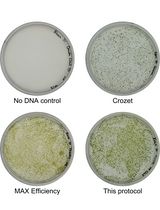
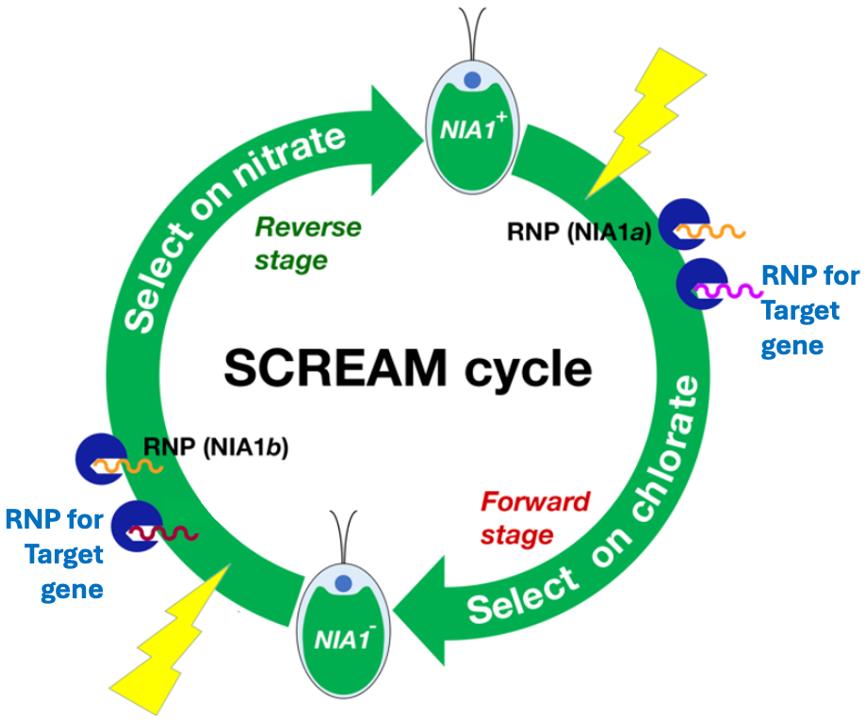
In the model alga Chlamydomonas reinhardtii, CRISPR (clustered regularly interspaced short palindromic repeat)-based gene editing using Cas (CRISPR-associated) enzymes enables both (a) insertion of large gene cassettes and (b) the creation of knockouts based on the introduction of indels, and specific mutations via mutation-directing oligonucleotides. Owing to the relatively low efficiency of this process, selection markers are frequently used to enrich the candidate pool prior to screening, which typically employs PCR. Unfortunately, few selection markers are available for Chlamydomonas. Furthermore, each marker requires different selection media, and deletion of the selectable marker can be difficult. When multiple successive gene editing steps are required, the use of these markers becomes onerous. The SCREAM (sequential CRISPR via recycling endogenous auxotrophic markers) technique employs an endogenous gene as a marker, the mutation of which can be selected both in the forward (loss of function) and reverse (gain of function) directions. During the first gene editing step, crRNA and mutation-directing oligonucleotides are provided for both the marker and the first target gene (Target 1). Candidates with edited marker genes are selected by loss of marker function, prior to screening for the desired modification of the first target gene. Using a successful candidate, a subsequent gene editing step directs reversion of the mutant marker gene to wild-type status, with candidates being selected on auxotrophic media to detect the regain of function of the auxotrophic marker to wild type (i.e., reversion). Simultaneously, a second target gene modification is produced using Target 2–specific crRNA and oligonucleotides. Revertants, now with a wild-type auxotrophic marker, are then screened for the specific mutation of Target 2. This reversion strategy enables a single selectable marker to be reused indefinitely, facilitating the creation of many successive mutations in a single cell line. As the marker can be completely reconstituted, strains can be created in which only the target gene is altered. Employment of homology-directed repair, using single-stranded oligonucleotides for mutation creation, enables the creation of site-directed mutants, tag insertion, and gene knockouts or reversion, rather than the insertion of large gene cassettes. In this implementation, nitrate reductase is used as the endogenous auxotrophic marker, and the adenine phosphoribosyltransferase gene is used as an example of a target gene.
Key features
• A single endogenous selectable marker gene is used for all successive mutational steps, employing only two standardized selection media.
• An indefinite series of gene edits created in a single cell line enables functional analysis of redundant gene families.
• Suitable applications include gene tagging, gene knockout, restoration of mutated genes to wild type, and site-directed mutagenesis to study gene function.
• Widely applicable to existing cell lines.
Keywords: CRISPR (CRISPR) Microalgae (微藻)
Chlamydomonas (衣藻)
SCREAM (SCREAM)
Selection markers (筛选标记)
NIA1 (NIA1)
Nit1 (Nit1)
Nitrate reductase (硝酸还原酶)
Microalgae (微藻)
Chlamydomonas (衣藻)
SCREAM (SCREAM)
Selection markers (筛选标记)
NIA1 (NIA1)
Nit1 (Nit1)
Nitrate reductase (硝酸还原酶)
Graphical overview
Background
The genetic manipulation of Chlamydomonas reinhardtii using CRISPR (clustered regularly interspaced short palindromic repeat) gene editing typically employs Cas (CRISPR-associated) enzymes, such as the widely employed Cas9, together with CRISPR RNAs (crRNA). CRISPR gene editing involves the creation of a double-strand break, either to facilitate disruption of the gene (e.g., via creation of an indel that leads to a frameshift) or to insert a transgene at a desired location to create a new function (e.g., an enzyme for a new metabolic pathway). Indel formation is typically produced via non-homologous end joining (NHEJ) DNA repair mechanisms [1]. However, CRISPR/Cas9 can also be used to create precise alterations to an existing gene element (e.g., promoter, coding region). This is achieved by exploiting homology-directed repair (HDR) by the endogenous polymerase theta [2]. This repair enzyme mediates microhomology-mediated end joining (MMEJ), also known as theta-mediated end joining (TMEJ), with the repair templates typically being small homologous regions on either side of the double-strand break. In CRISPR approaches, exogenously supplied single-stranded oligonucleotides act as templates to engineer the sequence at the repaired site [3,4]. This allows precise gene tagging, site-directed mutagenesis, and promoter engineering. Transgene insertion occurs at a very low frequency (~1 in 105), which requires the use of a marker on the transgene itself. Oligonucleotide-directed HDR in Chlamydomonas is also intrinsically inefficient and highly locus-dependent, typically ~0.1%–1% [5]. Although precise editing efficiencies up to ~10% have been reported for specific genes under optimized conditions [3], HDR remains generally too inefficient and variable to reliably identify edited cells without selection, reflecting a persistent bias toward non-homologous repair pathways. The use of parallel crRNAs against both an unselectable target gene and a selectable marker gene enables the selection of cells in which the marker is modified, i.e., an enrichment of cells that are competent to carry out the CRISPR/Cas9 reaction, even if not all of these will also have the target gene modified. This greatly simplifies the screening task. For a single CRISPR-mediated editing task, there are several markers to choose from, including both auxotrophic (e.g., ARG7) and antibiotic resistance markers (e.g., for paromomycin, hygromycin). Here, a target gene is typically disrupted by insertion of the exogenously supplied marker DNA (with or without additional functional DNA being supplied). But when multiple successive steps are required, the number of available markers is rapidly depleted. Removing a resistance marker at this stage, assuming it is located remote from the target gene, requires back-crossing with extensive validation of the crosses and also introduces a new genetic background. To solve this problem, the sequential CRISPR via recycling endogenous auxotrophic markers (SCREAM) protocol employs an endogenous marker gene that can be selected both for and against disruption, the archetypal example being the nitrate reductase gene NIA1 (previously known as Nit1) which, when functional, enables growth on nitrate (auxotrophic selection), but when knocked out confers resistance to the herbicide chlorate (antibiotic resistance) [5]. NIA1 is used in this protocol to illustrate the method, but other cyclical marker genes could be used instead. For example, mutations in the nucleotide salvage pathway enzyme adenine phosphoribosyltransferase (APRT) confer resistance to 2-fluoroadenine. Some Chlamydomonas cell lines lack a functional NIA1 gene, due to point mutations (which should, in principle, be repairable) or transposable element insertions (which may preclude efficient restoration by this approach). This limits the use of NIA1 as a marker strategy. Alternative selectable markers are therefore under evaluation for use with these cell lines.
SCREAM is a two-stage process in which the marker gene is first mutated, then reverted to the wild-type genotype. In the first stage, the population of NIA1-mutated cells is enriched for cells in which an accompanying target gene (Target 1) has been edited. These can then be screened for the alteration of the target gene (e.g., by PCR, for deletions that change amplicon size, or for the presence of an edited oligonucleotide insertion). Subsequently, Cas9 and HDR can be used to revert the mutated NIA1 gene back to the wild-type state, with auxotrophic selection (survival on nitrate) to identify NIA1 wild-type cells, and thereby enrich for cells in which a second target gene (Target 2) has been edited.
Because the marker is returned to the wild-type state, the marker system is regenerated and ready to use for an indefinite series of future modifications. A standard set of NIA1 gRNAs, which will be the same for each future experiment, is typically used. Target gene sequencing is used to confirm that the desired mutation has been introduced. This method is thus applicable to any gene editing that falls within the scope of oligonucleotide-directed HDR. The example here uses the cw15 (lacking a cell wall) strain CC-1883, which has a wild-type NIA1 gene. Strains with a cell wall are transfected at lower efficiency, but apart from this, it has been shown that they are also amenable to CRISPR modification. The example used here is the introduction of a specific mutation in the APRT gene, which can be used as a positive control by testing for the resulting resistance to 2-fluoroadenine. Notes on adapting this protocol for other target genes and cell lines are provided at the end of the protocol.
Materials and reagents
Biological materials
1. Chlamydomonas reinhardtii strain CC-1883, from The Chlamydomonas Resource Center, St Paul, Minneapolis (www.chlamycollection.org)
Reagents
1. Guide RNAs, supplied by Integrated DNA Technologies; AltRTM (see Table 1)
Table 1. Guide RNAs used in this protocol
| Name | Target gene | Gene ID† | Sequence (5′-3′) |
| NIA1_Disrupt | NIA1 (Nit1) | Cre09.g410950 | CCACCUACUGGACGGGCGUG |
| NIA1_Revert | NIA1 | Cre09.g410950 | CCACCUACUGAUCAGGCGUG* |
| APRT_Ex1 | APRT | Cre17.g704850 | UGCUGUACUGGAACGCCUGG |
| APRT_Ex3 | APRT | Cre17.g704850 | GCACAACGCGUUGCCCGGGC |
| †Phytozome database, phytozome-next.jgi.doe.gov *Bold residues show mutated residues targeted during the reversion cycle | |||
2. Single-stranded oligonucleotides (ssODN) used for HDR; supplied by Integrated DNA Technologies (see Table 2)
Table 2. Single-stranded DNA HDR oligonucleotides used in this protocol
| ssODN name | Gene | Function | Sequence (5´-3´) |
| NIA1_STOP_BclI | NIA1 | Insert STOP codon and insert BclI site | CTGAAGAAGAGCATTGGCTTCAACTGGGGCCCTTGTGCCACCAGCACCACCTACTGATCAGGCGTGCGGCTGCGCGACCTGTTGCAGCACGCCG |
| NIA1_Revert-to-WT | NIA1 | Repair mutated gene | CTGAAGAAGAGCATTGGCTTCAACTGGGGCCCTTGTGCCACGAGCACCACCTACTGGACGGGCGTGCGGCTCCGCGACCT |
| APRT_STOP_BclI | APRT | Insert STOP codon and insert BclI site | G*G*GTATTCTGTTCTGGGATGTCACCACCATCATGCTGAACCACCAGTGAT CAGTACAGCATTGACCTGTTCGCTGAGCAGTACAAGGACAAGAA*G*A |
| *Phosphorothioate linkages | |||
3. PCR primers (Integrated DNA Technologies) (see Table 3)
Table 3. Single-stranded DNA PCR primers used in this protocol
| Name | Gene | Amplicon length | Sequence (5´-3´) |
|---|---|---|---|
| NIA1_F | NIA1 | 547 | CAACAAGCCGTTGACTTTGA |
| NIA1_R | NIA1 | GGCATACATGCACTCACACC | |
| APRT_F | APRT | 920 | ATGGCTGACGTTGAGGC |
| APRT_R | APRT | TGCTGCCGTCTTCACAAA |
4. tracrRNA (20 nmoles) (IDT, catalog number: 1072533)
5. IDT duplex buffer (30 mM HEPES, pH 7.5, 100 mM potassium acetate; catalog number 11-01-03-01); duplex buffer is normally provided with tracrRNA and gRNAs ordered from IDT
6. Cas9 enzyme (IDT Alt-RTM S.p. Cas9 Nuclease V3, 500 µg, catalog number: 1081059)
7. PCR polymerase typically used for amplicons >1 kb (Q5 Hot Start High-Fidelity DNA Polymerase) (New England Biolabs, catalog number: M0493S/L; includes polymerase, 5× reaction buffer, and optional 5× high GC enhancer)
8. PCR polymerase typically used for amplicons <1 kb (Platinum II Hot-Start PCR Master Mix 2×, 200 reactions) (Thermo Fisher, catalog number: 14000013; includes optional 5× high GC enhancer).
9. Proteinase K, ~20 mg/mL (Thermo Fisher, catalog number: EO00491)
10. Hutner’s trace elements (available from the Chlamydomonas Resource Center, www.chlamycollection.org)
11. Potassium chlorate (KClO3) (Merck, catalog number: 255572-100G, CAS: 3811-04-9)
12. Sucrose (Chem-Supply, catalog number: SA030-5KG, CAS: 57-50-1)
13. Urea [CO(NH2)2] (Merck, catalog number: U0631-1KG, CAS: 57-13-6)
14. Dipotassium hydrogen phosphate (K2HPO4) (Sigma, catalog number: P8281-500G, CAS: 7758-11-4)
15. Potassium dihydrogen phosphate (KH2PO4) (Sigma, catalog number: P5655-500G, CAS 7778-77-0)
16. Potassium nitrate (KNO3) (Sigma, catalog number: P8291-500G, CAS: 7757-79-1)
17. Potassium chloride (KCl) (Chem-Supply, catalog number: PA054-500G, CAS: 7447-40-7)
18. Magnesium sulfate heptahydrate (MgSO4·7H2O) (Sigma, catalog number: M2773-1KG, CAS: 10034-99-8)
19. Magnesium chloride hexahydrate (MgCl2·6H2O) (Chem-Supply, catalog number: MA029-500G, CAS: 7791-18-6)
20. Calcium chloride dihydrate (CaCl2·2H2O) (Sigma, catalog number: 223506-500G, CAS: 10035-04-8)
21. Tris(hydroxymethyl)aminomethane (Tris), ultrapure grade (Astral Scientific, catalog number: BIO3094T-5X1KG, CAS: 77-86-1)
22. Glacial acetic acid (CH3COOH) (Merck, catalog number: 1000632511, CAS: 64-19-7)
23. Sodium dodecyl sulfate (SDS) (Sigma, catalog number: L4390-1KG, CAS: 151-21-3)
24. Agar (LabChem, Thermo Fisher, catalog number: AJA863)
25. Corn starch (Coles Cornflour, Coles supermarkets)
26. Hydrochloric acid (HCl) (Sigma-Aldrich, catalog number: 258148, CAS: 7647-01-0)
27. Ethanol (CH3CH2OH) (Chem-Supply, catalog number: EA043, CAS: 64-17-5)
Solutions
1. Phosphate stock for nitrate media (see Recipes)
2. Potassium nitrate 2 M stock (see Recipes)
3. Nitrate medium salts stock (see Recipes)
4. Nitrate medium (NM) pH 7.0 (see Recipes)
5. Nitrate medium Tris with sucrose (NM-ToS) (see Recipes)
6. Urea 2 M stock (see Recipes)
7. Potassium chlorate stock 40× (see Recipes)
8. Duplex buffer (supplied by IDT with gRNAs and tracrRNA) (see Recipes)
9. DNA isolation buffer pH 8.3 (see Recipes)
10. Sterile corn starch stock for spreading on plates (see Recipes)
Recipes
1. Phosphate stock for nitrate media
| Reagent | Final concentration | Quantity or volume |
|---|---|---|
| K2HPO4 | 1.653 M | 28.8 g |
| KH2PO4 | 1.05 M | 14.4 g |
| MilliQ water | To 100 mL | |
| Total phosphate | 2.711 M |
Autoclave.
2. Potassium nitrate 2 M stock
| Reagent | Final concentration | Quantity or volume |
|---|---|---|
| KNO3 | 2.0 M | 20.22 g |
| MilliQ water | n/a | To 100 mL |
Autoclave.
3. Nitrate medium salts stock
| Reagent | Final concentration | Quantity or volume |
|---|---|---|
| MgSO4·7H2O | 16.22 mM | 4.0 g |
| CaCl2·2H2O | 13.6 g/L | 2.0 g |
| MilliQ water | n/a | To 1 L |
Autoclave.
4. Nitrate medium (NM) pH 7.0
| Reagent | Final concentration | Quantity or volume |
|---|---|---|
| Tris-HCl | 20 mM | 2.42 g |
| Nitrate medium salts (Recipe 3) | 13.6 g/L | 25 mL |
| Potassium nitrate 2 M stock (Recipe 2) | 5 mM | 2.5 mL |
| Hutner’s trace elements | n/a | 1.0 mL |
| Glacial acetic acid | Total acetate 17.5 mM | 1.0 mL |
| MilliQ water | n/a | to 1 L |
Autoclave.
5. Nitrate medium Tris with sucrose (NM-ToS)
| Reagent | Final concentration | Quantity or volume |
|---|---|---|
| Sucrose | 40 mM | 1.369 g |
| Nitrate medium | n/a | To 100 mL |
Filter sterilize, do not autoclave.
6. Urea 2 M stock
| Reagent | Final concentration | Quantity or volume |
|---|---|---|
| CO(NH2)2 | 2.0 M | 17.0 g |
| MilliQ water | n/a | To 100 mL |
Filter sterilize, do not autoclave.
7. Potassium chlorate stock 40×
| Reagent | Final concentration | Quantity or volume |
|---|---|---|
| KClO3 | 0.4 M | 4.902 g |
| MilliQ water | n/a | To 100 mL |
Filter sterilize, do not autoclave.
8. Duplex buffer (supplied by IDT with gRNAs and tracrRNA)
| Reagent | Final concentration | Quantity or volume |
|---|---|---|
| HEPES pH 7.5 | 30 mM | 0.7149 g |
| NaOH 1 M stock | As required to bring pH to 7.5 | |
| Potassium acetate | 100 mM | 0.9815 g |
| MilliQ water | n/a | To 100 mL |
9. DNA isolation buffer pH 8.3
| Reagent | Final concentration | Quantity or volume |
|---|---|---|
| Tris-HCl pH 8.3 1 M stock | 50 mM | 1.21 g |
| KCl 1 M stock | 50 mM | 5 mL |
| MgCl2·6H2O 0.1 M stock | 2.5 mM | 2.5 mL |
| SDS 20% stock | 0.5% | 2.5 mL |
| HCl 32% | n/a | As required to bring pH to 8.3 |
| MilliQ water | n/a | To 100 mL |
10. Sterile corn starch stock for spreading on plates
| Reagent | Final concentration | Quantity or volume |
|---|---|---|
| Corn starch | 30% w/v | 15 g |
| Ethanol | n/a | To 50 mL |
Ethanol sterilized, do not autoclave.
Laboratory supplies
1. 1.5 mL safe-lock tubes (Fisher Scientific, Eppendorf, catalog number: 15625367)
2. Screw cap tube, 15 mL (Merck, catalog number: CLS430791)
3. Screw cap tube, 50 mL (Merck, catalog number: CLS430829)
4. No. 10 scalpel blade, 100 (LabCo, catalog number: BI0161-01)
5. Microscope slides (Menzel-Glaser, catalog number: EPBRSF21201)
6. 250 mL narrow-mouth Erlenmeyer flask (Merck, Corning, catalog number: Z232947)
7. 0.1 cm gap Gene Pulser electroporation cuvettes (Bio-Rad, catalog number: 1652089)
8. 200 μL filter tips, sterile, RNase/DNase free (LABCON, catalog number: 1059-965-008)
9. 10 μL filter tips, sterile, RNase/DNase free (LABCON, catalog number: 1036-260-000)
10. 100 mm × 100 mm × 20 mm square plates, sterile (Sarstedt Australia, catalog number: 82.9923.422)
11. Benchtop cooler (ThermoFisher, catalog number: 5115-0032)
12. Polypropylene micro tube rack, 96 well (LabCo Scientific, catalog number: 650.100.260)
13. Test tube racks for 15 and 50 mL tubes (Thermo Fisher, catalog number: 99019)
14. 1.8 mL cryotubes (Merck, catalog number: CLS430488)
15. 5 mL serological pipettes (Merck, catalog number: CLS4487)
16. 10 mL serological pipettes (Merck, catalog number: CLS4488)
17. 25 mL serological pipettes (Merck, catalog number: CLS4489)
18. PCR tubes 0.2 mL (Axygen Inc., catalog number: PCR-02-C)
19. PCR tubes 0.2 mL SnapStrip II (Scientific Specialities Inc., catalog number: 324500)
20. 200 μL tips (Greiner, catalog number: 775350)
21. 1000 μL tips (Axygen, catalog number: T-1000-B)
22. 90 mm sterile plates (Sarstedt Australia, catalog number: 82.1473.001)
23. Inoculation loop (Sarstedt Australia, catalog number: 6.1562.050)
24. Reagent reservoirs (LabCo, catalog number: 650.500.152)
25. 96-well deep-well plate (Merck, catalog number: CLS3596)
26. PCR microplate (Bio-Rad, catalog number: MLP9601)
27. Microplate sealing film, Rayon (Fisher Scientific, Axygen, catalog number: 11326254)
28. Syringe filter 0.22 micron (sterile) (Merck Millipore, catalog number: SLGP033RS)
29. Parafilm (Merck, catalog number: HS234526B)
Equipment
1. Mline 8-channel pipettor 30–300 μL (Sartorius, catalog number: 725140)
2. Single channel pipettors 0–10 μL, 10–100 μL, 100–1,000 μL (Eppendorf, catalog number: 3123000900)
3. S1 pipette filler (Thermo Fisher, catalog number: 9511)
4. Benchtop centrifuge 5810 R (Eppendorf, catalog number: 2230000080)
5. Pico 17 microcentrifuge (Thermo Fisher Scientific, catalog number: 75002410)
6. Bio-Rad T100 thermal cycler (Bio-Rad, catalog number: 1861096)
7. BR-2000 vortexer (Bio-Rad, catalog number: 1660611)
8. Hotblock (Major Science Elite Dry Bath incubator EL02, catalog number: EL-02-110/220)
9. Light meter (Walz, model: ULM-500)
10. C10 Benchtop Platform Shaker (New Brunswick Scientific, catalog number: M1245-0001)
11. Gene Pulser XCell electroporation apparatus, comprising main unit, capacitance extender module, pulse controller module, and ShockPod cuvette chamber (Bio-Rad, catalog number: 1652660)
12. ChemiDoc MP imaging system (Bio-Rad, catalog number: 1708280)
13. Mini-sub Cell GT electrophoresis tank (Bio-Rad, catalog number: 1704466)
14. Electrophoresis PowerPac HC (Bio-Rad, catalog number: 164-5052)
15. Counting chamber Neubauer pattern (Merck, catalog number: BR718605)
16. Horizontal laminar flow cabinet (Gelaire, catalog number: HLAF-1800; Email Westinghouse AirPure Laminar Flow Cabinet, catalog/model number: 1687-1400)
17. Nanodrop 2000c (Thermo Fisher, catalog number: ND-2000C)
18. Inverted microscope (Nikon Ts2) equipped with Kopa camera and software
Software and datasets
1. CRISPR RGEN tools: http://www.rgenome.net “Cas-OFFinder: A fast and versatile algorithm that searches for potential off-target sites of Cas9 RNA-guided endonucleases” [6] and “Microhomology-based choice of Cas9 nuclease target sites” [7], free
2. Snapgene v8.2.1 (Dotmatics, www.snapgene.com), requires license
3. Benchling (Biology software), 2024, https://www.benchling.com/, free alternative to Snapgene
4. Fiji (ImageJ; National Institutes of Health. https://imagej.net/software/fiji/downloads), free
5. Image Lab Software, Bio-Rad (Version 4.1) (SOFT-LIT-170-9690-ILSPC-V-4-1), free (current version requires a license)
6. Microsoft Excel (Microsoft.com), requires a license but is widely available. Free alternative: Apache OpenOffice https://openoffice.apache.org
Procedure
登录/注册后免费查看全文
文章信息
稿件历史记录
提交日期: Feb 5, 2026
接收日期: May 27, 2026
在线发布日期: Jun 29, 2026
出版日期: Jul 20, 2026
版权信息
© 2026 The Author(s); This is an open access article under the CC BY-NC license (https://creativecommons.org/licenses/by-nc/4.0/).
如何引用
Readers should cite both the Bio-protocol article and the original research article where this protocol was used:
- Ross, I. L. and Hankamer, B. (2026). Gene Editing in Chlamydomonas Using the SCREAM Technique. Bio-protocol 16(14): e5759. DOI: 10.21769/BioProtoc.5759.
- Ross, I. L., Le, H. P., Budiman, S., Xiong, D., Hemker, F., Millen, E. A., Oey, M. and Hankamer, B. (2024). A cyclical marker system enables indefinite series of oligonucleotide-directed gene editing in Chlamydomonas reinhardtii. Plant Physiol. 196(4): 2330–2345. https://doi.org/10.1093/plphys/kiae427

 Download Citation in RIS Format
分类
植物科学 > 植物分子生物学 > DNA
细胞生物学 > 细胞工程 > CRISPR-cas9
植物科学 > 藻类学 >
您对这篇实验方案有问题吗?
在此处发布您的问题,我们将邀请本文作者来回答。同时,我们会将您的问题发布到Bio-protocol Exchange,以便寻求社区成员的帮助。
 发布问题
发布问题


