


A Streamlined and Time-Saving Approach to Generate HLA-DR15 MHC Class II Tetramers via In Vivo Biotinylation
通过体内生物素化简便快速制备HLA-DR15 MHC II类四聚体

发布: 2026年07月20日第16卷第14期 DOI: 10.21769/BioProtoc.5755 浏览次数: 231
评审: Joel PraneethAnonymous reviewer(s)
 PDF
PDF  Q&A
Q&A
Advertisement





Abstract
This protocol describes an optimized strategy for the efficient generation of peptide-loaded major histocompatibility complex (MHC) class II (pMHC) tetramers, which are essential tools for detecting and characterizing antigen-specific T cells in immunological research. Traditional methods require separate expression of MHC proteins followed by in vitro biotinylation—a multi-step process that is time-consuming and prone to protein loss. Here, we present an integrated approach based on co-expression of MHC monomers and BirA biotin ligase in Expi293F T cells, enabling site-specific biotinylation in vivo during protein synthesis. At the same time, the incorporation of a thrombin-cleavable class II–associated invariant chain peptide (CLIP) peptide into the MHC construct allows flexible loading of any antigenic peptide of interest without the need for re-cloning or re-expression of the MHC molecule. Pre-biotinylated MHC molecules are subsequently purified, loaded with antigenic peptides, and assembled into fluorescent tetramers via streptavidin conjugation. This streamlined workflow significantly reduces handling steps, improves protein yield, and enhances reproducibility. The resulting tetramers are suitable for sensitive detection and isolation of antigen-specific T cells by flow cytometry, supporting applications in T-cell immunogenicity studies, vaccine development, and autoimmune disease research.
Key features
• One-step in vivo biotinylation.
• Eliminates purchased BirA enzyme, saves ~16 h, and reduces protein loss.
• CLIP-based peptide exchange without re-cloning.
• Produces antigen-specific tetramers validated by flow cytometry.
Keywords: MHC tetramer (MHC四聚体) HLA-DRB1*15:01 (HLA-DRB1*15:01)
Biotinylation (生物素化)
T cells (T细胞)
CLIP peptide (CLIP肽)
HLA-DRB1*15:01 (HLA-DRB1*15:01)
Biotinylation (生物素化)
T cells (T细胞)
CLIP peptide (CLIP肽)
Graphical overview
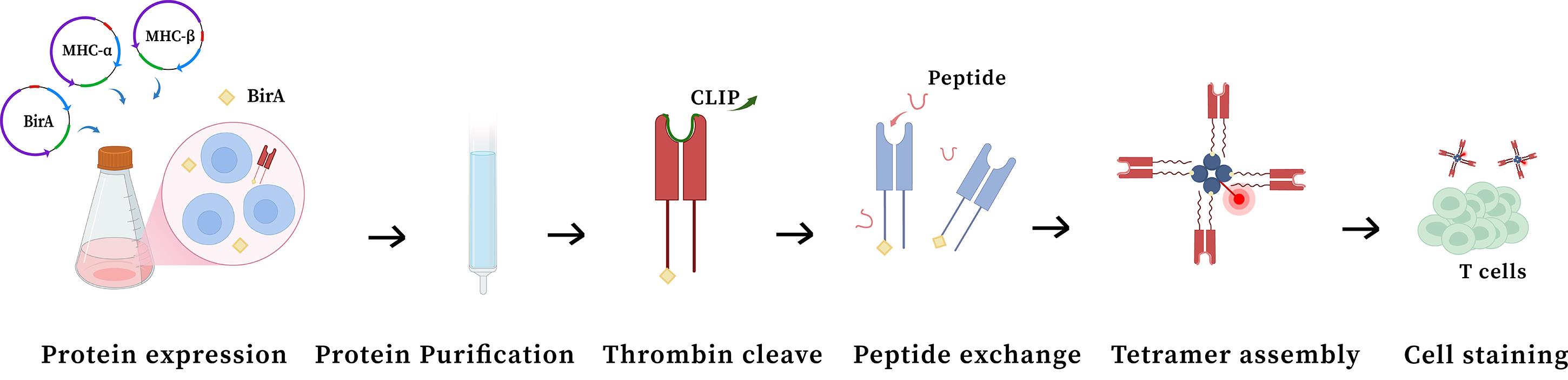
The whole process of preparation and application of HLA-DR15 major histocompatibility complex (MHC) class II tetramer. The sequential process of the experiment is represented, starting from protein expression to preparation of the tetramer and staining for flow cytometry analysis.
Background
Major histocompatibility complex (MHC) class II tetramers are indispensable tools for tracking and characterizing antigen-specific T-cell responses, with broad applications in vaccine development, autoimmune disease research, allergy studies, and cancer immunotherapy [1–4]. However, the widespread adoption of these reagents has been hampered by technical challenges associated with their production. Unlike MHC class I molecules, MHC class II molecules are heterodimeric and inherently unstable in the absence of bound peptide, making them difficult to produce as recombinant proteins [5]. Traditional preparation methods involve multiple sequential steps—including separate MHC protein expression, in vitro biotinylation, peptide loading, and multimer assembly—each requiring purification or buffer exchange [6]. These cumulative handling steps result in substantial protein loss, batch-to-batch variability, and overall low yields, limiting access to high-quality MHC class II tetramers for many research applications.
To overcome these limitations, we developed an integrated expression system that combines MHC class II monomer production with in vivo biotinylation. By co-expressing the engineered MHC α/β heterodimer and BirA biotin ligase in Expi293F cells, site-specific biotinylation occurs concurrently with protein synthesis, eliminating the need for a separate enzymatic reaction and associated purification steps. Compared with conventional in vitro biotinylation, this approach eliminates the need for purchased BirA enzyme, saves approximately 16 h of hands-on time, and avoids approximately half of protein loss caused by buffer exchange and concentration steps, while maintaining comparable tetramer quality. Furthermore, the incorporation of a thrombin-cleavable CLIP peptide allows for flexible loading of any antigenic peptide of interest without requiring re-cloning or re-expression of the MHC construct. This streamlined workflow significantly reduces processing time, minimizes protein loss through fewer handling steps, and ensures consistent, efficient biotinylation. Nevertheless, this method is primarily suitable for small-to-medium scale protein preparation; for large-scale production, the reliance on Ni-NTA gravity column purification and repeated ultrafiltration concentration steps makes the process labor-intensive and time-consuming.
The resulting human leukocyte antigen (HLA) tetramers exhibit excellent staining performance for antigen-specific T cells by flow cytometry, enabling sensitive detection and isolation of rare T-cell populations. Beyond conventional immunophenotyping, this method supports a range of applications, including longitudinal immune monitoring in clinical studies, epitope mapping in infectious and autoimmune diseases, and evaluation of T-cell responses in immunotherapy settings.
Materials and reagents
Biological materials
1. Expi293F (Gibco, catalog number: A14527CN)
2. pcDNA3.4 vector (TSINGKE Biological Technology, catalog number: ZT000101)
Reagents
1. RPMI 1640 (VivaCell, catalog number: C3010-0500); store at 4 °C
2. Fetal bovine serum (FBS) (Gibco, catalog number: 10091148); store at -20 °C
3. PBS pH 7.4 basic (1×) (Gibco, catalog number: C10010500BT); store at 4 °C
4. ExpiFectamineTM 293 Transfection kit, 1 L (Gibco, catalog number: A14524); store at 4 °C
5. Trypan Blue stain (0.4%) (Gibco, catalog number: 15250-061); store at room temperature
6. GibcoTM basic DMEM (Gibco, catalog number: C11995500BT); store at 4 °C
7. 20× tris-buffered saline (TBS) concentrate buffer (Thermo Scientific, catalog number: 28358); store at room temperature
8. Ampicillin (Beyotime, catalog number: ST008); store at -20 °C
9. Thrombin (Sigma, catalog number: T9326-150UN); store at -20 °C
10. PE Streptavidin (high concentration) (BioLegend, catalog number: 405245); store at 4 °C
11. Horseradish peroxidase (HRP)-labeled streptavidin (Beyotime, catalog number: A0305); store at -20 °C
12. Ni-NTA elution buffer (Sangon, catalog number: C600304); store at 4 °C
13. Ni-NTA binding/wash buffer (Sangon, catalog number: C600303); store at 4 °C
14. His Tag (C-terminal specific) mouse monoclonal antibody (HRP conjugated) (Beyotime, catalog number: AF2873); store at -20 °C
15. StrepII Tag mouse monoclonal antibody (HRP conjugate) (Beyotime, catalog number: AF2927); store at -20 °C
16. Skim milk (YEASEN, catalog number: 36120ES60); store at room temperature
17. Tris-MES-SDS running buffer power (Beyotime, catalog number: M00677); store at room temperature
18. Broad Multi Color Pre-Stained Protein Standard (Beyotime, catalog number: M00624); store at -20 °C
19. SDS-PAGE protein loading buffer (5×, odorless) (Beyotime, catalog number: P0286-2 mL); store at 4 °C
20. EDTA (0.5 M), pH 8.0 (Thermo Scientific, catalog number: AM9260G); store at room temperature
21. Octyl-β-D-glucopyranoside (≥98%, reagent grade) (Beyotime, catalog number: ST2546-1 g); store at -20 °C
22. Pepstatin A (YEASEN, catalog number: 20113ES08); store at -20 °C
23. Leupeptin (YEASEN, catalog number: 20112ES08); store at -20 °C
24. PMSF solution (100 mM) (Beyotime, catalog number: ST507-10 mL); store at -20 °C
25. DMSO (Sigma-Aldrich, catalog number: D5879); store at room temperature
26. Sodium citrate (absin, catalog number: abs42015609); store at room temperature
27. NaCl (Sigma-Aldrich, catalog number: S5886); store at room temperature
28. Opti-MEMTM I reduced serum medium (Gibco, catalog number: 31985070); store at 4 °C
29. UltraPureTM DNase/RNase-free distilled water (Thermo Scientific, catalog number: 10977015); store at room temperature
30. XbaI (NEB, catalog number: R0145V); store at -20 °C
31. AgeI-HF (NEB, catalog number: R3552S); store at -20 °C
Solutions
1. FACS buffer (see Recipes)
2. 10% octyl glucoside (see Recipes)
3. 1 mg/mL leupeptin (see Recipes)
4. 1 mg/mL pepstatin (see Recipes)
5. Sodium citrate buffer (see Recipes)
6. Peptide solution (see Recipes)
7. TBS buffer (see Recipes)
8. Peptide exchange buffer (see Recipes)
Recipes
1. FACS buffer (500 mL)
| Reagent | Final concentration | Quantity or volume |
|---|---|---|
| PBS | N/A | 490 mL |
| FBS | 2% | 10 mL |
Store at 4 °C.
2. 10% octyl glucoside (1 mL)
| Reagent | Final concentration | Quantity or volume |
|---|---|---|
| Octyl-β-D-glucopyranoside | N/A | 0.1 g |
| Ultrapure water | 10% | 1 mL |
Store at -20 °C unless using the day of.
3. 1 mg/mL leupeptin (5 mL)
| Reagent | Final concentration | Quantity or volume |
|---|---|---|
| Leupeptin | 1 mg/mL | 5 mg |
| Ultrapure water | N/A | 5 mL |
Store at -20 °C unless using the day of.
4. 1 mg/mL pepstatin (5 mL)
| Reagent | Final concentration | Quantity or volume |
|---|---|---|
| Pepstatin | 1 mg/mL | 5 mg |
| DMSO | N/A | 5 mL |
Store at -20 °C unless using the day of.
5. Sodium citrate buffer (50 mL)
| Reagent | Final concentration | Quantity or volume |
|---|---|---|
| NaCl | 150 mM | 0.4383 g |
| Sodium citrate | 50 mM | 0.645 g |
| Ultrapure water | N/A | 50 mL |
Store at room temperature.
6. Peptide solution
| Reagent | Final concentration | Quantity or volume |
|---|---|---|
| Peptide (1.64 kDa) | 20 mM | 2 mg |
| DMSO | N/A | 61 μL |
Store at -20 °C unless using the day of.
7. TBS buffer (500 mL)
| Reagent | Final concentration | Quantity or Volume |
|---|---|---|
| 20× TBS concentrate buffer | 1× | 25 mL |
| Ultrapure water | N/A | 475 mL |
Store at room temperature.
8. Peptide exchange buffer (1 mL)
| Reagent | Final concentration | Quantity or volume |
|---|---|---|
| 10% octyl glucoside | 1% | 100 μL |
| 1 mg/mL leupeptin | 2 μg/mL | 2 μL |
| 1 mg/mL pepstatin | 1 μg/mL | 1 μL |
| 0.5 M EDTA | 2 mM | 4 μL |
| 100 mM PMSF | 0.5 mM | 5 μL |
| 20 mM peptide | 100 μM | 5 μL |
| Cleaved pMHC | 1 μM | - |
| Sodium citrate buffer | N/A | Add to 1 mL |
Make fresh and keep on ice for use on the same day.
Laboratory supplies
1. Axygen® 1.5 mL MaxyClear Snaplock (Axygen, catalog number: MCT-150-C)
2. Corning® 125 mL polycarbonate Erlenmeyer flask with vent cap (Corning, catalog number: 431143)
3. Corning® flask, canted neck, 25 cm, vented (Corning, catalog number: CLS431463)
4. Amicon® Ultra 15 mL, 30 kDa cutoff (Merck, catalog number: UFC903096)
5. Amicon® Ultra centrifugal filters, 10 kDa molecular weight cutoff (MWCO) (Merck, catalog number: UFC501024)
6. HyPur T Ni-NTA 6FF (His-Tag) (Sangon, catalog number: C600332)
7. Sterile transfer pipette (BKMAM, catalog number: 110205008)
10. 0.2 mL PCR 8-tube strip with attached cap (YouLai, catalog number: PCR02-8TC-C-RT)
11.5 mL polystyrene round-bottom tube (Corning, catalog number: 352235)
12. CountessTM cell counting chamber slides (Thermo Scientific, catalog number: C10283)
13 50 mL centrifuge tube (Corning, catalog number: 430829)
14. 15 mL centrifuge tube (Corning, catalog number: 430790)
15. SurePAGETM, Bis-Tris, 10×8, 4%–20%, 12 wells (Beyotime, catalog number: M00656)
Equipment
1. Thermal cycler (Bio-Rad, model: T100TM)
2. CO2 incubator (Thermo Scientific, model: FormaTM Steri-CycleTM)
3. Biological safety cabinet (Thermo Scientific, catalog number: 1379)
4. Centrifuge (Eppendorf, model: 5810 R)
5. Flow cytometer (Thermo Scientific, model: Attune NxT)
6. Eppendorf ThermoMixer® C (Eppendorf, catalog number: 5382)
7. FrescoTM 17 microcentrifuge (Thermo Scientific, catalog number: 75002420)
8. Orbital shaker (YOONING, model: CS-200E)
9. Ice maker (SANYO, model: SIM-F140)
10. CountessTM 3 automated cell counter (InvitrogenTM, catalog number: AMQAX2000)
11. Milli-Q® SQ 200P ultrapure water system (Merck, catalog number: ZSQ200UPT0)
12. Contact nondestructive quantitative imager (e-Blot, model: Touch Imager XLi)
13. Mini-PROTEAN Tetra (Bio-Rad, catalog number: 165-8004)
14. Thermo ScientificTM RevcoTM laboratory refrigerator (Thermo Scientific, catalog number: REL3004V)
15. Variable speed mixer (DLAB, model: MX-S)
16. LocatorTM Plus rack and box system (Thermo Scientific, catalog number: CY50925-70)
17. Biomedical ultra-low temperature freezer (MEGSTEMAN Scientific, catalog number: DW-HL678D)
18. Microcentrifuge (YOONING, model: MC-12K)
19. Electric heating thermostatic water bath (Bluepard, model: MC-12K)
20. Combined refrigerator and freezer (Haier Biomedical, model: HYCD-471FD)
21. NanoDropTM One microvolume UV-Vis spectrophotometer (Thermo Fisher Scientific, catalog number: 840-317400)
Software and datasets
1. FlowJo version 10.8.1
2. SnapGene 6.0.2
Procedure
登录/注册后免费查看全文
文章信息
稿件历史记录
提交日期: Apr 29, 2026
接收日期: Jun 7, 2026
在线发布日期: Jun 24, 2026
出版日期: Jul 20, 2026
版权信息
© 2026 The Author(s); This is an open access article under the CC BY-NC license (https://creativecommons.org/licenses/by-nc/4.0/).
如何引用
Zhao, X. Y., Li, H. H., Ma, H. Y., Yang, B., Qian, R. Y., Zhang, X., Luo, L. J., Wu, Y. W. and Chen, L. (2026). A Streamlined and Time-Saving Approach to Generate HLA-DR15 MHC Class II Tetramers via In Vivo Biotinylation. Bio-protocol 16(14): e5755. DOI: 10.21769/BioProtoc.5755.

 Download Citation in RIS Format
分类
免疫学 > 免疫细胞染色 > 流式细胞术
免疫学 > 免疫细胞功能 > 抗原特异反应
生物化学 > 蛋白质 > 标记
您对这篇实验方案有问题吗?
在此处发布您的问题,我们将邀请本文作者来回答。同时,我们会将您的问题发布到Bio-protocol Exchange,以便寻求社区成员的帮助。
 发布问题
发布问题


