


DiRT v2.0: An Optimized Pipeline for Detecting Dicistronic tRNA-mRNA Transcripts in Plants
DiRT v2.0:用于检测植物双顺反子 tRNA-mRNA 转录本的优化流程

发布: 2026年06月20日第16卷第12期 DOI: 10.21769/BioProtoc.5754 浏览次数: 359
评审: Junhui LiHassan RasouliSabrina Moriom EliasAnonymous reviewer(s)
 PDF
PDF  Q&A
Q&A
Advertisement






Abstract
The canonical role of transfer RNAs (tRNAs) in protein synthesis has been extensively characterized; however, recent studies have uncovered novel functions for tRNA as a mediator of long-distance signaling in plants. Several studies have identified dicistronic tRNA-mRNA transcripts that contain a tRNA gene and an adjacent protein-coding gene (PCG) that are transcribed as a single unit. These transcripts are associated with RNA systemic mobility through the plant’s vascular tissues, potentially acting as non-cell-autonomous signaling messengers in coordinating development and stress responses. Here, we report a computational pipeline to detect dicistronic tRNA-mRNA transcripts from short-read next-generation RNA-sequencing datasets; to our knowledge, this is the only established pipeline for the systematic identification of such candidates in plants. The dicistronic RNA transcript version 2 (v2) described here improves on the earlier version DiRT v1 by expanding the repertoire of dicistronic transcripts detected to include tRNA-like structures (TLS) as well as functional tRNAs, which were already supported in the pipeline. The updated protocol also includes detection of dicistronic tRNA or TLS sequences within genomic features such as untranslated regions (UTRs). The accurate detection of both tRNAs and UTR-embedded tRNA-like sequences (TLS) is critical, as these RNA structures have been reported to function as mediators of long-distance RNA mobility. Furthermore, as NGS datasets are prone to sequencing artifacts and potential DNA contamination, we improved the pipeline’s statistical robustness by including read coverage of flanking intronic regions as a baseline control. To account for potential DNA contamination during RNA-seq library preparation, detected tRNA-mRNA transcripts are deemed as putatively dicistronic only if the coverage of their intergenic region is significantly higher (Student’s t-test, FDR < 0.05) than flanking intronic regions. Furthermore, the updated pipeline allows this statistical test to be applied to intronless and single-intron genes. Using this updated protocol, we identified novel tRNA and TLS dicistronic transcripts in both grapevine (Vitis spp. Ruggeri 140) and Arabidopsis thaliana datasets and validated in vitro using RT-PCR. We provide a fast and reliable method to detect dicistronic transcripts that can be applied to any short-read RNA-sequencing dataset, fast-tracking the functional characterization of these newly emerging transcripts.
Key features
• DiRT version 2.0 (v2) provides a reliable and improved bioinformatics workflow to identify dicistronic tRNA-mRNA transcriptomic features in plants.
• The updated workflow improves detection of tRNA-like structures (TLS) and UTRembedded dicistronic tRNA–mRNA candidates.
• Applies Student’s t-test (FDR < 0.05) and base pair coverage to validate transcript continuity, utilizing neighboring introns as the appropriate biological background control.
• DiRT v2 supports prediction of dicistronic candidates from intronless and singleintron protein coding genes (PCG).
Keywords: Transcriptomic analysis (转录组分析) Novel transcriptomic features (新型转录组特征)
Motif analysis (基序分析)
Bioinformatics (生物信息学)
Dicistronic transcripts (双顺反子转录本)
tRNA-mRNA (tRNA-mRNA)
Novel transcriptomic features (新型转录组特征)
Motif analysis (基序分析)
Bioinformatics (生物信息学)
Dicistronic transcripts (双顺反子转录本)
tRNA-mRNA (tRNA-mRNA)
Graphical overview
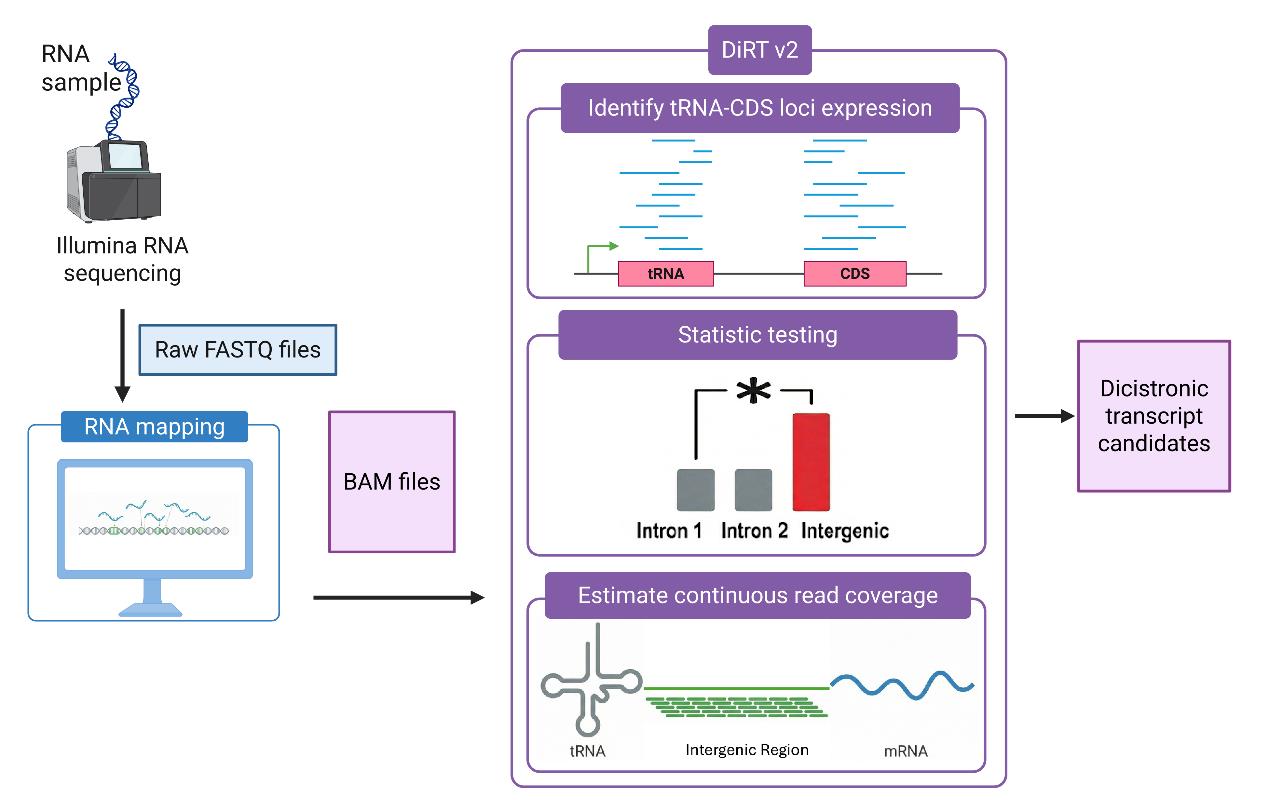
Bioinformatic workflow. RNA samples are sequenced by the Illumina NovaSeq X Plus. Following standard mapping of reads to a reference genome, BAM files generated are processed by DiRT v2, which identifies dicistronic tRNA-mRNA transcript candidates based on three criteria: (1) co-expression of both the tRNA and the adjacent protein coding gene (CDS); (2) statistically significant expression in the intergenic region compared to background noise (introns); and (3) continuous read coverage spanning the junction between the tRNA and mRNA (intergenic region).
Background
Dicistronic poly(A)-mRNA-tRNA transcripts occur when a protein-coding gene (PCG) and its adjacent tRNA gene are transcribed as a single transcriptional unit. Prior work shows that such co-transcribed mRNA-tRNA molecules can move systemically through the plant to target distant tissues [1]. The transgenic removal of tRNA or tRNA-like structure (TLS) sequences from these dicistronic transcripts renders them immobile, suggesting that movement is controlled by signals within the tRNA structure, sequence, or both [1]. Furthermore, as part of the co-transcribed units, mRNAs are translated to functional proteins in the target tissue, suggesting tRNAs or TLSs can facilitate the movement of these transcripts, potentially expanding their role in non-cell autonomous signaling pathways [1,2]. In field-grown commercial grapevines, the expression patterns of dicistronic tRNA-mRNAs were linked to the geographical location of the vineyards as well as the tissue type analyzed [3], which indicates that the expression patterns of these transcripts may be related to the microclimate, such as temperature or light, in different vineyards. We previously reported the development of a reusable computational workflow to reliably detect dicistronic tRNA-mRNA transcripts from RNA-seq datasets. The dicistronic tRNA-mRNA transcript (DiRT) workflow identified dicistronic tRNA-mRNA transcripts in multiple vascular species but not in non-vascular lineages, suggesting that their co-transcription may be related to phloem transportation of mRNA into distant tissues [3].
Although the majority of nuclear-encoded genes in plants are expressed as monocistronic units, an increasing number of studies report that plants utilize polycistronic and dicistronic transcripts to coordinate complex regulatory networks. For example, plant small nucleolar RNAs (snoRNAs) are frequently co-transcribed with adjacent tRNAs as dicistronic precursors [4]. In Arabidopsis thaliana and rice, these snoRNAs are transcribed from an upstream tRNA promoter to form dicistronic tRNA-snoRNA transcripts, which are subsequently cleaved into independent, functional tRNA and snoRNA [4]. Similarly, microRNAs (miRNAs) have been shown to cluster together in the rice genome and transcribed as a single polycistronic transcript [5]. These findings underscore the genome-wide prevalence of eukaryotic polycistronic transcription. While the biological roles of these co-transcribed units are still emerging, accurately capturing these complex transcripts directly from widely available short-read transcriptomic data remains a bottleneck. The first version of the DiRT pipeline v1 was developed to identify dicistronic tRNAs located upstream or downstream of mRNAs [3], but did not include tRNA-related sequences present in the untranslated regions (UTRs) of protein-coding genes. Indeed, many of the TLSs that share some structural similarities with canonical tRNAs but are non-functional as a translational adaptor are found localized to UTR regions of protein-coding genes [1]. Transgenic studies using TLSs derived from a tRNA in which specific functional domains were deleted were still able to confer long-distance mobility of their co-transcribed mRNA [1,2]. In Arabidopsis, TLS motifs located in the UTR of CK1 play a key role in regulating gene function by acting as a mobility motif for the CK1 transcript [1]. Furthermore, studies of turnip yellow mosaic virus (TYMV) and brome mosaic virus have demonstrated that TLS in the UTR regions of viral genes can mimic endogenous plant tRNAs to trigger systemic mobility through the phloem [6–8]. Together, these findings highlight the biological relevance of TLS and the importance of computational workflows to reliably detect dicistronic UTR-localized TLS sequences, as they may be functionally important in mobile signaling pathways in plants. Here, we address this gap by introducing DiRT pipeline v2, an enhanced version that incorporates the detection of tRNA-related sequences within mRNA UTRs.
Dicistronic tRNA-mRNA transcripts are also known to exhibit low expression levels compared to monocistronic nuclear-encoded protein-coding genes based on RNA-seq data [1,3], indicating the need for internal expression controls to distinguish biologically relevant transcript signals from technical noise or sequencing artifacts. The DiRT v1 pipeline relied on active transcription in the intergenic region between the tRNA and mRNA as indicative of co-transcription and compared the read coverage in this region with the two closest introns in the dicistronic protein-coding genes. tRNA-mRNA combinations were selected for further analysis in the workflow if the read coverage in the intergenic region was significantly higher than the intron-level coverage. However, this strategy excluded analyzing potential dicistronic tRNA-mRNA transcripts from protein-coding genes with one or no introns. As a significant proportion of protein-coding genes in plant species have one or no introns [9,10], excluding these genes may cause significant bias in the analysis of potential dicistronic tRNA-mRNA transcripts.
To overcome this bias, we modified the workflow for genes with no introns. Here, the average sequencing depth of the intergenic region [between the tRNA/TLS and the coding sequence (CDS) forming the given transcript] is compared with the top depth obtained for the first two introns from the closest protein-coding gene. For the analysis of dicistronic protein-coding genes with a single intron, an intron from the next closest flanking gene was used for sequencing depth comparison. After implementing these adjustments to control for minimum expression threshold levels, RNA coverage of each base pair of the intergenic region was estimated. Candidates that show both intergenic region continuous coverage and sequencing depth above background noise were classified as dicistronic tRNA-mRNA transcripts.
Materials and reagents
Biological material
1. Vitis Ruggeri 140
2. Arabidopsis thaliana Col-0 wild-type
Reagents
1. SpectrumTM Plant Total RNA kit (Sigma-Aldrich, UNSPSC Code: 41105501)
2. NEBNext® Poly(A) mRNA magnetic isolation module (New England Biolabs, catalog number: E7490S)
3. NEBNext® UltraTM II Directional RNA library prep with sample purification beads (New England Biolabs, catalog number: E7775S)
4. SuperScriptTM III first-strand synthesis system (Invitrogen, catalog number: 18080051)
5. DreamTaq PCR master mixes (2×) (Thermo Scientific, catalog number: K1081)
Software and datasets
DiRT v2 pipeline implementation is dependent on software packages in Linux, R, and RStudio environment to identify dicistronic tRNA-mRNA transcripts (Tables 1 and 2). Two RNA-seq datasets were used as examples for implementation of the DiRT v2 pipeline (Table 3).
Table 1. Linux environment
| Type | Software/dataset/resource | Version | Access (free/paid) |
|---|---|---|---|
| Software 1 | AdapterRemoval [11] | v2.3.3 | free |
| Software 2 | FastQC [12] | v0.12.1 | free |
| Software 3 | HISAT2 [13] | v2.2.1 | free |
| Software 4 | Samtools [14] | v1.22.1 | free |
| Software 5 | tRNAscan-SE [15] | v2.0 | free |
| Software 6 | BEDtools [16] | v2.30.0 | free |
Table 2. R and RStudio environment
| Type | Software/dataset/resource | Version | Access (free/paid) |
|---|---|---|---|
| Environment | R | v4.5.2 | free |
| Environment | RStudio | 2025.09.2 Build 418 | free |
| Package 1 | Bioconductor [17] | v3.22 | free |
| Package 2 | tidyverse [18] | v2.00.0 | free |
| Package 3 | data.table | v1.18.2.1 | free |
| Package 4 | GenomicAlignments [19] | v1.46.0 | free |
| Package 5 | rtracklayer [20] | v1.70.1 | free |
| Package 6 | GenomicFeatures [21] | v1.62.0 | free |
| Package 7 | Txdbmaker [22] | v1.62.0 | free |
| Package 8 | GeneOverlap [23] | v1.46.0 | free |
Table 3. RNA-seq datasets and reference genomes
| Species (tissue type) | RNA-seq dataset | Reference genome source file | GFF annotation version and file | Download resources | Recommended local file path |
|---|---|---|---|---|---|
| Vitis Ruggeri 140 (leaf) | Data 1: https://doi.org/10.5281/zenodo.20421456 | PNT2T_ref.fasta | Version 5.1: PN40024_5.1_on_T2T_ref_with_names.gff3 | https://grapedia.org/files-download/ | ~/DiRT_v2/data/grapevine/ |
Arabidopsis thaliana (whole seedling) | Data 2: PRJEB32714 (SRA) | Arabidopsis_thaliana. TAIR10.dna.toplevel.fa | Ensembl Plants v59: Arabidopsis_thaliana.TAIR10.59.gff3 | https://plants.ensembl.org/Arabidopsis_thaliana/Info/Index | ~/DiRT_v2/data/arabidopsis/ |
Procedure
登录/注册后免费查看全文
文章信息
稿件历史记录
提交日期: Mar 9, 2026
接收日期: Jun 13, 2026
在线发布日期: Jun 17, 2026
出版日期: Jun 20, 2026
版权信息
© 2026 The Author(s); This is an open access article under the CC BY license (https://creativecommons.org/licenses/by/4.0/).
如何引用
Zheng, F., Anand, L., Magnani, R., López, C. R. M. and David, R. (2026). DiRT v2.0: An Optimized Pipeline for Detecting Dicistronic tRNA-mRNA Transcripts in Plants. Bio-protocol 16(12): e5754. DOI: 10.21769/BioProtoc.5754.

 Download Citation in RIS Format
分类
生物信息学与计算生物学
系统生物学 > 转录组学 > RNA测序
植物科学 > 植物分子生物学 > RNA
您对这篇实验方案有问题吗?
在此处发布您的问题,我们将邀请本文作者来回答。同时,我们会将您的问题发布到Bio-protocol Exchange,以便寻求社区成员的帮助。
 发布问题
发布问题


