


Protocol for Measuring Drug–Target Engagement in Mouse Colorectal Cancer Organoids Using NanoBRET Assay
利用NanoBRET检测小鼠结直肠癌类器官中药物与靶标结合的实验方法

发布: 2026年07月20日第16卷第14期 DOI: 10.21769/BioProtoc.5752 浏览次数: 321
评审: Jessica DavisShilpa BishtAnonymous reviewer(s)
 PDF
PDF  Q&A
Q&A
Advertisement




Abstract
Organoids as a drug discovery platform represent an emerging field that continues to refine its tools. NanoBRET (bioluminescence resonance energy transfer) has emerged as a proximity-based and highly sensitive assay to measure protein–protein and protein–ligand interactions. NanoBRET assays were developed and are currently used for 2D cell line experiments. Here, we present the development of the first organoid-compatible Nanoluciferase (Nluc) for 3D model systems. We utilise the Nluc for NanoBRET assays to test drug–target engagement. We describe steps for seeding, transfecting, and replating of mouse colorectal cancer organoids. In addition, we provide detailed procedures for the NanoBRET assay. Various lines of evidence have shown significant difference in drug response between 2D human cell lines and 3D model systems, including patient-derived organoids. Our protocol provides a template for measuring this difference in the context of drug–target engagement.
Key features
• Development of organoid-compatible Nluc vector.
• Lentiviral delivery and antibiotic selection of MEK1-Nluc organoids.
• NanoBRET assay for the real-time measurement of drug–target engagement in organoids.
• Quantitative measurement of competitive drug binding in living 3D organoids.
• Impact of drug combinations on drug–target engagement in organoids.
Keywords: 3D organoid model (三维类器官模型) Colorectal cancer organoids (结直肠癌类器官)
NanoBRET (NanoBRET)
Protein–ligand interaction (蛋白质与配体相互作用)
Small molecules (小分子化合物)
Lentiviral transduction (慢病毒转导)
Trametinib (曲美替尼)
Colorectal cancer organoids (结直肠癌类器官)
NanoBRET (NanoBRET)
Protein–ligand interaction (蛋白质与配体相互作用)
Small molecules (小分子化合物)
Lentiviral transduction (慢病毒转导)
Trametinib (曲美替尼)
Graphical overview
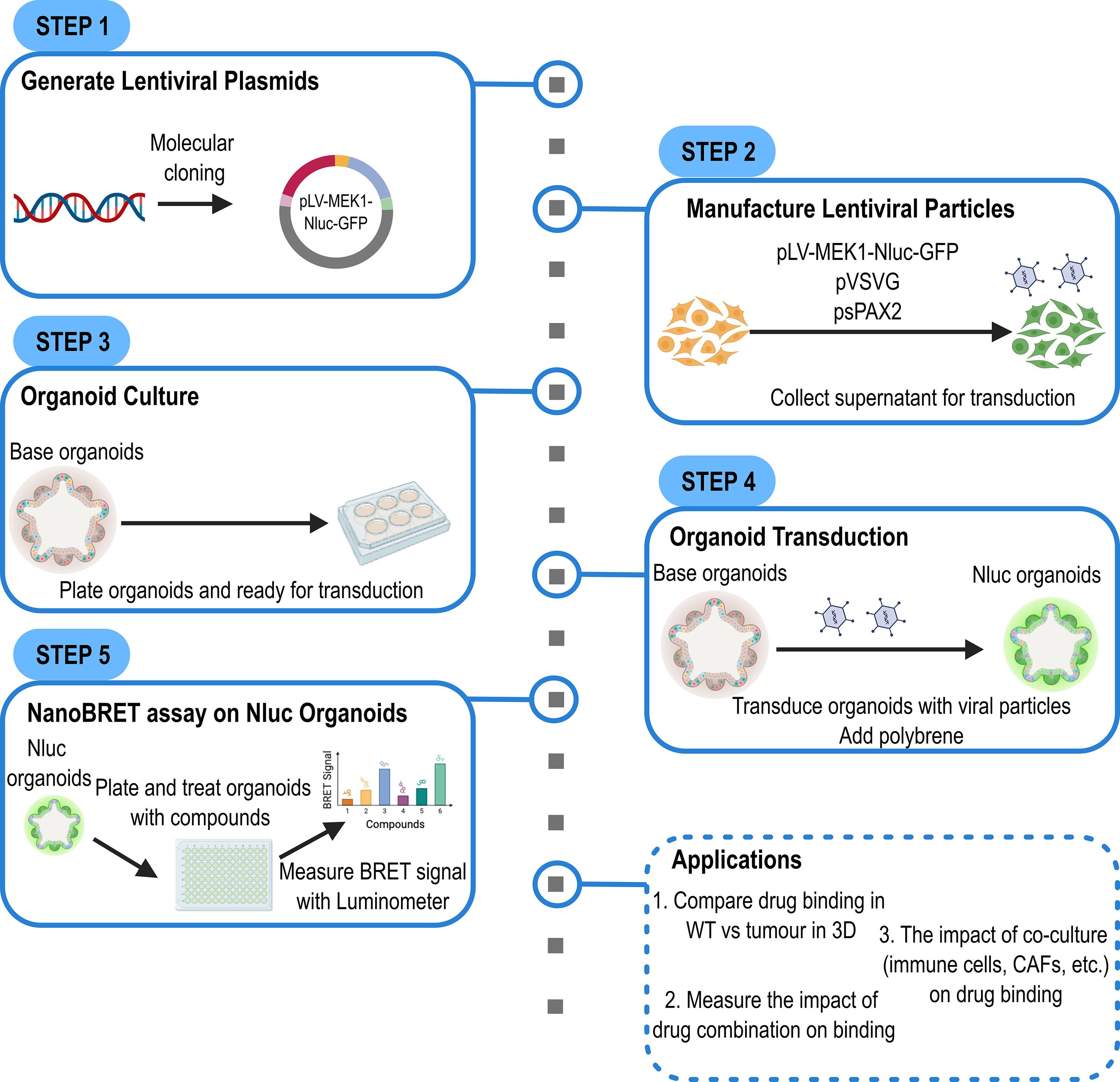
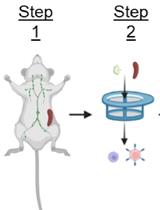
Schematic overview of the protocol for the development of the NanoBRET system in organoids
Background
Organoids have emerged as a powerful tool to study mammalian physiology in normal and disease states [1]. In a three-dimensional (3D) matrix, organoids can self-organise into organotypic structures; for example, intestinal organoids will form crypt and villus structures [2,3]. They provide the convenience of 2D cell culture with a more physiologically relevant 3D structure and are becoming essential research tools across many research areas, including developmental biology, cancer research, and personalised medicine [1,3].
Drug development remains an expensive and challenging process, and organoids are fast becoming a key screening platform. One key problem with targeted therapies is optimising drug–target interactions in vivo [4]. Although 2D cell culture approaches have led to the development of lead compounds and therapeutics, a wide discrepancy is often observed between drug activity in 2D cultures and patients due to the lack of cellular context required for proper in vivo drug–target engagement [4,5]. The complexity and heterogeneity of the organoid system provides one approach to help bridge this gap.
NanoBRET is a modified form of the bioluminescence resonance energy transfer (BRET) assay for the measurement of protein–ligand interactions in living cells, for example, drug–target engagement (Figure 1) [6,7]. This proximity-based assay measures the interaction between a protein of interest (POI) and fluorescently labelled ligands. The POI is tagged with nanoluciferase (Nluc) that serves as an energy donor to the fluorescently labelled “tracer” energy acceptor, which binds constitutively to the POI. This interaction generates a BRET signal that is measured with a system that can measure luminescence and fluorescence. This instrumentation includes Promega’s Glomax plate reader and Olympus LV200 microscope. The BRET signal is lost in the presence of an unlabelled ligand, such as a drug that competitively binds to the POI, because of the displacement of the tracer.
A key advantage of the NanoBRET system over other technologies, such as FRET, is that it provides wider spectral separations between the emissions of the energy donor and acceptor [5]. This provides greater dynamic range and a brighter signal, ideal for the measurement of sensitive changes in protein–ligand binding and drug–target engagement. The protocol presented here describes the engineering of mouse colorectal cancer organoids for the measurement of drug–target engagement in a living 3D organoid setting.
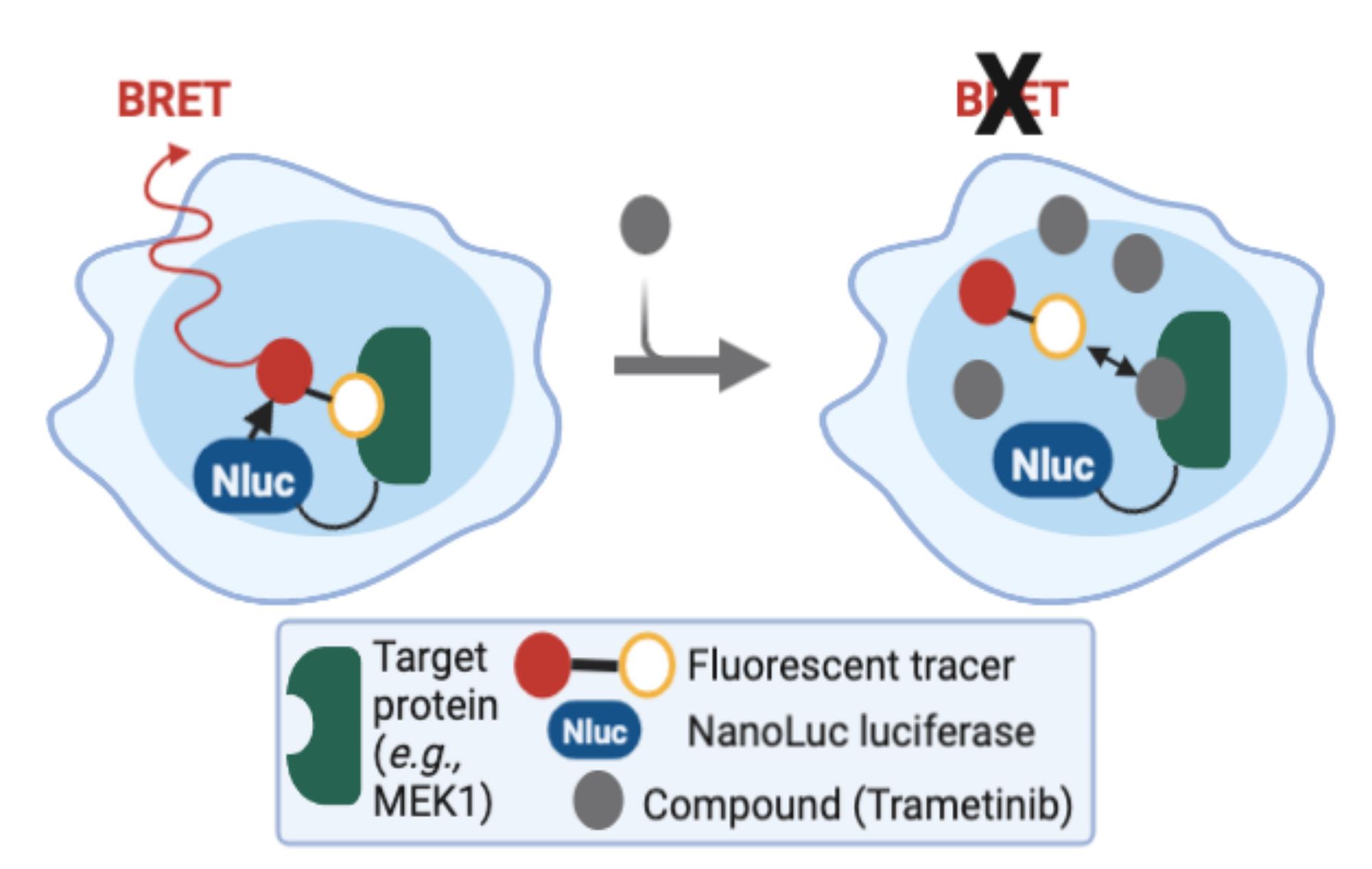
Figure 1. Overview of the NanoBRET system. The NanoBRET system is composed of a target protein (e.g., MEK1) tagged with Nanoluciferase. This target protein is the donor. BRET signal is achieved in the presence of a fluorescent tracer (the acceptor). This signal is competed away through the binding of unlabelled drug to the target protein.
Materials and reagents
Critical: Follow manufacturer’s guidelines for the storage of materials and reagents. Aliquot reagents to reduce freeze–thaw cycles to once or twice.
Biological materials
1. HEK293T cell line [American Type Culture Collection (ATCC), catalog number: CRL-3216]
2. VAPK mouse organoids (Villin-CreERT2: Apcfl/fl KrasG12D/+ Trp53fl/fl) are murine colorectal cancer organoids (gift from Sansom lab, CRUK SI) [3,8]
Reagents
1. Advanced Dulbecco’s modified Eagle medium/nutrient mixture F-12 (ADMEM/F12) (Gibco, catalog number: 12634-028)
2. GlutaMAX-I supplement (Gibco, catalog number: 35050-079)
3. HEPES (Gibco, catalog number: 15630-056)
4. Penicillin/streptomycin (Gibco, catalog number: 15140-122)
5. N2 supplement (Gibco, catalog number: 17502-048)
6. B27 supplement (Gibco, catalog number: 17504-044)
7. Mouse recombinant EGF (Invitrogen, catalog number: PMG8041)
8. Mouse recombinant Noggin (Peprotech, catalog number: 250-38)
9. TrypLE Express (Gibco, catalog number: 12604-021)
10. Opti-MEMTM I reduced serum media, without phenol red (Gibco, catalog number: 11058021)
11. Dulbecco’s modified Eagle medium (DMEM) plus GlutaMAX-I (Gibco, catalog number: 31966-021)
12. Fetal bovine serum (FBS) (Gibco, catalog number: A5256801)
13. Blasticidin S HCl (Gibco, catalog number: A1113903)
14. Matrigel growth factor reduced (GFR) basement membrane matrix (Corning, catalog number: 356231)
15. Trypan Blue stain (0.4%) (Invitrogen, catalog number: T10282)
16. Trametinib-bodipy [Dar lab (MSKCC)]; synthesised as previously reported [9]
17. Trametinib (Selleckchem, catalog number: S2673)
18. Nano-Glo(R) fluorofurimazine in vivo substrate (Promega, catalog number: N4100)
19. Tracer dilution buffer (Promega, catalog number: N2191)
20. FuGENE HD transfection reagent (Promega, catalog number: E2311)
21. Polybrene infection/transfection reagent (Sigma-Aldrich, catalog number: TR-1003)
22. psPAX2 plasmid vector (Addgene, catalog number: 12260)
23. pCMV-VSV-G plasmid vector (Addgene, catalog number: 8454)
24. pLV-CMV-MEK1-Nluc-CMV-EGFP-Bsd (synthesised from VectorBuilder)
25. NanoBRET Nano-Glo(R) furimazine substrate (Promega, catalog number: N1571)
Critical: We obtained trametinib-bodipy directly from Arvin Dar (MSKCC). This reagent can be obtained from the Dar lab or synthesised using their published methods. We are in the process of synthesising a new batch from our collaborator at the University of Strathclyde.
Solutions
1. Growth medium for HEK293T cell line (see Recipes)
2. Basal organoid medium (see Recipes)
3. Organoid culture medium (see Recipes)
Recipes
1. Growth medium for HEK293T cell line
| Reagent | Stock concentration | Final concentration | Volume |
|---|---|---|---|
| DMEM/GlutaMAX-I | - | - | 445 mL |
| FBS | 100% | 10% | 50 mL |
| Penicillin/streptomycin | 100× | 1× | 5 mL |
| Total | - | - | 500 mL |
Note: Store at 4 °C for up to 1 month and prewarm to 37 °C using a water bath prior to usage.
2. Basal organoid medium
| Reagent | Stock concentration | Final concentration | Volume |
|---|---|---|---|
| Advanced DMEM/F12 | - | - | 485 mL |
| GlutaMAX-I | 1× | 5 mL | |
| HEPES | 10 mM | 5 mL | |
| Penicillin/streptomycin | 1× | 5 mL | |
| Total | - | - | 500 mL |
Note: Store at 4 °C for up to 1 month and prewarm to 37 °C using a water bath prior to usage.
3. Organoid culture medium
| Reagent | Stock concentration | Final concentration | Volume |
|---|---|---|---|
| Basal organoid medium | - | - | 45 mL |
| N2 supplement | 100× | 1× | 0.5 mL |
| B27 supplement | 50× | 1× | 1 mL |
| EGF | 1 μg/mL | 50 ng/mL | 2.5 mL |
| Noggin | 5 μg/mL | 100 ng/mL | 1 mL |
| Total | - | - | 50 mL |
Note: Store at 4 °C for up to 2 weeks and prewarm to 37 °C using a water bath prior to usage. Store supplements at -20 °C.
Laboratory supplies
1. 6-well cell culture–treated plate (Thermo Fisher Scientific, catalog number: 140685)
2. T75 U-shaped cell culture flasks (Corning, catalog number: 15380591)
3. Nunc 96 solid white plate (Thermo Scientific, catalog number: 10346331)
4. 1.5 mL microtubes (Eppendorf, catalog number: 0030120086)
5. 15 mL centrifuge tube (Falcon, catalog number: 115074110)
6. 50 mL centrifuge tube (Falcon, catalog number: 11829650)
7. 2 mL aspirating pipette (Corning, catalog number: 9186)
8. 5 mL serological pipette (Corning, catalog number: 4050)
9. 10 mL serological pipette (Corning, catalog number: 4100)
10. 0.5–10 μL pipette tips (TipOne, catalog number: S1111-3810)
11. 20–200 μL pipette tips (TipOne, catalog number: S1113-1716)
12. 100–1,000 μL pipette tips (TipOne, catalog number: S1111-6811)
13. Cellometer SD100 slides (Revvity, catalog number: CHT4-SD100-002)
14. 40 μm sterile cell strainer (Greiner, catalog number: 542040)
Equipment
1. Biological safety cabinet (Nuaire, catalog number: NU4374005)
2. Cell culture incubator (37 °C, 5% CO2) (Eppendorf, catalog number: 170R-230-1000)
3. Refrigerated centrifuge (Sigma, catalog number: 3-16KL)
4. Water bath (Thermo Fisher Scientific, catalog number: TSGP20)
5. Nexcelom automated cell counter system (Revvity, catalog number: CMT-A2K)
6. CoolCell freezer container (Corning, catalog number: CLS432002)
7. Inverted microscope (Zeiss, model: Axiovert A1)
8. Single-channel variable pipette, 0.1–2 μL (Gilson, catalog number: FA10001P)
9. Single-channel variable pipette, 2–20 μL (Gilson, catalog number: FA10003P)
10. Single-channel variable pipette, 20–200 μL (Gilson, catalog number: FA10005P)
11. Single-channel variable pipette, 100–1,000 μL (Gilson, catalog number: FA10006P)
12. Fridge (Biocold, catalog number: BIO155FRSSL)
13. -20 °C freezer (Biocold, catalog number: BIO102FZSS)
14. -80 °C freezer (Panasonic, catalog number: KMDU53Y1E)
15. Pipette controller (Falcon, catalog number: 357804)
16. Glomax Discover plate reader (Promega, catalog number: GM3000)
Procedure
登录/注册后免费查看全文
文章信息
稿件历史记录
提交日期: Mar 17, 2026
接收日期: Jun 9, 2026
在线发布日期: Jun 22, 2026
出版日期: Jul 20, 2026
版权信息
© 2026 The Author(s); This is an open access article under the CC BY license (https://creativecommons.org/licenses/by/4.0/).
如何引用
Badmos, H. A., Steele, C. and Cagan, R. (2026). Protocol for Measuring Drug–Target Engagement in Mouse Colorectal Cancer Organoids Using NanoBRET Assay. Bio-protocol 16(14): e5752. DOI: 10.21769/BioProtoc.5752.

 Download Citation in RIS Format
分类
干细胞 > 类器官培养
癌症生物学 > 通用技术 > 药物发现和分析
细胞生物学 > 细胞工程 > 慢病毒递送
您对这篇实验方案有问题吗?
在此处发布您的问题,我们将邀请本文作者来回答。同时,我们会将您的问题发布到Bio-protocol Exchange,以便寻求社区成员的帮助。
 发布问题
发布问题


