


PrimeFlowTM Assay for Cell Type–Specific Co-detection of Transgene RNA and Protein in Mouse Spleens From Preclinical Studies
基于 PrimeFlowTM 的临床前小鼠脾脏样本转基因 RNA 与蛋白细胞类型特异性同步检测

发布: 2026年06月20日第16卷第12期 DOI: 10.21769/BioProtoc.5748 浏览次数: 389
评审: Kif Liakath-AliSalma MerchantAnonymous reviewer(s)
 PDF
PDF  Q&A
Q&A
Advertisement





Abstract
The PrimeFlowTM assay is a flow cytometry–based method for the co-detection of RNAs and proteins in cells. When combined with cell characterization by immunophenotyping, PrimeFlowTM can be used to simultaneously detect RNA and proteins in a cell type–specific manner in complex heterogeneous samples, offering an advantage over bulk tissue analysis methods. Here, we describe the implementation of the PrimeFlowTM assay protocol for the detection of transgene mRNA and protein expression in spleen samples from mice treated in vivo with luciferase mRNA-lipid nanoparticles (LNPs). This protocol involves spleen tissue dissociation for cell isolation, followed by cell fixation and permeabilization to allow immunolabeling of intracellular luciferase protein. The immunophenotyping strategy is based on immunolabeling with mouse CD marker antibodies for the identification of T cells, B cells, monocytes, granulocytes/macrophages, NK cells, and non-hematopoietic cells. The RNAs of luciferase and a housekeeping gene, β-actin, are detected with sequence-specific probe sets by employing sequential oligonucleotide annealing steps and fluorescent labeling using a branched DNA (bDNA) technology. Samples are analyzed by flow cytometry. Based on our analysis, we conclude it is feasible to apply the PrimeFlowTM approach for evaluating successful drug targeting to the cell types of interest and any potential differences in the kinetics of RNA delivery and protein expression in various tissue cells, supporting the discovery and development of RNA therapeutics.
Key features
• This protocol can be employed for cell-specific simultaneous detection of up to four different RNAs (using available commercial reagents) and multiple proteins by flow cytometry.
• This protocol requires application-specific optimization of the RNA-binding probe sets and antibody reagents for transgene detection and immunophenotyping panel.
Keywords: PrimeFlowTM assay (PrimeFlowTM 检测) Flow cytometry (流式细胞术)
RNA therapeutics (RNA 疗法)
Transgene expression (转基因表达)
Immunophenotyping (免疫表型分析)
RNA analysis (RNA 分析)
Flow-based in situ hybridization (基于流式的原位杂交)
Branched DNA (bDNA) (分支 DNA(bDNA))
Flow cytometry (流式细胞术)
RNA therapeutics (RNA 疗法)
Transgene expression (转基因表达)
Immunophenotyping (免疫表型分析)
RNA analysis (RNA 分析)
Flow-based in situ hybridization (基于流式的原位杂交)
Branched DNA (bDNA) (分支 DNA(bDNA))
Graphical overview
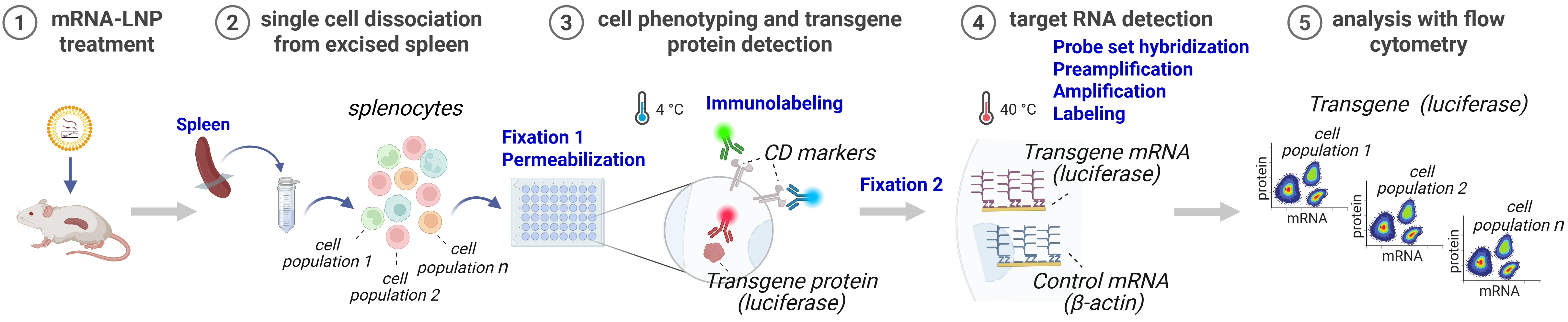
Overview of the PrimeFlowTM assay workflow for mouse spleen analysis. Cells are dissociated from the spleens of mRNA-lipid nanoparticle (LNP)-injected mice. Then, immunophenotyping with target protein labeling is conducted, followed by target-specific oligonucleotide probe hybridization and RNA signal amplification by bDNA reaction [1]. The cells are analyzed with flow cytometry. Created in Biorender.com.
Background
Development of gene therapies and vaccines relies on efficient transgene RNA delivery to target cell types, which necessitates a detailed understanding of RNA level and transgene protein expression kinetics in different cell populations. However, current bioanalytical methods, such as PCR for RNA and liquid chromatography–mass spectrometry (LC-MS) for protein measurements, usually do not allow simultaneous RNA and protein measurement in the same sample. More importantly, these methods rely on bulk tissue analysis and, therefore, do not provide cell type–specific resolution.
The PrimeFlowTM technique, commercially available as Thermo Fisher Scientific PrimeFlowTM RNA Assay, can potentially mitigate the above-mentioned issues. The PrimeFlowTM assay has been developed by combining flow cytometry with in-situ hybridization and the branched DNA (bDNA) amplification technique [1–5]. The detection of target proteins, either membrane or intracellular, is conducted with fluorescently labeled antibodies that are found compatible with the assay conditions. The RNA detection by the PrimeFlowTM approach requires in-situ hybridization with target-specific probe pairs, provided by Thermo Fisher, either off the shelf or custom-generated. Then, the bound probe signal is amplified (reportedly, ~8,000–16,000 fold [1–5]), through a series of steps: the bDNA reaction causes oligonucleotide pre-amplifiers to anneal the pre-bound target probe pairs, then multiple amplifiers bind each pre-amplifier, and, subsequently, multiple fluorescently tagged label probes bind to each amplifier, generating a tree-like structure on the target RNA molecule with a high number of associated fluorescent molecules. Studies have shown that the PrimeFlowTM assay has high sensitivity, with a detection limit of ~10 copies/cell for mRNA and ~20 copies/cell for miRNA [5], while also known to be specific [1]. Currently, the available commercial kit can be multiplexed to detect four RNAs and multiple target proteins [1,4].
Further, when combined with cell immunophenotyping, the PrimeFlowTM assay can provide valuable information on the presence of mRNA and protein in predefined cell populations in a tissue. Thus, we advanced the implementation of the PrimeFlowTM approach for the detection of luciferase transgene mRNA and protein in cells from the spleens of mice treated with luciferase mRNA-lipid nanoparticles (LNPs) in vivo. We found that, despite challenging execution (e.g., identifying and qualifying compatible reagents, temperature requirements, multistep labor-intensive protocol) and the need for further optimization (e.g., cell loss), the PrimeFlowTM assay can support simultaneous multiplex detection of transgene mRNA and protein in a cell type–specific manner in samples from preclinical studies with potential to provide otherwise unattainable information for development of RNA-based and other types of biotherapeutics.
Materials and reagents
Biological materials
1. Male BALB/c mice (8–10 weeks old, 25–30 g) (Charles River Labs)
Reagents
1. PrimeFlowTM RNA Assay Kit (Thermo Fisher Scientific, catalog number: 88-18005-210), containing:
a. PrimeFlowTM RNA Fixation Buffer 1A (catalog number: 00-18100-54)
b. PrimeFlowTM RNA II Fixation Buffer 1B (catalog number: 00-18200-54)
c. PrimeFlowTM RNA Permeabilization Buffer (10×) (catalog number: 00-18300-43)
d. PrimeFlowTM RNA Fixation Buffer 2 (8×) (catalog number: 00-18400-53)
e. PrimeFlowTM RNA Wash Buffer (catalog number: 00-19180-26)
f. PrimeFlowTM RNA Target Probe Diluent (catalog number: 00-19185-12)
g. PrimeFlowTM RNA PreAmp Mix (catalog number: 00-16000-53)
h. PrimeFlowTM RNA Amp Mix (catalog number: 00-16001-53)
i. PrimeFlowTM RNA Label Probe Diluent (catalog number: 00-19183-100)
j. PrimeFlowTM RNase Inhibitors (100×) (catalog number: 00-16002-19)
k. PrimeFlowTM Compensation Kit (catalog number: 88-17009-42)
l. IC Fixation Buffer (catalog number: 00-8222-758)
m. Label Probes, 100× (catalog number: 00-16003-32)
Note: Expiration dates and storage and handling instructions for all materials in the kit are provided by the manufacturer.
2. Antibodies
Note: All antibodies and antibody mixes were stored refrigerated and protected from light. Freezing and thawing were not examined and are not recommended.
a. Rat anti-mouse CD45-BUV496, clone 30-F11 [BD Biosciences (BD HorizonTM), catalog number: 569673]
b. Rat anti-mouse Ly-6C-BUV805, clone HK1.4 [BD Biosciences (BD OptiBuildTM), catalog number: 755202]
c. Mouse anti-mouse H2Kd/H2Dd (MHC-I)-BV421, clone 34-1-2S [BD Biosciences (BD HorizonTM), catalog number: 567294]
d. Rat anti-mouse CD19-BV605, clone 6D5 (BioLegend, catalog number: 115540)
e. Mouse anti-mouse NK1.1-BV711, clone PK136 [BD Biosciences (BD HorizonTM), catalog number: 569723]
Note: Immunolabeling of the NK1.1 marker cannot be employed with every mouse strain, as some strains are considered NK1.1-negative despite having an NK cell population. Strain-appropriate alternatives should be used.
f. Hamster anti-mouse CD3-BV750, clone 145-2C11 [BD Biosciences (BD OptiBuildTM), catalog number: 746988]
g. Rabbit anti-firefly luciferase-PE, clone EPR17789 (Abcam, catalog number: AB237253)
h. Rat anti-mouse CD11b-APC-eFluor780, clone M1/70 [Thermo Fisher Scientific (eBioscienceTM), catalog number: 47-0112-82]
3. Target probe sets, stored frozen (-20 °C), as recommended by the manufacturer:
a. PrimeFlowTM Type 4 Mouse β-Actin target probe set for Alexa Fluor 488 [Thermo Fisher Scientific (Invitrogen), catalog number: PF-210, VB4-10432]
b. PrimeFlowTM Type 1 luciferase target probe set for Alexa Fluor 647 (custom-designed VPWCWFC Synthetic G6 Luc co) [Thermo Fisher Scientific (Invitrogen), catalog number: PF-210]
4. BD OMICS-Guard sample preservation buffer (BD Biosciences, catalog number: 570911), stored refrigerated
5. BD PharmingenTM stain buffer (BSA) (BD Biosciences, catalog number: 554657), stored refrigerated
6. BD PharmingenTM stain buffer (FBS) (BD Biosciences, catalog number: 554656), stored refrigerated
7. Water (nuclease-free) (Fisher BioReagents, catalog number: BP2484-50), stored at ambient temperature
8. VitaStainTM AO/PI staining solution (Nexcelom Bioscience, catalog number: CS2-0106-5mL), stored refrigerated
Solutions
1. Permeabilization buffer (see Recipes)
2. Fixation buffer 2 (see Recipes)
3. RNA wash buffer with 1× RNase inhibitors (see Recipes)
Recipes
1. Permeabilization buffer
| Reagent | Dilution | Final concentration |
|---|---|---|
| PrimeFlowTM RNA permeabilization buffer (10×) | 1:10 | 1× |
| PrimeFlowTM RNase inhibitors (100×) | 1:100 | 1× |
Dilute in DNase/RNase-free water.
2. Fixation buffer 2
| Reagent | Dilution | Final concentration |
|---|---|---|
| PrimeFlowTM RNA fixation buffer 2 (8×) | 1:8 | 1× |
| PrimeFlowTM RNase inhibitors (100×) | 1:100 | 1× |
Dilute in PrimeFlowTM RNA wash buffer.
3. RNA wash buffer with 1× RNase inhibitors
| Reagent | Dilution | Final concentration in RNA wash buffer |
|---|---|---|
| PrimeFlowTM RNase inhibitors (100×) | 1:100 | 1× |
Laboratory supplies
Note: Based on the information provided by the manufacturers (website description, certificate of analysis), the supplies listed below are considered RNase-free.
1. 5 mL polystyrene round-bottom tube (12 × 75 mm style) (FACS tube) (Falcon, catalog number: 352054)
2. V-bottom 96-well plate (Costar, Corning, catalog number: 3896); supplemented with a lid from a flat-bottom 96-well plate (Costar, Corning, catalog number: 3596)
3. 50 mL polypropylene conical tube (30 × 115 mm style) (Falcon, catalog number: 352070)
4. 15 mL high-clarity polypropylene conical tube (17 × 120 mm style) (Falcon, catalog number: 352096)
5. 40 μm cell strainer (filter) (Fisher Scientific, catalog number: 07-201-430)
Equipment
1. BD FACSymphonyTM A5 Cell Analyzer (BD Biosciences, catalog number: 660964; any flow cytometer with appropriate optical setup can be used)
2. 40 °C incubator (Quincy Labs, model: 10E)
3. ViewRNATM Temperature Validation kit (Thermo Fisher Scientific, catalog number: QV0523)
4. Centrifuge (Thermo Fisher Scientific Sorvall X4R Pro-MD, catalog number: 75009521)
5. Cellometer Vision Cell Profiler (Nexcelom, model: Cellometer Vision)
Software and datasets
1. BD FACSDivaTM (BD Biosciences, version 9.1)
2. FlowJoTM (BD Biosciences, version 10)
3. Prism [GraphPad (Dotmatics), version 10]
4. Excel (Microsoft)
Procedure
登录/注册后免费查看全文
文章信息
稿件历史记录
提交日期: Mar 17, 2026
接收日期: May 31, 2026
在线发布日期: Jun 15, 2026
出版日期: Jun 20, 2026
版权信息
© 2026 The Author(s); This is an open access article under the CC BY-NC license (https://creativecommons.org/licenses/by-nc/4.0/).
如何引用
Gallolu Kankanamalage, S., Fan, X., Kundu, S., Villamizar, O., Roh, J. S., Cohen, J., Neubert, H. and Goihberg, P. (2026). PrimeFlowTM Assay for Cell Type–Specific Co-detection of Transgene RNA and Protein in Mouse Spleens From Preclinical Studies. Bio-protocol 16(12): e5748. DOI: 10.21769/BioProtoc.5748.

 Download Citation in RIS Format
分类
免疫学 > 免疫细胞染色 > 流式细胞术
分子生物学 > RNA > RNA 检测
您对这篇实验方案有问题吗?
在此处发布您的问题,我们将邀请本文作者来回答。同时,我们会将您的问题发布到Bio-protocol Exchange,以便寻求社区成员的帮助。
 发布问题
发布问题


