


An Accurate and Precise ddPCR-Based Method for Determining the Concentration of Plasmid DNA
基于ddPCR准确测定质粒DNA浓度的高精度方法

发布: 2026年07月20日第16卷第14期 DOI: 10.21769/BioProtoc.5741 浏览次数: 297
评审: Hemant Kumar PrajapatiPriyanka Mittal
 PDF
PDF  Q&A
Q&A
Advertisement






Abstract
Transient transfection is commonly used for the commercial production of adeno-associated viral particles for gene therapy. In this process, packaging cells such as HEK293 cells are transfected with three plasmids, including the Rep/Cap plasmid, the Helper plasmid, and the gene-of-interest plasmid containing the transgene/gene therapy product. The combination of these plasmids allows for the robust production of recombinant adeno-associated viral particles. As a result, the concentration of these plasmids plays a critical role in viral production and must be accurately assessed. Typically, A260/A280 readings are utilized to measure plasmid titer; however, this approach lacks accuracy and specificity and is susceptible to matrix interference. To address these shortcomings, a digital droplet PCR method was developed to titer plasmids. This method uses a combined restriction digest/PCR protocol to linearize the plasmid template and evaluate copy numbers of a plasmid-specific gene. Qualification demonstrated that the method is highly accurate, specific to plasmid DNA, and impervious to matrix interference.
Key features
• Digital droplet PCR (ddPCR)-based plasmid quantification using a combined linearization/PCR workflow, enabling highly accurate and precise copy-number measurements across plasmids of varying purity and production stages.
• Robust performance in complex sample matrices, with high dilution tolerance that minimizes matrix interference and ensures reliable quantification from crude lysates to highly purified plasmids.
• Specific detection of plasmid DNA independent of contaminating nucleic acids, providing reliable readouts when A260 measurements are distorted by residual DNA, RNA, or dNTP impurities.
• Universally applicable to plasmids sharing common selection cassettes, enabling a single primer–probe set to accurately quantify diverse constructs without plasmid-specific assay redesign.
Keywords: Plasmid DNA (质粒DNA) Droplet digital PCR (微滴式数字PCR)
DNA linearization (DNA线性化)
rAAV manufacturing (重组腺相关病毒生产)
Gene therapy workflows (基因治疗流程)
Selection cassette targeting (选择盒靶向)
Process development (工艺开发)
Droplet digital PCR (微滴式数字PCR)
DNA linearization (DNA线性化)
rAAV manufacturing (重组腺相关病毒生产)
Gene therapy workflows (基因治疗流程)
Selection cassette targeting (选择盒靶向)
Process development (工艺开发)
Graphical overview
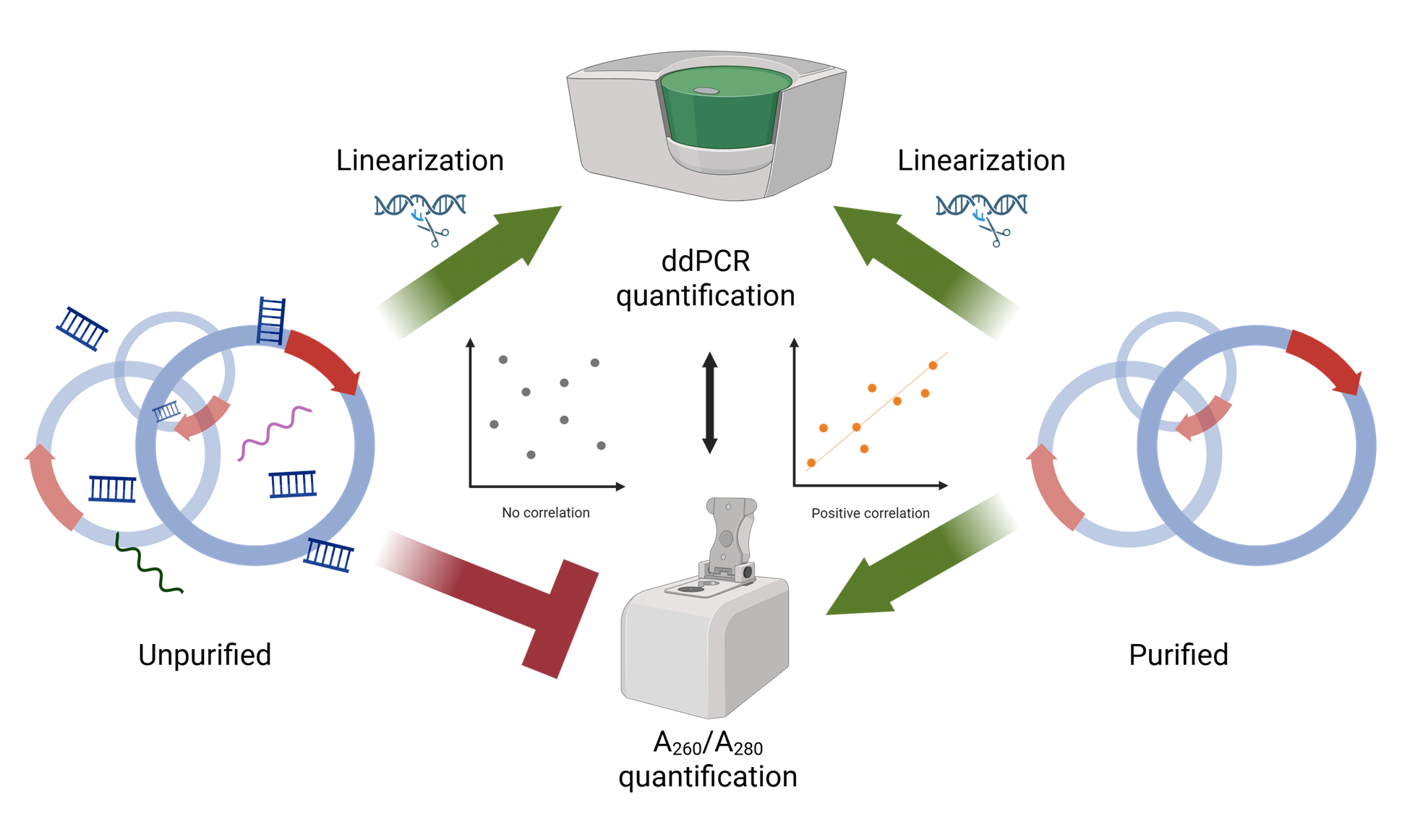
Digital droplet PCR (ddPCR) enables accurate, matrix-independent plasmid quantification for adeno-associated virus (AAV) production, outperforming traditional A260/A280 measurements
Background
Recombinant adeno-associated virus (rAAV) is a popular avenue for the development of gene therapy products, given its low safety risk and long-lasting transgene expression [1]. Production of rAAV particles can occur by multiple means; however, transient transfection (TT) remains at the forefront. The TT process utilizes three plasmids containing the necessary elements for rAAV production: replication and capsid genes (rep/cap), helper genes that support packaging without the need for helper virus, and the packaged transgene needed for therapeutic effect [1]. Adherent or suspension cells are simultaneously transfected with the three plasmids and ultimately generate rAAV that serves as the gene therapy product [1,2]. The ratio of TT plasmids [rep/cap, helper, and gene of interest (GOI)] significantly influences rAAV yield and the quality of the rAAV product; therefore, accurate plasmid concentration is a critical component of the TT process [2]. Plasmid DNA is frequently measured by taking the absorbance at 260 nm (A260) in a similar fashion to native DNA, as it is a quick approach that requires a spectrophotometer and as little as a few microliters of sample. Although the A260 readings provide insight into plasmid concentration, these titers are not reliable, as the readout is a measure of total nucleic acid that is not specific to plasmid DNA. The presence of residual host cell DNA or RNA can artificially inflate plasmid titer. Moreover, the sample matrix itself can also significantly impact the quality of the data, effects that are most severe in impure samples. These limitations of the A260 approach highlight the need for a more accurate and precise approach for evaluating plasmid concentration directly.
To address this need, we developed a simplified, one-step digital droplet PCR (ddPCR) assay that couples plasmid linearization with amplification and quantifies plasmid DNA using primers/probe targeting the antibiotic resistance cassette. Compared to quantitative PCR (qPCR), ddPCR enables absolute quantification without reliance on standard curves and is less sensitive to amplification efficiency and inhibitors. This approach is user-friendly as it allows for a single set of primers and probe to be used with multiple plasmid types. Given that the method is specific to plasmids, titers are not susceptible to inflation due to residual host cell DNA/RNA. Furthermore, the sensitivity of ddPCR requires substantial sample dilution to obtain copy numbers within the analytical range and results in negligible matrix interference regardless of sample purity. Plasmid preparations were tested using ddPCR and demonstrated that the method is extremely accurate and precise. Collectively, our findings suggest that our ddPCR method is suitable for evaluating plasmid concentration not only in the context of plasmid purification or rAAV generation by TT but also in any scenario requiring highly accurate and precise readouts.
Materials and reagents
Biological materials
1. Plasmids rep/cap, helper, and GOI, produced internally by E. coli, followed by alkaline lysis and column-based purification (e.g., Qiagen HiSpeed Plasmid Kit, catalog number: 12643)
Note: Most commercial or in-house plasmids will work with this method if a sequence-specific primer is designed.
Reagents
1. 2× ddPCR Supermix for probes (no dUTP) (Bio-Rad, catalog number: 186 3025)
2. Automated droplet generation oil for probes (Bio-Rad, catalog number: 186 4110)
3. Droplet reader oil (Bio-Rad, catalog number: 186 3004)
4. NdeI restriction enzyme (New England BioLabs, catalog number: R0111L)
5. Primer/probes (Thermo Fisher Scientific, custom); kanamycin resistance (KANR) primer/probe:
a. Forward primer: GGG CTT CCC ATA CAA TCG ATA G
b. Reverse primer: GGT ATA AAT GGG CTC GCG ATA A
c. Probe: TTG TCG CAC CTG ATT GCC CGA C
Note: The KANR primer probe was designed to target the KANR cassette commonly used for selection.
6. Reagent reservoirs (undivided and divided) (Vistalab, catalog numbers: 3054 1002, 3054 1004)
7. TE buffer, pH 8.0 (Thermo Fisher Scientific, catalog number: AM9849)
8. Ultrapure distilled water (DNase/RNase free) (Thermo Fisher Scientific, catalog number: 10977)
Solutions
1. Primers probe set specific to target cassette (see Recipes)
2. Combined linearization/ddPCR reaction master mix (see Recipes)
Recipes
1. Primers probe set specific to target cassette
| Reagent | Stock concentration (μM) | Volume stock (μL) | Final concentration (μM) in TE |
|---|---|---|---|
| Forward primer | 90 | 300 | 30 |
| Reverse primer | 90 | 300 | 30 |
| Probe | 25 | 300 | 8.33 |
The lyophilized primers are reconstituted to 90 μM in TE, and the probes are received at 100 μM. The probe is diluted down to 25 μM in TE. The primers and probe are then combined in equal volumes. An example is provided above. Store at -20 °C.
2. Combined linearization/ddPCR reaction master mix
| Reagent | Stock concentration | Reaction volume (μL) | Final concentration |
|---|---|---|---|
| ddPCR Supermix for probes | 2× | 12.5 | 1× |
| Primers probe set (Recipe 1) | 30 μM forward/reverse primers, 8.33 μM probe | 0.75 | 0.9 μM forward/reverse primers, 0.010 μM probe |
| Water | 1.55 | ||
| Restriction enzyme | 20,000 units/mL | 0.2 | 160 units/mL |
| Sample | 10 | ||
| Total | 25 |
Prepare fresh and store on ice until use.
Laboratory supplies
1. 1.5 mL DNA LoBind microcentrifuge tubes (Eppendorf, catalog number: 925000064)
2. 15 mL sterile polypropylene conical tube (Corning or equivalent, catalog number: 430052)
3. 96-well, not treated or tissue culture treated, round-bottom microplates (Corning, catalog number: 3359 or 3799)
4. ddPCR 96-well PCR plates (Bio-Rad, catalog number: 12001925)
5. DG32 automated droplet generator cartridges (Bio-Rad, catalog number: 186 4109)
6. Pierceable foil heat seal (Bio-Rad, catalog number: 181 4040)
7. Pipette tips for the AutoDG system (Bio-Rad, catalog number: 186 4120)
8. Pipette tips, sterile filter (any)
Equipment
1. C1000 TouchTM Thermal Cycler with 96-Deep Well Reaction Module (Bio-Rad, catalog number: 1851197)
2. Mini Centrifuge (Labnet, catalog number: C1301; or equivalent)
3. Mini Plate Spinner (Fisher Scientific, catalog number: 14100143; or equivalent)
4. PX1TM PCR Plate Sealer (Bio-Rad, catalog number: 1814000)
5. QX200TM Automated Droplet Generator (Bio-Rad, catalog number: 1864101)
6. QX200TM Digital PCR Reader (Bio-Rad, catalog number: 1864003)
7. Vortex mixer (Fisher Scientific, catalog number: 02215365; or equivalent)
Software and datasets
1. QuantaSoftTM (Bio-Rad, catalog number: 1.7.4); free to download
Note: This was used to analyze ddPCR data.
2. SnapGene (Dotmatics); basic version is free to download
Note: This was used to design the KANR primers probe set.
Procedure
登录/注册后免费查看全文
文章信息
稿件历史记录
提交日期: Apr 20, 2026
接收日期: May 31, 2026
在线发布日期: Jun 14, 2026
出版日期: Jul 20, 2026
版权信息
© 2026 The Author(s); This is an open access article under the CC BY license (https://creativecommons.org/licenses/by/4.0/).
如何引用
Puleo, F., Evans, A. and Mason, C. (2026). An Accurate and Precise ddPCR-Based Method for Determining the Concentration of Plasmid DNA. Bio-protocol 16(14): e5741. DOI: 10.21769/BioProtoc.5741.

 Download Citation in RIS Format
分类
分子生物学 > DNA > DNA 定量
分子生物学 > DNA > PCR
微生物学 > 异源表达系统 > 腺相关病毒
您对这篇实验方案有问题吗?
在此处发布您的问题,我们将邀请本文作者来回答。同时,我们会将您的问题发布到Bio-protocol Exchange,以便寻求社区成员的帮助。
 发布问题
发布问题


