


Simultaneous Transcriptomic Analysis of Both Host and Symbiont in Insect–Fungus Interactions
昆虫与真菌相互作用中宿主和共生体的同步转录组分析


发布: 2026年07月05日第16卷第13期 DOI: 10.21769/BioProtoc.5739 浏览次数: 373
评审: Lucy XieAnonymous reviewer(s)
 PDF
PDF  Q&A
Q&A
Advertisement




Abstract
In the last two decades, the field of molecular entomology has seen a shift toward next-generation sequencing techniques as a means of uncovering genetic and developmental processes. However, the standardization of methods is not well-established, and studies for insect–fungus consortia lack established protocols for advanced molecular techniques and downstream analysis compared to approaches applied in model systems involving insect–bacteria interactions. To investigate insect–microbe interactions, RNA sequencing and analysis is often used to identify genes involved in the symbiosis. But such protocols do not often consider insect–fungus systems, which vary significantly in community member abundance and/or fail to describe the details of the process from collection to data processing. This paper will introduce a comprehensive approach for RNA sequencing using two non-model insect–fungus consortia, which lack established, published protocols seen in model systems: the ambrosia beetle mutualism and cicada Massospora parasitism. The protocol includes a detailed TRIzol RNA extraction and quantification, RNA sequencing, and data processing using Nextflow pipeline software. Validation of a range of symbiotic interactions from mutualistic to parasitic is considered to justify this procedure to be utilized in a range of insect–fungus interactions with varied abundances and host interactions.
Key features
• Stepwise protocol for RNA extraction of samples containing insect and fungal tissue.
• Novel dissection technique for beetle pupae.
• Acquisition of transcriptomes of both host and symbiont with one protocol.
• Direct comparisons of transcriptomes across life stages, stages of symbiosis, and/or by treatment.
Keywords: Ambrosia beetle (食菌小蠹) Ambrosia Symbiosis (养菌共生)
Euwallacea (Euwallacea 属)
Fusarium (镰刀菌属)
Massospora (Massospora 属)
Cicada (蝉)
RNA Extraction (RNA 提取)
RNA Seq (RNA 测序)
Nextflow (Nextflow)
Ambrosia Symbiosis (养菌共生)
Euwallacea (Euwallacea 属)
Fusarium (镰刀菌属)
Massospora (Massospora 属)
Cicada (蝉)
RNA Extraction (RNA 提取)
RNA Seq (RNA 测序)
Nextflow (Nextflow)
Graphical overview
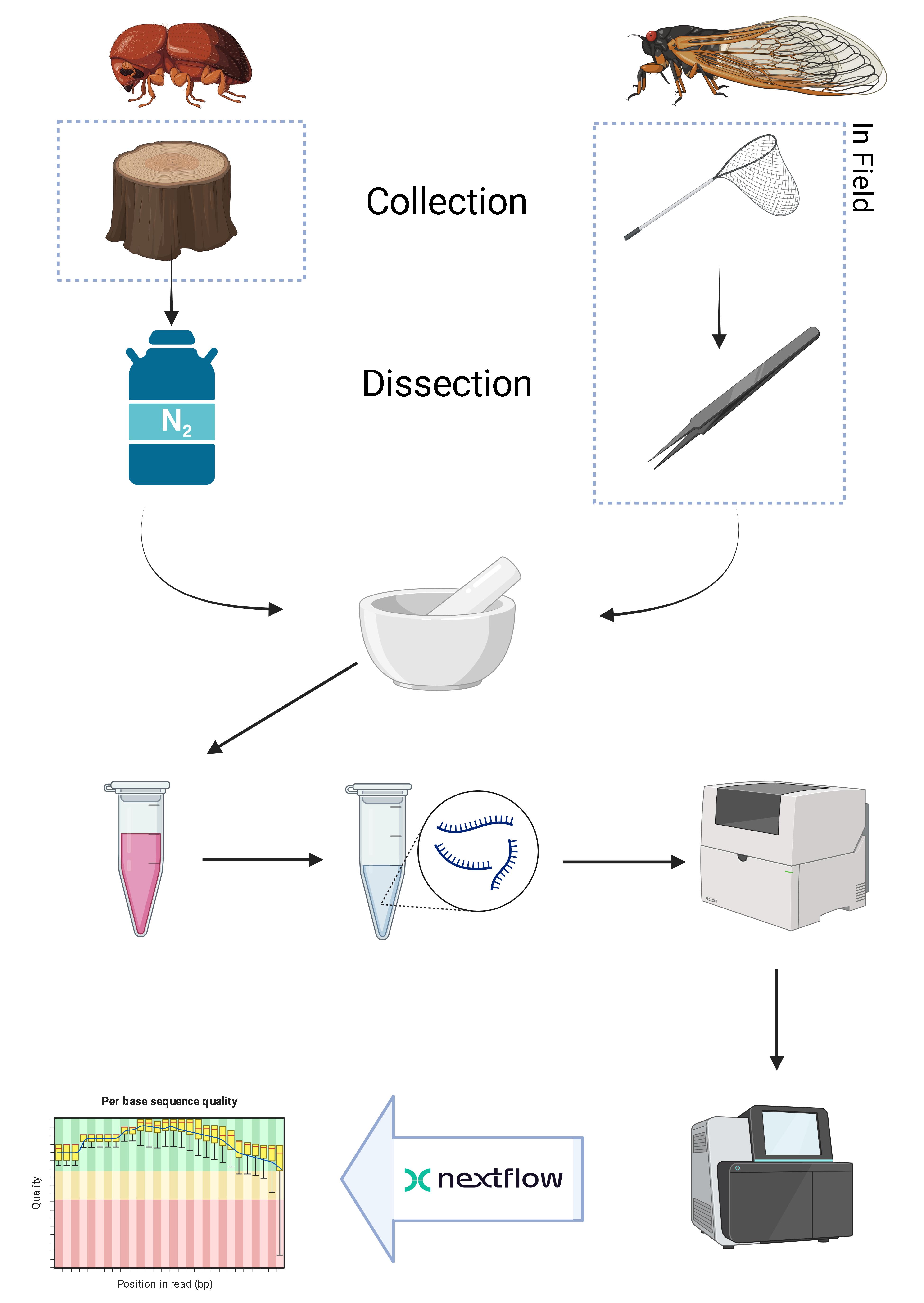
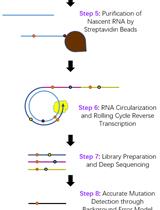
Protocol workflow. Collection methods for ambrosia beetles and cicadas are shown. Then, RNA extraction is shown in general terms: sample preparation, TRIzol extraction, and RNA purification. RNA concentration and quality are measured prior to sequencing. Samples are then analyzed in an Illumina NextSeq 2000 Sequencer. Finally, Nextflow is used to quantify data quality and downstream analysis.
Background
Insect–fungus interactions are ubiquitous in the environment and span the full range of symbiotic interactions, from obligate mutualism to obligate parasitism [1]. One end of the spectrum of symbiosis is obligate mutualism, such as fungus-farming insects, including attine ants (Hymenoptera; Formicidae; Attini), some species of termites (Blattodea; Macrotermitinae), and ambrosia beetles (Coleoptera; Scolytinae and Platypodinae) that engage in behaviors akin to agriculture [2]. Further along the spectrum are insects that still rely on fungi as nutritional sources but lack the specialization seen in the fungus-farming insects; examples of this intermediate mutualism include ship timber beetles (Coleoptera; Lymexylidea), woodwasps (Hymenoptera; Siricidae and Xiphydriidae), and gall midges (Diptera; Cecidomyiidea). Obligate parasitism falls on the opposite side of mutualism on the symbiotic spectrum and includes highly specialized fungal parasites that alter host behavior; these include Cordyceps (Ascomycota; Cordycipitaceae and Ophiocordyceps) and Entomophtora and Massospora (Entomophthoromycota) [3]. A myriad of less specialized facultative fungal pathogens infect insect hosts, making use of the fungal kingdom’s diverse enzymatic abilities to function as pathogens in a range of species. Studies of the molecular mechanisms of these symbioses can inform our understanding of ecology, evolution, and developmental biology, but as these research systems are emerging, they still lack well-established protocols that can be easily adopted and ensure reproducible results.
Determining the genetic and molecular underpinnings of emerging systems comes with a set of challenges not seen in systems with robust molecular procedures. Most insect–fungus systems cannot benefit from established protocols for extensive molecular biology–based research approaches, such as those used in studies of Tribolium and Drosophila [4], due to the range of potential community member abundance between systems. Tribolium and Drosophila have contributed greatly to the fields of developmental biology and genetics, but do not include the unique insect–fungus symbioses. Unfortunately, challenges exist in applying protocols from model systems to non-model systems due to differences in collection, sample composition and morphology, and the question of study [5].
Transcriptomic analysis through RNA sequencing, for example, can be used to determine genetic underpinnings of insect–fungus interactions by sampling at different points in the symbiosis on a temporal or morphological basis. However, insect–fungus samples of different systems will vary significantly in their relative composition of insect and fungal cells and subsequent RNA yields. Consider the following two insect–fungus interactions representing opposite ends of the symbiosis spectrum: The ambrosia beetle Euwallacea validus stores its obligate fungal mutualist Fusarium oligoseptatum in tiny pocket-like organs called mycangia within the head [6,7]. Samples are composed primarily of beetle tissue with relatively few fungal cells, which are aggregated in a discrete location. On the opposite end is the 17-year cicada Magicicada septendecim and its obligate fungal parasite, Massospora cicadina, which consumes and replaces the cicada’s abdomen with fungal spores [8,9]. The remaining “fungal plug” is mostly fungal tissue, while relatively little cicada tissue remains inside in a nonhomogeneous distribution [10].
In hopes of reducing the need for protocols individualized to each system and to promote the study of insect–fungus interactions, a standard transcriptomic analysis workflow for insect–fungus samples of varying composition has been created. These two systems described above, with opposing insect–fungus compositions, were chosen to test the applicability of this protocol across varied sample types representing extreme scenarios. We found that the compositional ratio of fungal tissue to insect tissue did not influence the experimental outcome of this protocol, as RNA extraction of both sample types yielded sufficiently high-quality material that could be sequenced, making it widely applicable across a range of insect–fungus interactions. However, we found that the proportion of transcripts recovered for each partner is dependent on its abundance in the sampled tissues (see Validation, section C).
This protocol is designed to be accessible to all scientists. Price and accessibility of materials were considered. A TRIzol extraction was chosen due to its affordability and applicability to a range of sample types over RNA extraction kits. Two means of quantification are produced. Data processing of RNASeq samples utilizes the open-source workflow and pipeline manager Nextflow [11,12]. Its community and extensive documentation allow its use by those with little to no bioinformatics background. With high accessibility and potential wide application, this protocol aims to bridge the gap of established protocols observed when comparing non-model and model systems, allowing a more effective study of insect–fungus interactions.
Materials and reagents
Biological materials
1. Foundress Euwallacea validus (wild caught: Morgantown, West Virginia, USA, June 2025)
2. Adult periodical cicadas (Magicicada spp.) with conspicuous Massospora cicadina infections (wild caught: Chicago, Illinois, USA, June 2024)
Reagents
1. Nuclease-free H2O (Fisher Bioreagents, catalog number: BP2484-50)
2. 2-propanol, ACS grade (Fisher Chemical, Fisher Scientific, catalog number: A416P-4)
3. RNA-grade ethyl alcohol 200 proof (Pharmco, catalog number: 111000200)
4. TRIzol reagent (Ambion, reference number: 15596018)
5. Chloroform–isoamyl alcohol mixture (Sigma-Aldrich, catalog number: 15593031)
6. Liquid nitrogen (N2)
a. Cold gloves (Tempshield, model: Cryo-Gloves)
b. Cryo bucket for liquid nitrogen
7. RNAlater stabilization solution (ThermoFisher, catalog number: AM7020)
Solutions
1. 70% ethanol (see Recipes)
Recipes
1. 70% ethanol
| Reagent | Final concentration | Volume |
|---|---|---|
| RNA-grade ethyl alcohol 200 proof | 70% | 70 mL |
| Nuclease-free H2O | 30% | 30 mL |
| Total | 100 mL |
Laboratory supplies
1. Supreme air fume hood (Kewaunee Scientific Corporation, model: H07_5472B00)
Note: SME Performance Rating: AI 0.10 ppm.
2. KN95 facemask (multiple manufacturers)
3. Scalpel
4. Aluminum foil
5. Mortar and pestle (cleaned and autoclaved)
Note: Mortar and pestle, 4 inches wide and 3 inches tall, was found to be ideal.
6. Zerotip pipette micro tips 1,000, 200, and 10 μL pipette tips (Biofil, catalog number: PMT371000)
7. 1,000, 200, and 10 μL pipettors (multiple manufacturers)
8. 1.5 mL microcentrifuge tubes (multiple manufacturers)
9. Illumina Stranded mRNA Prep, Ligation Kit (Illumina, catalog number: 20040532)
10. AMPure XP beads for DNA cleanup (Beckman Coulter, product number: A63880)
Note: These are required for the Illumina Stranded mRNA Prep, Ligation Kit.
Equipment
1. High-performance computing cluster
a. The following high-performance computing cluster (HPC) was used for the data analysis contained in this protocol: West Virginia University Research Computing HPC Thorny Flat [specs: 178 compute nodes, 6516 CPU cores, and 47 NVIDIA GPUs; P6000 (21), RTX 6000 (24), A100 (2)]
2. Dell OptiPlex 7060; Intel(R) Core(TM) i7-8700 CPU @ 3.20GHz (3.19 GHz), 64-bit operating system
3. Nanodrop 2000c (Thermo Fisher Scientific, catalog number: ND-2000C)
4. 4200 TapeStation System (Agilent, part number: G2991BA)
5. Microfuge 20R centrifuge (Beckman Coulter, Inc., catalog number: B31612)
6. Freezer
7. Ice and ice bucket
8. Equipment to fell a tree as needed
a. Hand saw or hatchet
b. Chainsaw
Software and datasets
Laboratory device software
1. NanoDrop Operating Software (Thermo Fischer Scientific, v1.2.1); requires registration to download: NanoDrop Product Authentication | Thermo Fisher Scientific - US (access date: 2/10/2026)
2. Tapestation Software (Agilent, v5.2); requires registration to download: Software Download TapeStation Systems | Agilent (access date: 2/10/2026)
Computer software
3. NF-Core RNASeq (Nextflow, v3.21.0); available on GitHub: https://github.com/nf-core/rnaseq.git (access date: 2/10/2026)
4. Miniconda (Anaconda Inc., v25.7.0); available at https://docs.conda.io/projects/conda/en/stable/user-guide/install/index.html (Access date: 2/10/2026)
5. Linux for Windows; Enter “wsl –install” in the terminal (Microsoft Corporation)
Note: XOS and Ubuntu are also compatible with Nextflow and miniconda.
Annotated genomes used for data analysis
Ambrosia beetle head samples:
1. Euwallacea fornicatus (abbreviated hereafter as E. forn; NCBI Genome assembly ASM4011564v1)
2. Euwallacea similis (abbreviated hereafter as E. sim; NCBI Genome assembly ESF131.1)
3. Fusarium oligoseptatum (abbreviated hereafter as F. oligo; NCBI Genome assembly NRRl62579.SpAdes)
4. Fusarium euwallacea (abbreviated hereafter as F. euw; NCBI Genome assembly ASM5061363v1)
5. Raffaelea albimanens (abbreviated hereafter as R. alb; NCBI Genome assembly ASM277824v1)
6. Raffaelea arxii (abbreviated hereafter as R. arx; NCBI Genome assembly ASM277816v1)
7. Raffaelea deltoideospora (abbreviated hereafter as R. delt; NCBI Genome assembly ASM1992538v1)
8. Raffaelea sp. RL272 (abbreviated hereafter as R. spad; NCBI Genome assembly ASM277795v1)
Cicada fungal plug samples:
1. Massospora cicadina (NCBI Genome assembly UCR_MCPNR19_1.0)
2. Magicicada septendecim (NCBI Genome assembly ASM113269v2_)
Procedure
登录/注册后免费查看全文
文章信息
稿件历史记录
提交日期: Mar 25, 2026
接收日期: May 22, 2026
在线发布日期: Jun 22, 2026
出版日期: Jul 5, 2026
版权信息
© 2026 The Author(s); This is an open access article under the CC BY-NC license (https://creativecommons.org/licenses/by-nc/4.0/).
如何引用
Laws, M., Burns, E. S., Kasson, M. T., Kijimoto, T. and Stajich, J. E. (2026). Simultaneous Transcriptomic Analysis of Both Host and Symbiont in Insect–Fungus Interactions. Bio-protocol 16(13): e5739. DOI: 10.21769/BioProtoc.5739.

 Download Citation in RIS Format
分类
生物信息学与计算生物学
分子生物学 > RNA > RNA 提取
系统生物学 > 转录组学 > RNA测序
您对这篇实验方案有问题吗?
在此处发布您的问题,我们将邀请本文作者来回答。同时,我们会将您的问题发布到Bio-protocol Exchange,以便寻求社区成员的帮助。
 发布问题
发布问题


