


Stepwise Protocol for Alternative Splicing Analysis in Single-Cell SMART-Seq2 RNA-Seq Data
单细胞 SMART-Seq2 RNA-seq 数据中可变剪接分析的分步流程

发布: 2026年06月20日第16卷第12期 DOI: 10.21769/BioProtoc.5735 浏览次数: 541
评审: Anonymous reviewer(s)
 PDF
PDF  Q&A
Q&A
参见作者原研究论文
The authors used this protocol in:

Dec 2025
Advertisement








Abstract
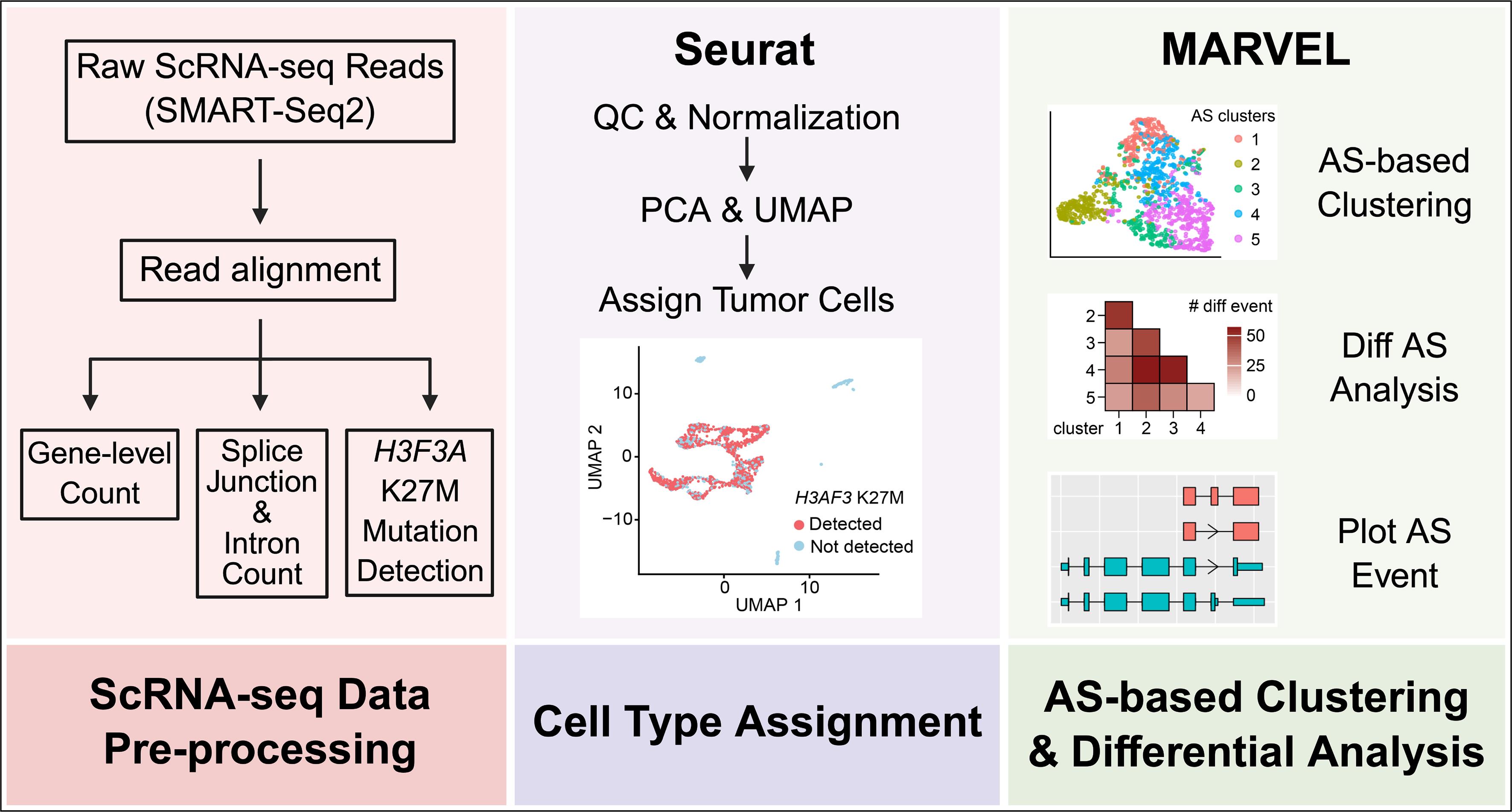
RNA alternative splicing (AS) is an essential process that expands transcriptomic and proteomic diversity in eukaryotic cells and contributes to cellular heterogeneity across physiological and pathological conditions in humans. With the advent of single-cell RNA sequencing (scRNA-seq), it has become possible to study AS at cellular resolution, although robust and standardized analytical workflows remain to be developed. Here, we present a stepwise protocol for analyzing AS in single cells from pediatric high-grade gliomas (pHGGs) harboring the histone H3.3 lysine 27-to-methionine (H3.3K27M) mutation using SMART-Seq2 scRNA-seq data. Starting from raw sequencing reads, the workflow includes read alignment, gene-level quantification, splice junction and intron quantification, and single-nucleotide variant-based mutation detection. Gene expression–based clustering and cell-type annotation are performed by using the Seurat R package. AS analysis in tumor cells is then conducted using the MARVEL R package in combination with customized scripts to calculate percent spliced-in (PSI) values, identify variable AS events, perform dimensionality reduction, cluster cells, conduct differential AS analysis, and visualize splicing patterns. This protocol provides a reproducible and comprehensive framework for dissecting AS dynamics at single-cell resolution. It is readily adaptable to other SMART-Seq2 datasets and facilitates systematic investigation of splicing heterogeneity in diverse biological contexts.
Key features
• Protocol for single-cell RNA alternative splicing (AS) analysis in pediatric high-grade gliomas (pHGGs) with H3.3K27M mutation using SMART-Seq2 data.
• Integrates gene expression–based clustering and genetic mutation to identify tumor populations.
• MARVEL plus custom scripts enable PSI computation, variable AS detection, clustering, differential splicing analysis, and visualization of splicing patterns.
• Flexible workflow applicable to other full-length scRNA-seq datasets for studying AS dynamics in cancer and development.
Keywords: Single-cell RNA sequencing (单细胞 RNA 测序) Alternative splicing (可变剪接)
Pediatric high-grade glioma (儿童高级别胶质瘤)
H3.3K27M mutation (H3.3K27M 突变)
SMART-Seq2 (SMART-Seq2)
MARVEL (MARVEL)
Alternative splicing (可变剪接)
Pediatric high-grade glioma (儿童高级别胶质瘤)
H3.3K27M mutation (H3.3K27M 突变)
SMART-Seq2 (SMART-Seq2)
MARVEL (MARVEL)
Graphical overview
Background
RNA alternative splicing (AS) is a fundamental regulatory mechanism in eukaryotic cells that expands transcriptomic and proteomic diversity by generating multiple RNA transcripts and protein isoforms from a single gene through differential exon usage [1]. This process plays critical roles in cell fate specification, tissue development, and the regulation of cellular states, and its dysregulation has been implicated in numerous diseases, including neurological disorders and cancer [2,3]. Understanding AS at single-cell resolution is therefore essential for dissecting cellular heterogeneity and dynamic state transitions in complex biological systems.
Advances in single-cell RNA sequencing (scRNA-seq) technologies have enabled transcriptome-wide profiling of individual cells; however, most widely used platforms, such as droplet-based methods [4,5], are limited in their ability to accurately quantify full-length transcripts and splice isoforms. Full-length scRNA-seq protocols such as SMART-Seq2 [6] enable accurate detection of splice junctions and isoform usage, providing a strong foundation for AS analysis at single-cell resolution [7]. Computational tools such as MARVEL [8] facilitate quantification and downstream analysis of splicing events, including calculation of percent spliced-in (PSI) values, differential AS analysis, and dimensionality reduction methods such as principal component analysis (PCA) and uniform manifold approximation and projection (UMAP). While MARVEL provides a robust framework for AS quantification in single-cell RNA-seq data, it has relatively limited built-in support for further downstream analyses, such as filtering AS events, clustering cells using AS features, and visualization of specific AS events. As a result, constructing a reproducible, end-to-end workflow from raw sequencing data to integrated biological interpretation remains challenging.
This protocol provides a comprehensive and stepwise workflow for analyzing AS using SMART-Seq2 scRNA-seq data, integrating gene expression and splicing analyses within a unified framework. Starting from raw sequencing reads, the pipeline includes read alignment, gene and splice junction quantification, mutation detection, and gene expression–based clustering and annotation. AS analysis is then performed using MARVEL in combination with customized steps to calculate PSI values, identify variable AS events, perform dimensionality reduction, cluster cells based on AS features, and conduct differential splicing analysis. This workflow emphasizes reproducibility, flexibility, and compatibility with standard single-cell analysis pipelines.
While this protocol is demonstrated in the context of pediatric high-grade glioma (pHGG) with H3.3K27M mutation, it is broadly applicable to other biological systems where full-length scRNA-seq data are available. It can be adapted to study AS dynamics in normal development, disease progression, and treatment response, and may be extended to investigate splicing regulation, isoform-specific functions, and interactions with genetic or epigenetic alterations.
Equipment
A personal computer or access to a high-performance computing (HPC) cluster is required.
Software and datasets
1. Raw FASTQ files of H3.3K27M glioma scRNA-seq dataset (https://duos.broadinstitute.org/dataset/DUOS-000107), free, application required for access
2. Codes, processed data, and analysis outputs from this protocol (https://zenodo.org/records/20213707), v2, free
3. STAR (https://github.com/alexdobin/STAR?tab=readme-ov-file), 2.7.9a, free
4. Samtools (https://www.htslib.org/), 1.6, free
5. HTSeq-count (https://htseq.readthedocs.io/en/latest/htseqcount.html), 2.0.9, free
6. Bedtools (https://bedtools.readthedocs.io/en/latest/), 2.30.0, free
7. RSEM (https://github.com/deweylab/RSEM), 1.3.3, free
8. Monovar (https://github.com/KChen-lab/MonoVar, python 2 required), NA, free
9. Python (https://www.python.org/), 2.7.5, free
10. R (https://www.r-project.org/), 4.4.0, free
11. R package Seurat (https://satijalab.org/seurat/), 5.4.0, free
12. R package MARVEL (https://github.com/wenweixiong/MARVEL), 2.0.5, free
13. R package dplyr (https://dplyr.tidyverse.org/), 1.2.0, free
14. R package kernlab (https://github.com/cran/kernlab), 0.9-33, free
15. R package tidyverse (https://tidyverse.org/packages/), 2.0.0, free
16. R package ggplot2 (https://ggplot2.tidyverse.org/), 4.0.2, free
17. R package patchwork (https://patchwork.data-imaginist.com/), 1.3.2, free
18. R package ggtranscript (https://github.com/dzhang32/ggtranscript), 1.0.0, free
19. R package gghalves (https://github.com/erocoar/gghalves), 0.1.4, free
Procedure
登录/注册后免费查看全文
文章信息
稿件历史记录
提交日期: Mar 30, 2026
接收日期: May 25, 2026
在线发布日期: Jun 3, 2026
出版日期: Jun 20, 2026
版权信息
© 2026 The Author(s); This is an open access article under the CC BY-NC license (https://creativecommons.org/licenses/by-nc/4.0/).
如何引用
Walker, M. N., Hu, B., Cheng, S. and Song, X. (2026). Stepwise Protocol for Alternative Splicing Analysis in Single-Cell SMART-Seq2 RNA-Seq Data. Bio-protocol 16(12): e5735. DOI: 10.21769/BioProtoc.5735.

 Download Citation in RIS Format
分类
生物信息学与计算生物学
分子生物学 > RNA > RNA 剪接
系统生物学 > 转录组学 > RNA测序
您对这篇实验方案有问题吗?
在此处发布您的问题,我们将邀请本文作者来回答。同时,我们会将您的问题发布到Bio-protocol Exchange,以便寻求社区成员的帮助。
 发布问题
发布问题


