


A Dual-gRNA CRISPR/Cas9 System for Efficient Generation of Large Fragment Deletions in Poplar
一种用于在杨树中高效构建大片段缺失的双 gRNA CRISPR/Cas9 系统

发布: 2026年07月05日第16卷第13期 DOI: 10.21769/BioProtoc.5734 浏览次数: 338
评审: Deepti M NambiarKishwar Jahan ShethiAnonymous reviewer(s)
 PDF
PDF  Q&A
Q&A
Advertisement






Abstract
CRISPR/Cas9-based genome editing is a powerful approach for functional genomics and bioenergy research in woody plants. However, conventional single guide RNA (gRNA) strategies predominantly generate small insertions or deletions that may not fully disrupt gene function and often require extensive sequencing for mutation identification. Here, we present an optimized protocol for the efficient generation of large-fragment deletion mutants in Populus tremula × P. alba clone INRA 717-1B4 using a dual-gRNA CRISPR/Cas9 system. Co-expression of two gRNAs flanking the target region induces double-strand breaks at both sites, enabling the deletion of the intervening genomic fragment, typically larger than 50 bp. This protocol describes step-by-step procedures for gRNA design, vector construction, Agrobacterium-mediated transformation, plant regeneration, and molecular validation. Using the PtFBX230 gene as a representative target, large deletions are readily identified by conventional PCR and agarose gel electrophoresis, enabling rapid and cost-effective genotyping. This protocol can be readily adopted to other loci in poplar and related woody species and provides a robust framework for generating null alleles to support functional genomics and bioenergy-related trait engineering in woody plants.
Key features
• Enables efficient deletion of large genomic fragments (>50 bp) using a dual-gRNA CRISPR/Cas9 strategy.
• Optimized for the hybrid poplar (Populus tremula × P. alba clone INRA 717-1B4) using the pORE303N vector system.
• Compatible with Agrobacterium-mediated transformation and tissue culture–based regeneration.
• Simplifies mutant screening through PCR-based genotyping, minimizing reliance on sequencing.
• Facilitates simultaneous editing of homologous genes in bioenergy-relevant poplar lines.
Keywords: CRISPR/Cas9 (CRISPR/Cas9) Genome editing (基因组编辑)
Dual-gRNA strategy (双 gRNA 策略)
PtFBX230 (PtFBX230)
Populus tremula × P. alba INRA 717-1B4 (欧洲山杨 × 银白杨 INRA 717-1B4)
Bioenergy crop (生物能源作物)
Genome editing (基因组编辑)
Dual-gRNA strategy (双 gRNA 策略)
PtFBX230 (PtFBX230)
Populus tremula × P. alba INRA 717-1B4 (欧洲山杨 × 银白杨 INRA 717-1B4)
Bioenergy crop (生物能源作物)
Graphical overview
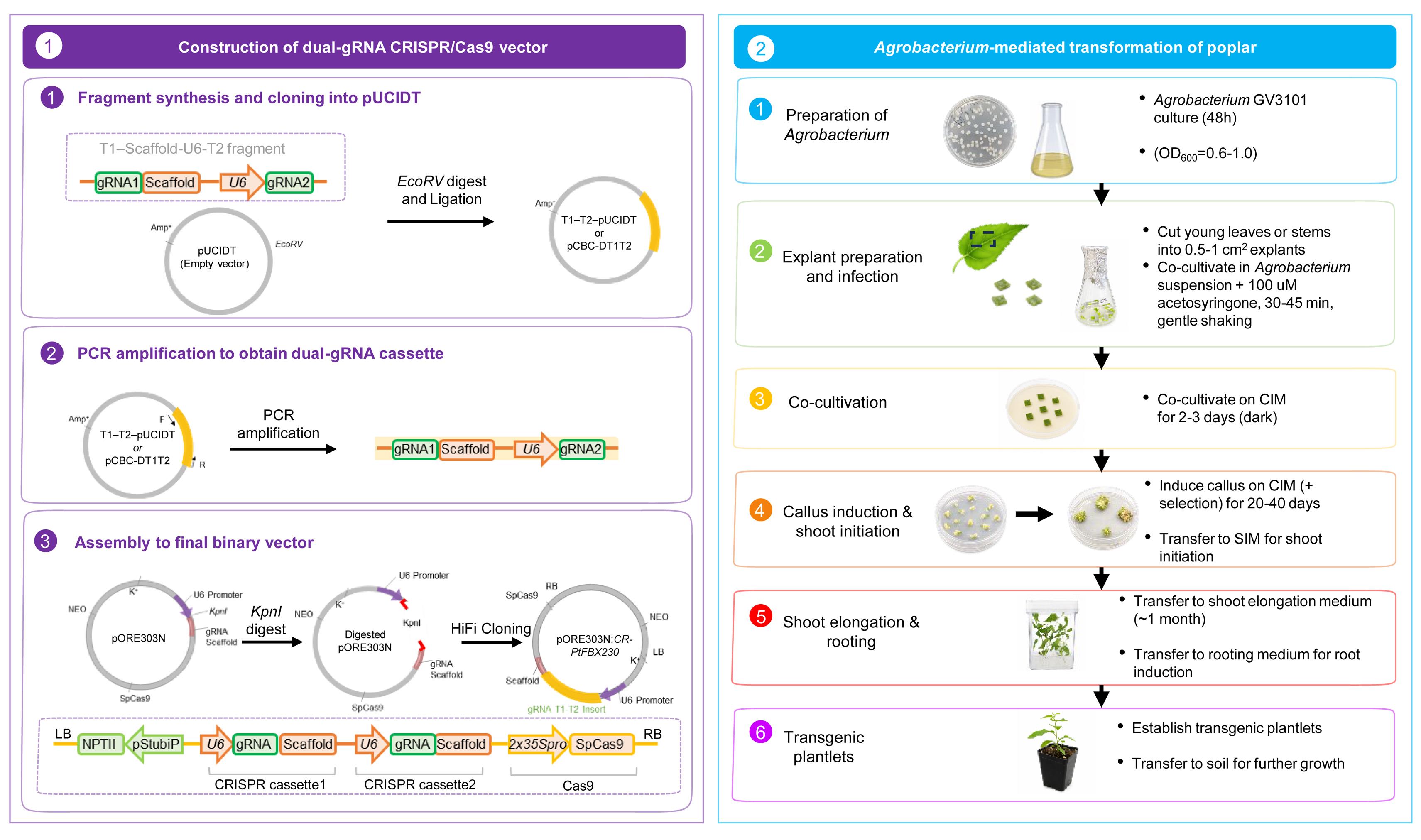
Dual-gRNA CRISPR/Cas9 vector construction and Agrobacterium-mediated transformation of hybrid poplar. CIM, callus-inducing medium; SIM, shoot-inducing medium.
Background
Trees in the genus Populus are among the most widely distributed woody plants in North America, Asia, and Europe and have become important model species for bioenergy research, particularly for studies of lignin biosynthesis, secondary cell wall formation, and biomass conversion [1,2]. Owing to their fast growth, ease of vegetative propagation, and extensive genomic resources, hybrid poplars such as Populus tremula × P. alba INRA 717-1B4 are widely used as feedstock models for engineering lignocellulosic biomass traits relevant to advanced biofuels and bioproducts [3–6].
The availability of high-quality genome assemblies and transcriptome datasets has greatly facilitated functional genomics in poplar [7–9]. However, stable genetic analysis in woody plants remains technically challenging because transformation and regeneration are time-consuming, and primary transgenic plants frequently exhibit chimeric editing events [10]. Therefore, efficient and reliable strategies for generating stable loss-of-function mutants are essential for both basic research and bioenergy-related trait engineering in poplar.
CRISPR/Cas9 technology has enabled targeted genome editing in multiple Populus species and genotypes [11–14]. Most reported poplar genome-editing studies rely on single guide RNA (gRNA) design, which predominantly generates small insertions or deletions (indels) [15]. Such small indels may not fully disrupt gene function and often require extensive Sanger or amplicon sequencing for reliable identification of the mutations. In addition, gRNA activity can be influenced by chromatin context, single-nucleotide polymorphisms (SNPs), and sequence features, making it difficult to predict editing efficiency prior to stable transformation [15,16].
Dual-gRNA CRISPR/Cas9 strategy provides an effective alternative by inducing two double-strand breaks flanking a target region, resulting in excision of the intervening genomic fragment [17,18]. This approach increases the likelihood of generating complete loss-of-function alleles and enables straightforward identification of edited lines by conventional PCR based on amplicon size shifts. In the context of woody plants, such PCR-detectable large-fragment deletions (larger than 50 bp) are particularly advantageous because they reduce the reliance on extensive sequencing and simplify screening of large numbers of regenerated lines.
The plant F-box proteins function as structural components of SCF (SKP1–Cullin–F-box) E3 ubiquitin ligase complex and are responsible for substrate recognition. They play central roles in phytohormone signaling, stress responses, and proteolytic regulation of secondary metabolism [19]. Many F-box genes belong to large gene families with partial functional redundancy. In this context, single-gRNA-induced small indels may not always yield definitive null alleles, necessitating additional strategies to ensure complete functional disruption. PtFBX230 (Potri.018G090800), a representative member of this gene family, is a homolog of the previously identified Arabidopsis F-box genes AtKFB01, AtKFB20, AtKFB39, and AtKFB50, which encode kelch domain–containing F-box proteins that mediate selective ubiquitination and degradation of the rate-limiting enzyme phenylalanine ammonia-lyase in the phenylpropanoid–lignin biosynthetic pathway, thus serving as proteolytic regulators of cell wall lignification [20,21]. As such, PtFBX230 was selected as a validation target in this protocol. This choice enables a demonstration of the utility and efficiency of dual gRNA-mediated large-fragment deletions for generating null alleles pertaining to secondary cell wall lignification in poplar.
Although the dual-gRNA approach has been applied in several other plant species [17,22], a standardized protocol optimized for Populus species is still lacking. Here, we describe a robust step-by-step protocol for generating large-fragment deletion mutants in P. tremula × P. alba INRA 717-1B4 using a dual-gRNA CRISPR/Cas9 system. The protocol integrates optimized gRNA design, efficient vector assembly, Agrobacterium-mediated transformation, tissue culture–based regeneration, and PCR-based molecular validation. This workflow provides a practical and scalable framework for generating stable large-deletion mutants to support functional genomics and bioenergy-related trait engineering in poplar and related woody species.
Materials and reagents
Biological materials
1. Populus tremula × P. alba clone INRA 717-1B4
Note: The hybrid poplar plant was originally from Institut National de la Recherche Agronomique (INRA), France; the in vitro plantlets are maintained in the laboratory.
2. Agrobacterium tumefaciens strain GV3101(GoldBio, catalog number: CC-207-5x50)
3. Escherichia coli DH5α competent cells (Thermo Scientific, catalog number: 18265017)
Sequences of gene editing targets
Target 1: positions 306–328 of PtFBX230 (+ strand): AATAAGAAGATGCCTCGAAG (PAM: AGG)
Target 2: positions 469–491 of PtFBX230 (+ strand): ATTGATCTAGGTCCCGTGCC (PAM: TGG)
Plasmids
1. T1–T2–pUCIDT: plasmid synthesized by Integrated DNA Technologies (IDT), containing the designed dual-gRNAs targeting PtFBX230, in which gRNA2 is driven by the Medicago truncatula U6 promoter (Figure S1A)
2. pCBC-DT1T2: plasmid containing a gRNA scaffold and the Arabidopsis thaliana U6 promoter that drives gRNA2 (Addgene, plasmid #50590 [23]) (Figure S1B)
3. pORE303N: Binary CRISPR/Cas9 vector compatible with poplar transformation (Addgene, plasmid #194438 [16,24]) (Figure S1C)
PCR primers for dual-gRNA insert amplification
PtFBX230_Sg_PORE_F: caagcgaaccagtaggcttGAATAAGAAGATGCCTCGAAGgttttagagctagaaatag
PtFBX230_Sg_PORE_R: ctatttctagctctaaaacGGCACGGGACCTAGATCAATCaagcctactggttcgcttg (T1-T2-pUCIDT as template).
PtFBX230_DT1_PORE_F: caagcgaaccagtaggcttGAATAAGAAGATGCCTCGAAGgttttagagctagaaatag
PtFBX230_DT2_PORE_R: ctatttctagctctaaaacGGCACGGGACCTAGATCAATCaatctcttagtcgactct (pCBC-DT1T2 as template).
Colony PCR primers
mtu6end_PORE_F: CTTCAAGCGAACCAGTAGGCTT
2×35Shyb_PORE_R: CTCCACCATGTTCACATCAATC
Construct sequencing primer
pStubiP_F: AGATCAAGATATATGCCCTTTTCCT
CRISPR genotyping primers
(300–600 bp upstream of gRNA1 and downstream of gRNA2)
PtFBX230CR-iden-F: GGTTGTCATTGATTATTGGCTATT
PtFBX230CR-iden-R: TCCCTTGGAGTCAAACGTGAA
Cas9 genotyping primer
SpCas9_F: ACTGCTGGGCATCACAATCA
SpCas9_R: TTATCGAGGTTAGCGTCGGC
Reagents
1. NEBuilder HiFi DNA Assembly Master Mix (New England Biolabs, catalog number: E2621L) (store at -20 °C)
2. KpnI-HF (New England Biolabs, catalog number: R3142) (store at -20 °C)
3. Luria-Bertani (LB) medium (Sigma, catalog number: L3522)
4. Murashige and Skoog (MS) basal medium (Sigma, catalog number: M5519) (store at 4 °C)
5. Sucrose (Sigma, catalog number: S5016)
6. L-glutamine (Sigma, catalog number: 68540)
7. 2-(N-Morpholino)ethanesulfonic acid (MES) (Sigma, catalog number: 69892)
8. Myo-inositol (Sigma, catalog number: I3011)
9. D-(+)-Galactose (Sigma, catalog number: G5388)
10. Agar/Phytol Gel (Sigma, catalog number: A1296)
11. Plant growth regulators:
a. 2-isopentenyladenine (2-IP) (Sigma, catalog number: D7660) (store at -20 °C)
b. 1-naphthaleneacetic acid (NAA) (Sigma, catalog number: 317918) (store at -20 °C)
c. 6-benzylaminopurine (BAP) (Sigma, catalog number: B3274) (store at -20 °C)
d. Indole-3-butyric acid (IBA) (Sigma, catalog number: 57310) (store at -20 °C)
e. Thidiazuron (TDZ) (Sigma, catalog number: P6186) (store at -20 °C)
12. Antibiotics for plant selection:
a. Kanamycin (GoldBio, catalog number: K-120-25, 50–100 mg/L) (store at -20 °C)
b. Cefotaxime (GoldBio, catalog number: C-104-25, 300–400 mg/L) (store at -20 °C)
c. Timentin (GoldBio, catalog number: T-104-25, 200–300 mg/L) (store at -20 °C)
13. Antibiotics for bacterial and Agrobacterium selection:
a. Gentamicin (GoldBio, catalog number: G-400-1) (store at -20 °C)
b. Ampicillin (GoldBio, catalog number: A-301-5) (store at -20 °C)
c. Spectinomycin (GoldBio, catalog number: S-140-5) (store at -20 °C)
d. Chloramphenicol (GoldBio, catalog number: C-105-5) (store at -20 °C)
e. Rifampicin (GoldBio, catalog number: R-120-1) (store at -20 °C)
Additional reagents
1. Acetosyringone (Sigma, catalog number: AMBH303C5EEB)
2. Cetyltrimethylammonium bromide (CTAB) (Sigma, catalog number: H9151)
3. Phusion High-fidelity DNA polymerase (Thermo Scientific, catalog number: F530) (store at -20 °C)
4. Agarose (Sigma, catalog number: A9539-500G)
5. DNA ladders (Thermo Scientific, catalog number: 10488085)
6. DNA gel staining dye (APExBIO, catalog number: A8743)
7. Ascorbic acid (MG Scientific, catalog number: MAL4407)
Kits
1. Zymoclean Gel DNA Recovery kit (Zymo Research, catalog number: D4002)
2. GeneJET Plasmid Miniprep kit (Thermo Scientific, catalog number: K0502)
Solutions
1. Agrobacterium induction medium (see Recipes)
2. Wash solution (see Recipes)
3. Callus induction medium (see Recipes)
4. Shoot induction medium (see Recipes)
5. Rooting medium (see Recipes)
Recipes
1. Agrobacterium induction medium
MS basal salts: 2.15 g/L
MES: 0.25 g/L
L-glutamine: 0.2 g/L
Myo-inositol: 0.05g/L
D-galactose: 1.8g/L
Ascorbic acid (VC): 250 mg/L
Adjust pH to 5.0 with sodium hydroxide (NaOH) before autoclaving at 121 °C for 20 min.
2. Wash solution
MS basal salts: 2.15 g/L
Thiamine: 40 mg/L
Ascorbic acid (VC): 250 mg/L
NAA: 10 μM
2-IP: 5 μM
BAP: 12.5 μg/L
Adjust pH to 5.8 with NaOH before autoclaving (121 °C, 20 min).
Antibiotics are filter-sterilized and added after the medium cools to ~60 °C, followed by thorough mixing.
3. Callus induction medium
MS basal salts: 4.3 g/L
Sucrose: 30 g/L
L-glutamine: 0.2 g/L
MES: 0.25 g/L
Myo-inositol: 0.1 g/L
NAA: 10 μM
2-IP: 5 μM
Kanamycin: 100–150 mg/L
Timentin: 100 mg/L
Cefotaxime: 300–350 mg/L
Agar 6 g/L
Adjust pH to 5.8 with NaOH before autoclaving (121 °C, 20 min).
4. Shoot induction medium
MS basal salts: 4.3 g/L
Sucrose: 25 g/L
L-glutamine: 0.2 g/L
MES: 0.25 g/L
Myo-inositol: 0.1 g/L
TDZ: 0.2 μM
Kanamycin: 100–150 mg/L
Timentin: 100 mg/L
Cefotaxime: 300 mg/L
Agar: 7 g/L
Adjust pH to 5.8–6.0 with NaOH (121 °C, 20 min).
5. Rooting medium
MS basal salts: 2.15 g/L
Sucrose: 15 g/L
IBA: 0.5 μM
Kanamycin: 50–100 mg/L
Timentin: 100 mg/L
Agar: 7.5 g/L
Adjust pH to 5.8–6.0 with NaOH (121 °C, 20 min).
Equipment
1. Laminar flow hood (Baker, model: SterilGARD e3)
2. Plant growth chamber (Percival Scientific, model: CU-36L5) with programmable light (16 h light/8 h dark) and temperature (22–25 °C)
3. Orbital shaker incubator (New Brunswick Scientific, model: Innova 44)
4. Benchtop centrifuge (Eppendorf, model: 5810 R)
5. Spectrophotometer (Thermo Fisher Scientific, model: NanoDrop One)
6. Analytical balance (Mettler Toledo, model: ME204T)
7. pH meter (Fisher Scientific, model: Accumet AB 15)
8. Autoclave (Buxton, model: 9400)
9. Gel Documentation System (analytik-jena, MultiDoc-It)
10. Thermal Cycler (for PCR verification) (Bio-Rad, model: C1000)
Surgical tools and tissue culture vessels
1. Forceps (Fine Science Tools, catalog number: 11000-12)
2. Scalpel handles and blades (Feather, size #11)
3. Magenta boxes (Sigma-Aldrich, catalog number: V8505)
4. Petri dishes (100 mm × 15 mm and 100 mm × 25 mm) (Sigma, catalog numbers: P5731 and Z358762)
5. Filter paper (Whatman, catalog number: 1001-090) and conical flasks (150 mL)
Software and datasets
1. CRISPR-P v2.0 (http://crispr.hzau.edu.cn/CRISPR2)
2. CHOPCHOP (https://chopchop.cbu.uib.no/)
3. Cas-OFFinder (http://www.rgenome.net/cas-offinder/)
4. Phytozome (https://phytozome-next.jgi.doe.gov/)
5. Primer3 (https://primer3.ut.ee/)
Procedure
登录/注册后免费查看全文
文章信息
稿件历史记录
提交日期: Mar 2, 2026
接收日期: May 14, 2026
在线发布日期: Jun 9, 2026
出版日期: Jul 5, 2026
版权信息
© 2026 The Author(s); This is an open access article under the CC BY-NC license (https://creativecommons.org/licenses/by-nc/4.0/).
如何引用
Yang, G., Yu, Y., Vulavala, V. K. R., Dwivedi, N. and Liu, C. (2026). A Dual-gRNA CRISPR/Cas9 System for Efficient Generation of Large Fragment Deletions in Poplar. Bio-protocol 16(13): e5734. DOI: 10.21769/BioProtoc.5734.

 Download Citation in RIS Format
分类
植物科学 > 植物分子生物学 > DNA > 诱/突变
分子生物学 > DNA > 诱/突变
植物科学 > 植物转化 > 农杆菌介导的转化方法
您对这篇实验方案有问题吗?
在此处发布您的问题,我们将邀请本文作者来回答。同时,我们会将您的问题发布到Bio-protocol Exchange,以便寻求社区成员的帮助。
 发布问题
发布问题


