


Tracking AC Electric Stimulation–Induced Persistent Locomotion Behavior in the Nematode Caenorhabditis elegans
追踪交流电刺激诱导的秀丽隐杆线虫持续性运动行为

发布: 2026年07月05日第16卷第13期 DOI: 10.21769/BioProtoc.5733 浏览次数: 222
评审: Athanas GuzhaAnonymous reviewer(s)
 PDF
PDF  Q&A
Q&A
参见作者原研究论文
The authors used this protocol in:
Oct 2023
Advertisement





Abstract
Persistent neural activity underlies fundamental brain functions such as memory, decision-making, and emotion. Despite its importance, experimental paradigms that enable quantitative analysis of persistent behavioral responses remain limited. Here, we describe a protocol to induce and measure a persistent locomotor response by applying a brief alternating current (AC) electric stimulus to the nematode Caenorhabditis elegans. This method reliably evokes a prolonged increase in locomotion speed that persists for minutes after stimulus termination and can be quantified by video tracking. Because C. elegans has a fully mapped connectome and is amenable to genetic and neurophysiological manipulation, this protocol provides a useful platform for dissecting the molecular and neural mechanisms underlying persistent behavioral responses. Electrically induced persistent locomotion serves as a simple, robust, and quantifiable behavioral readout for studying the regulation of neural persistence in vivo.
Key features
• A brief AC electric stimulus reliably induces a persistent locomotor response in C. elegans.
• The assay uses a simple setup and provides reproducible behavioral data.
• Video-tracking analysis enables quantitative measurement of locomotion speed and response persistence.
• This protocol enables quantitative comparisons and analyses of behavioral changes evoked by stimulus characteristics and/or genetic mutations.
Keywords: C. elegans (秀丽隐杆线虫) AC electric stimulation (交流电刺激)
Persistent behavior (持续性行为)
Video tracking (视频追踪)
Genetic analysis (遗传分析)
AC electric stimulation (交流电刺激)
Persistent behavior (持续性行为)
Video tracking (视频追踪)
Genetic analysis (遗传分析)
Graphical overview
Background
The nervous system not only responds transiently to external stimuli but can maintain activity after stimulus termination. Such persistent neural activity is thought to underlie fundamental brain functions, including memory, decision-making, and emotion [1,2]. At the behavioral level, this neural persistence can be observed as sustained changes in locomotion or other responses following brief stimulation. Quantitative analysis of these persistent behaviors provides an important entry point for investigating the neural mechanisms supporting persistent brain states. However, experimental paradigms that reliably and quantitatively induce persistent behavioral responses remain limited.
The nematode Caenorhabditis elegans is a powerful model organism for analyzing neural mechanisms due to its fully mapped connectome and genetic accessibility [3]. Well-established behavioral assays in C. elegans, such as chemotaxis and thermotaxis, have been widely used to study sensory-driven locomotor responses [4]. However, these paradigms typically rely on continuous or long-lasting external stimuli, making it difficult to untangle whether the observed behavioral persistence reflects intrinsic neural mechanisms or is simply maintained by ongoing stimulation. In contrast, a brief alternating current (AC) electric stimulation provides a simple and highly reproducible method to deliver precisely controlled stimuli [5].
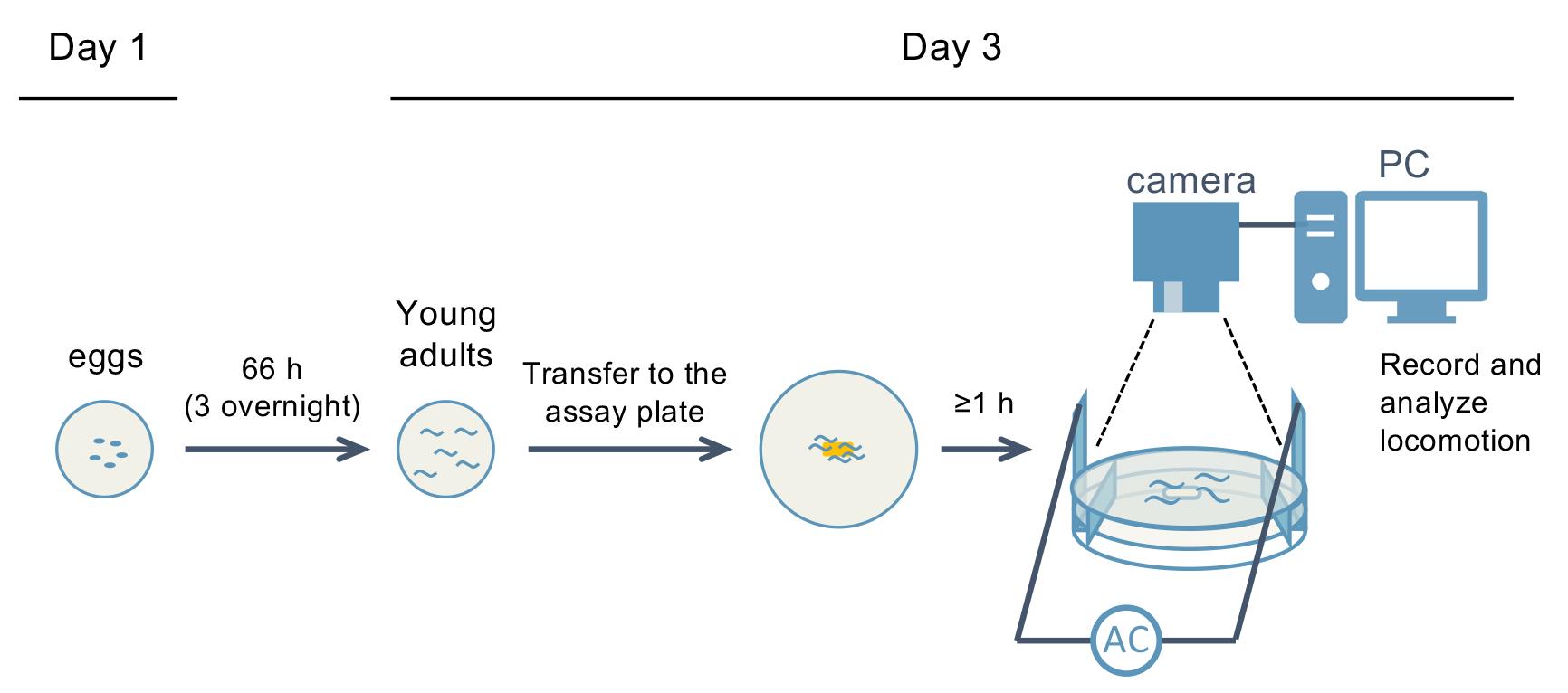
In this protocol, we describe a method to induce persistent locomotor behavior in C. elegans using a brief AC electric stimulus and to quantitatively analyze its temporal dynamics. This assay provides behavioral data with high reproducibility and offers a platform for investigating the regulation of persistent behavioral states.
Materials and reagents
Biological materials
1. Caenorhabditis elegans wild-type strain N2 (Caenorhabditis Genetics Center)
2. Escherichia coli OP50 (Caenorhabditis Genetics Center)
Reagents
1. NaCl (FUJIFILM Wako, catalog number: 191-01665)
2. BactoTM Peptone (Gibco, catalog number: 211677)
3. Agar (FUJIFILM Wako, catalog number: 010-08725)
4. Cholesterol (FUJIFILM Wako, catalog number: 034-03002)
5. Ethanol (99.5%) (FUJIFILM Wako, catalog number: 057-00456)
6. CaCl2·2H2O (FUJIFILM Wako, catalog number: 038-12775)
7. MgSO4·7H2O (FUJIFILM Wako, catalog number: 131-00405)
8. KH2PO4 (FUJIFILM Wako, catalog number: 169-04245)
9. K2HPO4 (FUJIFILM Wako, catalog number: 164-04295)
10. Streptomycin sulfate (FUJIFILM Wako, catalog number: 194-08512)
11. LB broth powder (BD, catalog number: 244620)
Solutions
1. Assay plate (see Recipes)
2. Nematode growth media (NGM) buffer (see Recipes)
3. 0.5% cholesterol (see Recipes)
4. 1 M CaCl2 (see Recipes)
5. 1 M MgSO4 (see Recipes)
6. 1 M KPO4 buffer (pH 6.0) (see Recipes)
7. 10 mg/mL streptomycin solution (see Recipes)
8. LB liquid medium (see Recipes)
Recipes
1. Assay plate
| Reagent | Final concentration | Quantity or volume |
|---|---|---|
| NaCl | 3 g/L | 1.5 g |
| Bacto peptone | 2.5 g/L | 1.25 g |
| Agar | 17 g/L | 8.5 g |
| 0.5% cholesterol | 5 μg/mL | 0.5 mL |
| CaCl2 (1 M) | 1 mM | 0.5 mL |
| MgSO4 (1 M) | 1 mM | 0.5 mL |
| KPO4 buffer (1 M, pH 6.0) | 25 mM | 12.5 mL |
| dH2O | — | up to 500 mL |
| Total | n/a | 500 mL |
Prepare the assay plates 2–3 days before the assay.
Mix dH2O, NaCl, Bacto peptone, agar, and 0.5% cholesterol, autoclave the mixture, and allow it to cool to 50 °C. After cooling, add CaCl2, MgSO4, and KPO4 buffer and mix thoroughly on a hot magnetic stirrer. Dispense 16 mL of the medium into each 90 mm Petri dish. Store at room temperature.
2. NGM buffer
| Reagent | Final concentration | Quantity or volume |
|---|---|---|
| NaCl | 3 g/L | 0.3 g |
| Bacto peptone | 2.5 g/L | 0.25 g |
| 0.5% cholesterol | 5 μg/mL | 0.1 mL |
| CaCl2 (1 M) | 1 mM | 0.1 mL |
| MgSO4 (1 M) | 1 mM | 0.1 mL |
| KPO4 buffer (1 M, pH 6.0) | 25 mM | 2.5 mL |
| dH2O | — | up to 100 mL |
| Total | n/a | 100 mL |
Mix dH2O, NaCl, Bacto peptone, and 0.5% cholesterol, autoclave the mixture, and allow it to cool to room temperature. After cooling, add CaCl2, MgSO4, and KPO4 buffer and mix thoroughly. Dispense 10 mL aliquots into sterile 15 mL tubes and store at -20 °C.
3. 0.5% cholesterol
| Reagent | Final concentration | Quantity or volume |
|---|---|---|
| Cholesterol | 0.5% | 0.5 g |
| EtOH (99.5%) | — | 100 mL |
| Total | n/a | 100 mL |
Mix EtOH and cholesterol in a 100 mL bottle and dissolve completely with stirring. Store at room temperature.
4. 1 M CaCl2
| Reagent | Final concentration | Quantity or volume |
|---|---|---|
| CaCl2·2H2O | 1 M | 14.70 g |
| dH2O | — | up to 100 mL |
| Total | n/a | 100 mL |
Mix dH2O and CaCl2·2H2O, autoclave the mixture, and allow it to cool to room temperature. After cooling, store at room temperature.
5. 1 M MgSO4
| Reagent | Final concentration | Quantity or volume |
|---|---|---|
| MgSO4·7H2O | 1 M | 24.64 g |
| dH2O | — | up to 100 mL |
| Total | n/a | 100 mL |
Mix dH2O and MgSO4·7H2O, autoclave the mixture, and allow it to cool to room temperature. After cooling, store at room temperature.
6. 1 M KPO4 buffer
| Reagent | Final concentration | Quantity or volume |
|---|---|---|
| KH2PO4 | 0.80 M | 108.3 g |
| K2HPO4 | 0.20 M | 35.6 g |
| dH2O | — | up to 1 L |
| Total | 1 M | 1 L |
Mix dH2O, KH2PO4, and K2HPO4, autoclave the mixture, and allow it to cool to room temperature. After cooling, store at room temperature.
7. 10 mg/mL streptomycin solution
| Reagent | Final concentration | Quantity or volume |
|---|---|---|
| Streptomycin sulfate | n/a | 10 mg |
| dH2O | — | 1 mL |
Mix dH2O and streptomycin sulfate. Store at -20 °C.
8. LB liquid medium
| Reagent | Final concentration | Quantity or volume |
|---|---|---|
| LB broth powder | 2.5% | 25 g |
| dH2O | — | up to 1 L |
| Total | 2.5% | 1 L |
Mix dH2O and LB broth powder and dissolve completely with a magnetic stirrer. Dispense 100 mL aliquots into 100 mL bottles or 500 mL flasks and autoclave them. After cooling, store at room temperature.
Laboratory supplies
1. 90 mm sterile Petri dishes (IWAKI, catalog number: SH90-15)
2. 50 mL centrifuge tubes (Greiner Bio-One, catalog number: 227261)
3. 1.5 mL microcentrifuge tubes (SARSTEDT, catalog number: 72.41152.002)
4. 15 mL tubes (Thermo Fisher Scientific, catalog number: 339650)
5. Sterile 200 μL Pipette tips (QSP, catalog number: T090RLS-Q)
6. Kimwipes (NIPPON PAPER CRECIA, catalog number: S-200)
7. Parafilm (Parafilm, catalog number: PM996)
8. Copper plates (Hikari, catalog number: MC332)
9. Weighing dish (BIO-BIK, catalog number: AS-DL)
Equipment
1. Autoclave (TOMY, model: LBS-325)
2. Hot magnetic stirrer (AS ONE, model: LSH-1D)
3. Cool incubator (PHC, model: MIR-154; MIR-254-PJ)
4. Dry heat sterilizer (ADVANTEC, model: STN620DD)
5. Refrigerated centrifuge (TOMY, model: MX-301)
6. Shaking incubator (BioShaker, model: BR-43FM)
7. Stereo dissecting microscope (OLYMPUS, model: SZX7)
8. Aspirator (AS ONE, model: GAS-1)
9. Arbitrary waveform generator (Function generator) (AS ONE, model: AWG1005)
10. Amplifier (KIKUSUI, model: PCR 500MA)
11. Analog interface (KIKUSUI, model: EX08-PCR-MA)
12. Oscilloscope (TEXIO, model: DCS-1054B)
13. Multimeter (Sanwa, model: PC720M)
14. USB optical communication unit (Sanwa, model: KB-USB7)
15. LED power supply (CCS, model: PD2-3012)
16. Ring LED light source (CCS, model: LDR2-170RD-LA)
17. Camera (The Imaging Source, model: DMK72AUC02)
18. Lens (KOWA, model: LM16HC/LM16JC5M2)
19. Desktop PC (Dell, model: Vostro 260s)
20. Laptop PC (Dell, model: Latitude 3540)
21. Lead wire with alligator clips (Teishin Electric, model: EA940DT-12)
22. Thermo-hygrometer (INKBIRD, model: IBS-TH1 Plus)
23. Metal scissors (SK11, model: SML-200)
Software and datasets
1. TsDMMViewer (Ts software, v. 17.1.0)
2. Custom-made image acquisition software developed in LabVIEW
3. Move-tr/2D (Library Ink)
Procedure
登录/注册后免费查看全文
文章信息
稿件历史记录
提交日期: Feb 13, 2026
接收日期: May 19, 2026
在线发布日期: Jun 4, 2026
出版日期: Jul 5, 2026
版权信息
© 2026 The Author(s); This is an open access article under the CC BY license (https://creativecommons.org/licenses/by/4.0/).
如何引用
Nakasone, M., Hanabaru, S., Sekizawa, K., Namba, S., Suzuki, R. and Kimura, K. D. (2026). Tracking AC Electric Stimulation–Induced Persistent Locomotion Behavior in the Nematode Caenorhabditis elegans. Bio-protocol 16(13): e5733. DOI: 10.21769/BioProtoc.5733.

 Download Citation in RIS Format
分类
神经科学 > 行为神经科学 > 感觉运动反应
神经科学 > 行为神经科学 > 实验动物模型
神经科学 > 感觉和运动系统 > 动物模型
您对这篇实验方案有问题吗?
在此处发布您的问题,我们将邀请本文作者来回答。同时,我们会将您的问题发布到Bio-protocol Exchange,以便寻求社区成员的帮助。
 发布问题
发布问题


