


Acute Contact and Oral Testing of Chemical Compounds on Vespa velutina nigrithorax (Hymenoptera, Vespidae) Under Laboratory Conditions
实验室条件下化合物对墨胸胡蜂的急性接触和经口毒性试验


发布: 2026年07月05日第16卷第13期 DOI: 10.21769/BioProtoc.5731 浏览次数: 501
评审: Shruthi BalachandraAnonymous reviewer(s)
 PDF
PDF  Q&A
Q&A
参见作者原研究论文
The authors used this protocol in:

Dec 2025
Advertisement




Abstract
Standardized laboratory assays are essential for generating reproducible and comparable data in toxicology. Although acute contact and oral toxicity tests are widely applied in pesticide risk assessment, these approaches have rarely been adapted for social vespids. Vespa velutina nigrithorax, an invasive hornet in Europe and East Asia, is commonly managed through chemical control, yet treatment efficacy may vary depending on the route of exposure and other biological factors. This protocol describes a standardized method to assess acute contact and oral toxicity of chemical compounds in adult V. v. nigrithorax workers under controlled laboratory conditions. Hornets are collected in the field, individually housed, and exposed either to topical applications on the thorax or to spiked food sources. Mortality is monitored over 48–96 h and analyzed using appropriate statistical approaches to estimate lethal endpoints. This protocol enables comparison among compounds and exposure routes and provides a practical framework for toxicity screening in hornets.
Key features
• Builds upon the ecotoxicological methodology developed by Souto et al. [1,2].
• Describes a standardized laboratory acute toxicity test for Vespa velutina nigrithorax, adaptable to other Vespa social and predatory species.
• Includes field collection, laboratory maintenance, and acute toxicity assays for oral and contact exposure with behavioral and mortality endpoints.
• Compatible with Organization for Economic Co-operation and Development (OECD) ecotoxicological frameworks, enabling reproducible dose–response analyses and comparisons with other insect toxicity studies.
Keywords: Compounds exposure (化合物暴露) Ecotoxicological tests (生态毒理学试验)
Hornet (胡蜂)
Insecticide (杀虫剂)
Toxic effects (毒性效应)
Wasp (黄蜂)
Ecotoxicological tests (生态毒理学试验)
Hornet (胡蜂)
Insecticide (杀虫剂)
Toxic effects (毒性效应)
Wasp (黄蜂)
Graphical overview
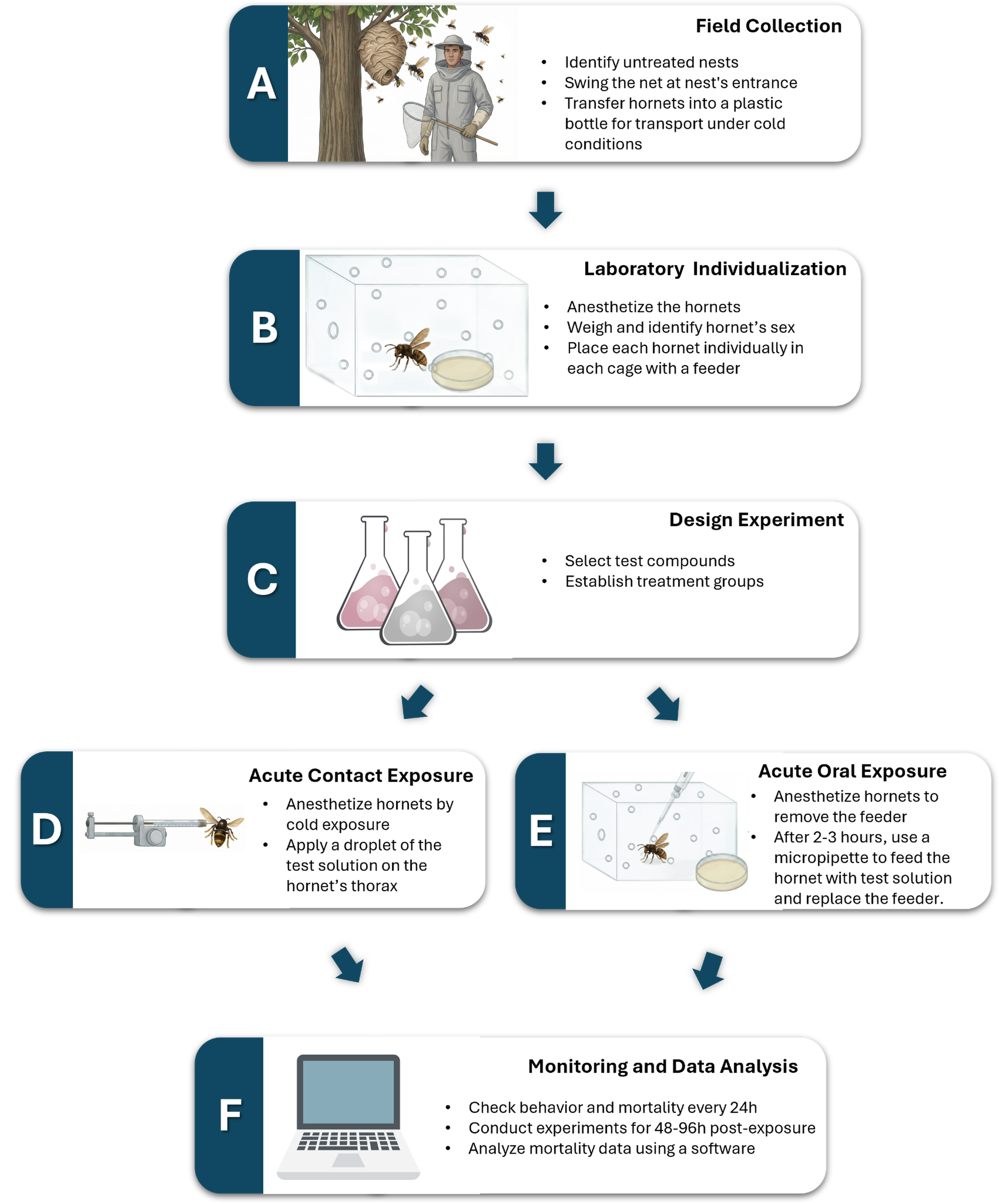
Workflow for the acute contact and oral exposure of chemical compounds in hornets. Overview of procedures for individual collection and acute ecotoxicological tests. (A) Detect and identify untreated nests and collect hornets. (B) Weigh and identify hornets’ sex before individualizing each one. (C) Establish treatment groups. (D, E) Acute exposure methods. (F) Monitoring mortality and behavior every 24 h for 48–96 h and data analysis.
Background
The evaluation of toxicity in organisms under laboratory conditions ensures consistent measurement endpoints, thereby improving comparability across studies [3–5]. Standardized acute contact and oral toxicity tests have been widely used in pesticide risk assessment, revealing significant interspecies susceptibility variation [5–9]. However, such frameworks have rarely been adapted for social vespids.
Vespa velutina nigrithorax (yellow-legged hornet) is a hornet that was accidentally introduced to Europe, Japan, South Korea, the United States of America, and, recently, New Zealand [10–14]. Its establishment has raised ecological and economic concerns due to its predation on pollinators, particularly honeybees, prompting the implementation of various management and control strategies [15,16]. Furthermore, other hornet species, such as Vespa soror, Vespa orientalis, and Vespa crabro, are expanding their ranges and may become invasive outside their native distributions. These species may exert similar impacts to those of the yellow-legged hornet, highlighting the importance of establishing effective control methods [17–19].
Current control approaches mainly rely on traps and physical or chemical nest elimination. Physical methods include nest removal or destruction, while chemical methods typically involve the direct injection of pesticides into the nests [20,21]. Chemical control is commonly applied; however, its effectiveness can vary depending on pesticide formulation, route of exposure, nest size, season, and other ecological and biological factors, such as age, stage, and body mass [1,2,4,21].
Standardized laboratory protocols are therefore essential to evaluate the toxicity of candidate compounds under controlled and reproducible conditions. This protocol provides a framework for acute oral and contact toxicity testing of adult hornets under laboratory conditions, based on Organization for Economic Co-operation and Development (OECD) guidelines and previously published methodologies [1,2,7]. Characterizing individual-level exposure enables the prediction of worker mortality, behavioral avoidance, and sublethal effects that drive colony collapse, facilitating comparative toxicity assessments with non-target organisms and remaining effective against hornets [1,2,22]. This protocol provides a detailed description of each experimental step, facilitating reproducibility and enabling its adaptation to other Vespa species. However, the protocol focuses on acute toxicity in adult hornets and is not currently adapted for chronic oral exposure assays or toxicity testing in larval stages.
Materials and reagents
Biological materials
1. Adult Vespa velutina nigrithorax workers (field-collected; Coimbra, Portugal)
Reagents
1. Distilled water (Elix® Essential Water Purification System, catalog number: ZLXE0030WW)
2. Biological agar-agar (Agar-agar Bio) (e.g., PRÓVIDA, catalog number: 401017B)
3. Multifloral honey (e.g., Lousamel, 1672 L1/25)
4. Test compounds (insecticides, e.g., Cythrin 10EC®, Arysta LifeScience Benelux Sprl.)
5. Surfactant (e.g., Triton X-100) (Sigma-Aldrich, CAS number: 9002-93-1)
6. Sugar (local store)
Solutions
1. Agar-honey (feed) (see Recipes)
2. Pesticide test solution (see Recipes)
Recipes
1. Agar-honey (feed)
| Reagent | Final concentration | Quantity or volume |
|---|---|---|
| Biological agar-agar | 7 g/L | 7 g |
| Honey | 500 g/L (50% w/v) | 500 g |
| Distilled water | - | 1 L |
a. Heat 1 L of distilled water.
b. Add 7 g of biological agar-agar and stir until completely dissolved.
c. When the solution reaches 91 °C, add 500 g of honey.
d. Stir continuously until the honey is fully dissolved and the mixture is homogeneous.
e. Dispense the mixture into 35 mm Petri dishes (~9–10 mL per dish).
f. Allow the feed to solidify at room temperature for ~20 min.
g. Store the prepared feeders at 4 °C for up to 7 days.
Caution: Ensure that the honey–agar mixture has completely solidified. If it has not solidified, discard the preparation and repeat the procedure, increasing the amount of agar if necessary.
Note: The quantities described in this recipe are sufficient for the preparation of 100 feeders.
2. Test solutions
| Reagent | Final concentration | Quantity or volume |
|---|---|---|
Test compound (insecticide or others) e.g., Cythrin 10EC (cypermethrin) | According to treatment; see Table 1 | According to treatment |
| Triton X-100 (for contact exposure) | 0.1% (v/v) | 100 μL/100 mL |
| Distilled water | - | up to final volume |
| Sucrose (for oral exposure) | 50% (w/v) | 500 g/L |
a. Prepare a Triton–water solution (contact exposure) or sugar–water solution (oral exposure).
b. Dissolve the test compound at the desired concentrations in Triton–water/sugar–water solution.
Note: This procedure can be adapted depending on study objectives and the test compounds (e.g., antibiotics, metals, etc.), if they are soluble in water or an organic solvent. For insecticides, the desired concentration can be selected based on LD50 values reported for other species (e.g., honeybees, wasps, hornets) and in the pesticide properties database (Table 1) [23]. In such cases, comparisons across species may be necessary to minimize impacts on non-target organisms. The dosages should be refined after preliminary tests (Table 2).
Example of test compound dosage selection for oral exposure [1,2]:
Table 1. Insecticide information and ecotoxicity data. a.i., active ingredient; LD50, lethal dose for 50% of the tested population; DT50, half-life of the substance.
| Parameter | Oral | Contact | |
| Commercial formulation | Cythrin 10EC | Cythrin 10EC | |
| Active ingredient | Cypermethrin | Cypermethrin | |
| Concentration | 100 g a.i./L; 10.9% (w/w) | 100 g a.i./L; 10.9% (w/w) | |
| Acute LD50 | Honeybees | 0.172 μg a.i. μg/bee | 0.023 μg a.i./bee |
| Mammals | 287 mg a.i./kg | >2,000 mg a.i./kg | |
| DT50 | Soil (lab at 20 °C) | 117.7 days | 117.7 days |
Table 2. Example of cypermethrin final concentrations for oral and contact exposure of yellow-legged hornet [1,2]. CTL, control.
| Concentration | Oral exposure | Contact exposure |
|---|---|---|
| CTL | 0 mg a.i./mL | 0 mg a.i./mL |
| C1 | 0.1850 mg a.i./mL | 1.000 mg a.i/mL |
| C2 | 0.2590 mg a.i./mL | 1.500 mg a.i/mL |
| C3 | 0.3626 mg a.i./mL | 2.250 mg a.i/mL |
| C4 | 0.5076 mg a.i./mL | 3.350 mg a.i/mL |
| C5 | 0.7106 mg a.i./mL | 5.000 mg a.i/mL |
| C6 | 0.9949 mg a.i./mL | - |
| C7 | 1.3929 mg a.i./mL | - |
| C8 | 1.9500 mg a.i./mL | - |
c. Mix gently until completely homogeneous.
d. Store the prepared solution at 4 °C until exposure.
Note: Triton–water solution and sugar–water solution are used for controls of contact and oral exposure, respectively, and are discarded 48 h after preparation.
Laboratory supplies
1. Plastic collection containers (1.5 L bottles with inverted funnel)
2. Transparent plastic cages (L 14.5 × D 10.5 × H 5.5, ~800 cm3) with ventilation holes (2 mm diameter) (5five, ref: 135007 boiter rect pp)
3. Plastic Petri dishes (35 mm diameter) (Sigma-Aldrich, catalog number: CLS430588)
4. Biological cotton balls (local store)
5. Tweezers (Labbox, catalog number: FORS-007-002)
6. Micropipette tips (any)
Equipment
1. Full protective suits, gloves, boots, and face protection mask (XORSA workwear, model: 1510)
2. Sweep net (Entomopraxis, model: F400B)
3. Cool boxes
4. Freezer (-20 °C) or carbon dioxide (CO2) spray system (GoZero Philips, model: ADD4902BK/10; maximum working pressure: 116 psi/~8 bar)
5. Analytical balance (±1 mg precision) (Kern, model: TADB 200-4-B)
6. Incubator with forced air circulation (Leec, model: SFC3C)
7. Hamilton syringe with repeating dispenser or repetitive pipette (Sigma-Aldrich, Hamilton® GASTIGHT® 1700 series syringe, catalog number: S9266; Sigma-Aldrich, Repeating Dispenser, catalog number: 20943)
8. Micropipettes (100 μL; 200 μL; 1,000 μL)
Software and datasets
1. Microsoft Excel Spreadsheet Software®
2. R (R Core Team, 2025) and RStudio (Posit Team, 2025)
Procedure
登录/注册后免费查看全文
文章信息
稿件历史记录
提交日期: Mar 16, 2026
接收日期: May 17, 2026
在线发布日期: Jun 3, 2026
出版日期: Jul 5, 2026
版权信息
© 2026 The Author(s); This is an open access article under the CC BY-NC license (https://creativecommons.org/licenses/by-nc/4.0/).
如何引用
Santos, S. S., Sarmento, A., Souto, P. M., Aguilar, A., Rasko, M., Darrouzet, É., Sousa, J. P. and Capela, N. (2026). Acute Contact and Oral Testing of Chemical Compounds on Vespa velutina nigrithorax (Hymenoptera, Vespidae) Under Laboratory Conditions. Bio-protocol 16(13): e5731. DOI: 10.21769/BioProtoc.5731.

 Download Citation in RIS Format
分类
环境生物学 > 环境毒理学
神经科学 > 行为神经科学
您对这篇实验方案有问题吗?
在此处发布您的问题,我们将邀请本文作者来回答。同时,我们会将您的问题发布到Bio-protocol Exchange,以便寻求社区成员的帮助。
 发布问题
发布问题


