


NADH-Dependent Oxidoreductase Activity Assay of OsAIM1 Using a Microplate Reader
利用酶标仪测定 OsAIM1 的 NADH 依赖性氧化还原酶活性

(*contributed equally to this work) 发布: 2026年07月05日第16卷第13期 DOI: 10.21769/BioProtoc.5722 浏览次数: 573
评审: Shweta PanchalFélix de CarpentierYue Xi
 PDF
PDF  Q&A
Q&A
参见作者原研究论文
The authors used this protocol in:

Feb 2026
Advertisement





Abstract
Peroxisomal β-oxidation is a key step in jasmonic acid biosynthesis. Quantitative biochemical characterization of enzymes involved in the β-oxidation pathway is essential for validating their catalytic functions and comparing differences among genetic variants. Existing enzyme activity assays largely rely on chromatographic techniques to quantify substrate consumption or product formation, but these approaches are not well-suited for high-throughput or continuous kinetic measurements. Here, we describe a spectrophotometric assay based on a plate reader determining OsAIM1 enzymatic activity by monitoring the decrease in NADH absorbance at 340 nm. The method employs a 96-well plate reaction system, enabling real-time kinetic measurements and providing a standardized workflow for calculating reaction rates. Reaction components, protein concentration ranges, and data processing parameters were systematically optimized to ensure linearity, reproducibility, and quantitative accuracy. This assay is simple to perform, requires small reaction volumes, and offers relatively high throughput, making it suitable for functional characterization and kinetic analysis of NADH-dependent enzymes.
Key features
• Enzyme activity assay based on NADH absorbance changes, enabling real-time measurement.
• Conducted in a 96-well plate format with a low reaction volume and minimal protein requirement.
• Allows calculation of reaction rates and specific activity with good reproducibility.
• Applicable to NADH-dependent enzymes and suitable for comparison between different samples.
Keywords: Spectrophotometric assay (分光光度法)
 Enzyme activity measurement (酶活性测定)
Plate reader assay (酶标仪检测)
NADH oxidation (NADH 氧化)
High-throughput analysis (高通量分析)
Enzyme activity measurement (酶活性测定)
Plate reader assay (酶标仪检测)
NADH oxidation (NADH 氧化)
High-throughput analysis (高通量分析)
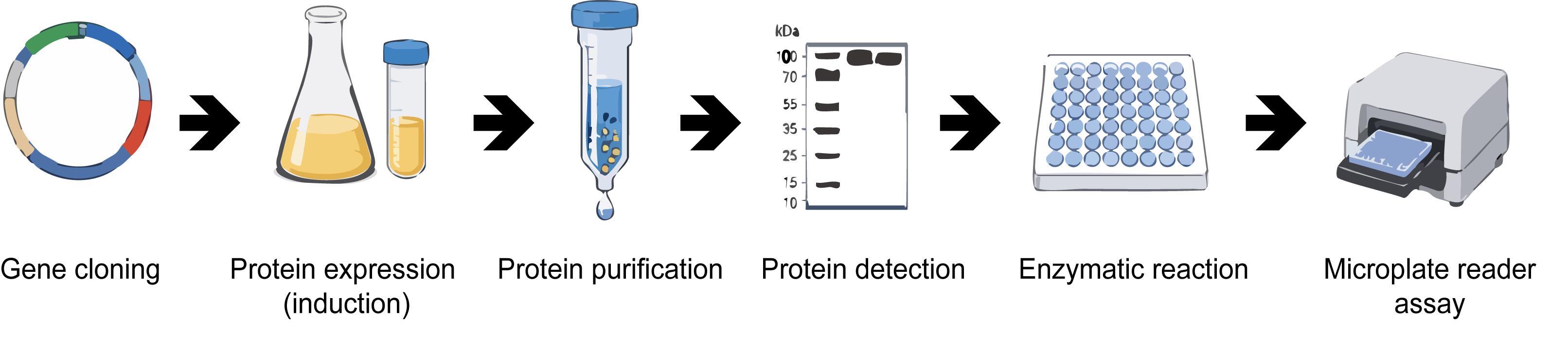
Graphical overview
Background
β-oxidation, an enzymatic process in which fatty acids are sequentially converted into acetyl-CoA, plays a key role in the biosynthesis of jasmonic acid (JA) and salicylic acid (SA) [1]. JA and SA play important roles in plant growth, development, and stress responses. Therefore, quantitative biochemical characterization of enzymes in the β-oxidation pathway is essential for linking genetic findings to catalytic function.
OsAIM1 (ABNORMAL INFLORESCENCE MERISTEM1) encodes a peroxisome-localized multifunctional enzyme that functions in the β-oxidation pathway. For recombinant expression, OsAIM1 was cloned into a pGEX-4T-2 vector and expressed in Escherichia coli as a GST (glutathione S-transferase) fusion protein, followed by affinity purification. It catalyzes the hydratase–dehydrogenase steps of acyl-CoA intermediates, thereby contributing to chain-shortening reactions in peroxisomes. In plants, this pathway is involved not only in fatty acid turnover but also in the production of benzoic acid–derived metabolites such as SA [2–3]. During catalysis, enzymes of this class are typically coupled to the conversion of NADH to NAD+. Because NADH exhibits a characteristic absorbance peak at 340 nm, whereas NAD+ shows minimal absorbance at this wavelength, enzymatic reaction rates can be continuously monitored by measuring the decrease in absorbance at 340 nm [4].
At present, activity assays for enzymes involved in β-oxidation commonly rely on high-performance liquid chromatography or mass spectrometry to quantify substrate consumption or product formation [5–8]. Despite their high sensitivity, these methods are inherently discontinuous, as they require intermittent sampling, reaction quenching, and offline analysis. Such procedures interrupt the reaction process and limit the ability to capture rapid changes over time, thereby preventing continuous, real-time monitoring of enzyme kinetics. In addition, the relatively low throughput and labor-intensive workflows further restrict their applicability in dynamic or high-throughput kinetic analyses. In contrast, spectrophotometric assays based on changes in NADH absorbance can be performed on a plate reader platform, enabling real-time detection in small reaction volumes and parallel measurement of multiple samples.
In this study, we describe an NADH-dependent enzyme activity assay using a plate reader and provide a detailed description of the reaction setup and the calculation of enzymatic reaction rates to improve reproducibility and quantitative accuracy. This method can be extended to the functional analysis of other NADH-dependent enzymes, such as 3-hydroxyacyl-CoA dehydrogenase and alcohol dehydrogenase [9–11].
Materials and reagents
Biological materials
1. DH5α chemically competent Escherichia coli cells (Tsingke Biotechnology Co., Ltd., catalog number: TSC-C14)
2. BL21 (DE3) Escherichia coli cells (Tiangen Biotech, catalog number: CB105-02)
3. pGEX-4T-2 vector
Reagents
1. Ampicillin (Aladdin, catalog number: A408319)
2. Yeast extract (Biomed, catalog number: LP0021)
3. Tryptone (Biomed, catalog number: LP0042)
4. Sodium chloride (NaCl) (Sigma-Aldrich, catalog number: S9625)
5. Agar powder (Solarbio, catalog number: A8190)
6. Isopropyl-β-D-thiogalactopyranoside (IPTG) (Sigma-Aldrich, catalog number: 367-93-1)
7. Phosphate-buffered saline (powder) buffer (PBS) (Pytbio, catalog number: FZ1055)
8. Triton X-100 (Sigma-Aldrich, catalog number: X-100)
9. L-Glutathione reduced (Sigma-Aldrich, Abcam, catalog number: 70-18-8)
10. Tris (Solarbio, catalog number: T8060)
11. Hydrochloric acid (HCl) (CaymanChemical, catalog number: 401137-50)
12. Bovine serum albumin (BSA) (Sigma-Aldrich, catalog number: A7906)
13. Nicotinamide adenine dinucleotide (reduced form) (NADH) (MCE, catalog number: 606-68-8)
14. Potassium dihydrogen phosphate (KH2PO4) (Aladdin, catalog number: P113041)
15. Potassium hydroxide (KOH) (Sigma-Aldrich, catalog number: 306568)
16. Acetoacetyl-CoA sodium salt (MCE, catalog number: HY-N7392A)
17. GST magnetic agarose (Solarbio, catalog number: M2320)
18. Ampicillin (MCE, catalog number: HY-B0522)
19. Protein loading buffer (SDS, 4×) (MREDA, catalog number: M212252-5ml)
Solutions
1. LB culture medium (see Recipes)
2. 50 mM Tris-HCl (see Recipes)
3. 20 mg/mL BSA (see Recipes)
4. 1 M KH2PO4, pH 7.0 (see Recipes)
5. 5.45 mM acetoacetyl-CoA (see Recipes)
6. 10 mM NADH (see Recipes)
7. Reaction buffer (see Recipes)
Recipes
1. LB culture medium
| Reagent | Quantity or volume |
|---|---|
| Yeast extract | 0.5 g |
| Tryptone | 1 g |
| NaCl | 1 g |
| ddH2O | To 100 mL |
For solid medium, add 1.5 g of agar. Sterilize at 121 °C for 20 min and store at 4 °C.
2. 50 mM Tris-HCl
| Reagent | Quantity or volume |
|---|---|
| Tris | 6.06 g |
| ddH2O | To 1 L |
Adjust the pH to 8.0 with concentrated HCl at room temperature (25 °C). Store at 4 °C.
3. 20 mg/mL BSA
| Reagent | Quantity or volume |
|---|---|
| BSA | 20 mg |
| ddH2O | To 1 mL |
Store at -20 °C.
4. 1 M KH2PO4, pH 7.0
| Reagent | Quantity or volume |
|---|---|
| KH2PO4 | 0.136 g |
| ddH2O | To 1 mL |
Adjust the pH to 7.0 with concentrated KOH at room temperature. Store at 4 °C.
5. 5.45 mM acetoacetyl-CoA
| Reagent | Quantity or volume |
|---|---|
| Acetoacetyl-CoA sodium salt | 0.005 g |
| ddH2O | To 1 mL |
Store at -20 °C.
6. 10 mM NADH
| Reagent | Quantity or volume |
|---|---|
| Nicotinamide adenine dinucleotide | 0.007 g |
| ddH2O | To 1 mL |
Store at -20 °C protected from light.
7. Reaction buffer
| Reagent | Final concentration | Quantity or volume |
|---|---|---|
| 20 mg/mL BSA | 0.2 mg/mL | 1 μL |
| 1 M KH2PO4 | 0.2 M | 20 μL |
| 5.45 mM acetoacetyl-CoA | 30 μM | 0.55 μL |
| ddH2O | n/a | 78.45 μL |
| Total | n/a | 100 μL |
Prepare fresh immediately before use and do not store.
Laboratory supplies
1. 1.5, 2.0, and 50 mL tubes
2. Magnetic rack (Aikerui Bioengineering Co., Ltd., catalog number: AG21301)
3. 96-well EIA/RIA plate (Corning, catalog number: 3590)
4. Erlenmeyer flask (Sigma-Aldrich, catalog number: Z567868)
5. Petri dish (Gadro, catalog number: GH10078)
Equipment
1. Low-temperature ultra-high-pressure continuous-flow cell disruptor (JNBIO, model: JN-Mini pro)
2. Microplate reader (Molecular Devices, LLC, model: Spectra M3)
3. NanoDrop (Thermo Fisher Scientific Inc, model: 840-317500)
4. Thermal cycler (Sigma-Aldrich, model: Z742467)
5. Water bath (POMEX, model: BM14099)
6. Autoclave
7. Laminar flow hood
8. Shaking incubator
Procedure
登录/注册后免费查看全文
文章信息
稿件历史记录
提交日期: Apr 3, 2026
接收日期: May 14, 2026
在线发布日期: May 27, 2026
出版日期: Jul 5, 2026
版权信息
© 2026 The Author(s); This is an open access article under the CC BY-NC license (https://creativecommons.org/licenses/by-nc/4.0/).
如何引用
Readers should cite both the Bio-protocol article and the original research article where this protocol was used:
- Hu, Y., Cui, S., Li, H., Hou, H., Xu, Z., Hao, B., Cai, L., Zhu, L., Wang, J., Chang, K., Li, W., Shao, W., Zhu, S., Li, C., Zhao, Z., Jiang, L., Tian, Y., Liu, X., Liu, S., Chen, L., Zhou, S. and Wan, J. (2026). NADH-Dependent Oxidoreductase Activity Assay of OsAIM1 Using a Microplate Reader. Bio-protocol 16(13): e5722. DOI: 10.21769/BioProtoc.5722.
- Hu, Y., Li, H., Hou, H., Cui, S., Xu, Z., Hao, B., Cai, L., Zhu, L., Wang, J., Chang, K., et al. (2026). The multifunctional protein OsAIM1 regulates floret opening and closure timing via jasmonic acid-mediated lodicule dynamics in rice. Plant Physiol. 200(2): e1093/plphys/kiaf690. https://doi.org/10.1093/plphys/kiaf690

 Download Citation in RIS Format
分类
生物化学 > 蛋白质 > 活性
生物化学 > 其它化合物 > NAD+/NADH
植物科学 > 植物生物化学 > 蛋白质 > 活性
您对这篇实验方案有问题吗?
在此处发布您的问题,我们将邀请本文作者来回答。同时,我们会将您的问题发布到Bio-protocol Exchange,以便寻求社区成员的帮助。
 发布问题
发布问题


