


Multiply Perturbed Response: A Computational Protocol to Identify Cooperative Allosteric Residue Combinations Driving Protein Conformational Transitions
多重扰动响应法:识别驱动蛋白质构象转变的协同变构残基组合的计算方案

发布: 2026年07月05日第16卷第13期 DOI: 10.21769/BioProtoc.5718 浏览次数: 733
评审: Natasha Shreekant KelkarYuhang WangAtharva DeoAnonymous reviewer(s)
 PDF
PDF  Q&A
Q&A
参见作者原研究论文
The authors used this protocol in:

Oct 2025
Advertisement






Abstract
Protein function often depends on dynamic conformational transitions driven by external factors or molecular interactions. Understanding the allosteric mechanisms underlying these transitions is essential for mechanistic insight into protein function. Molecular dynamics (MD) simulations are widely used to study protein dynamics; however, capturing large-scale, rare transitions is computationally expensive. To address this, we previously developed Perturbation Response Scanning (PRS), based on elastic network models and linear response theory, but PRS is limited in capturing collective effects because it perturbs one residue at a time. Here, we present Multiply Perturbed Response (MPR), which extends PRS by applying simultaneous perturbations to multiple residues to identify allosteric residue combinations that drive conformational transitions. This protocol provides a workflow for structure preparation, displacement, and covariance-matrix calculations, overlap analysis, and visualization. It can be applied to static structures or trajectories from MD simulations, requiring initial and final protein structures as the main inputs and an optional MD trajectory for trajectory-based analysis. The main outputs are residue combinations that maximize overlap, Omax values, corresponding force vectors, and visualization files. These outputs help identify cooperative allosteric regions and residues for mechanistic interpretation or further experimental validation. By perturbing multiple residues simultaneously, MPR captures conformational transitions arising from combined residue effects. The method is easy to use, reproducible, and accessible through open-source tools and libraries.
Key features
• Facilitates the identification of multiple allosteric hotspot residues using optimized multi-residue perturbations.
• Extends classical perturbation-response scanning to account for the coordinated effects of multiple simultaneous perturbations.
• Enables structure-based and trajectory-based analyses within a single framework, using static structural information or MD-derived covariance information.
•Provides interpretable outputs, including ranked residue combinations, overlap values, optimized force vectors, and ChimeraX-compatible visualization files.
Keywords: Multiply perturbed response (多重扰动响应) Conformational transition (构象转变)
Allosteric residue combinations (协同变构残基组合)
Elastic network model (弹性网络模型)
Linear response theory (线性响应理论)
Overlap maximization (重叠度最大化)
Variance-covariance matrix (方差-协方差矩阵)
Conformational transition (构象转变)
Allosteric residue combinations (协同变构残基组合)
Elastic network model (弹性网络模型)
Linear response theory (线性响应理论)
Overlap maximization (重叠度最大化)
Variance-covariance matrix (方差-协方差矩阵)
Graphical overview
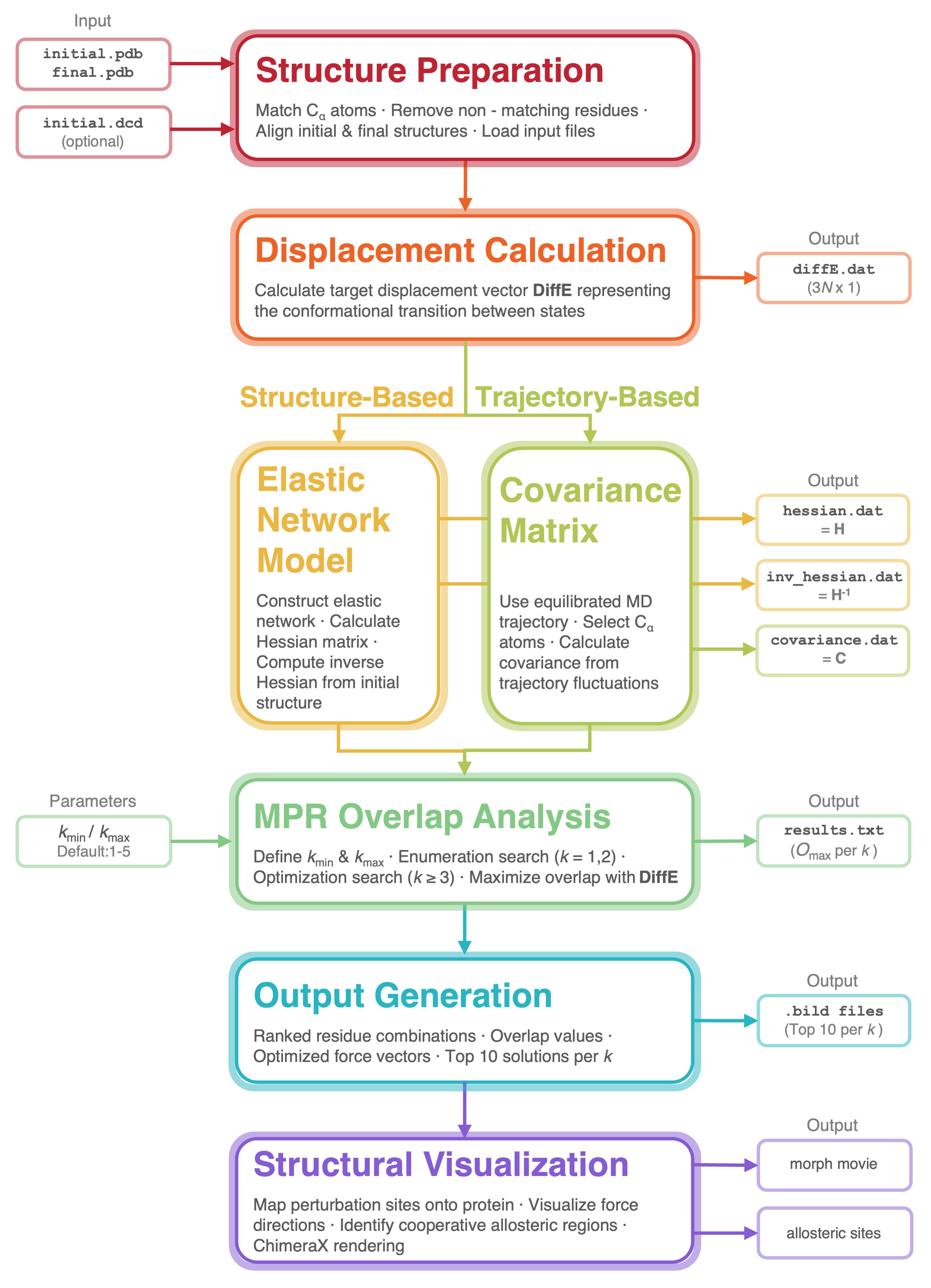
The Multiply Perturbed Response (MPR) workflow identifies allosteric residue combinations that drive protein conformational transitions using structure- or trajectory-based response matrices
Background
Proteins are dynamic molecules that adopt multiple conformations. Protein structure is closely linked to how it responds to internal factors and interactions with the external environment, which in turn determines function in diverse biological processes. The energy landscape of a protein describes the relative free energies of its possible conformations; the probability of occupying a given conformation is reflected by the depth of that state on the landscape. Factors such as ligand binding [1], pH [2], ionic strength [3], or mutations [4] can reshape the landscape and drive structural changes [5]. The physicochemical properties of amino acids also influence these responses. Charged, polar, or hydrophobic residues can affect local interactions, packing, and collective motions [6,7]. In this context, our research focuses on identifying allosteric regions. Allostery refers to a perturbation in one region of a protein that leads to structural and dynamic changes in distant regions, translating a local signal into a global functional response.
Molecular dynamics (MD) simulations are widely used to study protein dynamics and allostery; however, observing large and rare conformational transitions often requires long simulation times and substantial computational resources. In some cases, directly observing the effects of environmental conditions is not feasible, which limits the applicability of purely MD-based approaches [8]. Alternative approaches have been developed to overcome these limitations. For example, elastic network models (ENMs) and methods based on linear response theory have been introduced. In the ENM framework, proteins are represented as coarse-grained networks (typically at the Cα level), enabling the simple yet efficient computation of residue-level fluctuations and their modal decompositions [9–11].
Perturbation Response Scanning (PRS) is a widely used computational method for identifying allosteric residues, grounded in linear response theory [12]. This framework assumes that structural responses near equilibrium are linearly related to applied forces [13]. Accordingly, in PRS, proteins are coarse-grained at the Cα level and subjected to systematic single-residue perturbations to identify residues whose perturbations best reproduce experimentally observed conformational changes [14]. PRS has been successfully applied to various proteins to identify functional hotspots, including enzymes (Caspase-6, ADK) [15,16], molecular motors (Kinesin, Myosin) [16], signaling proteins (CheY, PDZ) [17,18], viral proteins (HIV-1 RT) [16], and many others. Interestingly, these studies have revealed that the residues that maximize the overlap with the identified conformational change are not limited to surface-exposed positions; depending on the system, they may include exposed residues, partially buried interface residues, or buried residues near functional cores. However, PRS is practically limited to single-residue perturbations, and it may not detect conformational changes caused by the simultaneous and collective effects of multiple residues. When it comes to domain or hinge-movements, or rearrangements dependent on environmental conditions, multiple coordinated perturbations may be required to trigger the observed structural rearrangements [16].
To overcome this limitation, we introduce the Multiply Perturbed Response (MPR) method [19]. This approach extends PRS by applying forces simultaneously to multiple residues, capturing conformational transitions driven by collective residue effects. When only static initial and final structures are available, the protocol can be executed using the structure-based formulation alone. When MD trajectories are provided, the trajectory-based method captures equilibrium conformational fluctuations, improving the precision of the predicted conformational response. We note that for proteins without experimentally determined structures, MPR can be applied using predicted structural models. In this case, alternative conformational states may be generated using AlphaFold/ColabFold with different MSA depths, RoseTTAFold, ESMFold, or other validated structure-prediction workflows. However, because the input conformations are computational predictions, the resulting MPR residues should be interpreted as hypotheses for future experimental testing rather than experimentally validated allosteric sites.
MPR integrates enumeration- and optimization-based strategies to explore solutions across different numbers of perturbed residues (k ≥ 1). Enumeration enables exhaustive identification of optimal residue combinations for small k values, while optimization-based formulations allow efficient exploration of higher-order perturbations without prohibitive computational costs. As a result, the method substantially reduces computational expense compared with fully atomistic approaches while retaining sensitivity to collective allosteric effects. Using open-source software and widely used bioinformatics libraries increases the accessibility and applicability of the method.
Software and datasets
1. Script/Code: MPR (Multiply Perturbed Response), v1.0.0, 2025, open source, free
2. Software: ProDy, v2.4.1, August 2025, MIT License, free
3. Software: Biopython, v1.86, October 2025, BSD 3-Clause License, free
4. Software: ChimeraX, v1.11, December 2025, GNU GPL 3.0 License, free for academic use
5. Software: AlphaFold2 (via ColabFold), ColabFold v1.5.5 and AlphaFold2 v2.3.2, April 2023, MIT License (ColabFold), Apache 2.0 License (AlphaFold2), and CC BY 4.0 License (associated model parameters and database contents), free
6. Software: AlphaFold3, v3.0.1, January 2025, CC-BY-NC-SA 4.0 License, free for academic use
7. Software: Gurobi Optimizer, v13.0.1, November 2025, Gurobi Academic License, free for academic use; restrictions apply. Gurobi Optimizer is used for optimization-based MPR calculations. Open-source alternatives such as HiGHS, SCIP, or GLPK may be possible, but they would require code adaptation and have not been systematically tested in the current implementation
8. Software: Python v3.8 is recommended
9. Data: RCSB Protein Data Bank, free access
The MPR code used in this protocol is freely available on GitHub at https://github.com/midstlab/MPR_Bio-Protocol. The repository includes a detailed README file with installation instructions, required input formats, example runs, expected output files, parameter descriptions, and explanations of the notebook used in the workflow. The repository also provides an environment.yml file to reproduce the recommended Python environment.
All analyses described in this protocol can be reproduced using this repository together with Biopython, ProDy, and ChimeraX. Optimization-based MPR analyses require Gurobi Optimizer or adaptation to an alternative solver. The required software is available through free or academic-use licenses.
Software setup
1. Download the MPR code from the MidstLab GitHub page.
2. Create the recommended Python environment using the environment.yml file provided in the GitHub repository. This file provides the Python 3.8 environment required for the ProDy-based structure calculations. Alternatively, install the required packages manually in a Python 3.8 environment.
3. Install the ProDy package, which is used for elastic network modeling and Hessian calculations based on linear response theory [20].
4. Install Biopython to perform structural alignment and overlapping operations [21].
5. Install ChimeraX for three-dimensional visualization of force vectors and protein conformational transitions [22].
6. Install Gurobi Optimizer if optimization-based MPR analysis is required; enumeration-based analyses for small k values can be performed without Gurobi [23]. Gurobi is not included in environment.yml because its Python version compatibility depends on the platform and installation method.
7. Place the MPR code in the working directory specified by the user.
Procedure
登录/注册后免费查看全文
文章信息
稿件历史记录
提交日期: Jan 30, 2026
接收日期: May 10, 2026
在线发布日期: May 27, 2026
出版日期: Jul 5, 2026
版权信息
© 2026 The Author(s); This is an open access article under the CC BY license (https://creativecommons.org/licenses/by/4.0/).
如何引用
Kazan, K., Berksoz, M., Kocuk, B., Atilgan, A. R. and Atilgan, C. (2026). Multiply Perturbed Response: A Computational Protocol to Identify Cooperative Allosteric Residue Combinations Driving Protein Conformational Transitions. Bio-protocol 16(13): e5718. DOI: 10.21769/BioProtoc.5718.

 Download Citation in RIS Format
分类
生物信息学与计算生物学
生物化学 > 蛋白质 > 结构
您对这篇实验方案有问题吗?
在此处发布您的问题,我们将邀请本文作者来回答。同时,我们会将您的问题发布到Bio-protocol Exchange,以便寻求社区成员的帮助。
 发布问题
发布问题


