


Customizable High-Throughput Chemical Phenotyping of Root Bacteria
可定制的根际细菌高通量化学表型分析

发布: 2026年06月05日第16卷第11期 DOI: 10.21769/BioProtoc.5710 浏览次数: 534
评审: Shweta PanchalSamujjal BhattacharjeeAnonymous reviewer(s)
 PDF
PDF  Q&A
Q&A
参见作者原研究论文
The authors used this protocol in:
Oct 2023
Advertisement








Abstract
Chemical phenotyping is a fundamental technique to study the metabolic properties or chemical sensitivities of bacteria. Traditional methods such as dilution methods, discs, or gradient diffusion assays are labor-intensive, often have high material requirements, and are limited in scalability. High-throughput cultivation approaches based on 96-well plates scale efficiently to large numbers of samples. A stacker, when coupled with a plate reader system (often already available in most laboratories), greatly enhances assay scalability and robustness. Here, we describe a customized high-throughput, flexible, scalable, robust, and affordable method for the chemical phenotyping of bacteria. This liquid culture–based growth system allows screening many bacteria in parallel and in a replicated manner for their tolerance to various chemicals, including specialized metabolites of plants, antibiotics, or pesticides. Compared to commercial solutions, our approach offers high flexibility in experimental conditions while keeping costs for consumables low.
Key features
• Approach to determine tolerance of bacteria against diverse chemicals, including specialized plant metabolites.
• Experimental platform where parameters like strains, media, chemicals, concentrations, or exposure time can be flexibly varied for bacterial phenotyping.
• Coupling a stacker to a plate reader permits highly replicated and efficient screenings of large bacterial collections and numerous different compounds.
Keywords: Bacteria phenotyping (细菌表型分析) Root microbiome (根系微生物组)
Bacterial isolates (细菌分离株)
Antimicrobials (抗菌物质)
High-throughput (高通量)
Tolerance testing (耐受性测试)
Root microbiome (根系微生物组)
Bacterial isolates (细菌分离株)
Antimicrobials (抗菌物质)
High-throughput (高通量)
Tolerance testing (耐受性测试)
Graphical overview
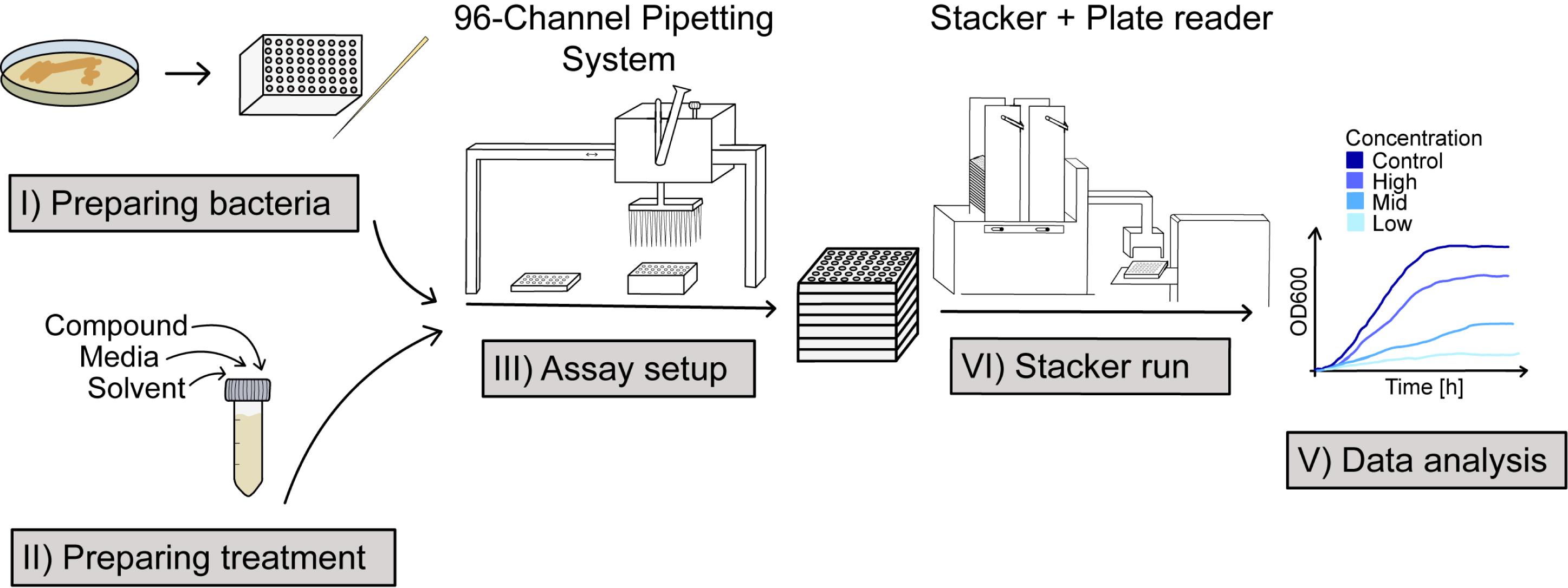
High-throughput phenotyping of bacteria. The scheme illustrates the five steps of the customizable high-throughput approach for chemical phenotyping of bacteria. (I) Preparation of bacteria from agar plates to liquid precultures. (II) Preparation of treatment solutions by mixing the culture media with the compound dissolved in a solvent. (III) Setting up the assay by combining bacteria and treatment solutions in 96-well plates using a 96-channel pipetting system. (IV) Starting a stacker run for parallel measurements of bacterial growth based on optical density. (V) Analysis of bacterial growth curves in the statistical software R.
Background
Many research questions in bacteriology, ranging from studying nutritional preferences (e.g., carbon substrates) to metabolic capacities or sensitivities against various compounds, including specialized metabolites from plants, antibiotics, or environmental chemicals, rely on chemical phenotyping, i.e., the quantitative assessment of bacterial growth during chemical exposure. When studying the plant root microbiome, chemical phenotyping is useful to dissect interactions of root microbes with plant root exudates. Root exudates are secreted to the surrounding soil and contain primary metabolites, on which microbes feed, as well as specialized metabolites with attractant and repellent properties [1–3]. These bioactive metabolites can affect bacterial behavior, such as motility, biofilm formation, and chemotaxis [4–8]. Studies on how specialized plant metabolites, such as coumarins or benzoxazinoids, contribute to the structure of root microbiomes are a prime area for chemical phenotyping [9–11].
Traditionally, bioactive compounds are tested using dilution methods, disc, gradient diffusion assays, or chromogenic media [12]. These methods are labor-intensive, have high material requirements, and need large amounts of compounds to be tested. Alternatively, commercially developed phenotyping arrays (e.g., www.biolog.com) permit screening and testing for metabolic capacities and other microbial properties. Such systems are based on 96-well plates, have much lower material requirements, and allow highly standardized growth and cross-referencing of results. One limitation is the restriction on the range of chemical compounds as offered by the company; thus, only broadly used and commercialized compounds can be tested. However, several specialized plant metabolites are not included in commercial phenotyping arrays or are not commercially available and need to be isolated and purified. A second limitation is linked to scalability and costs, particularly when a research question requires the chemical phenotyping of large sets of bacterial strains, such as established strain collections of the root microbiome [13–18]. In our research on how specialized plant metabolites affect the growth of root microbiome isolates, we sought to develop a custom approach satisfying the following requirements: (i) flexible and scalable, allowing simple variation in numbers of strains, compounds, and concentrations; (ii) adaptable to any dissolvable chemical compound, which is available in sufficient amounts and stable in the given conditions; (iii) high-throughput, where many reactions and replications can be run simultaneously for the production of robust and reproducible data; and finally, (iv) affordable for a small laboratory. Inspired by commercial solutions and previous work [19], we developed our custom approach for chemical phenotyping of bacteria fulfilling these requirements.
A few considerations regarding the necessary infrastructure need to be noted: plate readers are routinely used in molecular biology to measure absorbance, fluorescence, or luminescence in microtiter plates, and they are available in many laboratories. Plate readers are costly instruments (approximately 75,000€ in our case), and moderate investments can upgrade the scalability and throughput of experiments tremendously. The key investment is a stacker that automatically handles stacks of plates (typically between 15 and 25 plates; investment ~25,000€). A second investment is a benchtop 96-channel pipetting system (investment ~12,000€) that greatly speeds up the setup of many plates for replication of strains, compounds, and concentrations. The pipetting system makes it possible to set up a standard phenotyping run in less than 3 h, and the stacker then handles up to 25 × 96-well plates autonomously. Such a standard phenotyping run can include up to 60 strains in 3 replicates that are tested in 8 different conditions (compounds, concentrations, and controls). With hourly measurements, such a run will generate 70,000 datapoints in a 48-h assay. Overall, integrating high-throughput pipetting and automated measurements with multiple plates with a stacker significantly expands the capabilities of the plate reader, thereby enhancing the efficiency and scope of bacterial chemical phenotyping.
Here, we describe a customizable, high-throughput phenotyping approach that measures bacterial growth in the presence of chemical compounds originally developed in [20]. The basic requirements are that the bacteria grow aerobically, that the chemical compound of interest is stable in these conditions, and that, if a compound is not soluble in water, the used solvent does not prevent bacterial growth. Mild toxicity of the solvent can be controlled using appropriate controls. As the stacker and plate reader are not sterile environments, the assays require media controls (no-bacteria controls, NBCs) to detect potential contamination during a run. Using NBCs and media control plates, we typically do not detect environmental contamination for up to 68 h of assay length; however, contamination may depend on the media used. Our approach includes five steps, as illustrated in the Graphical overview. Preparatory steps are needed for the assay, including (i) pre-cultivation of the bacteria and (ii) preparation of the treatments, i.e., the stocks of the chemical compounds to be tested. Then, the 96-channel pipetting system helps to (iii) set up the assay plates, where the bacteria and their culture medium containing the different concentrations of the test chemicals are assembled. Then, (iv) plates are loaded onto the stacker, which handles them for autonomous recording of the optical density of the bacterial cultures over time with the plate reader. Finally, (v) exported data are analyzed using the open-source software R. We describe our approach based on an exemplary stacker run, for which we provide template data and a corresponding R script for analysis. In this example, we studied the antimicrobial activity of a specialized maize metabolite on the growth of maize root bacteria. Below, we provide the detailed protocol, including required materials and methodological steps. In the notes, we discuss limitations of our approach and offer recommendations for enhancing its scalability, as well as explore potential applications beyond the experimental example provided.
Materials and reagents
Note: Prepare and store all biological materials and solutions at room temperature unless indicated otherwise. Follow all waste disposal regulations.
Biological materials
1. Glycerol stocks of bacterial isolates (BIS) to be tested
Note: We describe this protocol based on an exemplary set of 60 BIS. We routinely use this protocol to investigate isolates of plant root bacteria [11,20–23]. See General note 1 on the choice of bacteria that can be tested with this approach.
Reagents
1. Tryptic soy broth (TSB) (Millipore, catalog number: 22092) and agar to prepare solid and liquid media for bacterial cultivation; see General note 2 on the choice of media other than TSB that can be used with this approach
2. Stock solutions of the chemicals to be tested
3. Solvent for the chemicals to be tested
Note: We describe this protocol based on an exemplary compound. However, we routinely use this protocol to investigate specialized plant metabolites like 6-Methoxy-2-benzoxazolinone (MBOA) (Sigma-Aldrich, catalog number: 543551) dissolved in dimethyl sulfoxide (DMSO) (Sigma-Aldrich, catalog number: D2438). See General note 3 on the choice of chemicals (and their solvents) to be used with this approach.
Laboratory supplies
1. Sterile Ø 9 cm Petri dishes (Sarstedt, catalog number: 82.1473.001)
2. 50 mL centrifugation tubes (Greiner, catalog number: 227261)
3. Sterile filter tips for pipettes (20–200 μL) (Sarstedt, catalog number: 70.3031.355) or for the benchtop 96-channel pipetting system (Mettler Toledo, model: Liquidator 96TM, catalog number: 17010646)
4. Sterile filter tips for 8-channel pipette (100–1,000 μL) (Sarstedt, catalog number: 70.3060.355)
5. Sterile reagent reservoirs (25 mL for 8-channel pipette) (ThermoFisher, catalog number: 8094)
6. Deep round-bottom 96-well plates, 2 mL volume (Carl Roth, catalog number: EN07.1)
7. Sterile inoculation loops (VWR, catalog number: 612-7274) and needles (Greiner, catalog number: 731185)
8. Sterile 96-channel reservoirs (200 mL volume for pipetting system) (Mettler Toledo, catalog number: 17012605)
9. Breathe-easy foil (gas-permeable sealing membrane) (Sigma-Aldrich, catalog number: Z380059)
10. Transparent flat-bottom 96-well culture plates with lids for the inoculation of the bacteria in the treatment solution (200 μL volume) (Corning, catalog number: 3595)
Equipment
A microplate stacker is a laboratory instrument that automatically stores and (un)loads multiple microplates (e.g., 96-well plates) into analytical instruments such as plate readers and can also handle lids if required. Combining such a stacker with a plate reader permits programming unattended time series assays, which greatly enhances the throughput. Figure 1 illustrates a possible stacker system combined with a plate reader.
1. Stacker (Agilent Technologies, model: BioStack 4)
2. Plate reader (Agilent Technologies, model: Synergy H1)
3. 96-channel pipetting system (Mettler Toledo, model: Liquidator 96TM)
4. Incubator (28 °C) for cultivation of bacteria on agar plates (Infors-HT, Ecotron)
5. Shaking incubator (28 °C) for cultivation of bacteria in liquid cultures (Infors-HT, Ecotron)
6. Sterile bench equipped with a UV light lamp (berner, model: Claire-Neo)
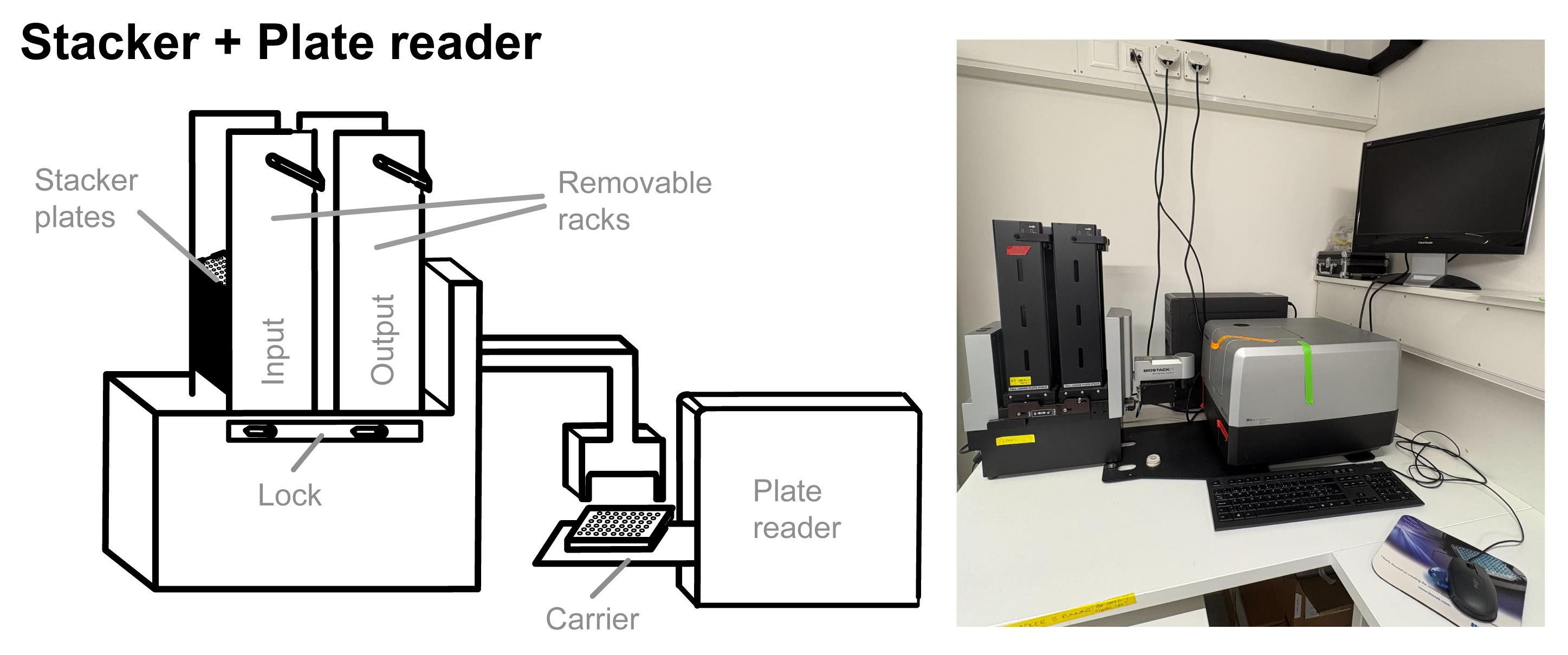
Figure 1. Stacker connected to a plate reader. The stacker connected to the plate reader handles up to 25 plates automatically. Plates are inserted into the input rack; then, a crawler moves the plate to the front, and the robotic arm removes the lid and places the plate onto the carrier. The carrier then inserts the plate into the plate reader, where the plate is shaken, and the optical density is measured. After the measurement, the plate is moved back, and the lid is added again and placed on the bottom of the output rack. When all plates are measured, they are automatically restacked to the input rack, and the process is repeated, allowing time series assays. The illustration (left) and photograph (right) show the stacker connected to the plate reader. A metal base plate fixes the distance between the two instruments.
Software and datasets
1. Software to control plate reader and stacker: Gen5 (Agilent Technologies, version 3.09.07)
2. R statistical software [24] (version 4.2.2) with packages Tidyverse [25], emmeans [26], MESS [27], and dr4pl [28]
3. All data and code are available at GitHub (https://github.com/PMI-Basel/Thoenen_et_al_HT_Chem_Pheno_bacteria)
Procedure
登录/注册后免费查看全文
文章信息
稿件历史记录
提交日期: Feb 24, 2026
接收日期: Apr 27, 2026
在线发布日期: May 15, 2026
出版日期: Jun 5, 2026
版权信息
© 2026 The Author(s); This is an open access article under the CC BY license (https://creativecommons.org/licenses/by/4.0/).
如何引用
Thoenen, L., Giroud, C., Probst, C., Rouyer, L., Schandry, N. and Schlaeppi, K. (2026). Customizable High-Throughput Chemical Phenotyping of Root Bacteria. Bio-protocol 16(11): e5710. DOI: 10.21769/BioProtoc.5710.

 Download Citation in RIS Format
分类
微生物学 > 抗微生物试验 > 抗细菌试验
微生物学 > 微生物细胞生物学 > 细胞活力
微生物学 > 微生物生理学 > 胁迫反应
您对这篇实验方案有问题吗?
在此处发布您的问题,我们将邀请本文作者来回答。同时,我们会将您的问题发布到Bio-protocol Exchange,以便寻求社区成员的帮助。
 发布问题
发布问题


