


Evaluating Thioredoxin-Mediated CFoCF1 Reduction Using an In Vitro Thylakoid Assay
利用体外类囊体实验评估硫氧还蛋白介导的 CFoCF1 还原

发布: 2026年06月05日第16卷第11期 DOI: 10.21769/BioProtoc.5706 浏览次数: 302
评审: Felix BuchertAnonymous reviewer(s)
 PDF
PDF  Q&A
Q&A
参见作者原研究论文
The authors used this protocol in:
Sep 2024
Advertisement







Abstract
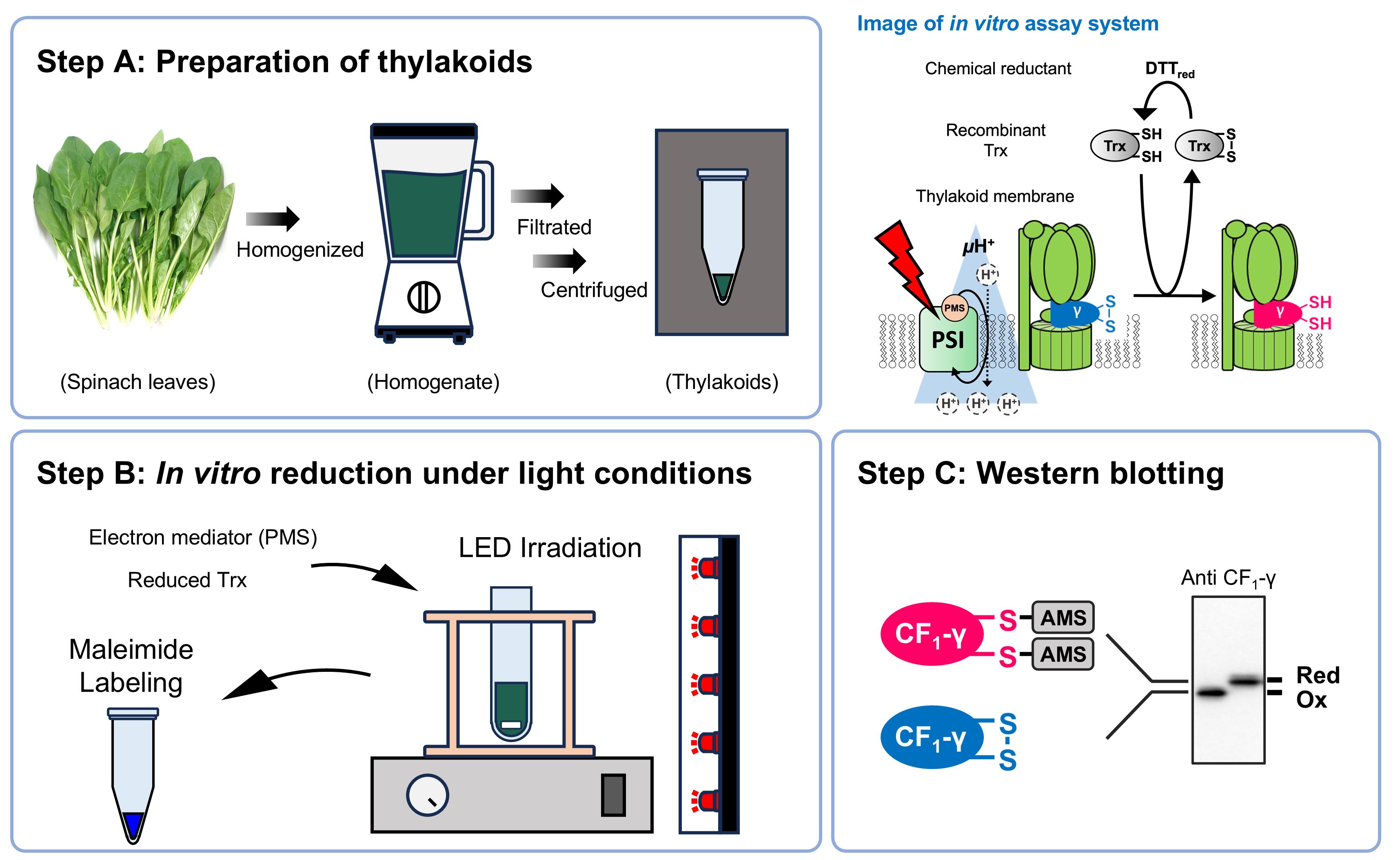
The activity of chloroplast ATP synthase (CFoCF1) is precisely regulated through a thioredoxin (Trx)-mediated dithiol/disulfide reaction in response to varying light conditions. This regulatory mechanism is further controlled by ΔpH formation across the thylakoid membrane. To better understand this complicating regulatory function of CFoCF1, a method is required to evaluate the extent of CFoCF1 reduction by Trx under controlled ΔpH conditions and to directly evaluate the redox state of CFoCF1. In this study, we present a simple in vitro procedure to assess the CFoCF1 reduction system using spinach thylakoids. The method consists of three key steps: (A) simple preparation of intact thylakoids from spinach leaves; (B) reduction of CFoCF1 on the thylakoid membrane using recombinant Trx under light irradiation; and (C) in situ determination of the redox state of CFoCF1 by labeling thiol groups with a maleimide reagent followed by protein detection using western blotting. The redox state of CFoCF1 was determined by mobility shifts on non-reducing SDS-PAGE. This protocol provides a refined strategy for elucidating the regulatory mechanism controlling energy conversion by CFoCF1 under fluctuating photosynthetic conditions.
Key features
• A simple isolation method for intact thylakoids from Spinacia oleracea that enables the evaluation of the reduction of chloroplast ATP synthase by thioredoxin.
• The combination of LED light irradiation and electron mediators allows controlled adjustment of the proton electrochemical gradient across thylakoid membranes.
• The redox state of chloroplast ATP synthase can be distinguished by labeling free thiols with maleimide reagents and quantitative detection by western blotting.
Keywords: Chloroplast ATP synthase (叶绿体 ATP 合酶) Thioredoxin (硫氧还蛋白)
Thylakoid membrane (类囊体膜)
Redox regulation (氧化还原调控)
Thiol labeling (巯基标记)
Western blotting (Western blot)
Spinacia oleracea (菠菜)
Thioredoxin (硫氧还蛋白)
Thylakoid membrane (类囊体膜)
Redox regulation (氧化还原调控)
Thiol labeling (巯基标记)
Western blotting (Western blot)
Spinacia oleracea (菠菜)
Graphical overview
Background
Chloroplast ATP synthase (CFoCF1) is a pivotal enzyme in photosynthetic energy conversion in green plants. When photosynthetic electron transport generates a proton electrochemical gradient (ΔμH+) across the thylakoid membrane under light conditions, this gradient is primarily consumed by CFoCF1 to drive ATP synthesis [1–3]. Therefore, CFoCF1 activity is strongly regulated to maintain efficient energy conversion under varying light conditions. One representative regulatory mechanism is redox control [4,5]. The γ subunit (CF1-γ), which rotates within the enzyme complex during catalysis, harbors a redox-active cysteine pair [6,7]. These cysteines are targets of thioredoxin (Trx), which mediates the reducing power from the photosynthetic electron transport chain [8]. Furthermore, CF1-γ is reduced by Trx only when ΔpH is formed across the thylakoid membrane under photosynthetic conditions [9–11]. Thus, CFoCF1 is regulated through a multistep control mechanism involving Trx-mediated redox reactions, closely linked to ΔpH formation, reflecting changes in light environment.
Over the past half-century of research on CF1, including by our research group, methods for examining the redox state of CF1-γ have been established. Jagendorf first demonstrated ATP synthesis driven by ΔpH across thylakoid membranes in isolated chloroplasts using the so-called acid–base transition experiment, in which chloroplasts were sequentially incubated in buffers of different pHs [12]. Subsequently, Gräber et al. applied the acid–base transition method to isolated thylakoids or liposomes containing isolated CFoCF1 in the presence of excess reducing agents, enabling kinetic analysis of the relationship between the redox state of CF1-γ and CFoCF1 enzymatic activity [13,14]. In another approach, Schwarz et al. investigated the selectivity of Trx toward CF1-γ by measuring ATP hydrolysis activity under defined pH gradients across thylakoid membranes in the presence of different Trx isoforms [15]. However, these studies focused primarily on the enzymatic activity of CFoCF1 rather than directly determining the exact redox state of CF1-γ. Because the extent of ΔpH affects both ATP synthesis and hydrolysis activities of CFoCF1, a system capable of directly monitoring the redox state of CF1-γ under ΔpH-forming conditions, independent of enzyme activity measurements, is required. In previous work, our laboratory successfully determined the redox state of CF1-γ by directly applying a maleimide reagent to isolated spinach chloroplasts under light conditions [16]. Using this approach, we observed that CF1-γ is rapidly reduced upon light irradiation, and that reduction is completely inhibited in the presence of an uncoupler in the chloroplast solutions.
In this study, we refine this conventional approach and provide a simple protocol for quantitative reduction analysis of CF1-γ using isolated spinach thylakoids combined with an artificial electron transfer mediator, which is required for membrane potential formation in the light [17], and recombinant Trx. Using this method, we successfully demonstrated the selectivity of major Trx family proteins toward CF1-γ [18], oxidation of CF1-γ by Trx-like proteins associated with ΔpH dissipation [19], and the distinct contributions of ΔpH and membrane potential to CF1-γ reduction [20], supporting the sensitivity and accuracy of this method.
Materials and reagents
Biological materials
1. Fresh bunched spinach (Spinacia oleracea) (purchased from the market)
Reagents
1. Distilled water
2. Tricine (Wako, catalog number: 347-02844)
3. Magnesium chloride hexahydrate (MgCl2·6H2O) (Nacalai Tesque, catalog number: 20909-55)
4. Sodium chloride (NaCl) (Nacalai Tesque, catalog number: 31320-05)
5. Potassium chloride (KCl) (Nacalai Tesque, catalog number: 28513-85)
6. Sodium hydroxide (NaOH) (Nacalai Tesque, catalog number: 31511-05)
7. Sucrose (Nacalai Tesque, catalog number: 30404-45)
8. Dithiothreitol (DTT) (Wako, catalog number: 049-08972)
9. 1-methoxy-5-methylphenazinium methylsulfate (1-Methoxy PMS) (Sigma-Aldrich, catalog number: M8640)
10. Carbonyl cyanide 4-(trifluoromethoxy)phenylhydrazone (FCCP) (Sigma-Aldrich, catalog number: C2920)
11. Ethanol (Nacalai Tesque, catalog number: 14713-24)
12. Sodium lauryl sulfate (SDS) (Nacalai Tesque, catalog number: 31607-65)
13. Glycerol (Nacalai Tesque, catalog number: 17018-83)
14. Bromophenol blue (BPB) (Wako, catalog number: 029-02912)
15. 4-acetamido-4’-maleimidylstilbene-2,2’-disulfonate (AMS) (Invitrogen, catalog number: A485)
16. Tris(hydroxymethyl)aminomethane (Tris) (Nacalai Tesque, catalog number: 35434-21)
17. Glycine (Nacalai Tesque, catalog number: 17141-95)
18. Polyoxyethylene (20) sorbitan monolaurate (Tween 20) (Wako, catalog number: 167-11515)
19. Methanol (Nacalai Tesque, catalog number: 21914-74)
20. Disodium hydrogen phosphate (Nacalai Tesque, catalog number: 31801-05)
21. Potassium dihydrogen phosphate (Nacalai Tesque, catalog number: 28721-55)
22. SDS-PAGE protein marker (Bio-Rad, catalog number: 161-0373)
23. ECL Prime western blotting detection reagent (GE Healthcare, catalog number: RPN2232)
24. Primary antibody for the protein of interest
25. Secondary antibody for the protein of interest
26. Skim milk (Morinaga Nyugyo, catalog number: 0652842)
27. 100% (w/v) trichloroacetic acid (TCA) (Wako, catalog number: 200-08085)
28. Acetone (Wako, catalog number: 019-00353)
Solutions
1. 4× stock solution for grinding buffer (see Recipes)
2. Grinding buffer (see Recipes)
3. 25× DTT stock solution (see Recipes)
4. 50× PMS stock solution (see Recipes)
5. FCCP stock solution (see Recipes)
6. Thiol-labeling solution (see Recipes)
7. Electrophoresis buffer for SDS-PAGE (see Recipes)
8. Transfer buffer for western blotting (see Recipes)
9. PBS buffer (see Recipes)
Recipes
1. 4× stock solution for grinding buffer
| Reagent | Final concentration | Quantity or volume |
|---|---|---|
| Tricine | 200 mM | 35.8 g |
| MgCl2·6H2O | 20 mM | 4.06 g |
| NaCl | 40 mM | 2.34 g |
| KCl | 200 mM | 14.9 g |
| Distilled water | N/A | Up to 1 L |
| Total | N/A | 1 L |
Adjust pH to 7.5 using NaOH. Prepare in a media bottle and store at 4 °C in a refrigerator; it is stable for several months.
2. Grinding buffer
| Reagent | Final concentration | Quantity or volume |
|---|---|---|
| 4× stock solution for grinding buffer | N/A | 100 mL |
| Sucrose | 0.4 M | 54.8 g |
| Distilled water | N/A | Up to 400 mL |
| Total | N/A | 400 mL |
Prepare in a media bottle. Always use a freshly prepared grinding buffer for each experiment and maintain it at low temperature until just before use.
3. 25× DTT stock solution
| Reagent | Final concentration | Quantity or volume |
|---|---|---|
| DTT | 500 mM | 77.1 mg |
| Distilled water | N/A | 1 mL |
Prepare in a microcentrifuge tube and store at -20 °C in a freezer; stable for several months. Dilute the 25× DTT stock solution to 1× (2 mM DTT) with grinding buffer before use.
4. 50× PMS stock solution
| Reagent | Final concentration | Quantity or volume |
|---|---|---|
| 1-Methoxy PMS | 10 mM | 3.36 mg |
| Distilled water | N/A | 1 mL |
Prepare in a microcentrifuge tube and store in a storage box away from light at room temperature; stable for several months. Dilute the 50× PMS stock solution to 1× (200 μM 1-Methoxy PMS) with grinding buffer before use.
5. FCCP solution
| Reagent | Final concentration | Quantity or volume |
|---|---|---|
| FCCP | 2 mM | 1.02 mg |
| Ethanol | N/A | 2 mL |
Prepare in a microcentrifuge tube and store at -20 °C in a freezer; stable for several months.
6. Thiol-labeling solution
| Reagent | Final concentration | Quantity or volume |
|---|---|---|
| Tris | 62.5 mM | 75.7 mg |
| SDS | 2% (w/v) | 200 mg |
| Glycerol | 7.5% (w/v) | 750 mg |
| BPB | 0.01% (w/v) | 1 mg |
| AMS | 2 mM | 10 mg |
| Distilled water | N/A | Up to 10 mL |
| Total | N/A | 10 mL |
Adjust pH to 6.8 using HCl. Prepare in a conical tube. Always use a freshly prepared thiol-labeling solution for each experiment. Store in a storage box away from light at room temperature until just before use.
7. Electrophoresis buffer for SDS-PAGE
| Reagent | Final concentration | Quantity or volume |
|---|---|---|
| Tris | 25 mM | 30.25 g |
| Glycine | 192 mM | 144.1 g |
| SDS | 0.1% (w/v) | 10 g |
| Distilled water | N/A | Up to 10 L |
| Total | N/A | 10 L |
Prepare in a solution tank and store at room temperature; stable for several months.
8. Transfer buffer for western blotting
| Reagent | Final concentration | Quantity or volume |
|---|---|---|
| Tris | 40 mM | 24.2 g |
| Glycine | 242 mM | 90.7 g |
| SDS | 0.1% (w/v) | 5 g |
| Ethanol | 20% (v/v) | 1 L |
| Distilled water | N/A | Up to 5 L |
| Total | N/A | 5 L |
Prepare in a solution tank and store at room temperature; stable for several months.
9. PBS buffer
| Reagent | Final concentration | Quantity or volume |
|---|---|---|
| NaCl | 137 mM | 80 g |
| KCl | 2.69 mM | 2 g |
| Na2HPO4 | 7.75 mM | 11 g |
| KH2PO4 | 1.47 mM | 2 g |
| Tween 20 | 0.4% (v/v) | 20 mL |
| Distilled water | N/A | Up to 10 L |
| Total | N/A | 10 L |
Prepare in a solution tank and store at room temperature; stable for several months.
Laboratory supplies
1. Newspaper
2. 1.5 mL microcentrifuge tube (WATSON, catalog number: 131-7155C)
3. 10 μL pipette tips (WATSON, catalog number: 110-201C)
4. 200 μL pipette tips (WATSON, catalog number: 110-705C)
5. 1,000 μL pipette tips (WATSON, catalog number: 110-804C)
6. Gauze (Iwatsuki, catalog number: 002-21540)
7. Absorbent paper (ATTO, catalog number: CB-09A)
8. Immun-Blot PVDF membrane (Bio-Rad, catalog number: 1620177)
Equipment
1. 10 μL pipette (Gilson, model: P10, catalog number: F144802)
2. 20 μL pipette (Gilson, model: P20, catalog number: F123600)
3. 200 μL pipette (Gilson, model: P200, catalog number: F123601)
4. 1,000 μL pipette (Gilson, model: P1000, catalog number: F123602)
5. Blender (Kuvings, model: KPB-351SP)
6. High-speed refrigerated centrifuge (Himac, model: CR20GIII)
7. Refrigerated microcentrifuge (TOMY, model: MX-307)
8. Equipment for SDS-PAGE (NIHON EIDO, model: NA-1012)
9. Equipment for western blotting (BIO CRAFT, model: BE-320)
10. Luminescence image analyzer (Fujifilm, model: LAS-3000 mini)
11. Spectrofluorometer (Jasco, model: FP-6500)
12. Quartz cell
13. Paintbrush
14. LED light (CCS Inc., model: ISLM-150150-HWHR)
15. Grass tube (AS ONE, catalog number: 14101005B)
16. Conical beaker (AS ONE, catalog number: 1-7117-03)
17. Funnel (AS ONE, catalog number: 6-319-06)
18. Magnetic stirrer (TOMY, model: FS-210)
Software and datasets
1. ImageJ, http://imagej.nih.gov/ij//
Procedure
登录/注册后免费查看全文
文章信息
稿件历史记录
提交日期: Mar 4, 2026
接收日期: Apr 22, 2026
在线发布日期: May 9, 2026
出版日期: Jun 5, 2026
版权信息
© 2026 The Author(s); This is an open access article under the CC BY-NC license (https://creativecommons.org/licenses/by-nc/4.0/).
如何引用
Readers should cite both the Bio-protocol article and the original research article where this protocol was used:
- Sekiguchi, T., Yoshida, K. and Hisabori, T. (2026). Evaluating Thioredoxin-Mediated CFoCF1 Reduction Using an In Vitro Thylakoid Assay. Bio-protocol 16(11): e5706. DOI: 10.21769/BioProtoc.5706.
- Sekiguchi, T., Yoshida, K., Wakabayashi, K. I. and Hisabori, T. (2024). Proton gradient across the chloroplast thylakoid membrane governs the redox regulatory function of ATP synthase. J Biol Chem. 300(9): 107659. https://doi.org/10.1016/j.jbc.2024.107659

 Download Citation in RIS Format
分类
植物科学 > 植物生物化学 > 蛋白质 > 活性
生物化学 > 蛋白质 > 标记
细胞生物学 > 细胞器分离 > 叶绿体
您对这篇实验方案有问题吗?
在此处发布您的问题,我们将邀请本文作者来回答。同时,我们会将您的问题发布到Bio-protocol Exchange,以便寻求社区成员的帮助。
 发布问题
发布问题


