


Parallelised Cloning, Mammalian Cell Expression, and Purification of Nanobodies Identified by Phage Display
噬菌体展示筛选纳米抗体的并行化克隆、哺乳动物细胞表达与纯化

发布: 2026年05月05日第16卷第9期 DOI: 10.21769/BioProtoc.5682 浏览次数: 734
评审: Sébastien GillotinMithun SantraAnonymous reviewer(s)
 PDF
PDF  Q&A
Q&A
Advertisement






Abstract
Nanobodies are recombinant single-domain antibodies (VHHs) derived from the heavy chain–only subset of camelid immunoglobulins that can be reverse-engineered into bivalent antibodies by fusion to immunoglobulin Fc constant regions. Mammalian cells are the system of choice to produce VHH-Fcs to ensure authentic folding and post-translation glycosylation of the expressed VHH-Fcs. In a recent project to find neutralising VHH-Fc binders to the spike proteins of SARS-CoV-2 viruses, we identified a need for rapid expression and purification of multiple VHH-Fc fusions from nanobodies selected by phage display. Here, we present a protocol for the construction of expression vectors by parallel ligase-independent cloning, transient small-scale expression in mammalian cells (4 mL culture volume), screening antigen-binding activity, and midi-scale purification (30 mL culture volume) for downstream activity assays. The workflow is completely transferable between different vector formats, of which three are described herein: Fc fusion dimers, monomeric CD4 fusions, and His-tagged monomers.
Key features
• Miniaturised and parallelised methodology for the screening and production of large numbers of VHHs that bind antigens of interest.
• Streamlined and unified, high-throughput cloning strategy for use in multiple modular vectors for monomeric and dimeric VHH production in mammalian culture.
Keywords: Camelid heavy chain-only antibody (骆驼科重链抗体) Nanobody (纳米抗体)
VHH (VHH)
Fc fusions (Fc 融合蛋白)
CD4 fusions (CD4 融合蛋白)
Modular vector system (模块化载体系统)
Expi293 (Expi293)
Mammalian expression system (哺乳动物表达系统)
Protein purification (蛋白纯化)
High throughput (高通量)
Nanobody (纳米抗体)
VHH (VHH)
Fc fusions (Fc 融合蛋白)
CD4 fusions (CD4 融合蛋白)
Modular vector system (模块化载体系统)
Expi293 (Expi293)
Mammalian expression system (哺乳动物表达系统)
Protein purification (蛋白纯化)
High throughput (高通量)
Graphical overview
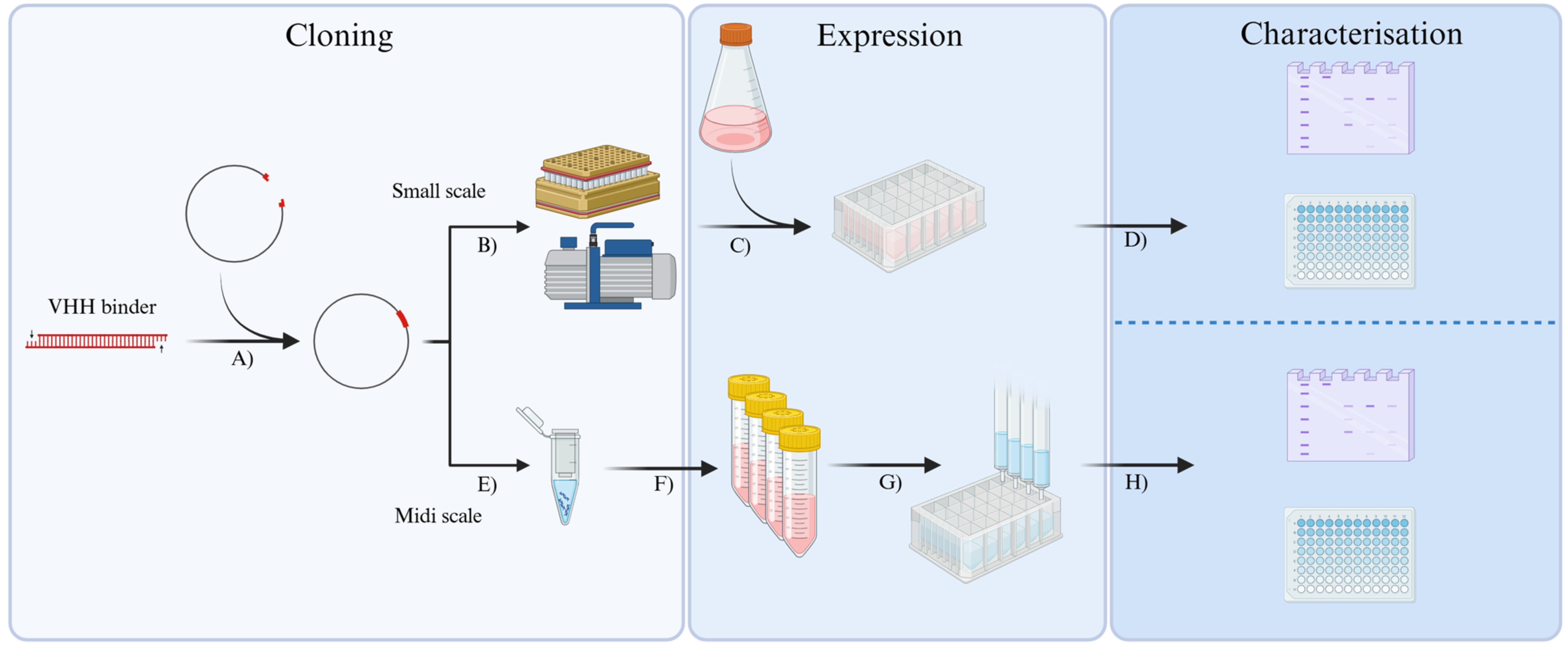
Schematic overview of the workflow outlined in this paper. Identified putative single-domain antibody (VHH) binders are (A) cloned into a selected vector from the pOPIN vector suite [1], (B) followed by plasmid DNA extraction and purification, and used for (C) small-scale (4 mL) mammalian transient transfection. (D) Secreted VHHs in the culture medium are quantified using densitometry on Coomassie-stained SDS-PAGE gels or observed by western blot, and binding to the target antigen is tested by titration enzyme-linked immunosorbent assay (ELISA). (E) Higher quantities of plasmid DNA from ELISA-positive clones are isolated by midi prep and used for (F) midi-scale (30 mL) mammalian transient transfection. (G) VHHs secreted into the culture medium are purified by affinity chromatography using a custom multi-column apparatus, which facilitates parallelised gravity purification. (H) The binding properties of the purified VHHs are observed and characterised by SDS-PAGE and titration ELISA before being used in subsequent pilot studies. Figure made using BioRender.
Background
Camelids (llamas, camels, and alpacas) produce unique heavy chain–only antibodies as part of their natural immune system, whose variable domains (VHHs or nanobodies) can be recombinantly expressed as monomeric antigen-binding proteins. VHHs have many applications in the biosciences, and their utilisation as anti-viral therapeutics has rapidly gathered momentum since the COVID-19 pandemic. Nanobodies are typically identified by screening phage display libraries of VHHs generated from either immunised camelids [2] or built by gene synthesis [3]. The small size of VHHs (14 kDa) means that they can easily be assembled into dimers and higher order multimers; a common format is genetic fusion to the Fc of immunoglobulin G (IgG). Bivalent nanobody-Fcs have increased binding activity compared to monomeric VHHs due to avidity and also gain the effector functions of IgGs. VHHs are generally produced in E. coli by secretion into the periplasm followed by purification using immobilised metal affinity chromatography [2,4,5]. However, transient expression in mammalian cells is the system of choice for producing VHH-Fcs as soluble authentic glycosylated products recoverable from the cell media by protein A affinity chromatography [6]. There is only one report of the expression of a soluble VHH-Fc in the cytoplasm of E. coli [7]. To accelerate the production of VHH-Fcs, we have developed a protocol for the streamlined construction and small-scale expression screening of VHH-Fcs using Expi293 cells. Given that not all VHHs are well expressed in E. coli in our experience, we have incorporated the production of monomeric nanobodies in mammalian cells into the workflow. These are expressed as either VHHs alone or fused to the extracellular domains of CD4, which can improve expression levels [8]. Using only common laboratory instrumentation and an easily made multi-column purification apparatus, this paper details an accessible, low-cost, and high-throughput method for the expression screening of VHHs in mammalian cells in three vector formats [1], midi scale up in 30 mL culture volume, and parallelised purification that generates sufficient material for characterising binding activity and testing in downstream functional assays. The identification of nanobodies that have been shown to bind to the spike protein of SARS-CoV-2 virus is presented to exemplify the methods.
Materials and reagents
Biological materials
1. StellarTM competent cells (TaKaRa, catalog number: 636766), store at -80 °C
2. Expi293FTM cells (Gibco, catalog number: A14527), store in liquid nitrogen vapour phase
Reagents
1. pOPINTTGneo_Fc (Addgene, catalog number: 252742), store at -20 °C
2. pOPINTTGneo_CD4 (Addgene, catalog number: 252740), store at -20 °C
3. pOPINTTGneo (Addgene, catalog number: 252739), store at -20 °C
4. Luria broth (LB) medium (FormediumTM, catalog number: LBL0103), store at room temperature (RT)
5. Bacto agar (FormediumTM, catalog number: AGR10), store at RT
6. Ampicillin (FormediumTM, catalog number: AMP100), store at 4 °C
7. QIAprep Spin Miniprep kit (QIAGEN, catalog number: 27104), store at RT
8. Nuclease-free water (not DEPC-treated) (InvitrogenTM, catalog number: AM9932), store at RT
9. rCutsmart® 10× buffer (New England Biolabs®, catalog number: B6004), store at -20 °C
10. KpnI-HFTM (New England Biolabs®, catalog number: R3142), store at -20 °C
11. PmeI (New England Biolabs®, catalog number: R0560L), store at -20 °C
12. Purelink PCR Purification kit (InvitrogenTM, catalog number: K310002), store at RT
13. TE buffer, Tris-EDTA, 1× solution, pH 8.0 (Fisher BioReagents, catalog number: BP2473), store at RT
14. Nb_Fc_Forward primer 5′ GCGTAGCTGAAACCGCCCAGGTGCAGCTGG 3′ (IDT), store at -20 °C
15. Nb_Fc_Reverse primer 5′ GTGATGGTGATGTTTCGAAGAGACGGTGACCTGG 3′ (IDT), store at -20 °C
16. Phusion flash high-fidelity PCR master mix (InvitrogenTM, catalog number: F548L), store at -20 °C
17. Highprep PCR magnetic beads (Magbio, catalog number: AC60050), store at 4 °C
18. Ethanol (EtOH) (Fisher BioReagentsTM, catalog number: E/0650DF/17), store at RT
19. ClonExpress II One-step Cloning kit (Vazymbiotech, catalog number: C112-02), store at -20 °C
20. Ultrapure IPTG (>99%) (NeoBiotech, catalog number: NB-45-00030-25G), store at -20 °C
21. X-gal ready to use (Thermo ScientificTM, catalog number: R0941), store at -20 °C
22. Terrific broth (TB), modified, granulated (Melford, catalog number: T15100), store at RT
23. Wizard® SV 96 plasmid DNA purification system (Promega, catalog number: A2255), store at RT
24. TTG_Forward primer 5′ CTGGCCATACACTTGAGTG 3′ (IDT), store at -20 °C
25. TTG_Reverse primer 5′ CCTTTATTAGCCAGAGGTCG 3′ (IDT), store at -20 °C
26. Taq polymerase with standard Taq reaction buffer (New England Biolabs, catalog number: M0273X), store at -20 °C
27. 25 mM dNTP (Thermo ScientificTM, catalog number: R1122), store at -20 °C
28. 5× GelPilot DNA loading dye (Qiagen, catalog number: 239901), store at 4 °C
29. Tris/borate/EDTA TBE buffer (Invitrogen, catalog number: 15581044), store at RT
30. SybrSafe DNA gel stain (Invitrogen, catalog number: S33102), store at 4 °C
31. HyperLadderTM 1 kb (Meridian Bioscience, catalog number: BIO-33053), store at 4 °C
32. Virkon® (Rely+onTM, catalog number: 12358667), store at RT
33. Expi293TM expression medium (GibcoTM, catalog number: A14351-01), store at 4 °C in the dark
34. Trypan Blue solution (Sigma, catalog number: T8154), store at RT
35. Opti-MEMTM I reduced serum medium (Gibco, catalog number: 31985062), store at RT in the dark
36. Polyethylenimine (PEI) MAX® 40K (Polysciences, catalog number: 24765-1), store at RT
37. HBSS, no calcium, no magnesium, no phenol red (GibcoTM, catalog number: 14175095), store at 4 °C
38. D (+)-glucose monohydrate (Thermo Fisher Scientific, catalog number: 450740050), store at RT
39. Valproic acid sodium salt (Sigma-Aldrich, catalog number: P4543), store at RT
40. Sodium propionate (Sigma-Aldrich, catalog number: P1880), store at RT
41. BSA (Sigma-Aldrich, catalog number: A2153), store at 4 °C
42. His-tagged VHH previously purified and quantified; store at -80 °C
43. 2× Laemmli buffer (Sigma-Aldrich, catalog number: S3401), store at 4 °C
44. Mark12TM unstained standard (InvitrogenTM, catalog number: LC5677), store at 4 °C
45. PageRulerTM Plus pre-stained protein ladder (ThermoScientific, catalog number: 26619), store at 4 °C
46. 20× NuPAGETM MES SDS running buffer (InvitrogenTM, catalog number: NP000202), store at RT
47. InstantBlue® Coomassie protein stain (Abcam, catalog number: ab119211), store at 4 °C
48. Ponceau S (Sigma, catalog number: P3504-10G), store at RT
49. Acetic acid (Thermo Scientific, catalog number: 11393358), store at RT
50. NaOH (Fluka, catalog number: 06203-5KG), store at RT
51. 10× PBS (Fisher BioReagentsTM, catalog number: BP399-20), store at RT
52. Skim milk powder (Oxoid, catalog number: LP0031), store at RT
53. Tween-20 (Sigma-Aldrich, catalog number: P1379), store at RT
54. Mouse monoclonal anti-polyhistidine-peroxidase antibody (Sigma, catalog number: A7058), store at -20 °C
55. Mouse monoclonal (JDC-10) anti-human IgG Fc (HRP) (Abcam, catalog number: ab99759), store at -20 °C
56. ECLTM western blotting detection reagent (Cytiva AmershamTM, catalog number: RPN2236), store at 4 °C
57. QuantaBluTM Fluorogenic Peroxidase Substrate kit (Thermo Scientific, catalog number: 15169), store at 4 °C
58. Plasmid Plus Midi kit (Qiagen, catalog number: 12945), store at RT
59. PierceTM Protein A plus agarose (Thermo ScientificTM, catalog number: 22811), store at 4 °C
60. TRIS base (Melford, catalog number: T60040), store at RT
61. Glycine (Melford, catalog number: G0709), store at RT
62. Hydrochloric acid (Sigma-Aldrich, catalog number: 30721-M), store at RT
63. Ni-NTA Superflow (Qiagen, catalog number: 1018142), store at 4 °C
64. Imidazole (Fluorochem, catalog number: F021690-1KG), store at RT
65. Sodium phosphate dibasic (Na2HPO4) (Sigma, catalog number: 71640-250G), store at RT
66. Sodium chloride (NaCl) (Fisher Chemical, catalog number: 10598630), store at RT
67. Ethylenediaminetetraacetic acid (EDTA) (Sigma, catalog number: 431788), store at RT
68. Nickel Sulphate (NiSO4) (Sigma, catalog number: N4882), store at RT
69. TRIS-HCl (Sigma, catalog number: 10812846001), store at RT
70. Sodium dodecyl sulfate (SDS) (Sigma, catalog number: L4509-10G), store at RT
Solutions
1. LB medium (see Recipes)
2. 100 mg/mL ampicillin (see Recipes)
3. 1% (w/v) agar LB plates containing 100 μg/mL ampicillin (see Recipes)
4. LB medium containing 100 μg/mL ampicillin (see Recipes)
5. 70% (v/v) EtOH (see Recipes)
6. 1 M IPTG (see Recipes)
7. 1% (w/v) agar LB containing 100 μg/mL ampicillin, 2 mM IPTG, and 40 μg/mL Xgal (see Recipes)
8. TB medium (see Recipes)
9. TB medium containing 100 μg/mL ampicillin (see Recipes)
10. 1× Tris/borate/EDTA (TBE) buffer (see Recipes)
11. 1% (w/v) agarose gel containing 1× SYBRTM Safe DNA gel stain (see Recipes)
12. 1 mg/mL PEI MAX 40K (see Recipes)
13. 45% w/v glucose (see Recipes)
14. 300 mM valproic acid (see Recipes)
15. 1 M sodium propionate (see Recipes)
16. 1× MES (see Recipes)
17. 0.1% Ponceau S (see Recipes)
18. 1 M NaOH (see Recipes)
19. 1× PBS (see Recipes)
20. 5% milk PBS (see Recipes)
21. 0.05% Tween-PBS (PBS-T) (see Recipes)
22. ECL western blotting substrate (see Recipes)
23. 2% milk PBS (see Recipes)
24. Antibody dilution buffer 0.1% (w/v) BSA-PBS (see Recipes)
25. QuantaBlu Fluorogenic Peroxidase Substrate kit (see Recipes)
26. Protein A neutralisation buffer (see Recipes)
27. Protein A elution buffer (see Recipes)
28. 0.5 M NaOH (see Recipes)
29. Ni-NTA wash buffer (see Recipes)
30. Ni-NTA elution buffer (see Recipes)
31. Stripping buffer (see Recipes)
32. Regeneration buffer (see Recipes)
Recipes
1. LB medium
| Reagent | Final concentration | Quantity or volume |
|---|---|---|
| LB medium mix | 25 g/L | 6.25 g |
| ddH2O | n/a | 250 mL |
| Total | n/a | 250 mL |
Autoclave and store at RT. Stable for at least one month.
2. 100 mg/mL ampicillin
| Reagent | Final concentration | Quantity or volume |
|---|---|---|
| Ampicillin | 100 mg/mL | 2 g |
| ddH2O | n/a | 20 mL |
| Total | n/a | 20 mL |
Filter-sterilise using a 0.22 μm filter. Prepare 500 μL aliquots and store at -20 °C. Stable for at least one year.
Caution: Ampicillin is a sensitiser.
3. 1% (w/v) agar LB plates containing 100 μg/mL ampicillin
| Reagent | Final concentration | Quantity or volume |
|---|---|---|
| LB medium mix | 25 g/L | 6.25 g |
| Bacto agar | 1% (w/v) | 2.5 g |
| ddH2O | n/a | 250 mL |
| Total | n/a | 250 mL |
| Ampicillin (Recipe 2) | 100 μg/mL | 250 μL |
Autoclave LB medium and Bacto agar mix and allow to cool to 55 °C before the addition of antibiotics. Invert to mix and pour into 8.5 cm Petri dishes in a safety cabinet. Allow to cool at RT. Prepare and use on the same day.
4. LB medium containing 100 μg/mL ampicillin
| Reagent | Final concentration | Quantity or volume |
|---|---|---|
| LB medium (Recipe 1) | n/a | 100 mL |
| Ampicillin (Recipe 2) | 100 μg/mL | 100 μL |
| Total | n/a | 100 mL |
Prepare just before use in a safety cabinet.
5. 70% (v/v) EtOH
| Reagent | Final concentration | Quantity or volume |
|---|---|---|
| Ethanol (absolute) | 70% (v/v) | 70 mL |
| H2O | n/a | 30 mL |
| Total | n/a | 100 mL |
Store at RT. Stable for at least 1 year.
6. 1 M IPTG
| Reagent | Final concentration | Quantity or volume |
|---|---|---|
| IPTG | 1 M | 4.766 g |
| ddH2O | n/a | 20 mL |
| Total | n/a | 20 mL |
Filter-sterilise using a 0.22 μm filter. Prepare 500 μL aliquots and store at -20 °C. Stable for at least one year.
7. 1% (w/v) agar LB containing 100 μg/mL ampicillin, 2 mM IPTG, and 40 μg/mL Xgal
| Reagent | Final concentration | Quantity or volume |
|---|---|---|
| LB medium mix | 25 g/L | 6.25 g |
| Bacto agar | 1% (w/v) | 2.5 g |
| ddH2O | n/a | Make up to 250 mL |
| Total | n/a | 250 mL |
| Ampicillin (Recipe 2) | 100 μg/mL | 250 μL |
| IPTG (Recipe 6) | 2 mM | 500 μL |
| X-gal (20 mg/mL) | 40 μg/mL | 500 μL |
Autoclave and allow to cool to 55 °C before the addition of additives. Invert to mix and pour into 8.5 cm Petri dishes in a safety cabinet. Allow to cool and set at RT. Store at 4 °C for one week.
8. TB medium
| Reagent | Final concentration | Quantity or volume |
|---|---|---|
| Bacto tryptone | 12 g/L | 3 g |
| Yeast extract | 24 g/L | 6 g |
| Glycerol | 0.4% (v/v) | 1 mL |
| KH2PO4 | 0.17 M | 0.5775 g |
| K2HPO4 | 0.72 M | 3.135 g |
| ddH2O | n/a | 250 mL |
| Total | n/a | 250 mL |
Autoclave and store at RT. Stable for at least one month.
9. TB medium containing 100 μg/mL ampicillin
| Reagent | Final concentration | Quantity or volume |
|---|---|---|
| TB medium (Recipe 8) | n/a | 100 mL |
| Ampicillin (Recipe 2) | 100 μg/mL | 100 μL |
| Total | n/a | 100 mL |
Prepare just before use in a safety cabinet.
10. 1× TBE buffer
| Reagent | Final concentration | Quantity or volume |
|---|---|---|
| TBE (10×) | 1× | 100 mL |
| H2O | n/a | 900 mL |
| Total | n/a | 1,000 mL |
Store at RT. Stable for at least one month.
11. 1% (w/v) agarose gel containing 1× SYBRTM Safe DNA gel stain
| Reagent | Final concentration | Quantity or volume |
|---|---|---|
| Agarose | 1% (w/v) | 1 g |
| TBE (Recipe 10) | 1× | 100 mL |
| Total | n/a | 100 mL |
| SYBRTM Safe DNA gel stain (1,000×) | 1× | 10 μL |
Heat in a microwave until the agarose has melted, and allow to cool to 55 °C before addition of the gel stain. Pour into the gel casting apparatus and allow to solidify. Prepare on the day of use.
12. 1 mg/mL PEI MAX 40K
| Reagent | Final concentration | Quantity or volume |
|---|---|---|
| PEI MAX 40K | 1 mg/mL | 100 mg |
| ddH2O | n/a | 100 mL |
| Adjust pH to 7 | ||
| Total | n/a | 100 mL |
Filter using a 0.22 μm membrane in a sterile environment. Store at 4 °C for one month or at -20 °C for up to 6 months.
13. 45% w/v glucose
| Reagent | Final concentration | Quantity or volume |
|---|---|---|
| Glucose | 45% (w/v) | 90 g |
| HBSS | n/a | 200 mL |
| Total | n/a | 200 mL |
Filter using a 0.22 μm membrane in a sterile environment. Store at 4 °C for one month or at -20 °C for up to 6 months.
Note: Enhancers can be prepared in sterile HBSS, cell media, or PBS. Preparation in HBSS may see precipitation of salts when storing, which can be resolved by warming in a water bath or preparing in an alternative solution.
14. 300 mM valproic acid
| Reagent | Final concentration | Quantity or volume |
|---|---|---|
| Valproic acid | 300 mM | 10 g |
| HBSS | n/a | 200 mL |
| Total | n/a | 200 mL |
Filter using a 0.22 μm membrane in a sterile environment. Store at 4 °C for one month or at -20 °C for up to 6 months.
Note: Enhancers can be prepared in sterile HBSS, cell media, or PBS. Preparation in HBSS may see precipitation of salts when storing, which can be resolved by warming in a water bath or preparing in an alternative solution.
15. 1 M sodium propionate
| Reagent | Final concentration | Quantity or volume |
|---|---|---|
| Sodium propionate | 1 M | 20 g |
| HBSS | n/a | 200 mL |
| Total | n/a | 200 mL |
Filter using a 0.22 μm membrane in a sterile environment. Store at 4 °C for one month or at -20 °C for up to 6 months.
Note: Enhancers can be prepared in sterile HBSS, cell media, or PBS. Preparation in HBSS may see precipitation of salts when storing, which can be resolved by warming in a water bath or preparing in an alternative solution.
16. 1× MES
| Reagent | Final concentration | Quantity or volume |
|---|---|---|
| MES (20×) | 1× | 100 mL |
| H2O | n/a | 1900 mL |
| Total | n/a | 2000 mL |
Store at RT. Stable for at least 1 year.
17. 0.1% Ponceau S
| Reagent | Final concentration | Quantity or volume |
|---|---|---|
| Ponceau S | 0.1% (w/v) | 0.1 g |
| Acetic acid | 1.5% (v/v) | 1.5 mL |
| ddH2O | n/a | 100 mL |
| Total | n/a | 100 mL |
Store at RT. Stable for at least 1 year.
18. 1 M NaOH
| Reagent | Final concentration | Quantity or volume |
|---|---|---|
| NaOH | 1 M | 40 g |
| ddH2O | n/a | 1,000 mL |
| Total | n/a | 1,000 mL |
Store at RT. Stable for at least 1 year.
19. 1× PBS
| Reagent | Final concentration | Quantity or volume |
|---|---|---|
| PBS (10×) | 1× | 100 mL |
| ddH2O | n/a | 900 mL |
| Total | n/a | 1,000 mL |
Store at RT. Stable for at least 1 month.
20. 5% milk PBS
| Reagent | Final concentration | Quantity or volume |
|---|---|---|
| Skim milk powder | 5% (w/v) | 2.5 g |
| PBS (Recipe 19) | 1× | 50 mL |
| Total | n/a | 50 mL |
Prepare on the day of use.
21. 0.05% Tween-PBS (PBS-T)
| Reagent | Final concentration | Quantity or volume |
|---|---|---|
| PBS (Recipe 19) | 1× | 1000 mL |
| Tween-20 | 0.05% (v/v) | 500 μL |
| Total | n/a | 1000 mL |
Store at RT. Stable for at least 1 month.
22. ECL western blotting substrate
| Reagent | Final concentration | Quantity or volume |
|---|---|---|
| Solution A | 50% (v/v) | 2.5 mL |
| Solution B | 50% (v/v) | 2.5 mL |
| Total | n/a | 5 mL |
Make and use immediately.
23. 2% milk PBS
| Reagent | Final concentration | Quantity or volume |
|---|---|---|
| Skim milk powder | 2% (w/v) | 1 g |
| PBS (Recipe 19) | 1× | 50 mL |
| Total | n/a | 50 mL |
Prepare on the day of use.
24. Antibody dilution buffer 0.1% (w/v) BSA-PBS
| Reagent | Final concentration | Quantity or volume |
|---|---|---|
| BSA | 0.1% (w/v) | 50 mg |
| PBS (Recipe 19) | 1× | 50 mL |
| Total | n/a | 50 mL |
Prepare on the day of use.
25. QuantaBlu Fluorogenic Peroxidase Substrate kit
| Reagent | Final concentration | Quantity or volume |
|---|---|---|
| QuantaBlu substrate solution | 90% (v/v) | 9 mL |
| QuantaBlu peroxide solution | 10% (v/v) | 1 mL |
| Total | n/a | 10 mL |
Prepare immediately before use.
26. Protein A neutralisation buffer
| Reagent | Final concentration | Quantity or volume |
|---|---|---|
| Tris base | 1 M | 12.11 g |
| ddH2O | n/a | 100 mL |
| Adjust pH to 9 | ||
| Total | n/a | 100 mL |
27. Protein A elution buffer
| Reagent | Final concentration | Quantity or volume |
|---|---|---|
| Glycine | 0.1 M | 751 mg |
| ddH2O | n/a | 100 mL |
| Adjust pH to 3.5 | ||
| Total | n/a | 100 mL |
Store at RT for up to one week.
28. 0.5 M NaOH
| Reagent | Final concentration | Quantity or volume |
|---|---|---|
| NaOH | 0.5 M | 20 g |
| ddH2O | n/a | 1000 mL |
| Total | n/a | 1000 mL |
Store at RT. Stable for at least 1 year.
29. Ni-NTA wash buffer
| Reagent | Final concentration | Quantity or volume |
|---|---|---|
| Imidazole | 30 mM | 1.02 g |
| PBS (Recipe 19) | 1× | 500 mL |
| Adjust pH to 7.4 | ||
| Total | n/a | 500 mL |
Store at RT. Stable for at least one month.
30. Ni-NTA elution buffer
| Reagent | Final concentration | Quantity or volume |
|---|---|---|
| Imidazole | 300 mM | 10.21 g |
| PBS (Recipe 19) | 1× | 500 mL |
| Adjust pH to 7.4 | ||
| Total | n/a | 500 mL |
Store at RT. Stable for at least one month.
31. Stripping buffer
| Reagent | Final concentration | Quantity or volume |
|---|---|---|
| Na2HPO4 | 20 mM | 2.84 g |
| NaCl | 500 mM | 29.22 g |
| EDTA | 50 mM | 14.61 g |
| ddH2O | n/a | 1,000 mL |
| Adjust pH to 7.5 | ||
| Total | n/a | 1,000 mL |
Store at RT. Stable for at least 6 months.
32. Regeneration buffer
| Reagent | Final concentration | Quantity or volume |
|---|---|---|
| NiSO4 | 0.1 M | 26.29 g |
| ddH2O | n/a | 1,000 mL |
| Total | n/a | 1,000 mL |
Store at RT. Stable for at least 6 months.
Laboratory supplies
1. 96-well PP 1.2 mL cluster tubes (Corning®, catalog number: CLS4411-960EA)
2. 8.5 cm Petri dishes (Greiner, Bio-One, catalog number: 633181)
3. 24-deep well plate (Sigma-Aldrich, Axygen, catalog number: AXYPDW10ML24C)
4. Cell culture adhesive seal (Azenta Life Sciences, catalog number: 4ti-0517)
5. PCR tubes and caps (VWR®, catalog number: 20170-010)
6. Microcentrifuge tube 1.5 mL (Greiner, Bio-One, catalog number: 616201)
7. 96-well PCR plate, non-skirted (StarLab, catalog number: E1403-1200-C)
8. 1.25 mL RitipsTM dispenser tips (Ritter PlasticTM, catalog number: 16610302)
9. Combitips® advanced 0.5, 2.5, 5, 10 mL (Eppendorf, catalog numbers: 0030089421, 0030089448, 0030089456, and 0030089464)
10. PCR foil seal (Azenta Life Sciences, catalog number: 4ti-0550)
11. 24-well tissue culture plate (Cell Scientific, catalog number: CC060024)
12. 96-well 2.2 mL deep-well block (Sigma Aldrich, Axygen, catalog number: AXYP2MLSQCS)
13. 1 L polycarbonate Erlenmeyer flask with vent cap (Corning®, catalog number: 431-147)
14. 15 mL conical centrifuge tube (Greiner, Bio-One, catalog number: 188261)
15. 24-well blocks RB (24) (Qiagen, catalog number: 19583)
16. NuPAGETM Bis-Tris Midi protein gels, 4%–12%, 1.0 mm (InvitrogenTM, catalog number: WG1403BOX)
17. iBlotTM 2 transfer stacks, nitrocellulose, regular size (Invitrogen, catalog number: IB23001)
18. Western blot box (Merck, catalog number: Z742095)
19. 384-well microplate without lid, black, high-binding, sterile (Greiner, Bio-One, catalog number: 781077)
20. Reagent reservoirs, non-sterile (VWR®, catalog number: 613-1176)
21. TPP® TubeSpin bioreactor tubes (Merck, catalog number: Z761028)
22. 50 mL centrifuge tube storage box (Merck, catalog number: EP0030140591)
23. 50 mL centrifuge tube, conical bottom (Greiner Bio-One, catalog number: 227261)
24. Poly-Prep® chromatography columns (Bio-Rad, catalog number: 7311550)
25. 96-deep-well 2 mL plate (FisherbrandTM, catalog number: 11391555)
26. NuPAGETM Bis-Tris Mini protein gels, 4%–12%, 1.0–1.5 mm (InvitrogenTM, catalog number: NP0329BOX)
27. PD Miditrap 10 (Sigma Aldrich, Cytiva, catalog number: GE28-9180-08)
Equipment
1. Class 2 microbiological safety cabinet (Contained Air solutions, catalog number: BioMAT 2)
2. Orbital shaking incubator (Shel Lab, catalog number: SI6/SI6R)
3. HeracellTM VIOS 160i CO2 Incubator (Thermo Scientific, catalog number: 51033559)
4. PCR thermal cycler (Applied Biosystems, catalog number: 4375305)
5. FrescoTM 21 microcentrifuge (Thermo Scientific, catalog number: 75002555)
6. NanoDropTM One/OneC microvolume UV-Vis spectrophotometer (Thermo Scientific, catalog number: ND-ONE-W)
7. Multi-sub electrophoresis system (Thistle Scientific, catalog number: 41105340)
8. HandyStepTM Touch Electronic Repeating Pipette (BRAND, catalog number: 16328007)
9. Picus® 2 Electronic 8-Channel Pipette 0.5–10 μL (Sartorius, catalog number: LH-747321)
10. Picus® 2 Electronic 8-Channel Pipette 10–300 μL (Sartorius, catalog number: LH-747361)
11. Picus® 2 Electronic 8-Channel Pipette 50–1,200 μL (Sartorius, catalog number: LH-747391)
12. DynaMagTM 96-side magnet (Invitrogen, catalog number: 12331D)
13. NanoPhotometer® N120 (Implen, catalog number: 16309021)
14. Multifuge X4 Pro-MD (Thermo Scientific, catalog number: 75009500)
15. Chemical duty pump (Millipore, catalog number: WP6122050)
16. Vac-Man® 96 vacuum manifold (Promega, catalog number: A2291)
17. Multipipette® M4 (Eppendorf, catalog number: 4982000012)
18. PowerPac basic power supply (Bio-Rad, catalog number: 1645050EDU)
19. XCell4 SureLockTM Midi-Cell (Invitrogen, catalog number: WR0100)
20. ChemiDocTM imaging system (Bio-Rad, catalog number: 12003154)
21. iBLOTTM 2 gel transfer device (Invitrogen, catalog number: IB21001)
22. Dry heating block (Grant, catalog number: QBD2)
23. WellwashTM microplate washer (ThermoFisher, catalog number: 5165000)
24. Digital microplate shaker (Corning, catalog number: S2020-P4-COR)
25. CLARIOstar Plus plate reader (BMG Labtech, catalog number: 430-501S-FL)
26. Custom multi-column purification apparatus
27. Roller mixer (Stuart, catalog number: SRT9)
Software and datasets
1. ImageLab Software (Bio-Rad, version 6.1.0 build7); requires a license but ImageJ can be used for free (detailed below)
2. ImageJ (NIH, version 1.54g); public domain
3. SnapGene (Dotmatics, version 8.2); requires a license
Procedure
登录/注册后免费查看全文
文章信息
稿件历史记录
提交日期: Feb 13, 2026
接收日期: Mar 27, 2026
在线发布日期: Apr 12, 2026
出版日期: May 5, 2026
版权信息
© 2026 The Author(s); This is an open access article under the CC BY-NC license (https://creativecommons.org/licenses/by-nc/4.0/).
如何引用
Campaigne, H. A., Parker, K., Owens, R. J. and Eyssen, L. E. A. (2026). Parallelised Cloning, Mammalian Cell Expression, and Purification of Nanobodies Identified by Phage Display. Bio-protocol 16(9): e5682. DOI: 10.21769/BioProtoc.5682.

 Download Citation in RIS Format
分类
分子生物学 > DNA > DNA 克隆
分子生物学 > 蛋白质 > 表达
生物化学 > 蛋白质 > 表达
您对这篇实验方案有问题吗?
在此处发布您的问题,我们将邀请本文作者来回答。同时,我们会将您的问题发布到Bio-protocol Exchange,以便寻求社区成员的帮助。
 发布问题
发布问题


