


Efficient and Site-Specific Incorporation of 3-Nitro-Tyrosine Into Recombinant Proteins in Escherichia coli
在大肠杆菌中高效、定点掺入 3-硝基酪氨酸至重组蛋白中的方案

发布: 2026年04月20日第16卷第8期 DOI: 10.21769/BioProtoc.5674 浏览次数: 481
评审: Elena A. OstrakhovitchAnonymous reviewer(s)
 PDF
PDF  Q&A
Q&A
参见作者原研究论文
The authors used this protocol in:
Jul 2020
Advertisement







Abstract
3-nitro-tyrosine (nitroTyr) is one of numerous oxidative protein modifications implicated in diseases such as cardiovascular disease, cancer, and amyotrophic lateral sclerosis (ALS). Because of this, the ability to site-specifically encode nitroTyr into recombinant proteins is a powerful approach for studying these disease pathways. However, producing proteins with defined nitration sites is technically challenging due to the limitations of traditional chemical nitration via peroxynitrite, which lacks residue and site-specificity. Genetic code expansion (GCE) offers a solution by enabling precise incorporation of nitroTyr at designated TAG codons using engineered aminoacyl-tRNA synthetase/tRNA pairs from Methanocaldococcus jannaschii and Methanomethylophilus alvus. This protocol provides a reliable, optimized workflow for incorporating nitroTyr into proteins in E. coli using GCE. It guides users through key considerations in selecting cell lines, media conditions, and GCE systems to minimize off-target effects such as release factor 1 competition, near-cognate suppression, and chemical reduction of nitroTyr. The method is demonstrated using wild-type and TAG-containing superfolder GFP but is broadly applicable to other proteins of interest.
Key features
• This protocol offers a practical guide for the recombinant expression of proteins containing site-specific 3-nitro-tyrosine in E. coli.
• These methods should be used to characterize the functional and structural consequences of site-specific tyrosine nitration on proteins without having to modify any other residues.
• This protocol avoids the use of peroxynitrite as a method to nitrate proteins, which modifies all solvent accessible tyrosine residues to different extents.
• Users are guided through the advantages and disadvantages of using different expression strains and genetic code expansion systems depending on specific needs.
Keywords: 3-nitro-tyrosine (3-硝基酪氨酸) Genetic code expansion (遗传密码子扩展)
Amber suppression (琥珀终止密码子抑制)
Aminoacyl tRNA synthetase (氨酰tRNA合成酶)
Methanocaldococcus jannaschii (詹氏甲烷热球菌)
Methanomethylophilus alvus (Alvus甲烷甲基嗜盐菌)
Genetic code expansion (遗传密码子扩展)
Amber suppression (琥珀终止密码子抑制)
Aminoacyl tRNA synthetase (氨酰tRNA合成酶)
Methanocaldococcus jannaschii (詹氏甲烷热球菌)
Methanomethylophilus alvus (Alvus甲烷甲基嗜盐菌)
Graphical overview
Background
The accumulation of oxidatively modified proteins is a hallmark of many human diseases, including cardiovascular disease, neurodegeneration, and cancer [1–3]. A key contributor to this phenomenon is oxidative stress, where cells experience an imbalance between oxidants and antioxidants, which leads to cellular damage via reactive oxygen and nitrogen species. Among these, peroxynitrite is a potent oxidant that reacts with tyrosine residues to form 3-nitro-tyrosine (nitroTyr) [4], a stable and commonly detected post-translational modification. Due to its strong association with pathological conditions, nitroTyr has emerged as a widely used marker of oxidative stress in both clinical and research settings [5].
Nitration of tyrosine residues is increasingly recognized as a mechanism that can alter protein function and contribute to disease phenotypes [1–3,6–7]. Several studies have shown that nitration can enhance or inhibit protein activity, affect subcellular localization, or modulate protein–protein interactions [8,9]. In cases where nitroTyr has been introduced into proteins site-specifically, they have been instrumental in confirming that specific nitration events are sufficient to cause gain-of-function and loss-of-function phenotypes in cells, providing causal evidence for the role of nitration in disease mechanisms [10,11].
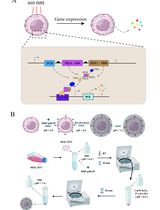
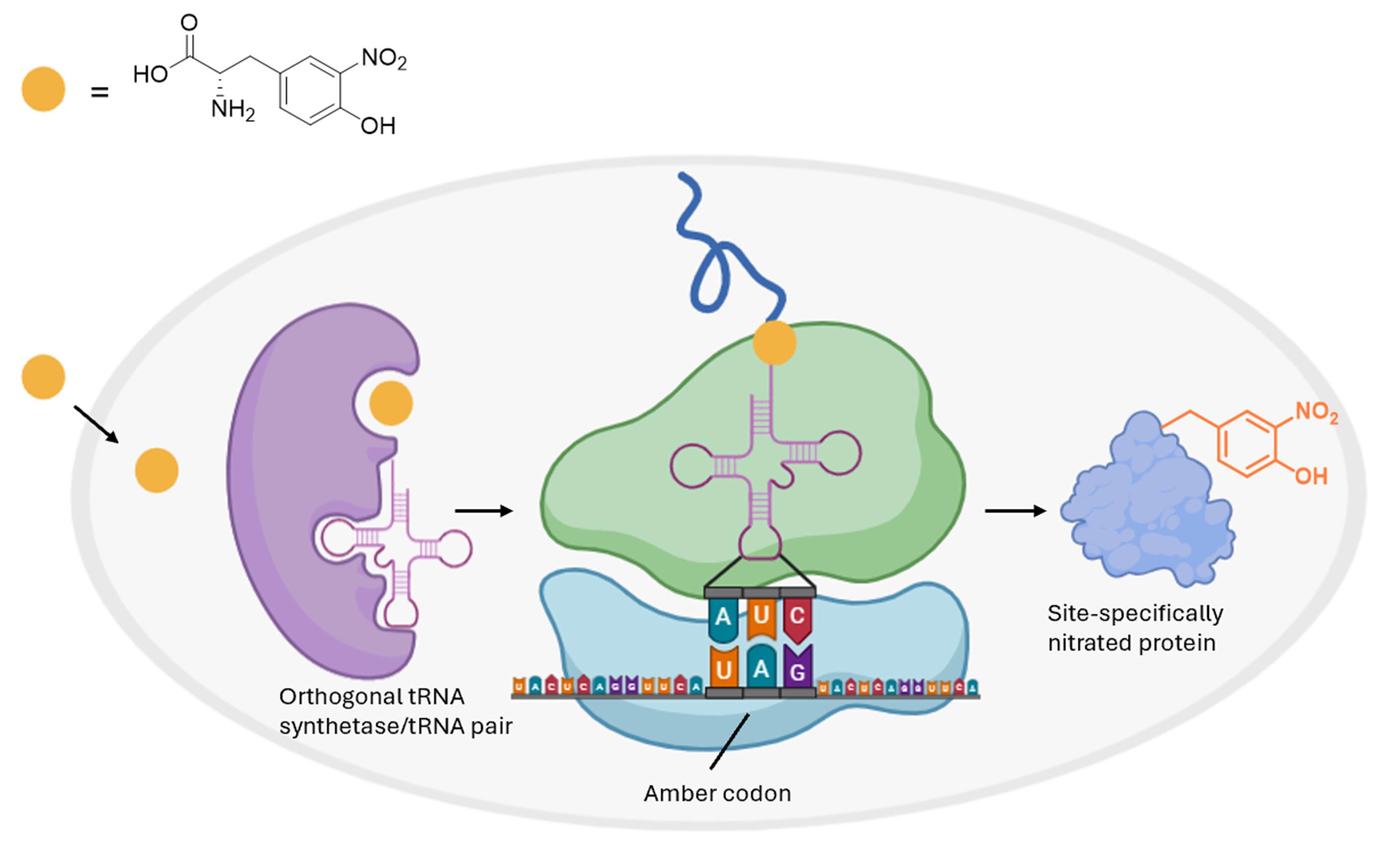
Genetic code expansion (GCE) allows for this translational incorporation of nitroTyr at genetically defined sites within a protein of interest (Figure 1). This is achieved by repurposing the TAG amber stop codon to encode nitroTyr, using engineered orthogonal aminoacyl-tRNA synthetase/tRNA pairs that recognize nitroTyr. This contrasts with traditional chemical nitration methods, such as treating proteins with peroxynitrite, which result in heterogeneous mixtures of nitrated protein due to lack of residue and site-specificity [12].
The need to generate homogenous and site-specific nitrated proteins has driven the development of improved systems for nitroTyr encoding [13,14]. For researchers new to GCE, selecting an appropriate system and set of expression conditions can be challenging. In this protocol, we focus on two broadly effective and well-validated systems derived from the Methanocaldococcus jannaschii tyrosyl pair (MjTyrRS/tRNA) [13] and the Methanomethylophilus alvus pyrrolysyl pair (MaPylRS/tRNA) [14], both of which have been engineered to support high-fidelity nitroTyr incorporation. While site-specific homogenous nitration is the goal, outcomes are often context-dependent and users may experience common GCE encoding issues observed under suboptimal GCE expression conditions, such as competition with release factor 1 (RF1) leading to truncated proteins [13], near-cognate suppression inserting natural amino acids at TAG sites [15], or chemical reduction of the encoded nitroTyr to 3-amino-tyrosine [16,17]. This protocol provides clear strategies for selecting appropriate cell lines, media formulations, and induction conditions that effectively mitigate these challenges.
Specifically, we present a detailed, step-by-step workflow for site-specific nitroTyr incorporation in E. coli, guiding users in the selection between release factor 1 (RF1)-containing [BL21(DE3)] and RF1-deficient [B95(DE3) ΔAΔfabR] strains, media conditions that minimize misincorporation or chemical reduction, and appropriate use of either Mj- or Ma-derived GCE systems. While the protocol is demonstrated using superfolder GFP (sfGFP) as a control protein, it is broadly applicable to other recombinant proteins. With careful optimization based on the guidelines provided here, researchers can reliably express homogeneously nitrated proteins suitable for downstream functional, structural, or mechanistic studies. Importantly, all required expression strains and GCE machinery plasmids described here are available through the public repository Addgene.
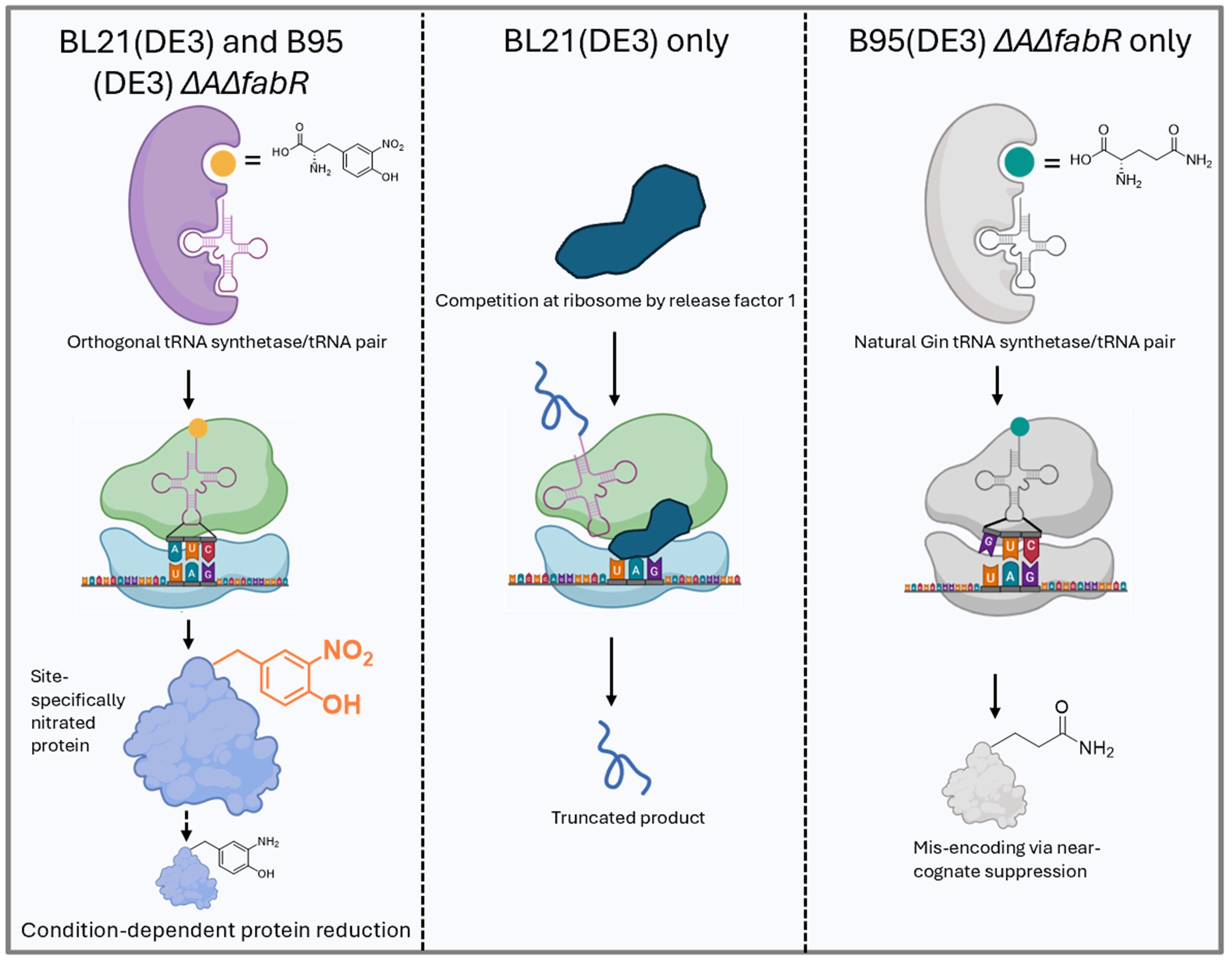
Figure 1. Genetic encoding of nitroTyr in BL21(DE3) and B95(DE3) ΔAΔfabR cells. (Left) After entering the cell, nitroTyr is aminoacylated onto its cognate amber-suppressing tRNA by the nitroTyr-specific tRNA-synthetase. At the ribosome, this charged tRNA base pairs with the UAG codon in the mRNA of the protein of interest, resulting in site-specific incorporation of nitroTyr into the growing polypeptide. Under reducing conditions or limited aeration, nitroTyr incorporated into the protein can be chemically reduced to amino-tyrosine. (Middle) In BL21(DE3) cells, which contain release factor 1 (RF1), translation can terminate prematurely at the UAG codon, producing truncated protein in addition to full-length, nitrated protein. (Right) RF1-deficient B95(DE3) ΔAΔfabR cells prevent truncation, but inefficient aminoacylation of the nitroTyr-tRNA can lead to near-cognate suppression, where glutamine is mis-incorporated at the UAG codon by endogenous Gln-tRNA.
Materials and reagents
Biological materials
Expression strains
1. BL21(DE3) (ThermoFisher, catalog number: EC0114)
This E. coli strain is optimized for over-expression of target proteins driven by the T7 transcriptional promoter, which is commonly used in pET expression vectors. It carries a genomic copy of the T7 RNA polymerase gene under control of the lacUV5 promoter; induction with IPTG triggers T7 polymerase expression, leading to efficient transcription of the target gene and high yields of recombinant protein. Because this strain retains release factor 1 (RF1, the protein that terminates translation at TAG stop codons), expression of proteins containing TAG-encoded noncanonical amino acids can result in both truncated and full-length proteins. To prevent co-purification of truncated protein with the desired full-length protein, the use of a C-terminal affinity tag is recommended.
2. B95(DE3) ΔAΔfabR (Addgene, catalog number: 197934)
This strain is a fast-growing BL21(DE3) derivative that lacks RF1, the protein responsible for terminating translation at TAG codons, and carries a spontaneous mutation in the fabR gene [18]. To preserve cellular viability and reduce unintended readthrough in the absence of RF1, endogenous TAG stop codons in 95 genes were converted to TAA or TGA. Compared to standard BL21(DE3), this strain may be preferred for protein expression because RF1 deletion enhances TAG codon suppression by GCE machinery and minimizes production of truncated proteins caused by premature termination at TAG sites. However, this introduces another issue: near-cognate suppression. If the level of nitroTyr aminoacylated tRNA concentration is insufficient, native tRNAs in the cell (e.g., Gln-tRNA) can suppress TAG codons and result in the insertion of natural amino acids at the intended site of nitroTyr encoding. Thus, optimizing nitroTyr concentration, as well as choosing the right cell line and media combination, is crucial for faithful incorporation of nitroTyr in B95 cells. See below in “Choice of cell line, GCE machinery system and media” for more information.
Plasmids
1. pAJE-30-Mj-nitroTyr (Addgene, catalog number: 249488)
Machinery plasmid that enables encoding of nitroTyr at TAG codons. It expresses the Methanocaldococcus jannaschii (Mj)-TyrRS-nitroTyr “A7” [13] RS from a constitutive lpp promoter, as well as its cognate TAG codon-suppressing tRNA from a constitutive lpp promoter. This plasmid has spectinomycin resistance and contains a low-copy synthetic origin of replication [19,20] that is compatible with all standard origins, including ColE1/pBR322/pMB1, CDF, and p15A.
2. pAJE-30-Ma-nitroTyr (Addgene, catalog number: 249487)
Machinery plasmid that enables encoding of nitroTyr at TAG codons. It expresses the Methanomethylophilus alvus (Ma)-TyrRS-nitroTyr [14] RS from a constitutive GlnS promoter, as well as its cognate TAG codon-suppressing tRNA from a constitutive lpp promoter. This plasmid has spectinomycin resistance and contains a low-copy synthetic origin of replication [19,20] that is compatible with all standard origins, including ColE1/pBR322/pMB1, CDF, and p15A.
3. pET28-sfGFP WT (Addgene, catalog number: 85492)
Expresses wild-type sfGFP control protein with C-terminal His6 tag, under a T7 transcriptional promoter, kanamycin resistance, and pBR322 origin of replication. sfGFP is expressed by the addition of IPTG or lactose.
4. pET28-sfGFP TAG150 (Addgene, catalog number: 85493)
Same as above, except the sfGFP gene contains a TAG amber stop codon at site N150. The TAG codon is used to direct the translational encoding of nitroTyr.
5. pET28-(GOI) WT (you must clone)
Expresses your wild-type protein of interest (POI). You can clone the gene for your POI into the pET28 backbone by digesting with the restriction enzymes NcoI and XhoI, thus removing the gene for sfGFP. Your gene of interest (GOI) can then be put in using standard cloning techniques (ligation, Gibson Assembly, or SLiCE [21]).
6. pET28-(GOI) TAG (you must clone)
Expresses your POI with nitroTyr encoded at a TAG codon. You can clone the gene for your POI into the pET28 backbone by digesting with the restriction enzymes NcoI and XhoI, thus removing the gene for sfGFP. Your GOI can then be put in using standard cloning techniques (ligation, Gibson Assembly, or SLiCE [21]). The codon where you want to encode nitroTyr can be changed to a TAG codon using site-directed mutagenesis.
Choice of cell line, GCE machinery system, and media
Successful, efficient encoding and purification of nitroTyr into proteins is strongly dependent on three key experimental variables: cell line, growth media, and the choice of GCE machinery. Optimal expression and purification yield full-length nitrated protein, with >95% of protein molecules containing nitroTyr at the intended site. However, suboptimal conditions can lead to three common side products, as shown in Figure 1: (i) reduction of nitroTyr to 3-amino-tyrosine (aminoTyr) after successful incorporation, driven by the reducing environment of the cell; (ii) truncated protein, resulting from premature translation termination at TAG codons due to RF1; and (iii) misincorporation of glutamine via near-cognate suppression when the TAG codon is misread by endogenous tRNAs.
Each of these outcomes is highly context-dependent. The greatest variable is the reduction of nitroTyr to aminoTyr, since this is influenced by oxygen availability, media composition, the POI, and the site of encoding. AminoTyr cannot be encoded by the nitroTyr RS/tRNA pairs, but cellular reductases can convert some encoded nitroTyr protein sites to aminoTyr, provided encoding sites are accessible and expression conditions are limited in oxygen. To minimize reduction, cultures should be well-aerated using baffled flasks, antifoam agents, and high shaking speeds (250–300 rpm) during expression.
Truncation at TAG codons is inherent to RF1-positive strains such as BL21(DE3), but the effects of this issue can often be mitigated by using C-terminal purification tags, which allow for selective purification of full-length product. When C-terminal tagging is compatible with the POI, BL21(DE3) is a practical and effective option. By contrast, B95(DE3) ΔAΔfabR is an RF1-deficient strain that enables truncation-free expression, supporting both N- and C-terminal tags without co-purification of prematurely truncated protein.
However, the B95(DE3) ΔAΔfabR strain is more sensitive to expression inefficiencies: when intracellular nitroTyr is insufficient, near-cognate suppression may occur, most often resulting in glutamine incorporation at the intended nitroTyr site. In our experience, the likelihood of near-cognate suppression in B95(DE3) ΔAΔfabR is strongly influenced by media composition because nitroTyr uptake is significantly more efficient in “defined” media compared to “complex” media (e.g., ZY) containing tryptone and yeast extract. Poor uptake of nitroTyr in “complex” media leads to low efficiency of nitroTyr tRNA aminoacylation, allowing endogenous tRNA suppression of the UAG codon to occur readily in B95(DE3) cells. In contrast, with BL21(DE3) cells, RF1 will dominate over near-cognate suppression, leading to translational termination instead of mis-encoding of canonical aminos at the UAG codon. With sfGFP proteins, we observe up to 40% misincorporation when nitroTyr-containing proteins are expressed in B95(DE3) ΔAΔfabR cells using ZY “complex” media with either the Mj or Ma machinery systems. Switching to defined media effectively eliminates this issue and yields homogeneously nitrated, full-length protein in the B95(DE3) ΔAΔfabR strain.
We have also observed that the M. alvus GCE system, while efficient, can be moderately toxic in B95 cells, likely due to background expression or metabolic burden. The M. jannaschii system is well tolerated in both BL21(DE3) and B95(DE3) ΔAΔfabR strains. From a practical standpoint, ZY media is easy to prepare and suitable for routine use, whereas defined media requires more components and preparation time.
Given these considerations, we recommend the following strategies:
• When truncation is acceptable and C-terminal tags are compatible with your POI, we recommend the M. alvus GCE system in BL21(DE3) grown in ZY auto-induction media. This setup is robust, user-friendly, and produces high yields of homogeneously nitrated protein. The Ma nitroTyr GCE system can also be used to incorporate 3-chloroTyr, 3-bromoTyr, and 3-iodoTyr [13].
• When N-terminal purification tags are required, multi-site incorporation is desired, or truncation would compromise protein function, we recommend the M. jannaschii GCE system in B95(DE3) ΔAΔfabR, grown in defined auto-induction media, to ensure full-length, site-specifically nitrated protein without misincorporation.
Table 1 summarizes the advantages and disadvantages of BL21(DE3) vs. B95(DE3) ΔAΔfabR expression hosts and media combination to help users select the most appropriate strategy for their specific expression system.
Table 1. Summary of GCE system considerations when expressing proteins with nitroTyr
| Feature/consideration | BL21(DE3) | B95(DE3) ΔAΔfabR |
|---|---|---|
| RF1 status | RF1-positive → truncation possible | RF1-deficient → full-length expression only, no truncation |
| Recommended purification tag | C-terminal tag (to exclude truncated products) | N- or C-terminal tag |
| Recommended media | ZY auto-induction media | Defined auto-induction media |
| Misincorporation (i.e., near-cognate suppression) | Undetectable in all media | Undetectable in defined media; high in ZY media |
| Ease of media preparation | Easy (ZY-based media) | More labor-intensive (defined media) |
| GCE system recommendation | M. alvus (preferred), M. jannaschii (also compatible) | M. jannaschii (preferred due to lower toxicity) |
| Multi-site incorporation compatibility | Modest, 1–2 sites (due to RF1-mediated truncation) | Effective, up to 3 sites (no RF1 interference) |
Reagents
Essential reagents
1. NaCl (e.g., VWR, catalog number: 97061-274)
2. α-D-glucose (e.g., VWR, catalog number: 97061-168)
3. α-lactose (e.g., RPI, catalog number: 26100-1000)
4. Glycerol (e.g., VWR, catalog number: BDH24388.320)
5. Na2HPO4 (e.g., VWR, catalog number: 97061-586)
6. KH2PO4 (e.g., VWR, catalog number: BDH9268)
7. NH4Cl (e.g., VWR, catalog number: 12125-02-9)
8. Na2SO4 (e.g., VWR, catalog number: 7757-82-6)
9. MgSO4 (e.g., VWR, catalog number: 7487-88-9)
10. CaCl2·2H2O (e.g., VWR, catalog number: 10035-04-8)
11. MnCl2·4H2O (e.g., VWR, catalog number: 13446-34-9)
12. ZnSO4·7H2O (e.g., VWR, catalog number: 7446-20-0)
13. CoCl2·6H2O (e.g., VWR, catalog number: 7791-13-1)
14. CuCl2 (e.g., VWR, catalog number: 10125-13-0)
15. NiCl2 (e.g., VWR, catalog number: 7791-20-0)
16. Na2MoO4·2H2O (e.g., VWR, catalog number: 10102-40-6)
17. Na2SeO3 (e.g., VWR, catalog number: 10102-18-8)
18. H3BO3 (e.g., VWR, catalog number: 10043-35-3)
19. FeCl3 (e.g., VWR, catalog number: 7705-08-0)
20. Kanamycin (e.g., VWR, catalog number: 75856-684)
21. Spectinomycin sulfate (e.g., VWR, catalog number: 89156-368)
22. Agar (e.g., VWR, catalog number: 97064-336)
23. Polypropylene glycol 2000 (PPG2000, antifoam) (e.g., Thermo Fisher Scientific, catalog number: AAL14699AP)
24. 3-Nitro-L-tyrosine (Thermo Fisher Scientific, catalog number: A11018)
Reagents necessary only for ZY media
25. Tryptone (e.g., VWR, catalog number: 97063-386)
26. Yeast extract (e.g., VWR, catalog number: 97064-368)
Reagents necessary only for defined auto-induction media
27. Glutamic acid, Na salt (e.g., VWR, catalog number: 56-86-0)
28. Aspartic acid (e.g., VWR, catalog number: 56-84-8)
29. Lysine-HCl (e.g., VWR, catalog number: 657-27-2)
30. Arginine-HCl (e.g., VWR, catalog number: 1119-34-2)
31. Histidine-HCl-H2O (e.g., VWR, catalog number: 5934-29-2)
32. Alanine (e.g., VWR, catalog number: 56-41-7)
33. Proline (e.g., VWR, catalog number: 147-85-3)
34. Glycine (e.g., VWR, catalog number: 56-40-6)
35. Threonine (e.g., VWR, catalog number: 72-19-5)
36. Serine (e.g., VWR, catalog number: 56-45-1)
37. Glutamine (e.g., VWR, catalog number: 56-85-9)
38. Asparagine-H2O (e.g., VWR, catalog number: 5794-13-8)
39. Valine (e.g., VWR, catalog number: 72-18-4)
40. Leucine (e.g., VWR, catalog number: 61-90-5)
41. Isoleucine (e.g., VWR, catalog number: 73-32-5)
42. Phenylalanine (e.g., VWR, catalog number: 63-91-2)
43. Tryptophan (e.g., VWR, catalog number: 73-22-3)
44. Methionine (e.g., VWR, catalog number: 63-68-3)
Solutions
Essential solutions for all media
1. LB/agar media (see Recipes)
2. 2× YT media (see Recipes)
3. SOC media (see Recipes)
4. Kanamycin stock (see Recipes)
5. Spectinomycin sulfate stock (see Recipes)
6. 25× M salts (see Recipes)
7. Trace metal stock solution (5,000×) (see Recipes)
8. 50× 5052 solution (see Recipes)
9. nitroTyr stock solution (see Recipes)
Solutions necessary only for ZY media
10. ZY media (see Recipes)
11. ZY non-inducing (ZY-NIM) and auto-inducing media (ZY-AIM) (see Recipes)
Solutions necessary only for defined auto-induction media
12. Aspartate [5% (w/v), pH 7.5] (see Recipes)
13. 18-amino-acid mix (25×) (see Recipes)
14. Defined NIM and AIM media (see Recipes)
Recipes
1. LB/agar media
| Reagent | Final concentration | Amount |
|---|---|---|
| Tryptone | 1% (w/v) | 5 g |
| Yeast extract | 0.5% (w/v) | 2.5 g |
| NaCl | 1.0% (w/v) | 5 g |
| Agar | 1.5% (w/v) | 7.5 g |
| H2O | n/a | To 500 mL |
| Total | n/a | 500 mL |
After mixing reagents thoroughly, autoclave on a standard liquid setting to sterilize. Note that the agar will not go into solution until autoclaved. After autoclaving, gently swirl the bottle to ensure molten agar is evenly mixed.
Notes:
1. Store LB/agar bottle in a 65 °C oven and pour plates on an as-needed basis. LB/agar media can be stored in molten form for ~2 weeks, if sterility is maintained.
2. If an oven is not available, plates can be poured with antibiotics once LB/agar is sufficiently cooled to touch. Plates can be stored at 4 °C for up to a week.
2. 2× YT media
| Reagent | Final concentration | Amount |
|---|---|---|
| Tryptone | 1.6% (w/v) | 16 g |
| Yeast extract | 1.0% (w/v) | 10 g |
| NaCl | 0.5% (w/v) | 5 g |
| H2O | n/a | To 1,000 mL |
| Total | n/a | 1 L |
After mixing the reagents thoroughly, autoclave on the standard liquid setting to sterilize. After autoclaving, allow it to cool to room temperature before use.
3. SOC media
| Reagent | Final concentration | Amount |
|---|---|---|
| 2× YT media | n/a | 49 mL |
| 1 M MgSO4 | 10 mM | 0.5 mL |
| 40% (w/v) α-D-glucose | 0.4% (w/v) or ~20 mM | 0.5 mL |
| Total | n/a | 50 mL |
a. 1 M MgSO4 can be made by mixing 12.3 g of MgSO4·7H2O in water up to 50 mL total volume. Adjust the mass of MgSO4 accordingly if using a salt with a different hydration status.
b. 40% (w/v) α-D-glucose can be made by mixing 20 g of α-D-glucose with water up to 50 mL total volume. Mix thoroughly until glucose is dissolved. Gentle heating in a microwave may facilitate the dissolution of glucose.
c. Sterilize MgSO4, glucose, and 2× YT solutions individually by autoclaving. Allow each component to cool to room temperature and mix as indicated above. Maintain sterility while adding components together.
d. It is easy to contaminate SOC. We suggest breaking this into 5 × 10 mL aliquots before use or making smaller batches. If sterility is maintained, SOC can be stored at room temperature indefinitely. It can also be stored at -20 °C, but avoid repeated freeze/thaws.
4. Kanamycin stock (10 mL)
| Reagent | Final concentration | Amount |
|---|---|---|
| Kanamycin | 50 mg/mL | 0.5 g |
| H2O | n/a | To 10 mL |
| Total | n/a | 10 mL |
Sterilize by filtering with a 0.2 μm syringe-end filter. Store in 1 mL aliquots at -20 °C.
5. Spectinomycin sulfate stock (10 mL)
| Reagent | Final concentration | Amount |
|---|---|---|
| Spectinomycin sulfate | 100 mg/mL | 1 g |
| H2O | n/a | To 10 mL |
| Total | n/a | 10 mL |
Sterilize by filtering with a 0.2 μm syringe-end filter. Store in 1 mL aliquots at -20 °C.
Note: Do not confuse spectinomycin with streptomycin. These antibiotics are not interchangeable.
6. 25× M salts
| Reagent | 25× concentration | Amount for 25× |
|---|---|---|
| Na2HPO4 | 0.625 M | 88.7 g |
| KH2PO4 | 0.625 M | 85.1 g |
| NH4Cl | 1.25 M | 66.9 g |
| Na2SO4 | 0.125 M | 17.8 g |
| H2O | n/a | to 1 L |
| Total | 1 L |
Add the above components to a 2 L beaker containing a magnetic stir bar. Add water up to 900 mL and mix until all solutions have dissolved. Add the remaining volume of water to reach 1 L. Weights indicated are based on anhydrous salts. If using hydrated phosphate salts, adjust the weights accordingly to maintain the indicated molarities.
7. Trace metal stock solution (5,000×)
| Reagent | Concentration | Amount for individual 30 mL stocks | |
| 5,000× | 1× | ||
| CaCl2·2H2O | 20 mM | 4 μM | 8.82 g |
| MnCl2·4H2O | 10 mM | 2 μM | 5.93 g |
| ZnSO4·7H2O | 2 M | 2 μM | 8.62 g |
| CoCl2·6H2O | 2 mM | 0.4 μM | 1.32 g |
| CuCl2 | 2 mM | 0.4 μM | 807 mg |
| NiCl2 | 2 mM | 0.4 μM | 777 mg |
| Na2SeO3 | 2 mM | 0.4 μM | 1.03 g |
| Na2MoO4·2H2O | 2 mM | 0.4 μM | 1.45 g |
| H3BO3 | 2 mM | 0.4 μM | 371 mg |
| FeCl3 | 50 mM | 10 μM | 486 mg |
| H2O | n/a | To 30 mL | |
a. For each of the metals above (except FeCl3), make individual stock solutions using the indicated masses and dissolve in Milli-Q water up to 30 mL total volume. Autoclave each metal solution separately to sterilize. The FeCl3 must be dissolved in 0.1 M HCl up to 30 mL total volume and then filtered (through a 0.2 μm filter) to remove insoluble material and sterilize (do not autoclave).
b. Once all individual stock solutions are prepared, add 500 μL of each stock solution (except FeCl3) to 20.5 mL of sterile Milli-Q water. Then, add 25 mL of the FeCl3 solution. The total volume should be exactly 50 mL.
c. This stock solution might show minor precipitation over time, but it remains stable at 15–25 °C for years.
8. 50× 5052 (500 mL)
| Reagent | Final concentration | Amount |
|---|---|---|
| α-D-glucose | 2.5% (w/v) | 12.5 g |
| α-lactose | 10% (w/v) | 50 g |
| glycerol | 25% (v/v) | 125 mL |
| H2O | n/a | to 500 mL |
| Total | n/a | 500 mL |
Add the glucose, lactose, and glycerol components to roughly 300 mL of warm water in a 0.5 L beaker containing a magnetic stir bar. Mix until all solutions have dissolved. Additional heating may be required via microwave to encourage lactose dissolution. Caution: Remove the magnetic stir bar before microwaving. Once fully dissolved, add the remaining volume of water to reach 500 mL. Autoclave on liquid cycle to sterilize.
9. nitroTyr stock solution
| Reagent | Final concentration | Amount |
|---|---|---|
| nitroTyr | 100 mM | 226 mg |
| 8 M NaOH | 180 mM | 225 μL |
| H2O | n/a | To 10 mL |
| Total | n/a | 10 mL |
Vortex the solution after combining to ensure all nitroTyr has dissolved. The solution can be split into 1 mL aliquots and stored at -20 °C for months. For optimal expressions, prepare the solution directly before use to avoid freeze/thaw cycles.
10. ZY media
| Reagent | Final concentration | Amount |
|---|---|---|
| Tryptone | 1% (w/v) | 10 g |
| Yeast extract | 0.5% (w/v) | 5 g |
| H2O | n/a | to 1 L |
| Total | n/a | 1 L |
Add the above components to a 1 L beaker containing a magnetic stir bar. Add water up to 900 mL and mix until all solutions have dissolved. Add the remaining volume of water to reach 1 L. Autoclave for sterilization.
11. ZY-NIM and ZY-AIM
| ZY-NIM | ZY-AIM | |
|---|---|---|
| Reagent | Volume | Volume |
| ZY media | 47 mL | 47 mL |
| MgSO4 | 0.1 mL | 0.1 mL |
| 25× M salts | 2 mL | 2 mL |
| 50× 5052 | – | 1 mL |
| 40% (w/v) α-D-glucose | 0.625 mL | – |
| Trace metal (5,000×) | 10 μL | 10 μL |
| Total | 50 mL | 50 mL |
a. When preparing media, dilute the concentrated components into ZY media. Do not mix concentrated stocks and then dilute with ZY media.
b. For BL21(DE3), final concentration for spectinomycin and kanamycin should be 100 and 50 μg/mL, respectively. For B95(DE3) expressions, the final concentration for spectinomycin and kanamycin should be 50 and 25 μg/mL, respectively.
c. Prepare immediately before use with sterile technique.
12. Aspartate [5% (w/v), pH 7.5]
| Reagent | Final concentration | Amount |
|---|---|---|
| Aspartate | 5% (w/v) | 50 g |
| H2O | n/a | To 1 L |
| Total | n/a | 1 L |
Mix by placing a suitable magnetic stir bar in a 2 L beaker and add 900 mL of water to the graduated cylinder. While stirring, add the appropriate amount of L-aspartic acid and adjust pH to 7.5 with 8 M NaOH. Add the remaining volume of H2O to bring the solution to a final volume of 1 L. Sterilize by autoclaving on a liquid setting.
13. 18-amino-acid mix (25×) (1 L)
| Reagent | Concentration | Amount for 25× | |
| 25× | 1× | ||
| Glutamic acid, Na salt | 200 μg/mL | 8 μg/mL | 5 g |
| Aspartic acid | 200 μg/mL | 8 μg/mL | 5 g |
| Lysine-HCl | 200 μg/mL | 8 μg/mL | 5 g |
| Arginine-HCl | 200 μg/mL | 8 μg/mL | 5 g |
| Histidine-HCl-H2O | 200 μg/mL | 8 μg/mL | 5 g |
| Alanine | 200 μg/mL | 8 μg/mL | 5 g |
| Proline | 200 μg/mL | 8 μg/mL | 5 g |
| Glycine | 200 μg/mL | 8 μg/mL | 5 g |
| Threonine | 200 μg/mL | 8 μg/mL | 5 g |
| Serine | 200 μg/mL | 8 μg/mL | 5 g |
| Glutamine | 200 μg/mL | 8 μg/mL | 5 g |
| Asparagine-H2O | 200 μg/mL | 8 μg/mL | 5 g |
| Valine | 200 μg/mL | 8 μg/mL | 5 g |
| Leucine | 200 μg/mL | 8 μg/mL | 5 g |
| Isoleucine | 200 μg/mL | 8 μg/mL | 5 g |
| Phenylalanine | 200 μg/mL | 8 μg/mL | 5 g |
| Tryptophan | 200 μg/mL | 8 μg/mL | 5 g |
| Methionine | 200 μg/mL | 8 μg/mL | 5 g |
| H2O | n/a | n/a | To 1 L |
| Total | n/a | n/a | 1 L |
a. Add 800 mL of water to a 1 L beaker, then add 5 g of each amino acid while stirring with a magnetic stir bar. Since some amino acids have trouble dissolving in solution, warming the water prior to adding the amino acids can aid in the dissolution process. It may take several hours for each component to fully dissolve. Finally, bring the volume to 1 L with water.
b. Sterilize by filtration.
c. Aliquot 45 mL of 25× 18-amino acid mix into sterile 50 mL conical tubes.
d. Store aliquots at -20 °C. Thaw working aliquots as needed, which can be stored stably at 4 °C for several months, provided sterility is maintained.
14. Defined NIM and AIM Media
| NIM | AIM | |
|---|---|---|
| Reagent | Volume | Volume |
| Aspartate [5% (w/v) pH 7.5] | 2.5 mL | 2.5 mL |
| 50× 5052 | – | 1 mL |
| 18-amino-acid mix | 2.0 mL | 2.0 mL |
| 25× M salts | 2.0 mL | 2.0 mL |
| MgSO4 (1 M) | 100 μL | 100 μL |
| Glucose [40% (w/v)] | 6.25 mL | – |
| Trace metal solution (5,000×) | 10 μL | 10 μL |
| Sterile H2O | 36.64 mL | 41. 89 mL |
| Total | 50 mL | 50 mL |
a. When preparing media, add the concentrated components to sterile H2O; do not mix concentrated stocks and then dilute with sterile H2O.
b. For BL21(DE3), final concentration for spectinomycin and kanamycin should be 100 and 50 μg/mL, respectively. For B95, the final concentration for spectinomycin and kanamycin should be 50 and 25 μg/mL, respectively.
c. Prepare immediately before use with sterile technique.
Laboratory supplies
1. 1.7 mL Eppendorf tubes (e.g., VWR, catalog number: 87003-294)
2. 100 mm plates (e.g., VWR, catalog number: 470210-568)
3. 500 mL graduated cylinder
4. 15 mL conical tubes (e.g., VWR, catalog number: 89126-798)
5. 50 mL conical tubes (e.g., VWR, catalog number: 89039-656)
6. 14 mL sterile culture tubes (e.g., VWR, catalog number: 60818-689)
7. 250 mL baffled flasks (e.g., VWR, catalog number: 89095-266)
8. Micro pipette tips 10 μL (e.g., VWR, catalog number: 76323-394)
9. Micro pipette tips 200 μL (e.g., VWR, catalog number: 76323-390)
10. Micro pipette tips 1,000 μL (e.g., VWR, catalog number: 76323-454)
11. Disposable PD-10 desalting column, with Sephadex G-25 resin, 1.0–2.5 mL samples (Cytiva, catalog number: 17085101)
12. TALON® SuperflowTM (VWR, catalog number: CA71006-006)
13. Nalgene® bottle-top sterile filter (Millipore Sigma, catalog number: Z358223-12EA)
Equipment
1. Autoclave capable of sterilizing liquid media and culturing materials at 121 °C, with saturated steam pressure of 15 PSI
2. Expression equipment:
a. Static incubator for growing LB/agar plates (set to 37 °C) (e.g., VWR, catalog number: 97025-630)
b. Shaker incubator for growing liquid cultures (e.g., New Brunswick I26R, Eppendorf, catalog number: M1324-0004)
Note: The shaker should be able to rotate at 250–300 rpm. Refrigeration is necessary for expressions below room temperature (<25 °C). Shaker deck should have clamps to hold 250 mL and 2.8 L Fernbach flasks.
c. Optical density 600 nm spectrophotometer (e.g., Ultrospec 10, Biochrome, catalog number: 80-2116-30)
3. Fluorometer capable of reading sfGFP fluorescence (excitation 485 nm/emission 510 nm); handheld fluorometers work well for routine fluorescence reads (e.g., PicoFluor from Turner Biosystems)
4. Freezer (-20 °C) for storing plasmids and antibiotics (e.g., Fisher Scientific, catalog number: 10-549-264)
5. Ice machine (e.g., Fisher Scientific, catalog number: 09-540-003)
6. Water bath (42 °C)
Procedure
登录/注册后免费查看全文
文章信息
稿件历史记录
提交日期: Jan 20, 2026
接收日期: Mar 15, 2026
在线发布日期: Apr 7, 2026
出版日期: Apr 20, 2026
版权信息
© 2026 The Author(s); This is an open access article under the CC BY license (https://creativecommons.org/licenses/by/4.0/).
如何引用
McGee, S. B., Stanisheuski, S., Mehl, R. A. and Cooley, R. B. (2026). Efficient and Site-Specific Incorporation of 3-Nitro-Tyrosine Into Recombinant Proteins in Escherichia coli. Bio-protocol 16(8): e5674. DOI: 10.21769/BioProtoc.5674.

 Download Citation in RIS Format
分类
微生物学 > 异源表达系统 > 大肠杆菌
生物化学 > 蛋白质 > 表达
生物工程 > 合成生物学 > 基因修饰
您对这篇实验方案有问题吗?
在此处发布您的问题,我们将邀请本文作者来回答。同时,我们会将您的问题发布到Bio-protocol Exchange,以便寻求社区成员的帮助。
 发布问题
发布问题


