


Assessing Mitochondrial Respiratory Complex-Associated Function From Previously Frozen Mouse Placental Tissue
利用冻存小鼠胎盘组织评估线粒体呼吸复合体相关功能

(*Contributed equally to this work, §Technical contact: podinict@mcmaster.ca) 发布: 2026年05月05日第16卷第9期 DOI: 10.21769/BioProtoc.5667 浏览次数: 462
评审: Migla MiskinyteAnonymous reviewer(s)
 PDF
PDF  Q&A
Q&A
Advertisement







Abstract
The placenta is a metabolically active organ whose mitochondrial activity is tightly linked to fetal growth, oxygenation, and nutrient transport, mediating fetal susceptibility to environmental exposures. Accordingly, aberrant mitochondrial function has been implicated in the progression of placental dysfunction. However, existing respirometry platforms require primarily fresh or cryopreserved placental tissue and offer limited throughput, rendering these platforms impractical in the context of large-scale placental dissections. Here, we describe and validate a Seahorse XF approach for measuring mitochondrial respiration in previously frozen placentae, enabling the functional interrogation of placental mitochondria in prenatal studies. Our protocol fundamentally relies on the restoration of matrix substrates that are depleted due to increased mitochondrial membrane permeability following freeze-thaw cycles. We provide a strategy to assess complex I and II-associated respiration adapted for the Seahorse XFe24 Analyzer and further demonstrate comparable oxygen consumption readouts between fresh and frozen placentae. We further demonstrate distinct differences in the magnitude of oxygen consumption between fresh and frozen placentae in the absence of exogenous NADH. Taken together, we present a simplified and convenient protocol for the assessment of respiratory enzyme complex-associated respiration from archived placental tissue.
Key features
• This protocol is suitable for use with previously frozen mouse placental tissue.
• Streamlined protocol for complex-associated respirometry assessments following large-scale placental dissections.
• Respirometry data may be acquired in <4 hours.
Keywords: Placenta (胎盘) Mitochondria (线粒体)
Respirometry (呼吸测定)
Metabolism (代谢)
Electron transport-chain enzyme activity (电子传递链酶活性)
Respiration (呼吸作用)
Bioenergetics (生物能量学)
Oxygen consumption (耗氧量)
Fresh tissue (新鲜组织)
Frozen tissue (冻存组织)
Mitochondria (线粒体)
Respirometry (呼吸测定)
Metabolism (代谢)
Electron transport-chain enzyme activity (电子传递链酶活性)
Respiration (呼吸作用)
Bioenergetics (生物能量学)
Oxygen consumption (耗氧量)
Fresh tissue (新鲜组织)
Frozen tissue (冻存组织)
Graphical overview
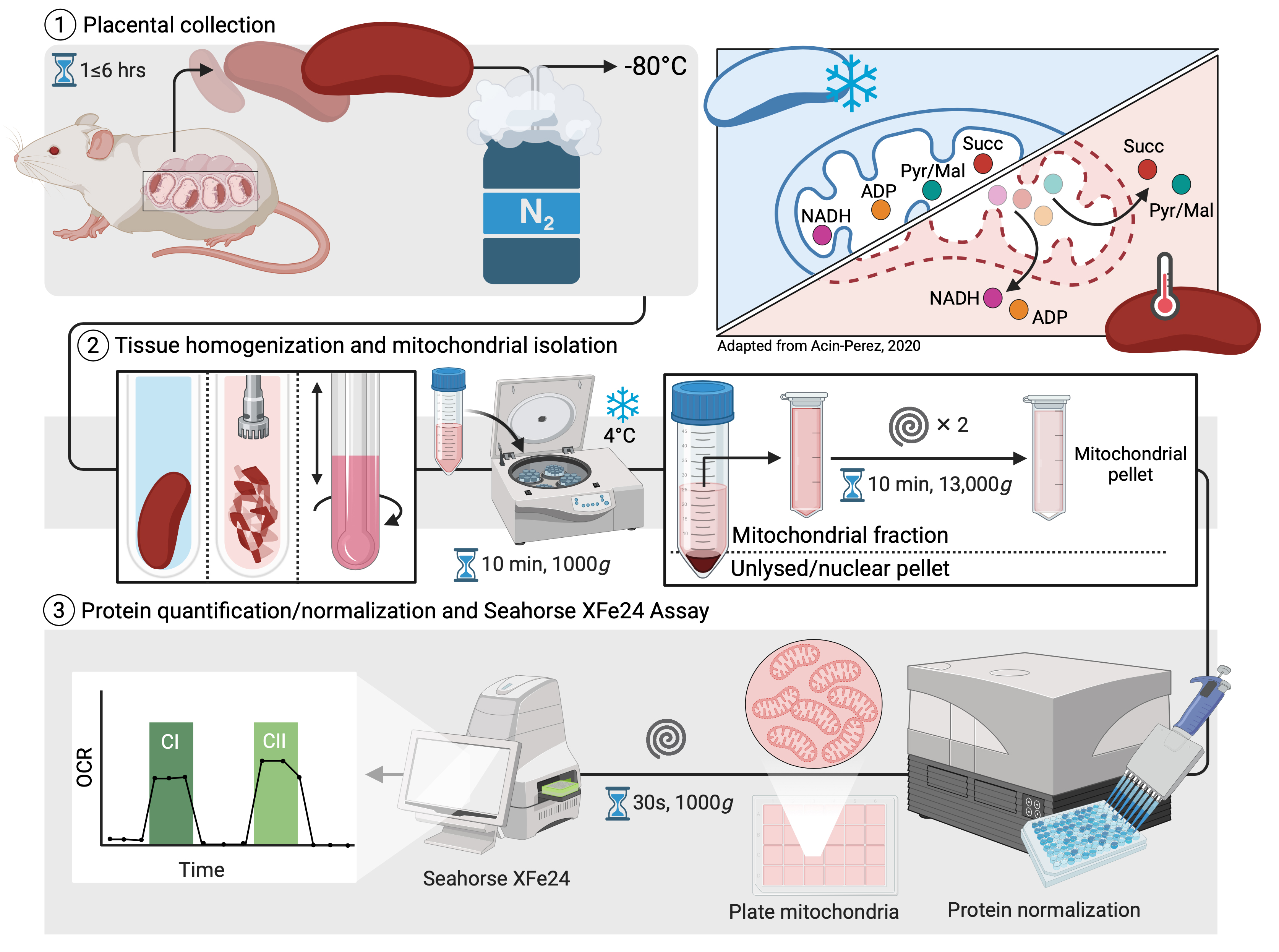
Overview of workflow for respirometry in previously frozen mouse placental tissue
Background
Placentation encompasses several key physiological and cellular stages, spanning from implantation to trophoblast differentiation [1]. This transient organ facilitates nutrient, gas, and waste exchange, while selectively transporting substances across the maternal–fetal interface and producing key pregnancy and fetal growth hormones [2,3]. As such, the energy-intensive demands of this multifunctional organ incur a significant metabolic cost sustained by its rich mitochondrial content [4]. Placental mitochondria undergo morphological and functional changes as villous cytotrophoblasts differentiate into syncytiotrophoblasts [5–7]. In addition, mitochondrial content and respiration have been shown to increase throughout pregnancy in mouse [8] and human placentae [9], respectively. Moreover, placental oxygen consumption and energy expenditure increase dramatically as pregnancy progresses, with up to 70% of O2 being consumed from the uterine circulation [4,10–12], suggesting a reliance on mitochondrial respiration for fetal growth. Placental mitochondrial dysfunction has increasingly been implicated in the etiology of common pregnancy disorders, including pre-eclampsia (PE) [13,14], fetal growth restriction (FGR) [15], and gestational diabetes mellitus (GDM) [15–18]. During oxidative phosphorylation (OXPHOS), electron leakage at complexes I, II, and III gives rise to mitochondrial reactive oxygen species (mtROS). Aberrant mtROS production, a hallmark of mitochondrial dysfunction, has been demonstrated in response to placental hypoxia and environmental insults [14]. Thus, mitochondrial respiratory chain enzyme complex–specific respiration is a critical parameter to consider when evaluating downstream mtROS production and oxidative pressure, as defects in electron transport may precede broader placental dysfunction.
In reproductive biology, both fresh and frozen placental tissues have been used to assess mitochondrial respiration [9,19–24]. Although fresh tissue is generally preferred, the timing of gestational stages and the logistical challenges of collecting placentae, particularly in late pregnancy, make it challenging to measure fresh samples in a study-controlled manner. These practical constraints, including the need to sacrifice large numbers of animals, limit the feasibility of fresh-tissue observations. To overcome this, recent studies have increasingly turned to frozen placentae to evaluate mitochondrial respiration [25–28]. Freeze-thaw cycles can disrupt mitochondrial membranes and result in the leakage of matrix substrates such as NADH, thereby compromising coupled mitochondrial respiration (29). The respiratory chain complexes themselves remain structurally and functionally intact [28,30]. Accordingly, respiratory enzyme complex-linked oxygen consumption has been measured in various snap-frozen tissues by supplying exogenous substrates and inhibitors [30–34], an approach that has been successfully applied to placental tissues using both Seahorse assays [25] and high-resolution respirometry in cryopreserved biopsies (28).
Here, we present a detailed protocol for measuring mitochondrial respiration in frozen mouse placentae using the Seahorse XF24 Analyzer. We outline recommended starting amounts of mitochondrial protein and provide suggestions on selecting and modifying injection port combinations to target specific mitochondrial complexes.
Materials and reagents
Biological materials
1. 6–11-week-old male and female CD1 mice (Charles River Laboratories) (see General note 1)
Reagents
1. PRAErrane isoflurane (Baxter, catalog number: CA2L9108)
2. HyCloneTM Hank’s 1× balanced salt solution (1× HBSS) (Thermo Fisher, Cytiva, catalog number: SH3058802)
3. D-mannitol (BioShop, catalog number: MAN509)
4. Sucrose (BioShop, catalog number: SUC507)
5. Potassium phosphate monobasic (KH2PO4) (Sigma-Aldrich, catalog number: P5379-100G)
6. Magnesium chloride (MgCl2) (Sigma-Aldrich, catalog number: M8266-100G)
7. Bovine serum albumin, fraction V, fatty acid free (BSA) (GoldBio, catalog number: A-421-250)
8. N-2-Hyxdroxyethylpiperazine-N’-2-ethanesulfonic acid (HEPES) (BioShop, catalog number: HEP001.500)
9. Ethylene glycol bis (2-Aminoethyl Ether) N,N,N’,N’ tetraacetic acid (EGTA) (BioShop, catalog number: EGT101)
10. Potassium hydroxide (KOH) (Sigma-Aldrich, 221473-25G)
11. Reduced β-nicotinamide adenine dinucleotide, reduced dipotassium salt (NADH) (Sigma-Aldrich, catalog number: N4505-100MG)
12. cOmpleteTM, Mini, EDTA-free protease inhibitor cocktail (Sigma-Aldrich, catalog number: 4693159001)
13. PhosSTOPTM (Sigma-Aldrich, catalog number: 4906837001)
14. Rotenone (Sigma-Aldrich, catalog number: R8875-10G)
15. Sodium succinate dibasic hexahydrate (succinate) (Sigma-Aldrich, catalog number: S2378)
16. Adenosine 5-diphosphate, potassium salt (ADP) (Sigma-Aldrich, catalog number: 117105)
17. Antimycin A (Sigma-Aldrich, catalog number: A8674-25MG)
18. Cytochrome c (Sigma-Aldrich, catalog number: C3131-10MG)
19. Carbonyl cyanide p-trifluoro-methoxyphenyl hydrazone, uncoupling agent (FCCP) (Sigma-Aldrich, catalog number: C2920)
20. Sodium pyruvate (Sigma-Aldrich, catalog number: P2256-100G)
21. L-malic acid (Sigma-Aldrich, catalog number: M1000)
22. Oligomycin (Sigma-Aldrich, catalog number: O4876)
23. Bradford reagent (Abcam, catalog number: ab119216)
24. InvitrogenTM UltraPureTM distilled water (Thermo Fisher Scientific, catalog number: 10977015)
25. Ethyl alcohol, pure (Sigma-Aldrich, catalog number: 459836)
26. Dimethyl sulfoxide (DMSO) (Sigma-Aldrich, catalog number: D8418-50ML)
27. Anti-Tom20 (D8T4N) rabbit monoclonal antibody (Cell Signaling Tech., catalog number: 42406)
28. Anti-Gapdh (14C10) rabbit monoclonal antibody (Cell Signaling Tech., catalog number: 2118)
29. Seahorse XF calibrant solution (included in Seahorse XFe24 FluxPak) (Agilent, catalog number: 102340-100)
Solutions
1. HEPES stock (1 M) (see Recipes)
2. EGTA stock (100 mM) (see Recipes)
3. Mitochondrial Assay Solution (MAS) (see Recipes)
4. NADH stock (75 mM) (see Recipes)
5. ADP stock (500 mM) (see Recipes)
6. Malate stock (400 mM) (see Recipes)
7. Pyruvate stock (2 M) (see Recipes)
8. Succinate stock (1 M) (see Recipes)
9. Antimycin A stock (5 mM) (see Recipes)
10. Oligomycin stock (10 mM) (see Recipes)
11. FCCP stock (10 mM) (see Recipes)
12. Cytochrome c stock (10 mg/mL) (see Recipes)
13. MAS buffer with cytochrome c (20 μg/mL) (see Recipes)
14. Port reagents for complex I and II assessment (see Recipes)
Recipes (see General note 2)
1. HEPES stock (1 M)
Dissolve 23.83 g of HEPES in 80 mL of ddH2O in a glass beaker. Mix on a magnetic stirrer and adjust pH to 7.4 using 5 M KOH. Adjust volume to 100 mL with ddH2O. Store at 2–8 °C.
2. EGTA stock (100 mM)
Dissolve 1.9 g of EGTA powder in 20 mL of sterile water. Adjust pH to 11 with KOH to allow for dissolution. Once dissolved, adjust pH to 8 with HCl and add sterile water to make a final volume of 50 mL. Store at 2–8 °C for <3 months.
3. Mitochondrial assay solution (MAS)
| Reagent | Final concentration | Quantity or volume for 50 mL of MAS buffer |
|---|---|---|
| Mannitol | 220 mM | 2.00 g |
| Sucrose | 70 mM | 1.20 g |
| KH2PO4 | 10 mM | 68 mg |
| MgCl2 | 5 mM | 23.8 mg |
| Fatty acid-free (FAF) BSA | 0.1% (w/v) | 50 mg |
| HEPES | 2 mM | 100 μL |
| EGTA | 1 mM | 200 μL |
Dissolve all reagents in 40 mL of ddH2O and adjust pH to 7.4 with KOH. Adjust volume to 50 mL and pH to 7.4, filter sterilize, and store at 2–8 °C for <2 weeks.
4. NADH stock (75 mM)
Dissolve 111.8 mg of NADH in 2 mL of sterile water. Aliquot to avoid freeze-thawing and store at -20 °C for <3 months.
5. ADP stock (500 mM)
Dissolve 1 g of ADP in 2.3 mL of sterile water and carefully neutralize with ~900 μL of 5 M KOH. Add 243.96 mg of MgCl2 and continue stirring until the white precipitate dissolves. Check and adjust pH to 7 with <50 μL of KOH (if necessary). Adjust volume with sterile water up to 4 mL. Aliquot and store at -80 °C to avoid freeze-thawing.
6. Malate stock (400 mM)
Dissolve 268.2 mg of L-malic acid in 3 mL of sterile water. Neutralize the solution with ~900 μL of 5 M KOH by adding 100–200 μL incrementally and monitoring pH. Adjust the final volume to 5 mL with sterile water. Aliquot and store at -20 °C.
Note: As this reaction is exothermic, it is recommended to dissolve L-malic acid in a volumetric glass flask or a closed 15-mL Falcon tube to minimize volume loss due to evaporation.
7. Pyruvate stock (2 M)
Dissolve 44 mg of sodium pyruvate in 200 μL of sterile water. Make the pyruvate stock fresh immediately prior to making the port reagents.
8. Succinate stock (1 M)
Dissolve 1.3505 g of succinate in 3 mL of sterile water. Check pH and adjust to 7 with ~65 μL of 1 M HCl. Adjust the volume to 5 mL with sterile water. Aliquot and store at -20 °C.
9. Antimycin A stock (5 mM)
Dissolve 5.4 mg of antimycin A in 2 mL of absolute ethanol. Aliquot and store at -20 °C.
10. Oligomycin stock (10 mM)
Dissolve 5 mg of oligomycin by adding 632.11 μL of DMSO into the glass vial. Mix well. Aliquot and store at -20 °C.
11. FCCP stock (10 mM)
Dissolve 2.54 mg of FCCP in 1 mL of absolute ethanol. Aliquot and store at -20 °C.
12. Cytochrome c stock (10 mg/mL)
Dissolve 10 mg of cytochrome c in 1 mL of sterile water. Aliquot to avoid freeze-thawing and store at -20 °C for <3 months.
13. MAS buffer with cytochrome c (20 μg/mL)
Add 10 μL of 10 mg/mL cytochrome c stock solution to 4990 μL of MAS warmed to room temperature. Make immediately prior to use in step D6.
14. Port reagents for complex I and II assessment
| Port | Compound | Stock concentration | Working concentration in the well | Volume of stock added in 2 mL of MAS buffer |
|---|---|---|---|---|
| A | NADH | 75 mM | 1 mM | 80 μL |
| A | ADP | 500 mM | 4 mM | 40 μL |
| A | Pyruvate | 2 M | 20 mM | 30 μL |
| A | Malate | 400 mM | 2 mM | 15 μL |
| B | Rotenone | 1 mM | 2 μM | 16 μL |
| C | Succinate | 1 M | 10 mM | 100 μL |
| D | Antimycin A | 5 mM | 4 μM | 10 μL |
There are four ports (labeled A–D) where substrates and inhibitors may be loaded for sequential injections in the assay. Port reagents are prepared at 9× of working concentration in 2 mL of MAS and loaded at 50 μL per port. Make stock concentration of reagents and store at -20 °C in one-time use aliquots. Do not reuse freeze-thawed aliquots. These working concentrations are adjusted to a starting volume of 100 μL of mitochondrial-enriched fraction loaded in the well. However, volumes can be changed based on the starting material.
Laboratory supplies
1. VWR® #5 precision tweezers (Avantor, catalog number: 89259-986)
2. Liquid nitrogen
3. Corning® polypropylene cryogenic vials (Thermo Fisher Scientific, catalog number: 09-761-71)
4. Seahorse XFe24 FluxPak (culture plates, sensor cartridge, calibrant) (Agilent, catalog number: 102340-100)
5. Falcon® 14-mL round-bottom high clarity PP test tube (Corning, catalog number: 352059)
6. PYREX® 5-mL Potter-Elvehjem tissue grinder with PTFE pestle (Corning, catalog number: 7725T-5)
7. Falcon® 15-mL high clarity PP conical centrifuge tube (Corning, catalog number: 352096)
8. 2-mL microtubes (Millipore Sigma, Corning, catalog number: AXYMCT200CS)
9. Corning® 96-well clear flat bottom UV-transparent microplate (Corning, catalog number: 3635)
10. FisherbrandTM disposable pipette basins (Thermo Fisher Scientific, catalog number: 13-601-508)
Equipment
1. Type 37900 culture incubator, 37 °C (Marshall Scientific, Thermolyne, model: 137925, catalog number: T37900)
2. Polytron® PT 1300 D handheld disperser (Kinematica, catalog number: 11010032)
3. EppendorfTM centrifuge 5810 R (4 °C) (Thermo Fisher Scientific, catalog number: 05-400-61)
4. Thermo Scientific IEC CL30 centrifuge (Marshall Scientific, catalog number: TSCL30)
5. Seahorse XFe24 Analyzer (Agilent, catalog number/model: S7801B)
6. TECAN Infinite 200 PRO (Tecan, catalog number/model: 490016-20BL)
Software and datasets
1. Seahorse Wave Desktop Software (Agilent, version 2.6.1), unlimited license with instrument
2. Seahorse Wave Controller Software (Agilent, version 2.2.1), unlimited license with instrument
Procedure
登录/注册后免费查看全文
文章信息
稿件历史记录
提交日期: Jan 27, 2026
接收日期: Mar 18, 2026
在线发布日期: Apr 9, 2026
出版日期: May 5, 2026
版权信息
© 2026 The Author(s); This is an open access article under the CC BY-NC license (https://creativecommons.org/licenses/by-nc/4.0/).
如何引用
Podinic, T., Xhuti, D., Monaco, C., Nederveen, J. P. and Raha, S. (2026). Assessing Mitochondrial Respiratory Complex-Associated Function From Previously Frozen Mouse Placental Tissue. Bio-protocol 16(9): e5667. DOI: 10.21769/BioProtoc.5667.

 Download Citation in RIS Format
分类
细胞生物学 > 细胞新陈代谢 > 呼吸测量法
细胞生物学 > 基于细胞的分析方法 > 线粒体呼吸
系统生物学 > 代谢组学 > 组织
您对这篇实验方案有问题吗?
在此处发布您的问题,我们将邀请本文作者来回答。同时,我们会将您的问题发布到Bio-protocol Exchange,以便寻求社区成员的帮助。
 发布问题
发布问题


