


ELISA-Based Enzyme Kinetics Assay for Measuring cGAS Activity
基于ELISA的cGAS酶动力学活性检测方法


发布: 2026年04月05日第16卷第7期 DOI: 10.21769/BioProtoc.5655 浏览次数: 614
评审: Luis Alberto Sánchez VargasRishith RavindranAndrew SylwesterAnonymous reviewer(s)
 PDF
PDF  Q&A
Q&A
参见作者原研究论文
The authors used this protocol in:

Jan 2026
Advertisement






Abstract
Cyclic GMP–AMP synthase (cGAS) is a key cytosolic double-stranded DNA sensor that activates innate immune responses. Upon binding double-stranded DNA, cGAS undergoes conformational activation and catalyzes the synthesis of the second messenger 2′3′-cyclic GMP–AMP (2′3′-cGAMP) from ATP and GTP. 2′3′-cGAMP then triggers a downstream signaling cascade that induces type-I interferon and inflammatory gene expression and has been shown to exert antitumor effects in the context of cancer. Accurate measurement of this enzymatic activity is therefore important for mechanistic studies. Traditional kinetic methods such as radiolabeling, HPLC, or mass spectrometry provide precise results but require specialized equipment and expertise. Here, we describe a rapid and accessible ELISA-based protocol to quantify 2′3′-cGAMP product formation and derive cGAS enzymatic parameters. Reactions are initiated with defined DNA ligands and quenched at multiple time points, and product accumulation is quantified by a commercially available 2′3′-cGAMP ELISA. Time course measurements are used to calculate initial velocities, which can be plotted against substrate concentration to obtain Michaelis–Menten parameters. This approach enables direct, product-specific quantification of 2′3′-cGAMP formation using only an absorbance plate reader. The protocol provides a sensitive and broadly applicable alternative to traditional methods, allowing laboratories without advanced instrumentation to perform reliable cGAS enzyme kinetics.
Key features
• Developed to evaluate how cofactors or regulatory proteins modulate cGAS activity in vitro.
• Suitable for assessing cGAS kinetics with diverse nucleic acid substrates under defined reaction conditions.
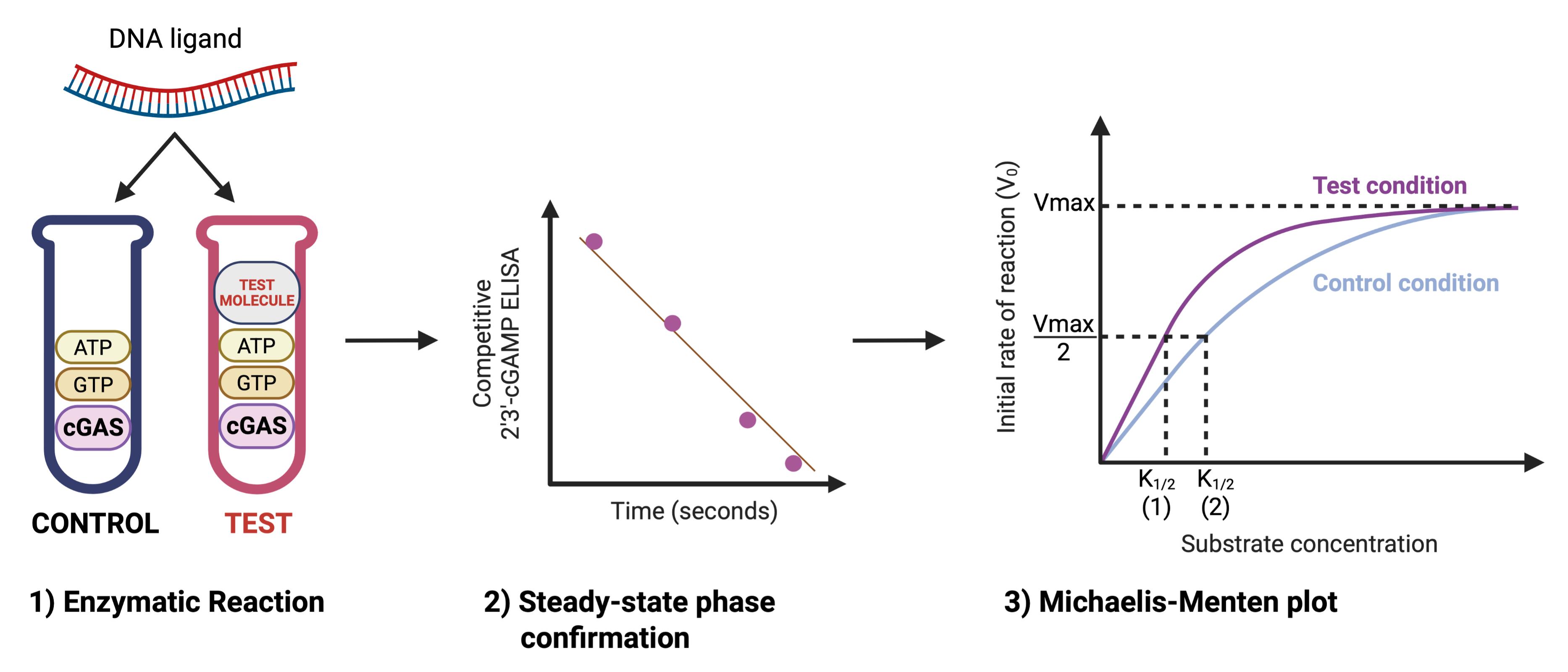
• Determination of initial (V0) and maximal (Vmax) reaction rates, catalytic turnover number (kcat), and k1/2, the DNA concentration at which cGAS reaches 1/2 Vmax.
• Yields reproducible kinetic results within ~4 h from reaction setup to data analysis.
Keywords: cGAS (cGAS) Enzyme kinetics (酶动力学)
2′3′-cGAMP synthesis (2′3′-cGAMP合成)
ELISA (ELISA)
Accessible (操作简便)
Michaelis–Menten (米氏方程)
Vmax (Vmax)
k1/2 (k1/2)
kcat (kcat)
Enzyme kinetics (酶动力学)
2′3′-cGAMP synthesis (2′3′-cGAMP合成)
ELISA (ELISA)
Accessible (操作简便)
Michaelis–Menten (米氏方程)
Vmax (Vmax)
k1/2 (k1/2)
kcat (kcat)
Graphical overview
Background
Cyclic GMP–AMP synthase (cGAS) is a cytosolic DNA sensor that catalyzes the synthesis of the second messenger 2′3′-cGAMP from ATP and GTP. Activation of cGAS triggers the STING pathway, leading to type-I interferon production and downstream immune responses. Because of its central role in innate immunity, autoimmunity, infection, and cancer biology [1], there is strong interest in understanding how cGAS activity is regulated and how cofactors, binding partners, or small molecules influence its enzymatic function.
Several methods have been described to measure cGAS activity. The most direct approaches rely on HPLC, LC–MS/MS, or radiolabeled nucleotide assays, which allow high sensitivity and precise quantification of 2′3′-cGAMP but require specialized instrumentation, radioisotope handling, or technically demanding protocols [2–5]. More accessible alternatives use ELISA-based detection kits that exploit the high specificity of antibodies against 2′3′-cGAMP. ELISAs offer simplicity, scalability, and compatibility with standard laboratory equipment, making them well-suited for kinetic analyses in laboratories without access to advanced analytical platforms.
The protocol described here provides a streamlined workflow to determine Michaelis–Menten kinetic parameters (Vmax, kcat, k1/2) [6,7] of cGAS using an endpoint ELISA readout. Compared to continuous real-time methods, this approach requires only standard molecular biology equipment and commercially available reagents, making it broadly applicable. While endpoint ELISA measurements rely on the assumption of linear product accumulation within the chosen incubation window, this can be validated with short-time-course experiments. Once established, the protocol enables reproducible assessment of how test molecules (e.g., protein cofactors or small molecules) alter cGAS catalytic activity and substrate affinity.
Beyond evaluating candidate regulators of cGAS, the protocol can be adapted to study mutant cGAS variants, viral or cellular proteins that interact with cGAS, or pharmacological inhibitors and activators. Together, this method provides an accessible and adaptable framework for interrogating DNA-sensing enzymatic activity and for identifying potential therapeutic modulators of innate immune signaling.
Materials and reagents
Reagents
1. Nuclease-free, molecular biology–grade water (Thermo Scientific, catalog number: J71786.XCR)
2. Tris-HCl pH 7.5 (1 M) (Fisher BioReagents, catalog number: BP152-5)
3. MgCl2 (1 M) (Sigma-Aldrich, catalog number: 208337)
4. Tween-20 (10%) (Fisher BioReagents, catalog number: BP337-500)
5. Adenosine triphosphate (ATP), 5 mM (Cayman Chemical, catalog number: 40182); store in aliquots at -20 °C
6. Guanosine triphosphate (GTP), 5 mM (Cayman Chemical, catalog number: 16060); store in aliquots at -20 °C
7. cGAS DNA ligand, forward and reverse sequences ordered from Eurofins [8]
8. His-cGAS human recombinant protein (10 μM, activity 3.10 U/mL) (Cayman Chemical, catalog number: 22810)
Note: The enzyme is extremely temperature sensitive. Store in ~5 μL aliquots at -80 °C. Use each aliquot only once to ensure the best reproducibility.
9. Ethylenediaminetetraacetic acid (EDTA), 55 mM (Sigma-Aldrich, catalog number: ED-100G)
10. 2′3′-cGAMP ELISA kit (Cayman Chemical, catalog number: 501700); store at 4 °C
Solutions
1. Reaction buffer 4× (see Recipes)
2. Recombinant cGAS protein dilution 1/10 (see Recipes)
Recipes
1. Reaction buffer 4×
| Reagent | Quantity or volume | Final concentration |
|---|---|---|
| Tris-HCl, pH 7.5 (1 M) | 200 μL | 40 mM |
| MgCl2 (1 M) | 50 μL | 10 mM |
| Tween-20 (10%) | 10 μL | 0.02% |
| Nuclease-free water | 4.74 mL | |
| Total | 5 mL |
Prepare fresh before the assay or store at 4 °C for up to 3 months. Alternatively, aliquot and store at -20 °C for up to 6 months.
2. Recombinant cGAS protein dilution 1/10
| Reagent | Quantity or volume | Final concentration |
|---|---|---|
| His-cGAS enzyme (10 μM stock) | 20 μL | 1 μM |
| Reaction buffer (4×) | 50 μL | 1× |
| Nuclease-free water | 130 μL | |
| Total | 200 μL |
The recombinant His-cGAS protein was provided by the manufacturer at 10 μM in 50 mM HEPES, pH 8.0, with 300 mM sodium chloride and 10% glycerol. Concentration may slightly vary between production batches.
Dilute the cGAS enzyme in reaction buffer as shown (example for 200 μL of final volume, sufficient for 40 reactions).
Note: The dilution can be performed immediately before the kinetic experiment. The diluted enzyme may be aliquoted (~5 μL) and stored at -80 °C for up to 1 month, as stability is reduced after 1:10 dilution. Use each aliquot only once. Do not subject aliquots to repeated freeze-thaw cycles.
Laboratory supplies
1. 0.2 mL PCR tubes (Thermo Scientific, catalog number: AB0620)
Equipment
1. T100 thermal cycler (Bio-Rad, catalog number: 1861096)
Note: Preferably, use a thermocycler for precise temperature control. Alternatively, a calibrated dry heat block or water bath set to 37 °C may be used. The enzyme reactions can also be performed at room temperature, but that may reduce the efficiency of the enzyme.
2. SpectraMax iD5 microplate reader (Molecular Devices, model: ID5-STD) or any plate reader able to read the absorbance of 96-well plates at 450 nm
3. Multichannel pipette (1–10 μL) (Thermo Scientific, catalog number: 4661000N)
Software and datasets
1. GraphPad Prism (Version 10.5.0)
Procedure
登录/注册后免费查看全文
文章信息
稿件历史记录
提交日期: Jan 20, 2026
接收日期: Mar 2, 2026
在线发布日期: Mar 22, 2026
出版日期: Apr 5, 2026
版权信息
© 2026 The Author(s); This is an open access article under the CC BY license (https://creativecommons.org/licenses/by/4.0/).
如何引用
Fréreux, C. and Howe, P. H. (2026). ELISA-Based Enzyme Kinetics Assay for Measuring cGAS Activity. Bio-protocol 16(7): e5655. DOI: 10.21769/BioProtoc.5655.

 Download Citation in RIS Format
分类
生物化学 > 蛋白质 > 活性
生物化学 > 蛋白质 > 免疫检测 > 酶联免疫吸附试验(ELISA)
生物化学 > 其它化合物 > cGAMP
您对这篇实验方案有问题吗?
在此处发布您的问题,我们将邀请本文作者来回答。同时,我们会将您的问题发布到Bio-protocol Exchange,以便寻求社区成员的帮助。
 发布问题
发布问题


