


A Simple and Easy Method for RNA Extraction from the Cyanobacterium Synechocystis sp. PCC 6803
一种简便高效的蓝藻 Synechocystis sp. PCC 6803 RNA提取方法

发布: 2026年04月05日第16卷第7期 DOI: 10.21769/BioProtoc.5654 浏览次数: 615
评审: Dennis J NürnbergSamujjal BhattacharjeeSrujana Samhita Yadavalli
 PDF
PDF  Q&A
Q&A
参见作者原研究论文
The authors used this protocol in:
2025
Advertisement






Abstract
Cyanobacteria have been widely used as model organisms in photobiochemical research and have recently been exploited as hosts in numerous pilot studies to produce valuable biochemicals via genetic and metabolic modifications. Analyzing cellular RNA is a suitable method for studying genetic changes in cells. Several methods have previously been reported for cyanobacterial RNA extraction. However, the majority of these methods rely heavily on phenol and chloroform, which are hazardous. Additionally, these methods are time-consuming and difficult to perform. Using Synechocystis sp. PCC 6803 as a model, this study developed a novel method for extracting total ribonucleic acid (RNA) using standard centrifugation techniques and laboratory chemicals such as citric acid, ethylenediaminetetraacetic acid, sodium dodecyl sulfate, sodium chloride, and tri-sodium citrate dihydrate to extract RNA from cyanobacterial cells. This method does not necessitate the use of hazardous chemicals, especially phenol and chloroform. Furthermore, it is cost-effective since it does not require expensive chemicals. The results of the quantification, purity, and integrity checks show the effectiveness of this method for extracting good-quality RNA. Furthermore, RT-qPCR results demonstrate that the quality of the extracted RNA is suitable for downstream applications.
Key features
• Simple and efficient RNA extraction method.
• Requires less than an hour to extract total RNA.
• Provides high-quality RNA suitable for downstream applications.
• This method might be used to extract RNA from other cyanobacteria and algae.
Keywords: Cyanobacteria (蓝藻) Synechocystis sp. PCC 6803 (Synechocystis sp. PCC 6803)
RNA extraction (RNA提取)
Quantitative reverse transcription polymerase chain reaction (RT-qPCR) (实时荧光定量反转录PCR(RT-qPCR))
Single-stranded complementary DNA (cDNA) (单链互补DNA(cDNA))
Synechocystis sp. PCC 6803 (Synechocystis sp. PCC 6803)
RNA extraction (RNA提取)
Quantitative reverse transcription polymerase chain reaction (RT-qPCR) (实时荧光定量反转录PCR(RT-qPCR))
Single-stranded complementary DNA (cDNA) (单链互补DNA(cDNA))
Graphical overview
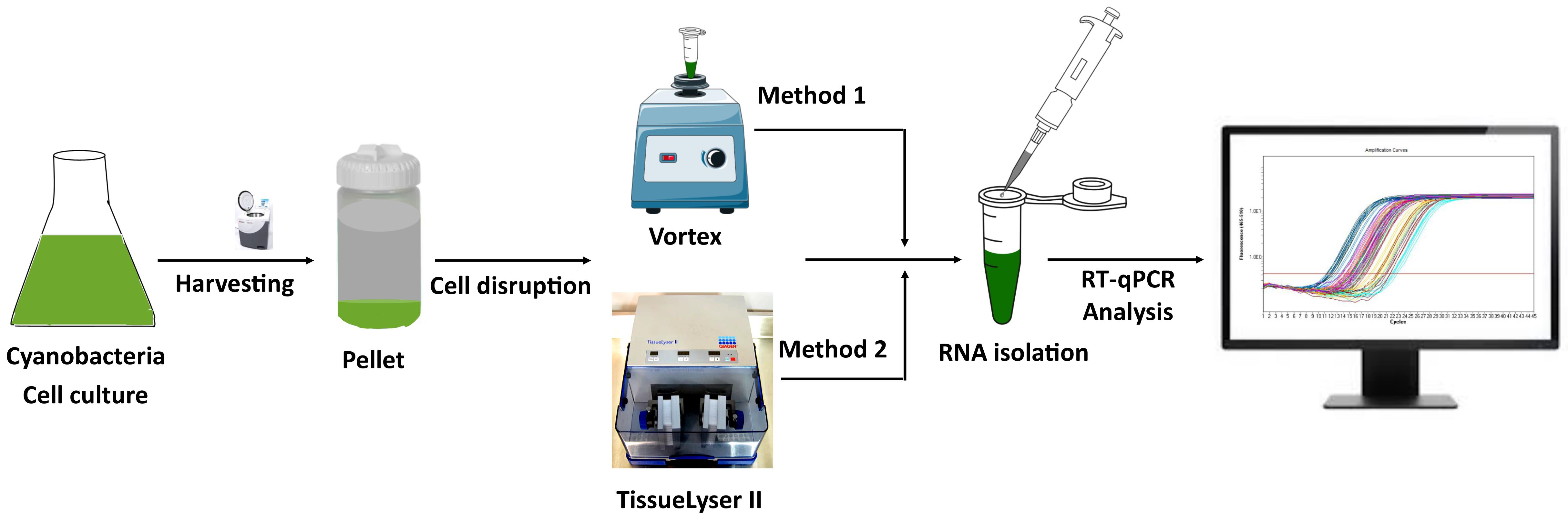
Overview of total RNA extraction from cyanobacteria and its downstream application
Background
Cyanobacteria are oxygenic photosynthetic organisms that have been used in various studies to investigate photosynthesis and biochemical production within the cell [1–4]. They have superior natural characteristics, including photoautotrophic growth [5], uptake of exogenous DNA in conjunction with homologous recombination (in some cyanobacteria) [6,7], and minimal growth requirements compared to other photosynthetic organisms [8], making them ideal candidates for biotechnological applications. Synechocystis sp. PCC 6803 is a unicellular freshwater cyanobacterium widely used as a model organism in photosynthesis research [9]. It has recently emerged as an efficient host for the production of a variety of valuable chemicals, including biofuels [3], biopharmaceutical proteins [4], and bioplastics [2]. The production of these chemicals within the cell requires effective genetic and metabolic changes. Modifying and introducing foreign genes into the genome to synthesize desired products necessitates their effective expression. RNA analysis is an efficient and reliable method for studying gene expression levels [10]. Several techniques have been developed to analyze RNA and evaluate gene expression, including quantitative polymerase chain reaction (qPCR), RNA-seq, RT-qPCR, complementary DNA (cDNA) libraries, and northern blotting [11–13]. Therefore, the quality and quantity of RNA are particularly critical for the many possible downstream applications.
Extracting high-quality RNA from cyanobacteria is always challenging. Cyanobacteria have a complex, gram-negative-type cell wall [14], which poses challenges to the currently available RNA extraction methods. Furthermore, cyanobacteria contain a variety of secondary metabolites, including polysaccharides and phenolic compounds, which hinder the effectiveness of RNA extraction methods in producing high-quality RNA [15]. Several methods, including chemical, physical, and hot and cold treatments, have been successfully used to extract RNA from cyanobacteria; however, they produce low yields [15–18]. Extracting RNA with chemicals such as organic solvents and phenol has been shown to work [15,19]; however, these chemicals constitute possible health hazards [20–22]. Physical and mechanical methods, on the other hand, produce higher yields than chemical ones, but require more time and processes to break the cells [18]. Commercial kits have been used to circumvent the multiple challenges of extracting large amounts of high-quality RNA in a short period of time. Although these commercial kits have a standard procedure for extracting high-quality RNA, they can be prohibitively expensive. Furthermore, the majority of commercially available RNA purification kits are not intended for organisms that contain polysaccharides and phenolic compounds, such as plants, algae, and cyanobacteria, because these compounds irreversibly bind to nucleic acids and co-precipitate them [23–27].
This study developed a novel method for extracting total RNA from Synechocystis sp. PCC 6803, using simple laboratory chemicals and no hazardous reagents. This new method is a combination of physical and chemical procedures. It is simple, quick, inexpensive, and produces a high yield. We used two different approaches to break the cells in order to avoid the use of expensive equipment and compared the effectiveness and yields of the two approaches. The cyanobacterium Synechocystis sp. PCC 6803 was used as a model organism for this study, but the protocol might also be applied to other cyanobacteria and algae. The method using a TissueLyser to break the cells showed better RNA yield than the method using a vortex mixer.
Materials and reagents
Biological materials
1. Cyanobacterium Synechocystis sp. PCC 6803
2. PCR primers (Table 1)
Table 1. List of primers used in RT-qPCR
| Protein name | Gene name | Primer name | Sequence (5-3) | Amplicon size (bp) |
|---|---|---|---|---|
| Photosystem II protein D1 | psbA2 | psbA2_qPCR-Fwd | TGTAATCGGCATCTGGTTCACT | 141 |
| psbA2_qPCR-Rev | ATGTTGGCTCGGTTCAATACA | |||
| Photosystem II protein D1 | psbA3 | psbA3_qPCR-Fwd | TCATCAAGGTACCGAACCAAC | 203 |
| psbA3_qPCR-Rev | TCTCTGAGCTTGAGGCCAA | |||
| Photosystem II CP47 chlorophyll-binding protein | psbB | psbB_qPCR-Fwd | TGCTGCTGGTATTGTCGGTAT | 124 |
| psbB_qPCR-Rev | AGCGGCAATACTACTGGACAA | |||
| Photosystem II CP43 chlorophyll-binding protein | psbC | psbC_qPCR-Fwd | TGGGTTGTGGTGCTCTGTTA | 126 |
| psbC_qPCR-Rev | AGATAATCGCCGGGTTGAG | |||
| Photosystem II D2 protein | psbDI | psbDI_qPCR-Fwd | TGCGGTGTTTGTCAGTGTCT | 196 |
| psbDI_qPCR-Rev | ACCGTGGATAGCACAGAGGA | |||
| Photosystem II D2 protein | psbDII | psbDII_qPCR-Fwd | AGACGGTGAAGATTCCAACAC | 184 |
| psbDII_qPCR-Rev | ACCCACAGAACTCATCCACAA | |||
| Cytochrome b559 α subunit | psbE | psbE_qPCR-Fwd | TGTCACCAGCATTCGCTACT | 208 |
| psbE_qPCR-Rev | TTATTGATTAAACTCTTGAATTTCC | |||
| Cytochrome b559 β subunit | psbF | psbF_qPCR-Fwd | GTTGGTAATTAACAATGGCAACC | 150 |
| psbF_qPCR-Rev | CCTAGCGTTGAATAAATTGCATC | |||
| Photosystem II protein J | psbJ | psbJ_qPCR-Fwd | CAATTTAGGAGGCATGGTATGTTC | 144 |
| psbJ_qPCR-Rev | CCTCGATTACATGGAAGAACCTAA | |||
| Photosystem I chlorophyll-binding reaction center protein A | psaA | psaA_qPCR-Fwd | CACCAGATCCACGTCTCCAT | 116 |
| psaA_qPCR-Rev | TAGAGTTCCGCCATCTTGCT | |||
| Photosystem I chlorophyll-binding reaction center protein B | psaB | psaB_qPCR-Fwd | TTCTAAGTTGATGCCGGACAA | 120 |
| psaB_qPCR-Rev | AAGCAGAGATGTCGCAGGTA | |||
| Bacterial RNase P | rnpB | rnpB_qPCR-Fwd | AGAGCGCACCAGCAGTATC | 118 |
| rnpB_qPCR-Rev | ATTCCTCAAGCGGTTCCA |
Reagents
1. EDTA (Sigma-Aldrich, catalog number: E9884)
2. Anhydrous citric acid (Sigma-Aldrich, catalog number: 1.93026)
3. Sodium chloride (NaCl) (Merck, catalog number: 1.06404)
4. Sodium dodecyl sulfate (SDS) (Sigma-Aldrich, catalog number: 436143)
5. Tri-sodium citrate dehydrate (Sigma-Aldrich, catalog number: 1.06448)
6. RNaseOUT (InvitrogenTM, catalog number: 10777019)
7. DNase I (InvitrogenTM, catalog number: 18080044)
8. Superscript III (InvitrogenTM, catalog number: 18068015)
9. qPCRBIO SyGreen Blue Mix Separate Rox (PCRBIOSYSTEMS, catalog number: PB20.17)
10. Liquid nitrogen
11. Diethyl pyrocarbonate (DEPC)-treated MilliQ water (Thermo Fisher Scientific, catalog number: AM9922)
12. Agarose (Sigma-Aldrich, catalog number: A2576)
13. Tris-borate-EDTA (TBE), 10× buffer (Thermo Scientific Chemicals, catalog number: J62788.K2)
14. Deoxyribonucleotide triphosphate (dNTP) mix (Thermo Scientific, catalog number: FERR0192)
15. 96-well plates (Bio-Rad, catalog number: HSP9601)
16. Dithiothreitol (DTT) (Thermo Scientific Chemicals, catalog number: AC327190010)
17. Phusion DNA polymerase (NEB, catalog number: M0530)
18. 1 kb Plus DNA ladder (Thermo Fisher Scientific, catalog number: 10787018)
19. RNA loading dye (NEB, catalog number: B0363S)
20. DNA loading dye (NEB, catalog number: B7024S)
21. BG-11 media (Gibco, catalog number: A1379901)
22. Isopropanol (Thermo Scientific Chemicals, catalog number: 327272500)
Solutions
1. Lysis buffer (see recipes)
2. Precipitation buffer (see recipes)
Recipes
1. Lysis buffer
| Reagent | Final concentration | Quantity or volume |
|---|---|---|
| EDTA | 0.01 M | 0.372 g |
| Anhydrous citric acid | 0.132 M | 2.536 g |
| Tri-sodium citrate dihydrate | 0.068 M | 2.82 g |
| SDS, pH 5.0 | 0.069 M | 1.99 g |
| DEPC-treated MilliQ water | n/a | to 100 mL |
2. Precipitation buffer
| Reagent | Final concentration | Quantity or volume |
|---|---|---|
| NaCl | 4 M | 23.37 g |
| Anhydrous citric acid | 0.033 M | 0.634 g |
| Tri-sodium citrate dihydrate | 0.017 M | 0.50 g |
| DEPC-treated MilliQ water | n/a | to 100 mL |
Note: Lysis and precipitation buffer can be stored at room temperature up to one year. Filtration/autoclaving is not needed.
Laboratory supplies
1. Nuclease-free microfuge tubes (Eppendorf, catalog number: 022364111)
2. Nuclease-free pipette tips (Eppendorf, catalog number: 0030078748)
Equipment
1. Pipettes (GILSON, catalog numbers: F167500, F167300)
2. Vortex (USA Scientific Inc, catalog number: 74045600)
3. Refrigerated tabletop micro centrifuge (Eppendorf centrifuge 5415 R, with rotor, catalog number: 022621431)
4. Mini centrifuge (Thermo ScientificTM, catalog number: 75004061)
5. Thermocycler (Eppendorf Mastercycler® nexus X2, catalog number: 6337000043)
6. TissueLyser II (QIAGEN, catalog number: 85300)
8. Agarose gel electrophoresis system (Analytik Jena, model: Biometra Horizon 58)
9. LightCycler® 480 system (Roche, catalog number: 05 015 278 001)
10. Gel Doc XR+ System (Bio-Rad, catalog number: 170–8195)
11. NanoDrop (Thermo Fisher Scientific, catalog number: ND-ONE-W)
12. Steel beads (5 mm) (QIAGEN, catalog number: 69989)
13. UV-Visible spectrophotometer (JASCO, model: V-550)
Procedure
登录/注册后免费查看全文
文章信息
稿件历史记录
提交日期: Dec 19, 2025
接收日期: Mar 2, 2026
在线发布日期: Mar 13, 2026
出版日期: Apr 5, 2026
版权信息
© 2026 The Author(s); This is an open access article under the CC BY-NC license (https://creativecommons.org/licenses/by-nc/4.0/).
如何引用
Majhi, B. K. and Eaton-Rye, J. J. (2026). A Simple and Easy Method for RNA Extraction from the Cyanobacterium Synechocystis sp. PCC 6803. Bio-protocol 16(7): e5654. DOI: 10.21769/BioProtoc.5654.

 Download Citation in RIS Format
分类
植物科学 > 藻类学 > 蓝绿藻
分子生物学 > RNA > RNA 提取
微生物学 > 微生物遗传学 > RNA > RNA 提取
您对这篇实验方案有问题吗?
在此处发布您的问题,我们将邀请本文作者来回答。同时,我们会将您的问题发布到Bio-protocol Exchange,以便寻求社区成员的帮助。
 发布问题
发布问题


